What Is Technographic Data? Definition, Sources and Uses
Technographic data shows the software a company runs. How it's collected, what our 29.9M-domain crawl finds in a typical stack, and where it misleads.
Published •19 min read

Technographic data is information about the software and infrastructure a company uses, such as its CMS, analytics, email host, CRM and cloud providers. Most of it is collected from public signals on the company's website and DNS. In our October 2026 crawl, the median business website ran 11 detectable technologies.
I run TechnologyChecker, and before that I worked on web crawling at Bing, so this guide skips the glossary tour. You'll get the definition, then what a real stack looks like across 29.9M live business domains, how each collection method works, and the places where technographic data quietly misleads sales teams.
Technographic data is a record of which technologies an organisation uses, observed from its public footprint (website code, HTTP headers, DNS records, certificates) or inferred from sources such as job postings. Unlike firmographic data, which describes what a company is, technographics describe what it runs, so teams can target, score and time outreach by stack.
What is technographic data?
Technographic data answers one question about an account: what is it built on? A technographic record links a company (usually through its domain) to a technology, a category and a date. "Acme.com runs Marketo, detected first in March 2024, last seen yesterday" is a single technographic data point. A full profile is a few dozen of those.
The word blends technology and demographics, and it sits next to two older data types in every B2B stack. Firmographic data describes the company itself. Intent data describes what its people are researching. Technographic data describes the systems the company has already chosen, which makes it the closest thing to a fact of the three: a script tag or an MX record is either there or it isn't.
What technographic data is not matters just as much:
- It isn't a purchase record. Seeing a tool on a website doesn't tell you the contract value, the seat count or the renewal date.
- It isn't proof of active use. A snippet left behind after cancellation still matches. More on that in the accuracy section.
- It isn't an account list by default. Detection works on domains, and one company can own dozens of them.
Technographic vs firmographic vs intent data
Technographic data describes a company's systems, firmographic data describes the company, and intent data describes current research behaviour. Most GTM teams need all three. They answer different questions and go stale at different speeds.
| Data type | Describes | Example | Typical source | How fast it changes |
|---|---|---|---|---|
| Firmographic | The organisation | 500 employees, SaaS, Berlin | Company registries, LinkedIn, filings | Slowly (quarters to years) |
| Technographic | The systems it runs | Runs Marketo, Cloudflare, Microsoft 365 | Website and DNS detection, job posts | Medium (weeks to months) |
| Intent | What its people research | Reading "CRM migration" content this week | Publisher networks, review sites, your own site | Fast (days) |
What does a typical company tech stack look like?
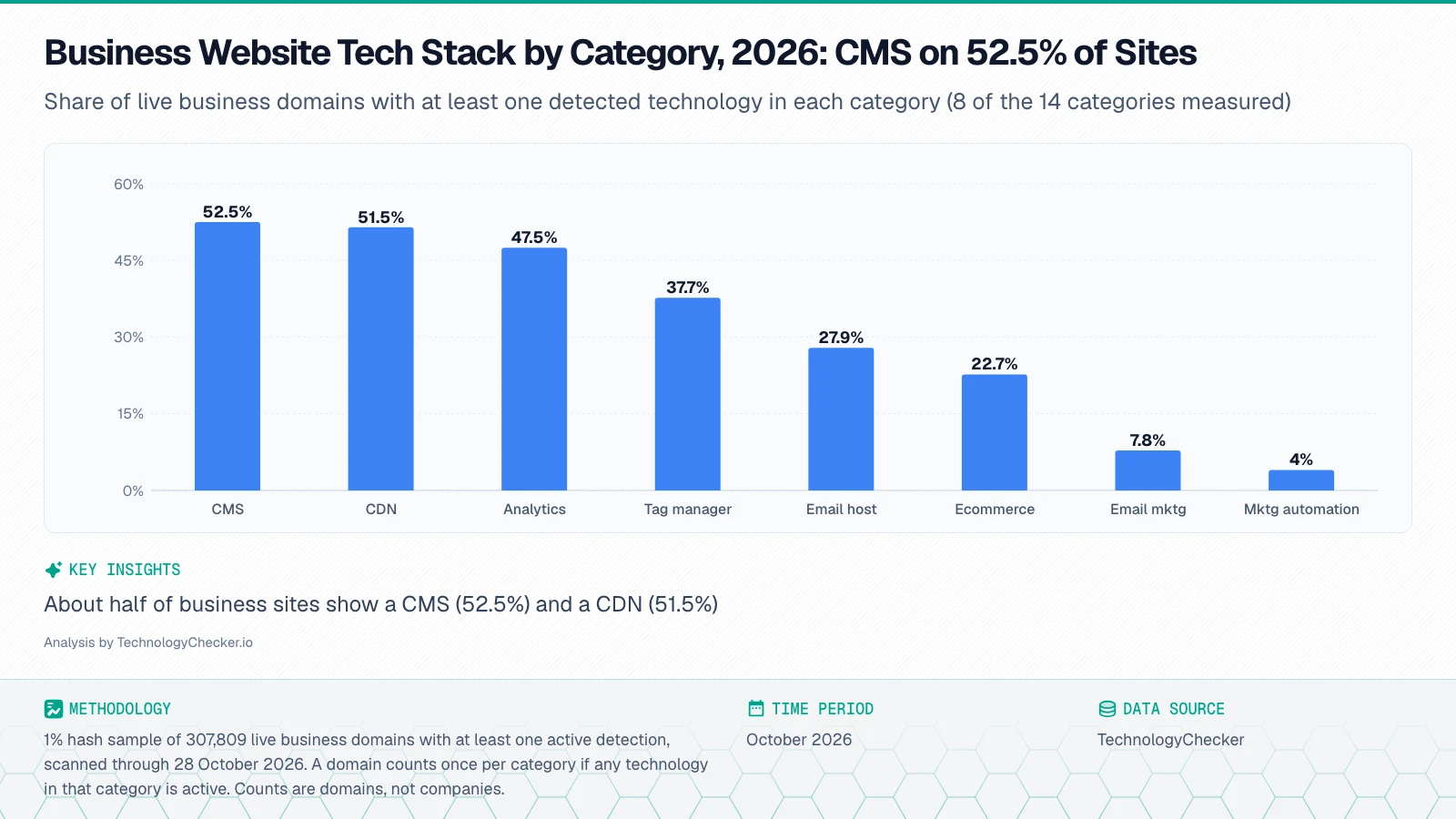
A typical business website exposes about a dozen technologies, spread across delivery, content, measurement and email. We took a 1% hash sample of the domains in our crawl (307,809 live business domains, each with at least one active detection, scanned up to 28 October 2026) and counted how many carry at least one technology in each category. The chart shows the eight categories sales teams ask about most; the table below it has all 14.
All 14 categories as a table
| Category | Share of sampled domains |
|---|---|
| CMS and website builders | 52.5% |
| CDN | 51.5% |
| Web servers | 50.3% |
| Web analytics | 47.5% |
| Tag management | 37.7% |
| Email and webmail hosting | 27.9% |
| JavaScript frameworks | 24.4% |
| Ecommerce platforms | 22.7% |
| SEO tools | 18.6% |
| Consent and privacy management | 12.4% |
| Form builders | 11.7% |
| Email marketing | 7.8% |
| Heatmaps and session recording | 5.0% |
| Marketing automation | 4.0% |
Two things stand out to me. First, the high-coverage rows are infrastructure: about half of all business sites show a CDN, and about half show a CMS. Second, the tools that sales teams usually sell against, marketing automation and session recording, sit in the low single digits. That's the real value of technographic segmentation: the market for a marketing automation vendor isn't "all companies", it's the roughly 4% of sites already running one plus the much larger group running the cheaper tools that usually come first.
The full per-technology numbers live in the technology directory, where each profile lists the companies using it.
How is technographic data collected?
Technographic data is collected by reading signals a company exposes in public, or by inferring tools from what the company publishes about itself. Each method sees a different slice of the stack:
| Method | What it reads | Sees well | Misses |
|---|---|---|---|
| Page code | Script URLs, JavaScript globals, HTML, cookies | Analytics, tag managers, chat, CMS, ecommerce | Anything with no front-end footprint |
| HTTP headers | Server responses | Web servers, CDNs, hosting, frameworks | Tools behind the same proxy |
| DNS records | MX, TXT, CNAME | Email host, verified SaaS accounts, hosted platforms | Whether the account is still paid for |
| TLS certificates | Certificate transparency logs | Subdomains and the platforms behind them | The tools those subdomains run, until crawled |
| Job postings | Tools named in hiring ads | Back-office systems (ERP, data warehouse, HR) | Companies that aren't hiring; mentions aren't installs |
| Surveys and partner data | Self-reported or licensed lists | Enterprise software and spend | Freshness and small companies |
The first four are observed signals: the technology left a trace you can check. The last two are inferred: someone said the company uses it. I trust observed signals more, but they have a blind spot, and you should know where it is.
For a single domain, the observed signals combine like this:
Page code is the richest layer, and it's also the one that needs a real browser. Across the 6,675 fingerprints in our live detection engine, 1 in 5 can only be matched by a browser that executes JavaScript; a plain HTTP fetch never sees them. Cheap scrapers skip this step, which is why two tools can disagree about the same site.
DNS is the layer most people forget. MX records name the email provider: Microsoft 365 mail routes through hosts ending in mail.protection.outlook.com, as Microsoft's DNS setup guide shows, and Google publishes its own Google Workspace MX values. TXT records hold domain-verification tokens and SPF entries, defined in RFC 7208, that list which services may send mail for the domain.
Certificates fill the last gap. Every publicly trusted TLS certificate is written to an append-only public log, explained on the certificate transparency site, and certificates name the subdomains they cover. That's how a crawler finds help.example.com or shop.example.com, which often run on different software from the main site.
Types of technographic data
Technographic data comes in four types, and providers mix them under one label. Knowing which type you're buying tells you what the data can and can't support.
Current stack
The current stack is what a domain runs today: every technology with an active detection. It's the type most people mean by "technographics", and it powers list building and scoring.
Historical adoption and churn
Historical technographic data records when each technology first appeared and when it disappeared. Adds and drops are the timing signal: a company that removed a competitor's script last month is in a buying window. Our own history combines recent crawls with years rebuilt from public web archives; the methodology page explains how.
Observed versus inferred
Observed data comes from the company's own public footprint. Inferred data comes from what someone wrote about the company, most often a job ad asking for "3+ years of NetSuite". Inferred signals reach back-office tools that observed signals can't, at the cost of precision: a job ad shows what a company wants experience in, not necessarily what's installed.
Usage depth and spend
Spend and seat data estimate how much of a tool a company uses. No public signal measures this directly; it comes from surveys, partner data or modelling. Treat any spend figure as an estimate with a wide range.
Technographic data examples
Three real segments from our crawl on 28 October 2026 show what technographic data can and can't tell you.
Marketo sites, and the Salesforce gap
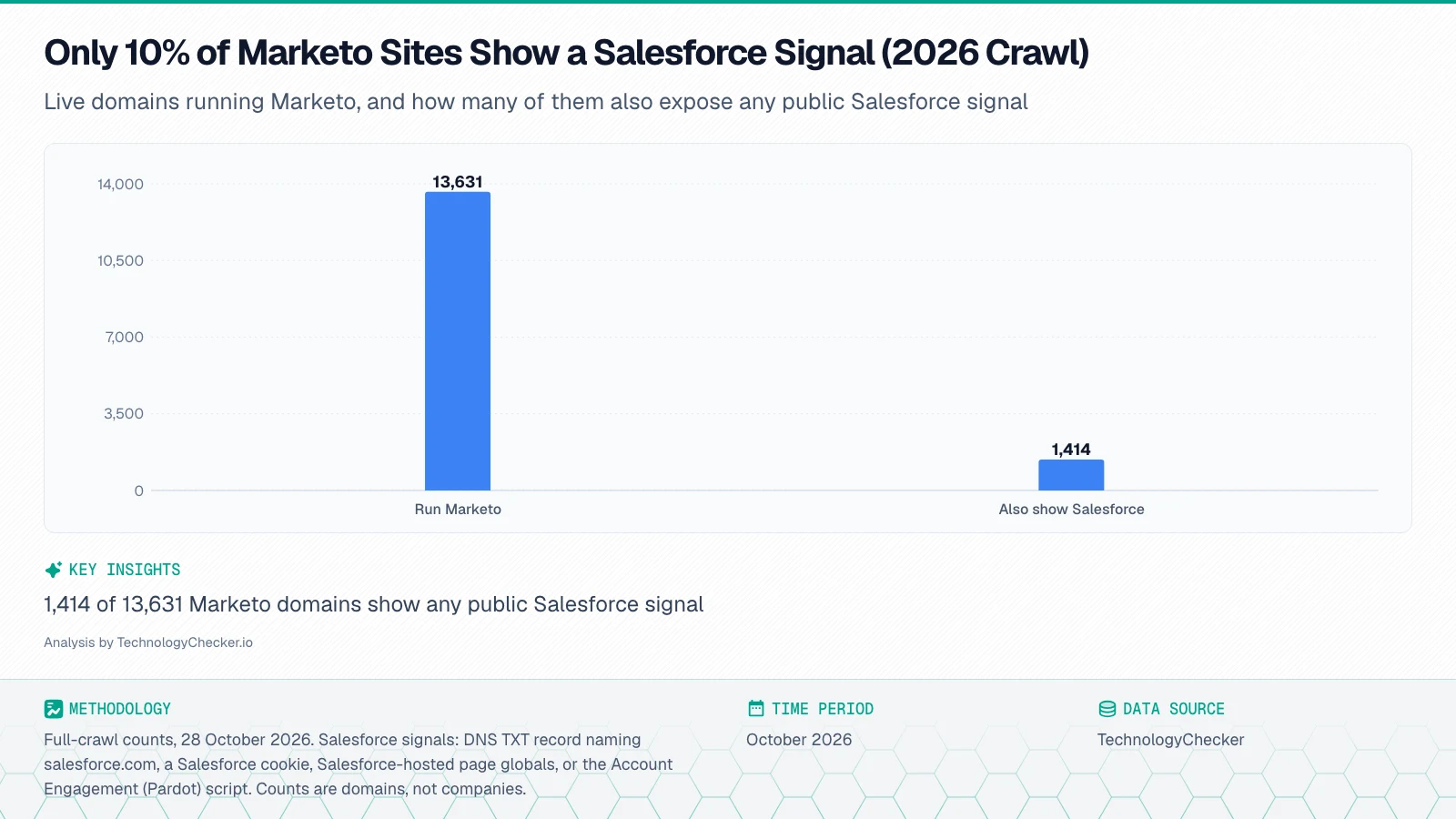
We detect Marketo on 13,631 domains. Only 1,414 of those, about 10%, also show a Salesforce signal. That doesn't mean 90% of Marketo users skip Salesforce. A CRM lives behind a login; from the outside, Salesforce only shows up when it leaves a trace, such as an SPF entry that lets it send mail for the domain, a Salesforce-hosted page, or its Account Engagement tracking script.
Email host split
The email host is one of the cleanest technographic signals because it comes straight from MX records. Our profiles count Microsoft 365 on 3.75M domains and Google Workspace on 3.63M, but read the second number as a floor. Google now gives new customers a single smtp.google.com MX record, which our current Google Workspace rule doesn't match. A 2,500-domain check this month found about 12% of Google-hosted domains invisible for that reason, which puts Google Workspace nearer 4.1M, ahead of Microsoft 365.
That correction is the point of the example. For anyone selling an add-on, an email security product or a migration service, the split decides which integration to build first, and a rule that misses one vendor's new record would have pointed you at the wrong one.
HubSpot accounts that also run Salesforce
HubSpot appears on 588,919 domains in the same crawl, and 12,233 of them (2.1%) also show a Salesforce signal. Companies running two overlapping systems are worth a closer look: they're often mid-migration, or running marketing in one tool and sales in the other. That's a narrow, specific list a rep can work in a week.
How do sales and marketing teams use technographic data?
Sales and marketing teams use technographic data to decide who to target, in what order and with which message. These are the uses I see most often:
- Size the market. Count the domains running the tools your product integrates with or replaces. That count is your serviceable market, by stack, not by industry code.
- Build and segment lists. Filter by "runs X", "runs X but not Y", or "runs X with Y", then layer firmographics (country, size, industry) on top.
- Score and route leads. Add points when an inbound lead runs a compatible stack, and route competitor users to a displacement playbook.
- Personalise the message. "I saw you're on Marketo" lands better than a generic opener, as long as it's true. Check before you send.
- Time the outreach. Adoption and churn signals tell you when an account added or dropped a tool, which is when budgets and opinions are in play.
- Find partners. Agencies and integration partners use the same data to find companies on the platforms they specialise in.
For account-based marketing, technographic data mostly does jobs 2 and 4: it turns a broad target account list into tiers with a reason attached.
Technographic data providers: how they differ
Technographic data providers differ mainly in how they collect the data, which matters more than how many technologies they list. A provider with a huge catalogue that can't see the five tools you sell against is the wrong provider for you.
| Approach | How it works | Strongest on | Examples |
|---|---|---|---|
| Website and DNS detection | Crawls sites and matches fingerprints in code, headers, DNS and certificates | Web-facing stack: CMS, analytics, CDN, email host, ecommerce | TechnologyChecker, BuiltWith, Wappalyzer |
| Job-posting extraction | Parses hiring ads for tool names | Internal tools with no web footprint | TheirStack, PredictLeads, Coresignal |
| Install-base and spend estimates | Compiles many public and partner sources, often with modelling | Enterprise software and IT spend | HG Insights |
| Bundled in sales or ABM platforms | Combines sources like the above inside a broader product | Convenience inside one workflow | ZoomInfo, 6sense, Demandbase |
I'm obviously not neutral here: TechnologyChecker is a website and DNS detection provider. The honest summary is that detection-based data is the best fit for web-facing technologies and timing signals, and job-posting data is the better fit for ERP and HR systems. If your product sells into the back office, buy job-posting data too, or use a provider that combines both. Our BuiltWith alternatives comparison goes deeper on the detection-based tools.
How accurate is technographic data?
Technographic data is accurate for what it observes and much weaker for what it infers. The errors cluster in six places, and every provider has them:
- Domains aren't accounts. Counts are domains. One company can run dozens of country sites and campaign domains, so "50,000 companies use X" is usually fewer companies. Deduplicate to the account before sizing a market.
- Installed isn't running. A tracking script left in a theme after cancellation still matches. Look for the vendor's script actually loading, not just its tag sitting in the page.
- Consent banners hide tags. Tags that wait for cookie consent may not load for any crawler or extension that hasn't clicked "accept", so consent-gated tools are under-counted everywhere.
- Back-office tools are mostly invisible. CRM, ERP and HR software rarely leave a public trace, as the Marketo example above shows.
- Freshness varies. A detection is only as current as the last crawl of that domain. Ask every provider for first-seen and last-seen dates on each record.
- Rules go stale. When a vendor changes the record or script it tells customers to install, a fingerprint written for the old one stops matching new customers, as the Google Workspace example shows.
Privacy is simpler than people expect. Technographic data describes a company's systems, not a person, so on its own it's rarely personal data. That changes when you attach named contacts; the GDPR definition of personal data then applies to those contact records, not to the fact that a domain runs Cloudflare.
How to choose and use technographic data
Choose technographic data by testing it against the decision you need it for, not against the provider's catalogue size. This is the order I'd follow:
Write down the question first
"Which mid-market SaaS companies run HubSpot and Salesforce together?" needs different data from "which retailers dropped a competitor this quarter".
Match the method to the tool
Web-facing tool: detection data. Back-office tool: job-posting data, or both.
Run a recall test
Upload 50 to 100 of your own customers and measure how many the provider finds on the tools you know they run.
Ask for dates on every record
First-seen and last-seen dates let you filter out stale detections and use adoption and churn as timing signals.
Deduplicate to accounts
Group domains by company before you count, score or assign territories.
Combine with firmographic and intent data
Stack fit, company fit and timing together beat any one of them.
Refresh on a schedule
Stacks change; a list pulled once and used for a year decays.
If you want to check a single company first, the free website technology checker on our homepage looks up any domain without an account. For volume, the technographic data API returns the same detections, with first-seen and last-seen dates, for lists of domains.
Frequently asked questions
What does technographic mean?
Technographic describes the technologies an organisation uses, by analogy with demographic (people) and firmographic (companies). A technographic profile lists a company's software and infrastructure: its CMS, analytics, CDN, email host, marketing tools and so on, ideally with the date each one was first and last seen.
What is the difference between firmographic and technographic data?
Firmographic data describes the company: size, industry, location, revenue. Technographic data describes the systems it runs: CRM, CMS, analytics, cloud. Firmographics tell you whether an account fits your market. Technographics tell you whether your product fits the account's stack, which tools you'd replace, and which you'd integrate with.
What are examples of technographic data?
Examples include "runs Shopify and sends email through Klaviyo", "email hosted on Microsoft 365", "added a session-recording tool in May", and "uses React on the main site and Zendesk on its help subdomain". Each pairs a company domain with a technology and, in better datasets, a first-seen and last-seen date.
How is technographic data collected?
Most technographic data is collected by crawling websites and matching fingerprints in page code, HTTP headers, DNS records and TLS certificates. Some providers add inferred data, mostly from job postings that name tools, plus surveys or partner data for enterprise software. Observed signals are more precise; inferred signals reach back-office systems.
How accurate is technographic data?
It's accurate for web-facing tools a crawler can observe and weaker for back-office software, which rarely leaves a public trace. The main error sources are leftover scripts after cancellation, consent-gated tags, stale TXT records, and counting domains as companies. Ask for first-seen and last-seen dates, and run a recall test on your own customer list.
How do B2B sales teams use technographic data?
Sales teams use it to build lists by stack ("runs X but not Y"), to prioritise accounts whose tools integrate with their product, to open conversations with a specific reference to the prospect's stack, and to time outreach around adoption or churn of a competitor. Marketing teams use the same data for segmentation and ad audiences.
Why does technographic data matter for account-based marketing?
Account-based marketing depends on picking the right accounts and saying something specific to each. Technographic data does both: it tiers a target list by stack compatibility and gives every message a concrete hook. It's also verifiable, which matters when a wrong personalisation ("I see you use X") damages trust.
Is technographic data GDPR compliant?
Technographic data about a company's systems is usually not personal data, because it describes infrastructure rather than people. GDPR obligations apply when you combine it with named contacts, so the compliance work sits in your contact data, its lawful basis and your outreach practices, not in the fact that a domain runs a CDN.
How often should technographic data be refreshed?
Refresh at least monthly for active campaigns and before any outreach that references a specific tool. Web-facing stacks change through redesigns, migrations and cancellations, and a detection is only as current as the domain's last crawl. Providers that expose last-seen dates let you filter out records that haven't been confirmed recently.
Where can I get technographic data?
You can get it from website-detection providers, job-posting datasets, install-base vendors, or as a feature inside sales and ABM platforms. For a single company, a free lookup tool is enough. For lists and enrichment, use a provider with an API and record-level dates, and test it against your own customers first.
Methodology
All first-party figures come from TechnologyChecker's crawl, queried on 28 October 2026. The stack-size and category figures use a 1% hash sample of domains (307,809 live business domains with at least one active detection), deduplicated to the latest state per domain, subdomain and technology. Category shares count a domain once per category if any technology in that category is active. The Marketo, Salesforce and HubSpot counts are full-crawl counts on the same date; the Microsoft 365 and Google Workspace counts come from their profile pages (updated 14 October and 15 August 2026), and the Google Workspace undercount comes from a 2,500-domain DNS check on 3 October 2026 (49 of 398 Google-hosted domains used only the newer smtp.google.com record). Counts are domains, not companies.

CEO & Co-founder
12+ years of experience
Mehmet is the CEO and co-founder of TechnologyChecker.
- BSc Computer Engineering, Bilkent University
- Certified SaaS Growth Strategist
- Member, British Computer Society (BCS)
Never miss our research