AI in Marketing Statistics Q3 2026: Adoption, ROI and Trust
AI in marketing, Q3 2026: 86.4% of marketing teams use AI (HubSpot), CMOs give it 15.3% of budgets (Gartner), and AI search crawling doubled.
Published •Updated •Data through September 2026•34 min read
Updated October 1, 2026 with Q3 2026 data (July to September 2026; September is provisional). Earlier figures stay in place, annotated where newer data supersedes them; the change log is in the update history at the end.
Q3 2026 in one paragraph: AI in marketing has moved from "who uses it" to "how much of the budget it gets." 86.4% of marketing teams now use AI in at least a few areas (HubSpot 2026 State of Marketing, 1,500+ marketers), and CMOs direct 15.3% of marketing budgets to AI (Gartner 2026 CMO Spend Survey, 401 leaders). On the web, the AI crawlers that decide which brands appear in assistant answers changed purpose: search-purpose crawling rose to 8.26% of AI-crawler requests in Q3 2026, from 1.32% a year earlier (Cloudflare Radar).
The global AI market is on track to grow from $94.81 billion in 2020 to a forecast $1.675 trillion by 2031, and the slice aimed squarely at marketing is climbing past $107 billion by 2028. Adoption has already crossed the halfway line: 56% of marketers now run AI in production, and 70% name generative AI the most important consumer trend to watch in 2026. Yet the same data exposes a widening gap. Consumer comfort with brand AI fell from 57% to 46% in a single year, and nearly 60% of marketers worry the technology could cost them their jobs. This report pulls 35 data points into interactive charts and data tables, then translates them into the use cases and ROI evidence that actually move a 2026 marketing plan.
Key findings:
- Q3 2026: 86.4% of marketing teams use AI in at least a few areas (HubSpot 2026 State of Marketing), CMOs direct 15.3% of marketing budgets to AI (Gartner, 11 May 2026), and search-purpose AI crawling reached 8.26% of AI-crawler requests (Cloudflare Radar)
- The global AI market is forecast to reach $1.675 trillion by 2031, up from $94.81B in 2020, a 17.7x expansion (Statista Market Insights)
- The AI-in-marketing market is projected to grow about 9x, from $12.05B in 2020 to $107.54B by 2028 (The Insight Partners)
- 56% of marketers have integrated AI into data-driven work (17% extensively, 39% in select areas) (Ascend2)
- Generative AI tops the 2026 trend list at 70%, ahead of CTV/streaming (63%) (Mediaocean)
- 53% of new unicorns in 2025 were AI startups, up from 6% in 2015 (CB Insights)
- Consumer spend on AI mobile apps hit $1.42 billion in 2024, a 274% year-over-year jump (Appfigures)
- Consumer comfort with brands using AI fell from 57% (2023) to 46% (2024) (Qualtrics)
- Marketers worried AI may jeopardize their role rose from 35.6% to 59.8% in one year (Influencer Marketing Hub)
Every chart and table below names its original primary source: Ascend2, HubSpot, CB Insights, Appfigures, Attest, Capterra, Econsultancy, the World Economic Forum, and others, with modeled market forecasts attributed to Statista Market Insights. Two sections go further than the survey data: we add live deployment counts from our own detection crawl of tens of millions of active domains, and live AI-crawler traffic from Cloudflare Radar. You can browse every visual in our interactive charts library, and for the wider picture see our AI adoption trends report.
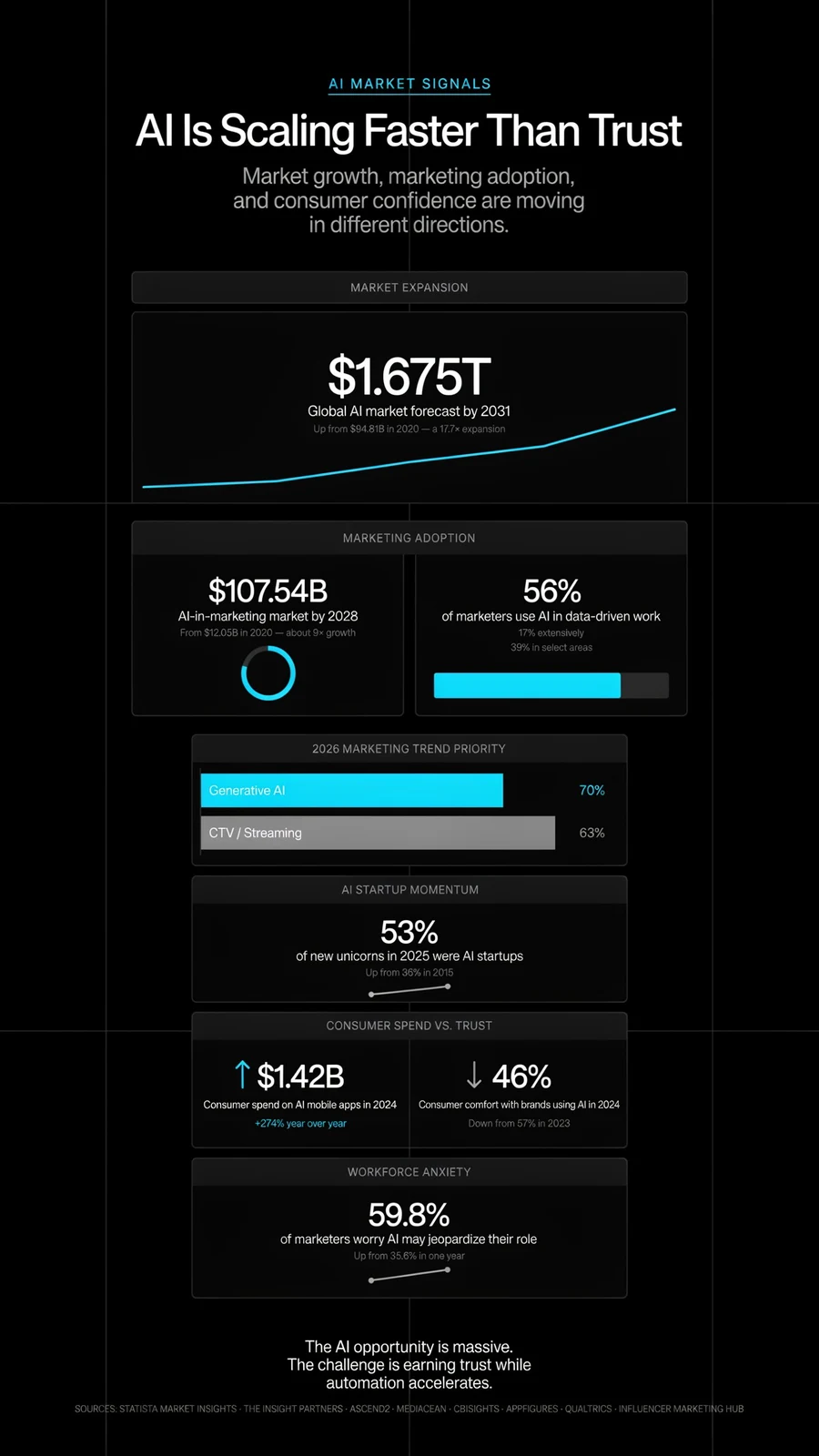
AI is scaling faster than trust: market size, marketing adoption, and consumer confidence are moving in different directions. Sources: Statista Market Insights, The Insight Partners, Ascend2, Mediaocean, CB Insights, Appfigures, Qualtrics, Influencer Marketing Hub.
How many companies use AI for marketing?
86.4% of marketing teams use AI in at least a few marketing areas, and only 1.7% neither use it nor plan to, according to HubSpot's 2026 State of Marketing survey of 1,500+ marketers. Budgets follow: CMOs direct 15.3% of marketing spend to AI, yet only 30% say they are ready to scale it (Gartner 2026 CMO Spend Survey).
| Measure | Value | Source and date |
|---|---|---|
| Marketing teams using AI in at least a few areas | 86.4% | HubSpot 2026 State of Marketing (1,500+ marketers, April 2026) |
| Marketers who say they understand how to use AI | 68.2% (47% in 2025) | HubSpot 2026 State of Marketing |
| Share of marketing budgets going to AI | 15.3% | Gartner 2026 CMO Spend Survey (401 leaders, Jan–Mar 2026) |
| CMOs ready to scale AI | 30% | Gartner 2026 CMO Spend Survey |
| Business websites running an OpenAI integration | 230,932 | TechnologyChecker crawl, 1 October 2026 |
Survey answers describe teams; our crawl describes live websites. The two are separate measurements and are not combined.
Q3 2026 analysis: adoption is settled, so the fight moved to AI search
The 2026 surveys close the adoption question. HubSpot's share of marketers who understand how to use AI jumped from 47% to 68.2% in a year, and the share who know how to measure its impact rose from 48% to 67.5%. Gartner's CMOs now ring-fence 15.3% of budgets for AI. What changed in Q3 is on the distribution side: which AI systems read marketing content, and why.
| AI crawler (share of AI-crawler requests) | Q3 2025 | Q2 2026 | Q3 2026 |
|---|---|---|---|
| Googlebot | 41.94% | 27.49% | 23.80% |
| Meta-ExternalAgent | 8.35% | 12.70% | 13.28% |
| ClaudeBot | 10.26% | 13.87% | 13.23% |
| GPTBot | 12.21% | 10.23% | 8.05% |
| Bingbot | 11.90% | 8.11% | 7.88% |
| Applebot | 1.75% | 7.36% | 7.18% |
| Amazonbot | 6.72% | 5.08% | 6.95% |
| Crawl purpose: search | 1.32% | 4.05% | 8.26% |
| Crawl purpose: training | 40.82% | 49.93% | 47.62% |
Source: Cloudflare Radar, radar/ai/bots/summary/user_agent and radar/ai/bots/summary/crawl_purpose, calendar quarters, pulled 1 October 2026. September 2026 is provisional. Cloudflare reclassified crawl purpose across its history in late September 2026, so the Q2 figures differ from those first published in this report.
Here is how I read this as someone who works on getting brands cited by AI. The crawl-purpose shift matters more than any adoption survey in this report. A year ago, barely 1% of AI crawling was declared as search, which meant almost everything an AI bot read on your site went into training a future model. In Q3 2026 that share passed 8%, so a growing slice of AI crawling now feeds answers that are generated today and can cite you today. GPTBot's falling share does not mean OpenAI cares less about the web; OpenAI fetches live pages through separate search and user agents. The practical move is unchanged but more urgent: keep the search and citation crawlers allowed, and put the answer to each buyer question in a short, sourced passage.
2026 month by month: which AI crawlers read the web
| Month (2026) | Googlebot | ClaudeBot | Meta-ExternalAgent | GPTBot | Bingbot |
|---|---|---|---|---|---|
| January | 38.45% | 11.84% | 10.86% | 12.65% | 9.88% |
| February | 35.94% | 10.40% | 14.27% | 12.94% | 9.29% |
| March | 32.09% | 11.81% | 16.21% | 11.85% | 8.70% |
| April | 30.37% | 11.62% | 15.08% | 9.82% | 8.04% |
| May | 27.38% | 9.92% | 13.38% | 11.27% | 8.41% |
| June | 25.18% | 19.77% | 10.20% | 9.40% | 7.83% |
| July | 24.44% | 16.54% | 12.44% | 9.73% | 8.89% |
| August (provisional) | 22.90% | 11.88% | 14.04% | 8.34% | 7.42% |
| September (provisional) | 24.49% | 12.00% | 13.10% | 6.26% | 7.62% |
| Jan → Sep | −13.96 pt | +0.16 pt | +2.24 pt | −6.39 pt | −2.26 pt |
Source: Cloudflare Radar, radar/ai/bots/summary/user_agent, calendar months, pulled 1 October 2026; September cross-checked against a daily timeseries_groups pull (Googlebot 24.48% daily mean). Shares are of verified AI-crawler requests, not of all web traffic. For the full crawler picture see our AI crawler statistics.
The AI market backdrop: how big the opportunity is
Marketing AI does not exist in a vacuum. It rides on top of one of the fastest-growing technology markets ever measured. The global AI market grew from $94.81 billion in 2020 to $186.93 billion in 2024, and Statista Market Insights models it reaching $1.675 trillion by 2031. The only contraction in the eleven-year series is the 2022 dip, a brief funding pullback before the generative-AI wave reset the trajectory. We break this curve down further in our dedicated AI market size statistics report.
Global AI Market Size 2020-2031: $94.81B to Forecast $1.675 Trillion
The global AI market is forecast to grow from $94.81 billion in 2020 to $1.675 trillion in 2031, a 17.7x expansion in eleven years. The $1.3 trillion of new market value created between 2026 and 2031 (+382.65%) is roughly the size of Australia's GDP added to a single software category. The 2022 dip from $206B (2021) to $127B reflects a brief funding pullback before the generative-AI wave resumed the trajectory.
Source: Statista Market Insights · 2020-2031
| Year | AI market size (USD billions) |
|---|---|
| 2020 | $94.81B |
| 2021 | $206.34B |
| 2022 | $126.78B |
| 2023 | $137.5B |
| 2024 | $186.93B |
| 2025 | $254.5B |
| 2026 | $347.05B |
| 2027 | $473.98B |
| 2028 | $648.34B |
| 2029 | $888.24B |
| 2030 | $1218.8B |
| 2031 | $1675B |
- 2031 forecast of $1.675T is 17.7x the 2020 baseline
- $1.3 trillion in new market value added between 2026 and 2031 alone
- The 2022 dip is the only contraction year in the 11-year series
That growth is spread across every technical segment. Across AI robotics, autonomous and sensor technology, computer vision, machine learning, and natural language processing, the market is forecast to reach its maximum value at the end of the period, with machine learning the largest single segment at roughly $552 billion by 2032. The table below ranks the five segments by projected 2032 size.
| AI segment (2032 projection) | Relative scale |
|---|---|
| Machine learning | Largest, about $552 billion |
| Natural language processing | Second |
| AI robotics | Third |
| Computer vision | Fourth |
| Autonomous & sensor technology | Smallest |
Source: Statista Market Insights. Machine learning's ~$552B figure is the only labeled value in the source chart; the remaining segments are ranked by projected size.
The portion of that market built specifically for marketing is smaller but compounding fast. Estimated at $15.84 billion in 2021, AI in marketing is forecast to exceed $107.5 billion by 2028, roughly 9x growth, with figures from 2021 onward calculated by Statista based on The Insight Partners data.
AI in Marketing Market Value 2020-2028: $12B to $107.5B
The market for AI in marketing was estimated at $15.84 billion in 2021 and is projected to reach more than $107.5 billion by 2028 — roughly 9x growth across the period. Values from 2021 onward are forecasts calculated by Statista based on figures from The Insight Partners.
Source: The Insight Partners · 2020-2028
| Year | AI in marketing market value (USD billions) |
|---|---|
| 2020 | $12.05B |
| 2021 | $15.84B |
| 2022 | $20.82B |
| 2023 | $27.37B |
| 2024 | $35.99B |
| 2025 | $47.32B |
| 2026 | $62.21B |
| 2027 | $81.79B |
| 2028 | $107.54B |
- AI in marketing crosses $100B by 2028, reaching $107.54B
- ~9x growth from the $12.05B 2020 baseline in eight years
- Forecast assumes steady ~33% annual compounding through 2028
Employers expect the underlying skills to become standard. In the World Economic Forum's survey of 1,000 employers, information and technology services and telecommunications tied at the top: 66% of employers in each expect AI and big data to be core workforce skills between 2025 and 2030. Even the lowest-ranked industries kept the skill above one in three workers.
| Industry | Expect AI & big data as a core skill (2025-2030) |
|---|---|
| Information and technology services | 66% |
| Telecommunication | 66% |
| Financial services and capital markets | 61% |
| Insurance and pensions management | 58% |
| Education and training | 56% |
| Automotive and aerospace | 54% |
| Medical and healthcare services | 51% |
| Government and public sector | 50% |
| Electronics | 44% |
| Supply chain and transportation | 44% |
| Real estate | 43% |
| Production of consumer goods | 42% |
| Retail and wholesale of consumer goods | 41% |
| Infrastructure | 39% |
| Professional services | 37% |
Source: World Economic Forum.
Consumer spending on AI creative tools is heavily concentrated. Between January 2023 and December 2024, the United States accounted for 66.3% of global consumer spend on AI visual generator and editor apps, more than ten times China's second-place 6.3%.
AI Visual App Consumer Spend by Country 2023-2024: US Tops at 66.3%
Between January 2023 and December 2024, the United States registered over 66 percent of global consumer spend on AI graphic editing and generator apps. China ranked a distant second at 6.3 percent, followed by the United Kingdom at 5.6 percent. The concentration shows how heavily AI creative-app revenue skews toward the US market.
Source: Appfigures · 2023-2024
| Country | Share of consumer spend (%) |
|---|---|
| United States | 66.3% |
| China | 6.3% |
| United Kingdom | 5.6% |
| Germany | 4.1% |
| Canada | 4% |
| Japan | 3.5% |
| Australia | 3.3% |
| Brazil | 2.9% |
| France | 2.4% |
| Mexico | 1.6% |
- The US alone accounts for 66.3% of global AI visual-app consumer spend
- The US share is more than 10x China's second-place 6.3%
- The top three markets (US, China, UK) combine for over 78% of spend
Investors have noticed. The share of new unicorns that are AI startups climbed from 6% in 2015 to 53% in 2025, meaning more than half of all new billion-dollar companies are now AI businesses. CB Insights notes that one in five of those 2025 unicorns are AI agents.
AI Share of New Unicorns 2015-2025: From 6% to 53%
In 2025, 53 percent of new unicorn births worldwide were AI startups — up from 6 percent in 2015 and 44 percent in 2024. Growth accelerated sharply between 2023 and 2025, roughly tripling the AI share of new billion-dollar companies in three years. CB Insights reports that one in five new unicorns in 2025 are AI agents.
Source: CB Insights · 2015-2025
| Year | AI share of new unicorns (%) |
|---|---|
| 2015 | 6% |
| 2016 | 11% |
| 2017 | 15% |
| 2018 | 17% |
| 2019 | 23% |
| 2020 | 14% |
| 2021 | 18% |
| 2022 | 17% |
| 2023 | 32% |
| 2024 | 44% |
| 2025 | 53% |
- 53% of 2025 unicorn births were AI startups — more than half of all new billion-dollar companies
- The 2023-2025 acceleration (32% → 53%) maps directly to the GenAI funding wave post-ChatGPT launch
- One in five new 2025 unicorns are AI agents, per CB Insights — an emerging category inside the category
Funding concentrates at the top. Among machine learning operations and platform startups, OpenAI raised over $11.3 billion, roughly 19 times the second-place Scale AI ($602.6 million). All ten leading MLOps startups had raised more than $100 million.
| AI / MLOps startup | Total funding (Jan 2024) |
|---|---|
| OpenAI | $11,300M |
| Scale AI | $602.6M |
| Adept | $415M |
| Cohere.ai | $414.9M |
| Anyscale | $259M |
| Inflection AI | $225M |
| Weights & Biases | $200M |
| Hugging Face | $160.2M |
| OctoML | $131.9M |
| AI21 Labs | $118.5M |
Source: NFX, January 2024.
What this means for marketers: AI budgets now compete inside a market growing toward $1.7 trillion. The platforms and skills you adopt in 2026 will be table stakes by 2030, not differentiators, so the cost of waiting compounds faster than the cost of experimenting.
AI use cases in marketing: where the work actually happens
Headline market numbers say AI is big. The survey data says how marketers actually use it. As of January 2025, 56% of marketing professionals had AI in production: 17% extensively across multiple channels and 39% in select areas. Another 26% were exploring it, leaving only 13% with no plans at all.
Extent of AI Use in Marketing 2025: 56% Have Integrated AI
As of January 2025, about 17 percent of marketing professionals reported using AI extensively across multiple channels and another 39 percent had integrated it in select areas — meaning 56 percent had AI in production. A further 26 percent were exploring AI but had not implemented it, while 13 percent had no plans to use AI in marketing.
Source: Ascend2 · 2025
| Level of AI integration | Share of respondents (%) |
|---|---|
| Extensively integrated across multiple channels | 17% |
| Integrated in select areas | 39% |
| Exploring AI but not yet implemented | 26% |
| No plans to use AI in marketing | 13% |
| Unsure | 5% |
- 56% of marketers have AI in production (17% extensively + 39% in select areas)
- Only 13% have no plans to use AI in marketing at all
- 26% are still in the exploration phase — the largest pool of future adopters
When marketers name the tactics they apply AI to, the top of the list is content and communication work. Content creation and enhancement leads at 37%, with email optimization (36%), social media management and ad targeting (35%), and content personalization (33%) clustered right behind.
Top AI Marketing Tactics 2025: Content Creation Leads at 37%
Content creation and enhancement was the leading use of AI among marketers in January 2025, cited by 37 percent of respondents. Email marketing optimization (36%) and social media management and ad targeting (35%) followed closely. Voice and visual search optimization was one of the least common uses, at 20 percent.
Source: Ascend2 · 2025
| AI tactic | Share of respondents (%) |
|---|---|
| Content creation and enhancement | 37% |
| Email marketing optimization | 36% |
| Social media management and ad targeting | 35% |
| Personalization of content | 33% |
| Chatbots and conversational AI | 25% |
| Predictive analytics for customer behavior | 22% |
| Audience segmentation and targeting | 22% |
| Voice and visual search optimization | 20% |
| Other | 14% |
- The top four tactics — content, email, social, personalization — cluster within 33-37%
- Content creation and enhancement is the single most common AI use at 37%
- Voice and visual search optimization trails the leaders at 20%
Influencer marketing has adopted AI almost wholesale. About 60% of marketers already use AI for influencer work: 37.8% on a limited basis and 22.4% extensively, while just 9.5% have no plans to adopt it. Our full influencer marketing statistics report tracks where that spend is going.
AI in Influencer Marketing 2025: 60% of Marketers Already Use It
During a 2025 survey of marketing agencies and brands, about 38 percent said they were using AI for influencer marketing on a limited basis and 22.4 percent were using it extensively — meaning roughly 60 percent were already using AI. Another 30.3 percent were not yet using it but exploring options, while just 9.5 percent had no plans to adopt it.
Source: Influencer Marketing Hub · 2025
| Adoption status | Share of respondents (%) |
|---|---|
| Yes, but limited usage | 37.8 |
| No, but we are exploring options | 30.3 |
| Yes, extensively | 22.4 |
| No, and we don't plan to | 9.5 |
- 60.2% of marketers already use AI for influencer marketing (37.8% limited + 22.4% extensive)
- Only 9.5% have no plans to adopt AI for influencer work
- A further 30.3% are actively exploring options
The purpose behind that adoption is dominated by language. Natural language processing accounts for 49% of AI tool use in influencer marketing, nearly double machine learning (28.7%). Notably, deepfake technology already ranks third at 24.3%.
AI Tools in Influencer Marketing 2025: NLP Leads at 49%
In a survey published at the end of 2025, almost half (49 percent) of marketers reported using AI tools for natural language processing in influencer marketing. Machine learning tools followed at nearly 29 percent, ahead of deepfake technology (24.3%) and predictive analytics (22.3%). About 18 percent said they did not use AI tools at all.
Source: Influencer Marketing Hub · 2025
| AI tool purpose | Share of respondents (%) |
|---|---|
| Natural language processing | 49% |
| Machine learning | 28.7% |
| Deepfake technology | 24.3% |
| Predictive analytics | 22.3% |
| Audience segmentation tools | 18.7% |
| No AI-based tools used | 18.3% |
| Other | 3.2% |
- NLP is the dominant influencer-marketing use of AI at 49% — nearly double machine learning
- Deepfake technology already ranks third at 24.3%
- 18.3% of marketers still use no AI-based influencer tools
For broader digital experience delivery, chatbots (38%) and personalization (36%) lead the use cases marketers find most impactful, with brand intelligence, content intelligence, and product recommendations close behind. Generative tasks such as content authoring, video, and image generation all cluster around 28-29%.
| AI digital-experience use case | Marketers citing it (2024) |
|---|---|
| Chatbot | 38% |
| Personalization | 36% |
| Brand intelligence | 33% |
| Content intelligence | 31% |
| Product recommendations | 31% |
| Content authoring | 29% |
| Video generation | 29% |
| Image generation | 28% |
| Customer journey optimization | 27% |
| Content performance predictions | 26% |
| Content findability | 25% |
| Digital asset discovery | 25% |
| Asset tagging | 18% |
| Ideation | 17% |
| Briefing | 16% |
Source: Sitecore, 2024.
Ecommerce shows the broadest, flattest adoption of any segment. Customer service and support leads at 37%, but every listed application, from data analysis and image generation to copy generation and admin tasks, sits within a narrow 30-37% band.
AI Use in Ecommerce Marketing 2024: Customer Service Leads at 37%
A 2024 survey found customer service and support was the leading application of AI in ecommerce marketing, named by 37 percent of responding ecommerce marketers. Data analysis and image generation ranked second, both cited by 36 percent. The spread is tight — even copy generation and administrative tasks reached 30 percent.
Source: Klaviyo · 2024
| Ecommerce AI application | Share of respondents (%) |
|---|---|
| Customer service & support | 37% |
| Data analysis | 36% |
| Image generation | 36% |
| Research & idea generation | 35% |
| Website personalization | 34% |
| Internal processes automation | 33% |
| Product recommendations | 33% |
| Testing & optimization | 33% |
| Copy generation | 30% |
| Administrative tasks | 30% |
- Customer service & support leads ecommerce AI use at 37%
- All 10 listed applications fall within a narrow 30-37% band — adoption is broad, not concentrated
- Image generation (36%) is already as common as data analysis in ecommerce
One 2024 finding has aged quickly but is worth keeping for context: as of early 2024, 52% of marketing and media leaders used no AI content tool at all. Among those who did, ChatGPT dominated at 29%, roughly ten times its nearest rival. (For how far ChatGPT has scaled since, see our ChatGPT statistics breakdown.)
| AI content tool | Share of marketers using it (early 2024) |
|---|---|
| None | 52% |
| ChatGPT | 29% |
| Other / don't know | 15% |
| Google Bard/Gemini | 3% |
| Midjourney | 3% |
| Canva | 2% |
| Adobe AI | 2% |
| JasperAI | 2% |
| Grammarly | 2% |
| Google AI | 1% |
| Microsoft (Azure/Copilot) | 1% |
| Bing | 1% |
Source: WordPress VIP, early 2024.
What this means for marketers: Start where adoption is already proven, content, email, personalization, and customer service, rather than chasing novelty use cases. The fastest, lowest-risk ROI sits in tasks your peers have already validated at 30%-plus adoption.
Which AI marketing tools are actually deployed on live sites
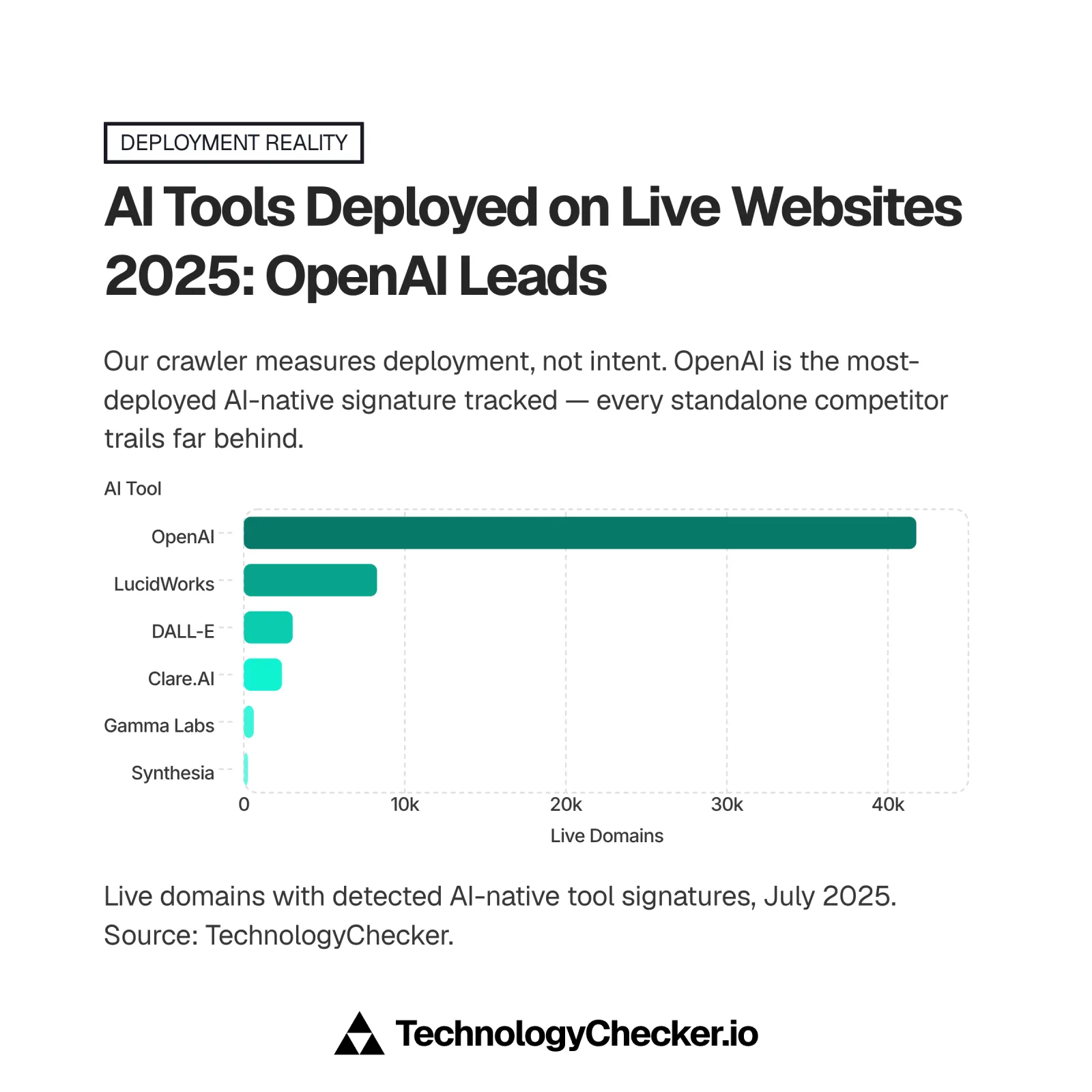
Surveys measure intent. Our crawler measures deployment, and the two tell different stories. TechnologyChecker scans the public tech stack of tens of millions of active domains every month. In our most recent complete crawl (July 2025), OpenAI-powered integrations were detectable on 41,764 domains, the single most-deployed AI-native signature we track. Every other standalone AI tool trails far behind it.

The visible tip is the standalone AI tool. The hidden mass is the marketing stack already running it.
| AI-native tool | Category | Live domains (Jul 2025) |
|---|---|---|
| OpenAI | AI chatbots & assistants | 41,764 |
| LucidWorks | AI search & discovery | 8,275 |
| DALL-E | AI image generation | 3,038 |
| Clare.AI | AI chatbots & assistants | 2,368 |
| Gamma Labs | AI content generation | 620 |
| Synthesia | AI image generation | 259 |
Source: TechnologyChecker detection crawl, July 2025. Counts are domains where each tool's signature is live in the page source.
Now set those numbers against the marketing platforms sites already run. Traditional automation and live-chat tools dwarf every AI-native product, and most of them have since added their own AI features.
| Marketing platform | Category | Live domains (Jul 2025) |
|---|---|---|
| MailChimp | Marketing automation | 313,840 |
| Klaviyo | Marketing automation | 191,547 |
| Tawk.to | Live chat | 145,895 |
| HubSpot | Marketing automation | 107,974 |
| Tidio | Live chat | 39,806 |
| Intercom | Live chat | 22,512 |
Source: TechnologyChecker detection crawl, July 2025.
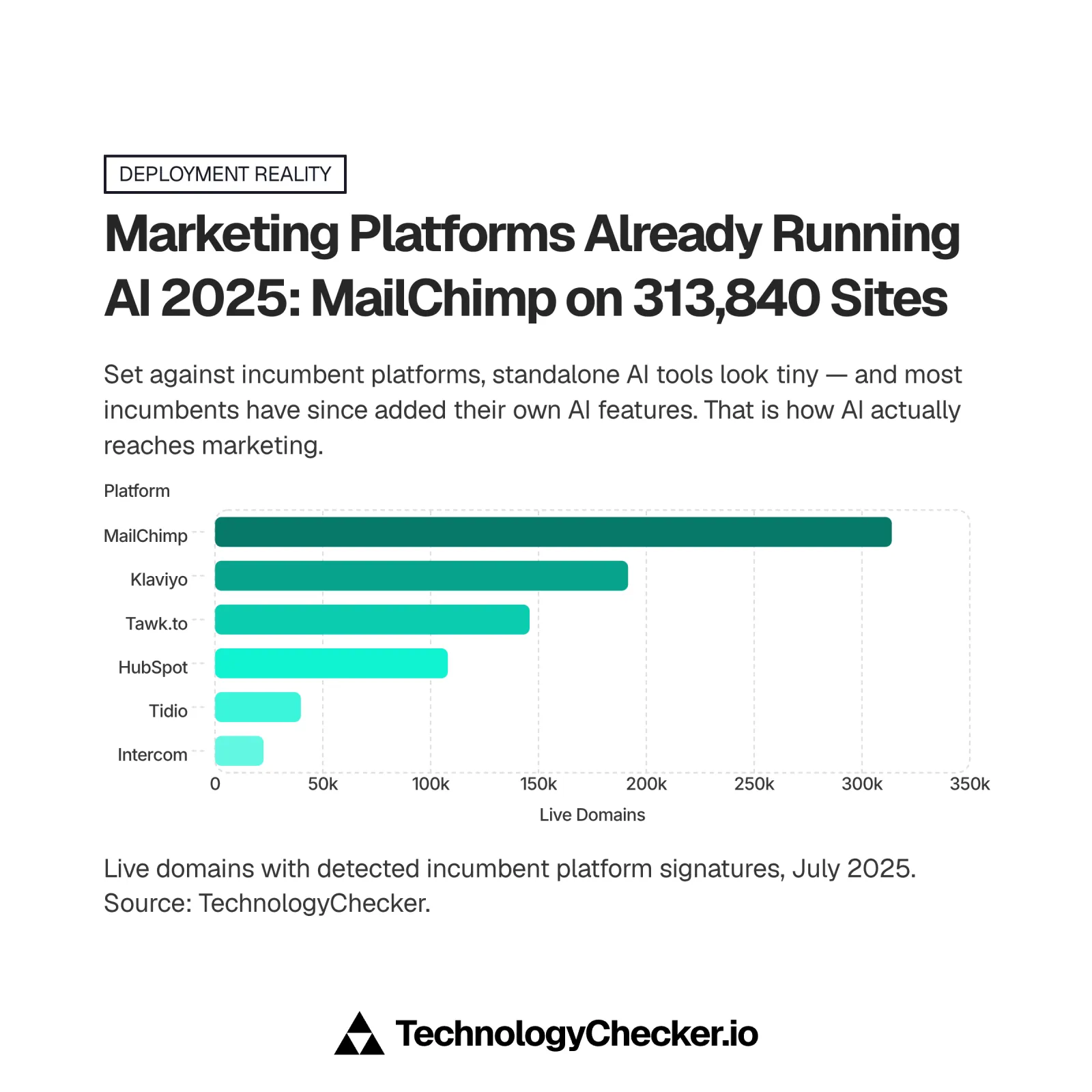
MailChimp alone sits on more than seven times as many domains as every AI-native tool in the table above combined. The takeaway is not that marketers ignore AI. It is that AI mostly reaches their sites as features inside the platforms they already pay for, Klaviyo's predictive sends, HubSpot's content assistant, Tidio's Lyro bot, rather than as a wave of new AI-only products bolted on to the front end. The 56% adoption figure from surveys and the few thousand standalone AI deployments we detect are both accurate; they describe different layers of the same stack.
Live in September 2026: the same pattern, larger counts
Our current crawl shows the same layering at a larger scale. TechnologyChecker detects an OpenAI integration on 230,932 of the 29.9M live business domains we crawl, as of the 1 October 2026 crawl, while HubSpot sits on 602,953, MailChimp on 547,029 and Klaviyo on 429,474 in the September 2026 crawl. These counts are not a like-for-like series with the July 2025 tables above: the set of domains we crawl turns over every month, with dead sites dropping out and newly discovered ones added, and our detection signals widen over time.
| Industry (OpenAI, 129,324 matched domains) | Share | Over-index vs all matched live domains |
|---|---|---|
| Software Development | 8.14% | 3.2× |
| Marketing Services | 2.82% | 2.7× |
| Technology, Information and Internet | 5.52% | 2.6× |
| IT Services and IT Consulting | 8.17% | 2.2× |
| Advertising Services | 6.03% | 2.1× |
Source: TechnologyChecker website observations enriched with company information, 1 October 2026 crawl. The OpenAI count rose 23.6% between the August and September crawls, faster than our crawl grew, so we publish it as a dated level rather than a growth rate.
What this means for marketers: Audit the AI you already own before buying more. The fastest path to measurable AI in marketing usually runs through a feature toggle in your existing email, CRM, or chat platform, not a net-new tool that adds another login and another integration to maintain.
Marketer insights: budgets, trust, and the things slowing AI down
Among B2B marketers, AI proves most effective at the front of the funnel and the back office. Targeting audiences (43%) and analytics and reporting (41%) top the list, ahead of personalization, email, and content creation, which cluster at 35-36%. This mirrors the broader marketing automation market trends we track across 29.9 million active domains.
AI Marketing Automation for B2B 2025: Targeting Leads at 43%
Among B2B marketers surveyed in February 2025, about 43 percent named targeting audiences as the most effective application of AI in marketing automation. Analytics and reporting followed at 41 percent, ahead of personalization (36%), email marketing (35%), and content creation (35%). Campaign and channel optimization ranked last at 17 percent.
Source: Act-On · 2025
| Marketing automation application | Share of respondents (%) |
|---|---|
| Targeting audiences | 43% |
| Analytics and reporting | 41% |
| Personalization | 36% |
| Email marketing | 35% |
| Content creation | 35% |
| Customer service | 29% |
| Lead generation and qualification | 27% |
| Campaign/channel optimization | 17% |
- Targeting audiences (43%) and analytics/reporting (41%) top B2B AI automation
- Personalization, email, and content creation cluster at 35-36%
- Lead generation and qualification ranks surprisingly low at 27%
Looking ahead, marketers rank generative AI as the trend that matters most. In a November 2025 survey, 70% named generative AI among the most important consumer trends for 2026, ahead of CTV and streaming (63%). The metaverse, by contrast, has collapsed to last place at 12%.
Leading Consumer Trends Marketers Watch for 2026: GenAI Tops at 70%
In a November 2025 survey, 70 percent of marketers included generative AI among the most important consumer trends they were watching for 2026 — the single most-cited trend. Connected TV and streaming followed closely at 63 percent, and TikTok and social video rounded out the top three at 43 percent. The metaverse ranked last at 12 percent.
Source: Mediaocean · 2026
| Consumer trend | Share of respondents (%) |
|---|---|
| Generative AI | 70% |
| CTV/streaming | 63% |
| TikTok/social video | 43% |
| Consumer privacy | 28% |
| E-commerce everywhere | 27% |
| Political & advocacy trends | 18% |
| Sustainability/carbon impact | 17% |
| Gaming | 13% |
| Metaverse | 12% |
- Generative AI tops the 2026 trend list at 70% — ahead of CTV/streaming
- AI and CTV pull away from the field, with a 15-point gap to third-placed TikTok/social video
- The metaverse has collapsed to last place at 12%, far behind GenAI
Enthusiasm comes with caution. Only 13% of marketers fully trust AI insights without human checks. The vast majority sit in a "trust but verify" middle: 33% validate AI insights with human review and 35% rely mostly on human judgment.
Marketer Trust in AI Insights 2025: Only 13% Fully Trust AI
According to a January 2025 survey, 35 percent of marketers said they somewhat trust AI for guiding critical marketing insights but rely mostly on human judgment, and 33 percent trust AI insights but validate them with human review. Only 13 percent fully trust AI insights, while 11 percent do not trust AI-driven insights at all.
Source: Ascend2 · 2025
| Level of trust in AI insights | Share of respondents (%) |
|---|---|
| Fully trust AI insights | 13% |
| Trust AI insights but validate with human review | 33% |
| Somewhat trust AI but rely mostly on human judgment | 35% |
| Do not trust AI-driven insights | 11% |
| Unsure | 8% |
- Only 13% of marketers fully trust AI insights without human checks
- 68% sit in the 'trust but verify' middle (33% validate + 35% rely mostly on humans)
- Just 11% reject AI-driven insights outright
That caution shows up in spending. Nearly half of marketers (47.6%) allocate under 10% of their marketing budget to AI-driven campaigns, and only 19% commit more than 40%. Most organizations are still testing AI with small budget slices rather than betting the bulk of spend on it.
AI Marketing Budget Allocation 2024: 48% Spend Under 10%
According to a 2024 survey, roughly 48 percent of marketers allocated less than 10 percent of their marketing budget to AI-driven campaigns. Another 33.4 percent dedicated between 10 and 40 percent, while 19 percent committed over 40 percent of budget to AI. Most organizations are still testing AI with small budget slices rather than betting the bulk of spend on it.
Source: Influencer Marketing Hub · 2024
| Budget share allocated to AI | Share of respondents (%) |
|---|---|
| Under 10% of marketing budget | 47.6 |
| 10-40% of marketing budget | 33.4 |
| Over 40% of marketing budget | 19 |
- Nearly half (47.6%) of marketers allocate under 10% of budget to AI campaigns
- Only 19% commit more than 40% of marketing budget to AI
- A third (33.4%) sit in the 10-40% middle band
When organizations do invest, the leading strategy is internal upskilling. 27% say training courses and workshops are their main AI adoption play, ahead of partnering with AI vendors (16.7%) or hiring external experts (15.9%).
Generative AI specifically is mostly live or near-live inside brands. About 57% are already running GenAI: 30% implementing initial solutions and pilots, 27% with solutions in place and being evaluated. Just 2% report a company policy that prohibits its use.
Brand GenAI Adoption Status 2024: 30% Running Pilot Projects
In a survey conducted in September and October 2024, about 30 percent of marketers said their organizations were implementing initial generative AI solutions, including pilot projects. Around 27 percent had solutions in place and were evaluating effectiveness, while 21 percent reported no formal adoption strategy. Only 2 percent said company policy prohibited GenAI use.
Source: Econsultancy · 2024
| GenAI adoption status | Share of respondents (%) |
|---|---|
| Implementing initial solutions, including pilot projects | 30% |
| Have solutions in place and evaluating effectiveness | 27% |
| No formal adoption strategy | 21% |
| Identifying use cases and evaluating vendors | 11% |
| Conducting organization-wide assessment of if/where to deploy | 8% |
| Company policy prohibits use | 2% |
- 57% of brands are already live with GenAI (30% piloting + 27% evaluating in production)
- 21% still have no formal GenAI adoption strategy
- Just 2% of organizations outright prohibit GenAI use
So what holds the rest back? When marketers list barriers to adopting new AI tools, data privacy concerns rank first at 41%, with training and time investment close behind at 39%. Tool sprawl and legacy-system integration tie at 34%, an interoperability problem as much as a trust one.
| Barrier to adopting new AI tools | Marketers citing it (2025) |
|---|---|
| Data privacy concerns | 41% |
| Training and time investment | 39% |
| Too many tools that do similar things but don't connect | 34% |
| Integration with existing or legacy systems | 34% |
| Prefer a different AI tool than the company invests in | 27% |
| Resistance to change within the organization | 27% |
| Role security concerns | 26% |
| Ethical or legal compliance concerns | 22% |
| No barriers experienced in the past year | 11% |
Source: HubSpot, 2025.
The biggest organizational challenge with generative AI is output you cannot fully trust. 35% cite concerns about reliability, including hallucinations, ahead of skills gaps (30%) and security risks (29%). Nineteen percent also worry they are not moving fast enough, a reminder that fear of falling behind sits alongside fear of the technology itself.
| Organizational GenAI challenge | Organizations citing it (2024) |
|---|---|
| Reliability concerns (e.g. hallucinations) | 35% |
| Lack of skills or training | 30% |
| Security risks | 29% |
| Lack of a clear strategy | 25% |
| Brand-safety concerns | 24% |
| Difficulty integrating AI into daily workflows | 24% |
| Not moving fast enough | 19% |
| Limited or poor-quality data | 18% |
| Limited budgets | 18% |
Source: Econsultancy, 2024.
In social media specifically, the leading concerns are human rather than technical. Maintaining authenticity (43%) and the value of human creativity (40%) top the list of GenAI challenges.
Top GenAI Social Media Challenges 2024: Authenticity Tops at 43%
As of May 2024, around 43 percent of marketers said maintaining authenticity was a challenge when using generative AI for social media marketing. Maintaining the value of human creativity ranked second at 40 percent, followed by ensuring content resonates (35%) and keeping up with AI advancements (33%). Labeling GenAI content and overcoming internal resistance were the least-cited challenges.
Source: Capterra · 2024
| GenAI social media challenge | Share of respondents (%) |
|---|---|
| Maintaining authenticity | 43% |
| Maintaining value of human creativity | 40% |
| Ensuring content resonates | 35% |
| Keeping up with AI advancements | 33% |
| Protecting proprietary info | 26% |
| Managing biases/inaccuracies | 25% |
| Labeling GenAI content | 20% |
| Overcoming internal resistance | 19% |
- Maintaining authenticity (43%) is the top GenAI social-media challenge
- The top two concerns are human, not technical — authenticity and the value of human creativity (40%)
- Only 20% cite labeling GenAI content as a challenge, despite rising disclosure rules
The benefits side of that same survey explains why marketers push through those concerns. Increased efficiency (38%) leads, but easier idea generation, more content, and enhanced creativity (33-34%) all rank above pure cost savings (32%). Speed and ideation, not just budget, drive the appeal.
| GenAI benefit in social media | Marketers citing it (2024) |
|---|---|
| Increased efficiency | 38% |
| Easier idea generation | 34% |
| Increased content production | 33% |
| Enhanced creativity | 33% |
| Reduced costs | 32% |
| Reduced turnaround time | 26% |
| Competitive advantage | 20% |
| Audience personalization | 18% |
Source: Capterra, 2024.
At the individual level, the daily frustrations are about quality. 43% of marketers say generative AI sometimes produces inaccurate information, followed by bias (34%), irrelevant output (31%), and prompting difficulty (30%).
| Challenge using generative AI | Marketers citing it (2025) |
|---|---|
| Sometimes produces inaccurate information | 43% |
| Sometimes produces biased information | 34% |
| Content not always relevant to the goal | 31% |
| Difficulty prompting to the desired goal | 30% |
| Content too surface-level or vague | 29% |
| Lacks up-to-date info on trends and events | 23% |
| Cannot create truly original content | 19% |
| Sometimes produces plagiarized information | 19% |
| Concerned about what AI tools do with data | 15% |
| Helps summarize large amounts of data | 14% |
Source: HubSpot, 2025.
All of this lands on the people doing the work. The share of marketers worried AI may jeopardize their role jumped from 35.6% in 2023 to 59.8% in 2024, a 24-point rise in a single year, tracking the mainstreaming of generative AI in everyday workflows.
Marketers Worried AI May Impact Their Jobs: 36% to 60% in One Year
According to a 2024 survey, roughly 60 percent of marketers were concerned that AI could impact their roles, up sharply from approximately 36 percent in 2023. Job-security anxiety among marketers rose by about 24 percentage points in a single year as generative AI tools became mainstream.
Source: Influencer Marketing Hub · 2023-2024
| Year | Share of respondents (%) |
|---|---|
| 2023 | 35.6% |
| 2024 | 59.8% |
- Job-impact worry jumped from 35.6% (2023) to 59.8% (2024) — a 24-point rise in one year
- By 2024, three in five marketers feared AI could jeopardize their role
- The spike tracks the mainstreaming of generative AI in marketing workflows
What this means for marketers: Treat reliability and integration as the real blockers, not enthusiasm. Budget explicitly for training and human review, and consolidate overlapping tools before adding new ones, since tool sprawl is now as big a barrier as data privacy.
Consumer insights: how shoppers actually feel about brand AI
Marketers have moved fast. The final question is whether consumers are coming with them. On the demand side, the answer is broadly yes: roughly half of consumers in four English-speaking markets are open to AI-assisted shopping research, led by Canada at 51%, the US at 49%, the UK at 47%, and Australia at 43%.
| Country | Consumers open to AI-assisted purchase research (2025) |
|---|---|
| Canada | 51% |
| United States | 49% |
| United Kingdom | 47% |
| Australia | 43% |
Source: Attest, 2025.
Who actually uses AI apps skews sharply male. AI utility apps are 89.1% male, and every category, from transcription to music to writing tools, leans male. Education apps are the most balanced, at 31.4% female users.
AI App Users by Gender 2023-2024: Up to 89% Male in Utility Apps
Between 2023 and 2024, around 89 percent of AI utility app users were men. Across every selected AI app category, male users outnumbered female users. AI education apps had the largest share of female users, with approximately 31 percent of women accessing AI learning apps — the most balanced category.
Source: Appfigures · 2023-2024
| AI app category | Share of users (%) |
|---|---|
| Utility | 89.1% |
| Transcription | 88.3% |
| Music | 86.6% |
| Lifestyle | 85.9% |
| Graphics | 85.8% |
| Writing tools | 85.1% |
| Assistants | 81.8% |
| Photo and video | 77.8% |
| Health | 74.4% |
| Companion | 69.8% |
| Education | 68.6% |
- AI utility apps are 89.1% male — the most male-skewed category
- Education apps are the most balanced, with 31.4% female users
- Every AI app category still skews male, but companion and education narrow the gap most
It also skews young. The 18-24 cohort is the largest demographic in every AI app category, peaking at 65% for companion apps and 56% for education. Writing tools and transcription draw the oldest audiences, with 23% of users aged 50+.
AI App Users by Age 2023-2024: Under-25s Dominate Every Category
Between 2023 and 2024, AI companion apps had an audience of around 65 percent users aged 18 to 24 — the youngest-skewing category. Education apps followed, with 56 percent of users in the same age group. The 18-24 cohort was the largest demographic using AI-powered apps in every examined category, from companions to transcription.
Source: Appfigures · 2023-2024
| AI app category | Share of users (%) |
|---|---|
| Companion | 65% |
| Education | 56% |
| Assistants | 52% |
| Music | 50% |
| Photo and video | 50% |
| Writing tools | 48% |
| Lifestyle | 47% |
| Graphics | 47% |
| Utility | 44% |
| Health | 44% |
| Transcription | 41% |
- AI companion apps skew youngest — 65% of users are 18-24
- The 18-24 cohort is the largest group in every single AI app category
- Writing tools and transcription draw the oldest audiences (23% aged 50+)
Consumers are increasingly willing to pay. Spending on AI mobile apps reached $1.42 billion in 2024, up 274% from $380 million in 2023, a sign that paid AI apps moved from novelty to mainstream spending in a single year.
AI Mobile App Consumer Spend 2023-2024: $380M to $1.42B (+274%)
AI mobile apps registered global consumer spend of $1.42 billion in 2024, up from around $380 million in 2023. The 274 percent year-over-year increase shows how quickly paid AI apps moved from novelty to mainstream consumer spending in a single year.
Source: Appfigures · 2023-2024
| Year | Consumer spend (USD millions) |
|---|---|
| 2023 | $380M |
| 2024 | $1420M |
- AI app consumer spend hit $1.42B in 2024 — up 274% year-over-year
- Spending nearly quadrupled from $380M in 2023 in a single year
- Consumers are now paying directly for AI apps, not just using free tiers
When consumers describe the upside of brands using AI, they reward operational speed. Faster customer support leads at 47%, ahead of helping staff do their jobs (38%) and more creative advertising (35%).
| Consumer-seen advantage of brand AI | Consumers citing it (2025) |
|---|---|
| Faster customer support | 47% |
| Helping staff do their jobs | 38% |
| More creative advertising | 35% |
| Cost savings passed on to consumers | 32% |
| Greater product innovation | 32% |
Source: Attest, 2025.
The downsides they name are overwhelmingly about losing the human element. Loss of the human touch (59%) tops the list, with job losses and the inability to speak to a real person tied at 57%. Contact-center software is built around that person, and the companies that use NICE CXone for website chat are organizations that take a lot of customer calls, such as Desjardins, DTE Energy and Holland America.
Consumer-Seen Downsides of Brand AI 2025: Lost Human Touch at 59%
According to a January 2025 survey of consumers in Australia, Canada, the UK, and the US, 59 percent saw loss of the human touch as the main disadvantage of brands using AI. Job losses and the inability to speak to a real person tied at 57 percent. Privacy or security weaknesses (43%) and the potential for misleading consumers (40.5%) followed.
Source: Attest · 2025
| Disadvantage of brand AI | Share of respondents (%) |
|---|---|
| Loss of the human touch | 59% |
| Job losses | 57% |
| Inability to speak to a real person | 57% |
| Privacy or security weaknesses | 43% |
| Potential for misleading consumers | 40.5% |
- Loss of the human touch (59%) is consumers' top concern about brand AI
- Human-experience fears (lost touch, no real person) outrank privacy and accuracy concerns
- Even the lowest concern — misleading consumers (40.5%) — worries four in ten shoppers
Those concerns add up to a trust problem. Only 26% of consumers say they trust brands generally to use AI responsibly, meaning nearly three in four withhold that trust.
Consumer Trust in Brands to Use AI Responsibly 2024: Only 26% Say Yes
During a 2024 global survey, a little more than one-quarter — 26 percent — of consumers said they trusted brands generally to use AI responsibly. The remaining 74 percent did not, signaling a wide trust gap that brands deploying AI in customer-facing experiences must close.
Source: Qualtrics · 2024
| Trust brands to use AI responsibly | Share of respondents (%) |
|---|---|
| No | 74 |
| Yes | 26 |
- Only 26% of consumers trust brands to use AI responsibly
- Nearly three in four (74%) withhold that trust
- The trust gap is the central obstacle for consumer-facing brand AI
And the gap is widening, not closing. Consumer comfort with brands using AI fell from 57% in Q3 2023 to 46% in Q3 2024, an 11-point drop even as brand adoption accelerated.
Consumer Comfort With Brands Using AI: 57% to 46% in One Year
During a 2024 global survey, approximately 46 percent of consumers expressed comfort around brands using AI. A year earlier, that share stood at 57 percent. Consumer comfort with brand AI fell by 11 percentage points in twelve months, even as adoption accelerated — a widening gap between how fast brands deploy AI and how comfortable consumers feel about it.
Source: Qualtrics · 2023-2024
| Quarter | Share of respondents (%) |
|---|---|
| Q3 2023 | 57% |
| Q3 2024 | 46% |
- Consumer comfort with brand AI fell from 57% to 46% in one year
- An 11-point drop even as brand AI adoption sped up
- Comfort is now a minority position — fewer than half of consumers
The discomfort is sharpest where AI replaces something visibly human. 51% of consumers are uncomfortable with AI virtual brand ambassadors standing in for celebrity spokespeople. Comfort rises for behind-the-scenes work: AI writing descriptions and taglines (43% comfortable) or deciding ad placement (42%) nearly break even.
Consumer Comfort With AI Ad Tactics 2024: Most Stay Uneasy
During a January 2024 survey across 17 markets, over half — 51 percent — of consumers reported discomfort with brands using AI to create a virtual brand ambassador in place of a celebrity spokesperson. Around 48 percent were uncomfortable with AI-reliant product image editing and 47 percent with AI-generated product pictures. Comfort was highest for AI generating descriptions and taglines (43%) and deciding ad placement (42%).
Source: YouGov · 2024
| Advertising tactic | Share of respondents (%) |
|---|---|
| Virtual brand ambassador (vs celebrity spokesperson) | 34% |
| Editing product images (vs graphic designers) | 39% |
| Generating product images (vs product photography) | 39% |
| Generating descriptions and taglines (vs copywriters) | 43% |
| Deciding ad placement (vs advertising professionals) | 42% |
- 51% are uncomfortable with AI virtual brand ambassadors — the least-accepted tactic
- Comfort rises for behind-the-scenes tasks: copywriting (43%) and ad placement (42%) nearly break even
- The more human-facing the AI use, the more consumer discomfort it draws
What this means for marketers: Use AI loudly where it speeds things up, such as support and recommendations, and quietly where consumers expect a human. Disclose AI use and keep a clear human escalation path, because the trust gap, not the technology, is now the limiting factor.
AI marketing ROI and real-world use cases
The survey data shows where marketers apply AI. Independent research shows what it returns. McKinsey estimates that generative AI applied across marketing and sales could add the equivalent of roughly $463 billion in value annually, with productivity gains worth 5 to 15 percent of total marketing spend. HubSpot's State of Marketing data points the same way: about 80% of marketers now use AI for content creation and 75% for media production, and 61% say marketing is going through its biggest disruption in 20 years.
The strongest returns come from AI compressing an existing workflow, not inventing a new one.
Those returns concentrate in a handful of repeatable use cases, most of which map directly onto the adoption rankings above:
- Personalization at scale. Product recommendations and tailored content (36% of digital-experience use cases) let small teams run the kind of one-to-one targeting that once needed a full CRM team. Predictive personalization is where brands like Nike have reported lifts in repeat purchase behavior.
- Content and creative production. The single most common tactic (37%) covers drafting, repurposing, and localizing copy, plus AI image and video generation for ad variants and social posts.
- Customer service automation. Chatbots top both the digital-experience list (38%) and consumer-perceived benefits (47% cite faster support), making service the clearest win-win for brands and buyers.
- Predictive analytics and targeting. B2B marketers rate audience targeting (43%) and analytics and reporting (41%) their most effective AI applications, using models to score leads and forecast behavior.
- Visual commerce and virtual try-on. AI visual tools power try-before-you-buy experiences; beauty and apparel brands such as L'Oréal have built AI diagnostics and virtual try-on into the path to purchase.
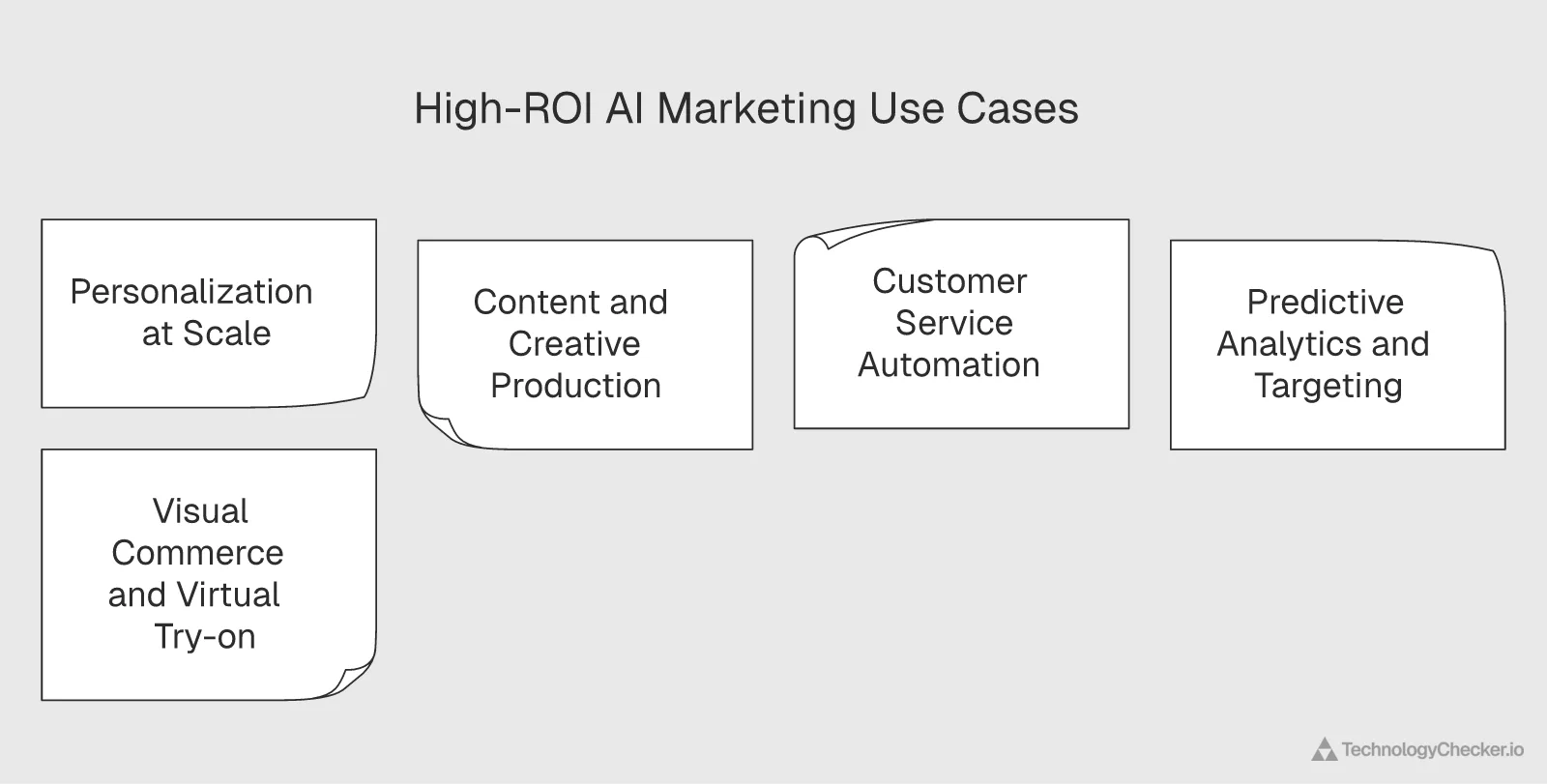
The five use cases where AI delivers measurable marketing ROI, each mapping to a proven adoption tactic above.
The pattern across these examples is consistent: the brands seeing measurable returns are not the ones generating the most content fastest. They are the ones embedding AI inside governed, repeatable workflows that protect brand voice and keep a human in the loop, exactly the discipline the trust and reliability data argues for.
What this means for marketers: Tie every AI pilot to one of these proven use cases and one metric (response time, conversion, content cycle time). The ROI case is strongest where AI compresses an existing workflow, not where it invents a new one.
What the data adds up to
Three patterns run through all 35 data points. First, adoption is no longer the story, integration is. A majority of marketers already use AI, generative AI is the top trend they are watching, and the open question has shifted from "should we use it" to "how deeply and where."
Second, the constraints are human and organizational, not just technical. Reliability and hallucinations lead the challenge lists, but data privacy, skills gaps, tool sprawl, authenticity, and job security all rank highly. The biggest barriers to getting more value from AI sit in budgets, training, and integration, not in the models themselves.
Third, the consumer trust gap is widening as deployment speeds up. Comfort fell 11 points in a year, only a quarter of consumers trust brands to use AI responsibly, and discomfort spikes wherever AI replaces a visibly human role. The marketers who win the next phase will be the ones who treat that gap as a design constraint, using AI where it earns trust, such as faster support and better targeting, and keeping humans visible where consumers expect them.
How AI search is changing who finds your marketing
AI assistants now crawl the web at a scale that rivals classic search, and that traffic is becoming the new top of the funnel. Across Q2 2026 (1 April–30 June), Googlebot led all measured bot requests at 27.49%, followed by ClaudeBot (13.87%), Meta-ExternalAgent (12.70%), and OpenAI's GPTBot (10.23%), according to Cloudflare Radar. Anthropic's crawler is now the #2 AI bot behind only Googlebot, having overtaken Meta-ExternalAgent this quarter. AI crawlers from Anthropic, OpenAI, and ByteDance now individually rival the traffic of Bing's crawler.

AI crawlers now decide which brands show up when buyers ask an assistant for recommendations.
| Crawler | Share of bot requests (Q2 2026, 1 Apr–30 Jun) |
|---|---|
| Googlebot | 27.49% |
| ClaudeBot | 13.87% |
| Meta-ExternalAgent | 12.70% |
| GPTBot | 10.23% |
| Bingbot | 8.11% |
| Bytespider | 7.91% |
| Applebot | 7.36% |
| Amazonbot | 5.08% |
Source: Cloudflare Radar, ai/bots/summary/user_agent + crawl_purpose, Q2 2026 (1 Apr–30 Jun), retrieved 3 Jul 2026.
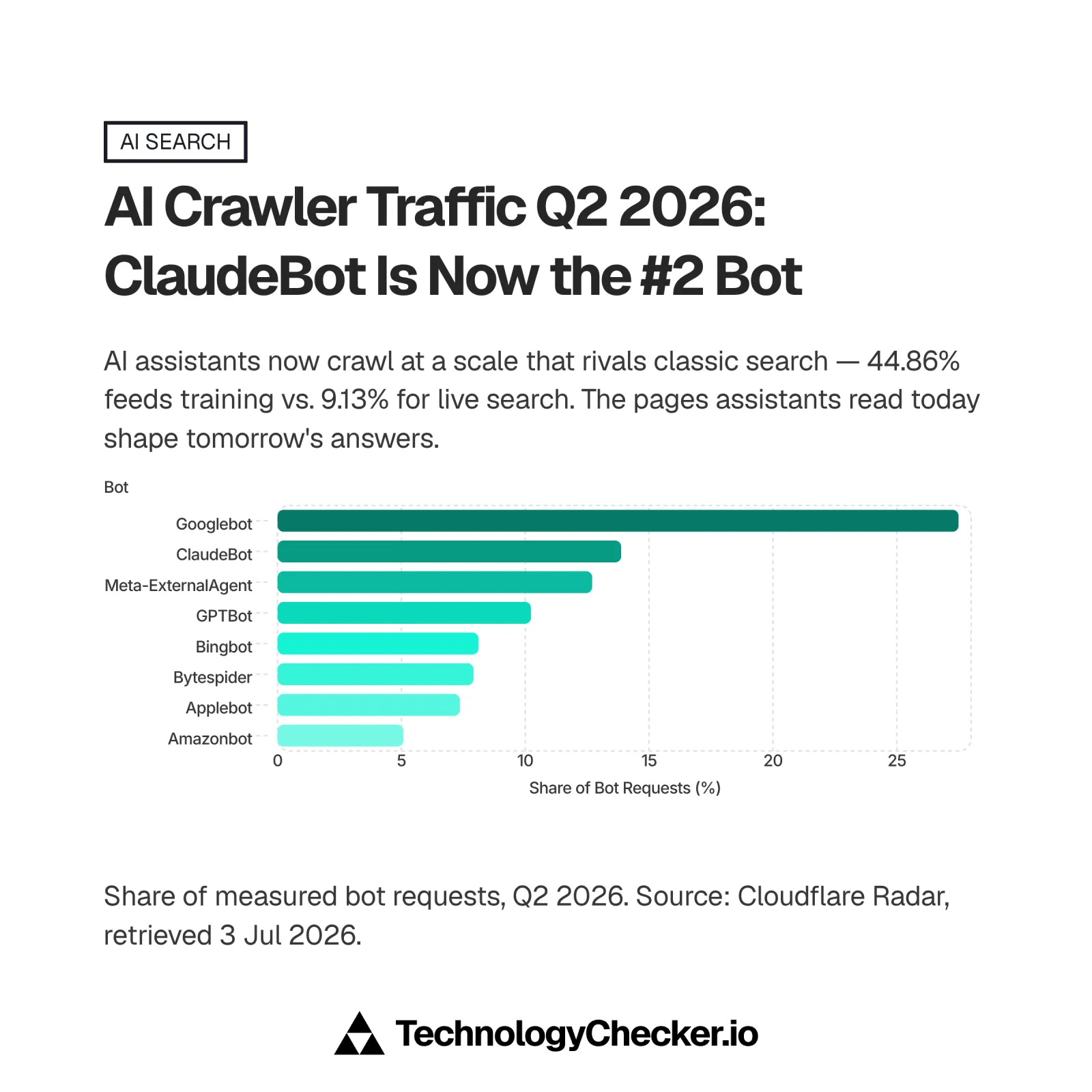
Most of that activity still feeds model training. Cloudflare classifies 44.86% of AI crawl requests as training, 42.96% as mixed purpose, and only 9.13% as search, so the majority of AI crawling is building the models that will later answer buyer questions, not indexing pages for a results list. That marks a shift from the prior reading, when training sat near 52% and mixed purpose near 35%: the two categories are now nearly level, though live search still accounts for under a tenth of AI crawl traffic. The web has started writing rules for these bots: GPTBot is still the user agent that the most domains name in robots.txt, ahead of ClaudeBot, Google-Extended, and CCBot, confirmed on the latest snapshot.
⚠️ Updated for Q3 2026: Cloudflare has since reclassified its crawl-purpose history, so Q2 2026 now reads 49.93% training, 42.96% mixed purpose and 4.05% search (not 44.86% and 9.13%). In Q3 2026 training was 47.62% and search 8.26%. See the Q3 2026 analysis near the top.
For marketing teams, the practical consequence is direct. If your robots.txt or CDN blocks GPTBot, ClaudeBot, or PerplexityBot, you remove your brand from the data these assistants draw on, and increasingly from the answers they generate. Getting cited in an AI answer now follows the same playbook that wins our own marketing technology statistics coverage: allow the citation crawlers, structure pages as clear question-and-answer passages, and keep your data fresh.
What this means for marketers: Treat AI crawler access as a marketing setting, not just an IT one. Audit robots.txt for accidental blocks of the search and citation bots, then structure your highest-intent pages so a model can lift a clean, sourced answer, because that is how brands surface in ChatGPT, Perplexity, and Google's AI results.
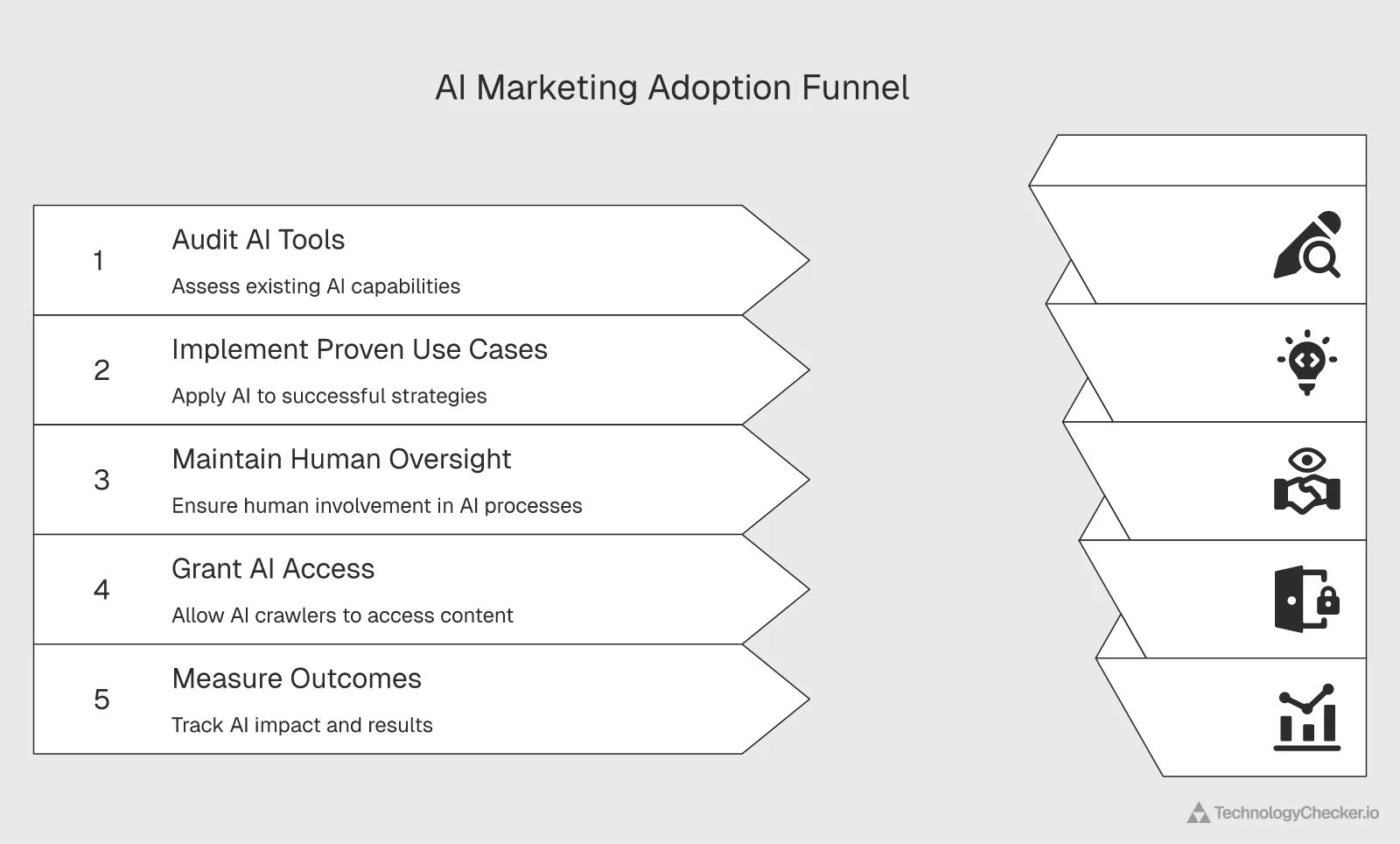
Put together, the data points to a clear sequence for the year ahead: start with the AI you already own, prove it on a known use case, keep a human in the loop, open access to the AI crawlers, then measure what gets cited.
Frequently asked questions
How many companies use AI for marketing in 2026? 86.4% of marketing teams use AI in at least a few marketing areas, and only 1.7% neither use it nor plan to (HubSpot 2026 State of Marketing, 1,500+ marketers). CMOs direct 15.3% of marketing budgets to AI, but only 30% say they are ready to scale it (Gartner 2026 CMO Spend Survey).
What percentage of advertising is AI? There is no measured share of all ads yet, only buyer expectations. In the IAB's 2025 Digital Video Ad Spend & Strategy report (15 July 2025), 86% of video ad buyers said they use or plan to use generative AI to build video creative, and buyers expected generative AI to produce 40% of video ads by 2026.
Why are AI use in marketing statistics important in 2026? They show where adoption, budgets, and consumer sentiment actually sit, rather than where the hype suggests. With 56% of marketers already running AI and the AI-in-marketing market heading past $107 billion by 2028, benchmarking against real numbers is how teams decide what to fund and what to skip.
What is the projected AI in marketing market size? The market for AI in marketing is forecast to grow from about $12.05 billion in 2020 to $107.54 billion by 2028 (figures from 2021 onward are forecasts based on The Insight Partners data). It sits inside a broader AI market projected to reach $1.675 trillion by 2031 (Statista Market Insights).
What are the latest AI in marketing adoption statistics? As of January 2025, 56% of marketers had integrated AI into data-driven work (17% extensively, 39% in select areas), per Ascend2. Among brands specifically, around 57% are already running generative AI in pilots or production (Econsultancy).
What are the most effective AI use cases for marketing? The leading tactics are content creation and enhancement (37%), email optimization (36%), and social media management and ad targeting (35%), per Ascend2. For B2B marketers, audience targeting (43%) and analytics and reporting (41%) are rated most effective (Act-On). Chatbots and personalization lead digital-experience use cases.
Which companies are successfully using AI for marketing? Brands across retail and ecommerce use AI for personalization, customer service automation, and visual commerce. Reported examples include L'Oréal's AI beauty diagnostics and virtual try-on and Nike's predictive personalization. The common thread is embedding AI in repeatable workflows rather than one-off content generation.
How is consumer comfort with AI marketing changing? It is falling. Consumer comfort with brands using AI dropped from 57% in Q3 2023 to 46% in Q3 2024, and only 26% of consumers trust brands generally to use AI responsibly (Qualtrics). Discomfort is highest where AI replaces a visibly human role, such as a virtual brand ambassador (51% uncomfortable).
What are the biggest risks of using AI in marketing? Marketers cite output reliability and hallucinations (35%), data privacy (41% as an adoption barrier), and integration with legacy systems (34%) as top organizational risks. On the people side, nearly 60% of marketers worry AI could impact their roles, up from 35.6% a year earlier.
How many websites actually run AI marketing tools? Fewer than the survey numbers imply. In our 1 October 2026 crawl, OpenAI integrations were live on 230,932 of the 29.9M live business domains we crawl. By comparison, HubSpot appeared on 602,953 and MailChimp on 547,029 in the September 2026 crawl. (Our July 2025 crawl had OpenAI on 41,764 domains, on a smaller crawl, so the two are not a growth rate.) The pattern suggests AI is reaching marketing mostly as features inside incumbent platforms rather than as new AI-only products.
Does AI search affect how brands get discovered? Yes. In Q3 2026, Meta-ExternalAgent (13.28%) and ClaudeBot (13.23%) were the largest AI crawlers after Googlebot (23.80%), and the share of AI crawling declared as search rose to 8.26%, from 1.32% a year earlier (Cloudflare Radar). Blocking those crawlers in robots.txt can remove a brand from the answers ChatGPT, Claude, and Perplexity generate, so AI crawler access is now a marketing concern.
About the author
Emre Elbeyoglu is a growth marketer and entrepreneur with 15 years in SEO and growth. He reverse-engineers how search engines and AI ranking systems decide what to surface, then applies those patterns to acquire customers and scale products, including his own bootstrapped SaaS startups. He writes about AI, GEO, and growth experiments at GrowthMarketing.ai and across TechnologyChecker.io.
Methodology and sources
All figures in this report are drawn from a Statista dossier, "Artificial intelligence (AI) use in marketing." Statista aggregates the underlying studies; each chart and table here credits the original primary source, including Ascend2, HubSpot, CB Insights, Appfigures, Attest, Capterra, Econsultancy, Influencer Marketing Hub, Klaviyo, Sitecore, Act-On, Mediaocean, NFX, WordPress VIP, the World Economic Forum, YouGov, and Qualtrics. Market-size and AI-in-marketing forecasts are modeled by Statista Market Insights and The Insight Partners. The ROI and use-cases section draws on additional external research from McKinsey, HubSpot, and published brand case studies, each linked inline.
Survey-based figures reflect different samples, dates, and geographies, ranging from a 312-respondent global marketer survey (Ascend2, January 2025) to a 23,730-respondent multi-market consumer study (Qualtrics, Q3 2024) and an 8,500-to-34,680-respondent 17-market advertising study (YouGov, January 2024). Percentages may not sum to 100 because of rounding or multi-select questions. The "AI technologies market by segment" table reports machine learning's labeled 2032 value; the remaining segments are ranked by projected size, since the source chart does not label them individually.
Two sections use first-party and live data rather than the dossier. Tool deployment counts come from the TechnologyChecker detection crawl (the tables in the deployment section use the July 2025 crawl; the "Live in September 2026" figures use the September and 1 October 2026 crawls), which records the technology signatures present in the public page source of active domains; counts are signature-level and re-verified on a recurring crawl. The AI crawler figures come from Cloudflare Radar (ai/bots and robots_txt datasets, Q2 2026 (1 Apr–30 Jun), retrieved 3 Jul 2026) and represent shares of aggregate request traffic, not absolute volumes. The Q3 2026 and monthly 2026 crawler tables were pulled on 1 October 2026. The 2026 survey figures come from HubSpot's 2026 State of Marketing and Gartner's 2026 CMO Spend Survey (11 May 2026).
Every visualization in this post is available in the TechnologyChecker interactive charts library. For related analysis, see our reports on AI market size statistics, AI adoption trends, marketing technology statistics, and social media advertising insights.
Update history
Added an answer section on how many companies use AI for marketing (HubSpot 2026, Gartner 2026), a Q3 2026 analysis of AI crawler shares and crawl purpose, a 2026 month-by-month crawler table, September 2026 detection counts with an industry panel, and two FAQ answers. Annotated the Q2 crawl-purpose figures, which Cloudflare has since reclassified.
Added Cloudflare Radar AI-crawler figures for Q2 2026 (1 April to 30 June). All earlier figures are preserved in the body above.

Growth & AI Advisor
15+ years of experience
Emre is a growth marketer, maker, and entrepreneur.
- Computer Technology & Information Systems, Bilkent University
- Co-founder & Growth Lead, Popupsmart (2019-2026)
- Co-founder, LiveChatAI (since 2023)
Never miss our research