Ecommerce Marketplace Market Share Q3 2026: Top Marketplaces Ranked
Q3 2026 Cloudflare Radar ranks: Amazon, Shopee and Shein held #1 for 14 months; Trendyol held Fast Fashion #2 all September; eBay contested #2.
Published •Updated •Data through September 2026•75 min read

Updated October 1, 2026 with Q3 2026 data. We re-pulled all three Cloudflare Radar ecommerce category rankings at the Q3 close (September 30, 2026), set them against the Q2 close (June 30, 2026) and the Q3 close a year earlier (September 30, 2025), and checked every September position on five dates (September 7, 14, 21, 28 and 30) before calling a move. Two things changed this quarter. Trendyol held Fast Fashion #2 on every September date we sampled, after holding it through August, which is the first time it has cleared this report's bar. And eBay reached General E-Commerce #2 above Shopee on two of the five September dates, the first time anything but Shopee has sat at #2 on a date we sampled this year. Amazon, Shopee and Shein each extended their category #1 streaks to fourteen months. Earlier editions are preserved in the update history at the end of this post.
What are the top 5 online marketplaces?
By Cloudflare Radar's worldwide traffic ranking in September 2026, the top five general online marketplaces are Amazon, Shopee, eBay, Temu and Taobao, excluding Shopify, which is a store platform rather than a marketplace. Amazon held #1 on every date we sampled. Places two to five traded between dates, so the table below gives each one a status. This is traffic rank, not sales.
| Rank (Sep 30, 2026) | Marketplace | September status (5 dates) |
|---|---|---|
| #1 | Amazon | Held: #1 on all five dates |
| #2 | Shopee | Contested: #2 on three dates, #3 on September 7 and 14 |
| #3 | eBay | Contested: #2 on September 7 and 14, #3 on the other three |
| #4 | Temu | Contested: #4 on two dates, #5 on three |
| #5 (#6 on Sep 30) | Taobao | Contested: #4 on three dates, #5 on one, #6 at the close |
Source: Cloudflare Radar, ranking/internet_services/top, serviceCategory=E-commerce, date=2026-09-07, 09-14, 09-21, 09-28 and 09-30, Shopify filtered out per this report's scope. Pulled 2026-10-01. Ordinal ranks only: the endpoint carries no traffic volume.
Q3 2026 analysis: Trendyol earns #2, and eBay contests Shopee
A method note first. Every comparison here is close to close: the Q3 2026 close (September 30, 2026) against the Q2 close (June 30, 2026) and the Q3 close a year earlier (September 30, 2025). We checked the year-ago end against a second date (September 28, 2025): the General top ten was identical on both, Low-Cost differed only at #10, and Fast Fashion's top three (Shein, Trendyol, H&M) matched while its tail reordered. So the year-over-year deltas for the leading positions don't rest on a single baseline date. The status column reports what September's five sample dates show.
General E-Commerce: Q3 2025 close → Q2 close → Q3 2026 close (excluding Shopify)
| Marketplace | Sep 30, 2025 | Jun 30, 2026 | Sep 30, 2026 | September status (5 dates) |
|---|---|---|---|---|
| Amazon | #1 | #1 | #1 | Held on all five |
| Shopee | #2 | #2 | #2 | Contested: #3 on Sep 7 and 14 |
| eBay | #6 | #3 | #3 | Contested: #2 on Sep 7 and 14 |
| Temu | #3 | #4 | #4 | Contested: #4 on two dates, #5 on three |
| Alibaba | #5 | #6 | #5 | Close-date only: #6 on the four other dates |
| Taobao | #4 | #5 | #6 | Contested: #4 on three dates, #5 on one |
| Shein | #7 | #9 | #7 | #7 on four dates, #8 on one |
| Walmart | out of top 10 | #7 | #8 | In on all five (#7 to #9) |
| Mercado Libre | #8 | #8 | #9 | #8 on one date, #9 on four |
| AliExpress | #9 | out | out | Out on all five |
Source: Cloudflare Radar, ranking/internet_services/top, serviceCategory=E-commerce, date=2025-09-28, 2025-09-30, 2026-06-30 and the five September 2026 dates. Shopify filtered out. Excluding Shopify the category returns nine marketplaces in its top ten. Pulled 2026-10-01.
Low-Cost E-Commerce: Q3 2025 close → Q2 close → Q3 2026 close
| Marketplace | Sep 30, 2025 | Jun 30, 2026 | Sep 30, 2026 | September status (5 dates) |
|---|---|---|---|---|
| Shopee | #1 | #1 | #1 | Held on all five |
| Temu | #2 | #2 | #2 | Held on all five |
| AliExpress | #3 | #3 | #3 | Held on all five |
| Allegro (PL) | #6 | #6 | #5 | #4 on four of five dates (#5 at the close only) |
| Tokopedia | #5 | #4 | #4 | #4 at the close only; #5 or #6 on the other four |
| DHgate | #4 | #5 | #6 | #5 or #6 on all five (it was #4 through August) |
| Tmall | #7 | #7 | #7 | #7 on four dates |
| Joom | out of top 10 | #8 | #8 | In on all five |
| Banggood | #10 | #9 | #9 | In on four dates |
| Takealot | #8 | #10 | #10 | In on all five |
Source: Cloudflare Radar, ranking/internet_services/top, serviceCategory=Low cost E-commerce, same dates as above. Wish (#9 on September 30, 2025) is outside every September 2026 top 10. Pulled 2026-10-01.
Fast Fashion: Q3 2025 close → Q2 close → Q3 2026 close
| Marketplace | Sep 30, 2025 | Jun 30, 2026 | Sep 30, 2026 | September status (5 dates) |
|---|---|---|---|---|
| Shein | #1 | #1 | #1 | Held on all five |
| Trendyol (TR) | #2 | #3 | #2 | #2 on all five |
| H&M | #3 | #2 | #3 | #3 on three dates, #4 on two |
| Zara | #4 | #5 | #4 | Close-date only: #5 on the four other dates |
| Asos | #5 | #4 | #5 | #4 to #6 |
| Falabella | #8 | #6 | #6 | #3 to #8: the widest swing in the table |
| Cotton:On | out of top 10 | out | #7 | In on four of five dates (#3 to #8) |
| Uniqlo | #6 | #7 | #8 | In on all five |
| Fashion Nova | out | #9 | #9 | In on all five |
| American Eagle | #9 | #8 | #10 | In on all five |
Source: Cloudflare Radar, ranking/internet_services/top, serviceCategory=Fast Fashion, same dates as above. Renner (BR) and Mango (#7 and #10 on September 30, 2025) are outside the September 2026 top 10; Boohoo appears at #10 on September 21 only. Pulled 2026-10-01.
I've watched Trendyol touch #2 and fall back three times this year, and each time this report called it a single-date reading. September is different: #2 on every date we sampled, after holding it on every August date too. Two months on every sampled date clears the bar we set, so I'm calling it a real move. One caution I'd keep in view: Trendyol was also #2 on both September 2025 dates we checked, then back at #3 for most of the first half of 2026. If it holds into December, it's structural. If it slips in the spring again, September is a seasonal peak, not a takeover.
eBay is the other name to watch, and for "Amazon vs eBay" searchers the order is settled: Amazon has been #1 on every date this year. What isn't settled is #2. eBay sat above Shopee on September 7 and 14, then fell back to #3 for the rest of the month. Two of five dates is a contest, not a hold, and I'd want a full month at #2 before saying eBay has passed Shopee. Temu has the opposite problem: it held #4 on every August date and only two of five in September, sharing the slot with Taobao.
Which earlier calls did Q3 settle?
- "Trendyol touches #2 every few weeks without holding it" (July, August): overturned. It held #2 on every August and September date we sampled.
- "Rank 4 in Fast Fashion changed on every date sampled" (August): still true in September, with Cotton:On now in the top ten on four of five dates rather than one.
- "DHgate passed Tokopedia for Low-Cost #4" (July, August): reversed. Allegro took #4 for most of September, and DHgate fell to #5-6.
- "Walmart flickers in and out at the #7-8 line" (Q2): Walmart was in the General top ten on all five September dates, its most consistent month in this report.
2026 month by month: the top four at each month-end
Every month-end close of 2026 in one table. These are single dates, so treat the rank-4 slots as readings, not holds; the status columns above say which positions held across September.
| Month-end (2026) | General #1 to #4 (excl. Shopify) | Low-Cost #1 to #4 | Fast Fashion #1 to #4 |
|---|---|---|---|
| Jan 31 | Amazon, Shopee, Temu, Taobao | Shopee, Temu, AliExpress, Tokopedia | Shein, H&M, Trendyol, Zara |
| Feb 28 | Amazon, Shopee, Temu, Alibaba | Shopee, Temu, AliExpress, Tokopedia | Shein, H&M, Trendyol, Falabella |
| Mar 31 | Amazon, Shopee, Temu, eBay | Shopee, Temu, AliExpress, Tokopedia | Shein, H&M, Falabella, Trendyol |
| Apr 30 | Amazon, Shopee, Temu, eBay | Shopee, Temu, AliExpress, Tokopedia | Shein, H&M, Trendyol, Asos |
| May 31 | Amazon, Shopee, eBay, Temu | Shopee, Temu, AliExpress, Allegro | Shein, H&M, Trendyol, Uniqlo |
| Jun 30 | Amazon, Shopee, eBay, Temu | Shopee, Temu, AliExpress, Tokopedia | Shein, H&M, Trendyol, Asos |
| Jul 31 | Amazon, Shopee, eBay, Temu | Shopee, Temu, AliExpress, DHgate | Shein, Trendyol, H&M, Asos |
| Aug 31 | Amazon, Shopee, eBay, Temu | Shopee, Temu, AliExpress, DHgate | Shein, Trendyol, H&M, Cotton:On |
| Sep 30 | Amazon, Shopee, eBay, Temu | Shopee, Temu, AliExpress, Tokopedia | Shein, Trendyol, H&M, Zara |
Source: Cloudflare Radar, ranking/internet_services/top, serviceCategory=E-commerce / Low cost E-commerce / Fast Fashion, date = last day of each month, January to September 2026. Pulled 2026-10-01. September is provisional.
Three patterns run the whole year. The #1 in every category never changed. eBay replaced Temu at General #3 between April and May and hasn't given it back at a month-end. And Fast Fashion's #2 flipped from H&M to Trendyol between June and July, which is what the five September dates now confirm.
Amazon held rank 1 every single day of Q1 2026. Walmart, the world's largest retailer by revenue, cracked the top 10 on only 11 days. Shopee and Shein are the only two marketplaces spanning multiple Cloudflare Radar ecommerce categories. Those are the findings we pulled when we analyzed 90 days of internet traffic rankings from January 1 to March 31, 2026.
 Q1 2026 traffic rankings across three Cloudflare Radar ecommerce categories.
Every three months, we pull Cloudflare Radar traffic rankings and map them against our own detection data at TechnologyChecker.io. This quarter we tracked three overlapping categories (E-Commerce, Low-Cost E-Commerce, Fast Fashion) to answer one question: which ecommerce marketplaces are actually winning consumer attention right now, and where?
A note on scope before we start. This report covers marketplaces: sites where multiple sellers transact with consumers on one domain (Amazon, Shopee, Temu, Shein, Mercado Libre, etc.). We're deliberately excluding ecommerce platforms like Shopify, BigCommerce, and WooCommerce. Their model is different. Shopify doesn't aggregate sellers on shopify.com. It powers 5.6M+ independent merchant stores running on their own custom domains. The merchant-platform picture is a separate lens on the same market, and we cover it in our Shopify analytics report. If you're after ecommerce platform market share (Shopify, WooCommerce, Wix and the rest), our ecommerce platform market share rankings cover it.
Ecommerce marketplace rankings at the July 2026 close, against the Q2 close and July 2025
A method note first, because it decides how you read everything below. July is one month, not a quarter. We haven't swapped a 31-day sample into the Q2 tables; the July tables sit alongside them. Every column is a named date: the July close (July 31, 2026), the Q2 close (June 30, 2026), and the same calendar date twelve months back (July 31, 2025). That last column is new, and it's the first like-for-like month against the same month comparison this report has run. The Q2 layer compared quarter-close to quarter-close, which answers a different question.
We also hardened how we test a move. A single date can land on a fluke, and this report has been caught by that twice already, on Trendyol and on Walmart. So for every position that differs between the July 31 close and the June 30 close, we re-pulled four intermediate July dates (July 7, 14, 21 and 28) and only call a shift real if it holds across most of them. Anything that shows up on July 31 alone is marked † and reported as a single-date reading, not as movement. Ten categories-by-dates of spot checks is what this section rests on, and where we didn't check, we say so.
General E-Commerce: July 2025 → Q2 close → July 2026 (excluding Shopify)
| Marketplace | Jul 31, 2025 | Jun 30, 2026 (Q2 close) | Jul 31, 2026 | Year over year |
|---|---|---|---|---|
| Amazon | #1 | #1 | #1 | Held, rank 1 on both July dates |
| Shopee | #2 | #2 | #2 | Held, all five July dates |
| eBay | #5 | #3 | #3 | ▲ up 2, and #3 on all five July dates |
| Temu | #3 | #4 | #4 | ▼ down 1, and #4 on all five July dates |
| Taobao | #4 | #5 | #5 | ▼ down 1 (rotates #5-6 with Alibaba) |
| Alibaba | #6 | #6 | #6 | Held (rotates #5-6 with Taobao) |
| Walmart | out of top 10 | #7 | #7 | ▲ entered, in on 4 of 5 July dates |
| AliExpress | #9 | out of top 10 | #8 | ▲ up 1, back in on 3 of 5 July dates |
| Mercado Libre | #8 | #8 | #9 | ▼ down 1, the only tail name in on all five |
| Shein | #7 | #9 | out of top 10 | ▼ out at the close, in on 3 of 5 July dates |
Source: Cloudflare Radar, ranking/internet_services/top, serviceCategory=E-commerce, date=2025-07-31, 2026-06-30 and 2026-07-31, with spot checks at date=2026-07-07, 07-14, 07-21 and 07-28. Shopify filtered out per this report's scope. Pulled 2026-08-01.
Fast Fashion: July 2025 → Q2 close → July 2026
| Marketplace | Jul 31, 2025 | Jun 30, 2026 (Q2 close) | Jul 31, 2026 | Year over year |
|---|---|---|---|---|
| Shein | #1 | #1 | #1 | Held, rank 1 on both July dates |
| Trendyol (TR) | #3 | #3 | #2 † | Close-date only; #3 on all four other July dates |
| H&M | #2 | #2 | #3 † | Close-date only; #2 on all four other July dates |
| Asos | #6 | #4 | #4 | ▲ up 2, and #4 on all five July dates |
| Fashion Nova | out of top 10 | #9 | #5 | ▲ entered, top 7 on all five July dates |
| Falabella | #10 | #6 | #6 | ▲ up 4 |
| Zara | #4 | #5 | #7 | ▼ down 3 |
| American Eagle | #8 | #8 | #8 | Held, #8 on all five July dates |
| Uniqlo | #5 | #7 | #9 | ▼ down 4, and #9 on all five July dates |
| Renner (BR) | #7 | out of top 10 | #10 | ▼ down 3, back in |
Source: Cloudflare Radar, ranking/internet_services/top, serviceCategory=Fast Fashion, date=2025-07-31, 2026-06-30 and 2026-07-31, with spot checks at date=2026-07-07, 07-14, 07-21 and 07-28. Urban Outfitters (#9 in July 2025) and Kiabi (#10 at the Q2 close) are outside the July 2026 top 10; Cotton:On took #10 on July 14 only. Pulled 2026-08-01.
Low-Cost E-Commerce: July 2025 → Q2 close → July 2026
| Marketplace | Jul 31, 2025 | Jun 30, 2026 (Q2 close) | Jul 31, 2026 | Year over year |
|---|---|---|---|---|
| Shopee | #1 | #1 | #1 | Held, rank 1 on both July dates |
| Temu | #2 | #2 | #2 | Held |
| AliExpress | #3 | #3 | #3 | Held |
| DHgate | #5 | #5 | #4 | ▲ up 1, and #4 on all three July dates checked |
| Tokopedia | #4 | #4 | #5 | ▼ down 1 |
| Allegro (PL) | #6 | #6 | #6 | Held |
| Tmall | #7 | #7 | #7 | Held |
| Takealot | #8 | #10 | #8 | Held |
| Joom | out of top 10 | #8 | #9 | ▲ entered, took the slot Wish held |
| Banggood | #10 | #9 | #10 | Held |
Source: Cloudflare Radar, ranking/internet_services/top, serviceCategory=Low cost E-commerce, date=2025-07-31, 2026-06-30 and 2026-07-31, with spot checks at date=2026-07-14 and 07-28. Wish (#9 in July 2025) sits outside the July 31, 2026 top 10 but reappeared at #9 on July 28. We sampled two intermediate July dates here rather than four, because only two positions differed from the Q2 close. Pulled 2026-08-01.
Read that Low-Cost table twice. Eight of its ten slots hold the same occupant on July 31, 2025 and July 31, 2026, and the top seven names sit in the identical order on both dates a full year apart. Two things changed in twelve months: DHgate passed Tokopedia for #4, and Joom took the slot Wish used to hold. That is the most static ranking anywhere in this dataset, and it's now static across a year rather than across a quarter.
Correction: Shopee did not take the Low-Cost #1 from Temu
Last month we reported that Shopee took the Low-Cost #1 outright from Temu over the year. The basis was Temu at #1 on June 30, 2025 and Shopee at #1 on June 30, 2026. The July data says that comparison was reading a baseline artifact, not a handover.
On July 31, 2025, Shopee was already #1 in Low-Cost and Temu already #2, which is exactly where they sit on July 31, 2026. Move the 2025 baseline forward by one month and the handover disappears. Temu's spell at #1 around the June 2025 quarter close was short, and our year-over-year layer happened to anchor on it. The honest read is that Shopee has held Low-Cost #1 and Temu #2 for at least a full year, which is a duller finding and a truer one.
That same baseline problem shrinks a second number. We reported Temu sliding from #2 to #4 in General E-Commerce over the year, a two-place fall. On the July basis Temu was #3 in July 2025 and #4 in July 2026: down one, not two. eBay's climb, by contrast, reads identically off both baselines (#5 in June 2025, #5 in July 2025, #3 on both 2026 dates), and that's what separates a durable move from a fragile one.
The lesson here is the one this report keeps relearning, now pointed at itself. We've spent two editions warning that a single-date reading can be a fluke. A single-date baseline is the same risk running backwards, and it's easier to miss, because a baseline looks settled just by being in the past. From this edition on we check both ends of a year-over-year claim against a second date before we publish the delta.
The Q2 cliffhanger, answered: eBay held #3 all month
"If eBay holds #3 into July, that's a structural reordering, not a blip." That was the call left open on June 1 and carried into the Q2 close. July answers it cleanly.
eBay sat at #3 in General E-Commerce (excluding Shopify) on July 7, 14, 21, 28 and 31. Every date we sampled. The excluding-Shopify top four, Amazon then Shopee then eBay then Temu, is identical on all five. For the first time in this report's life the General top three isn't Amazon-Shopee-Temu, and it stayed that way for a full month rather than a single snapshot. Grade: hit.
The Trendyol #2 that isn't (†)
The July 31 snapshot shows Trendyol at #2 in Fast Fashion, ahead of H&M. We're not publishing that as a takeover, and neither should anyone quoting this page.
The four intermediate July dates are why. On July 7, 14, 21 and 28, H&M holds #2 and Trendyol #3, all four times. So July 31 is the third single-date Trendyol #2 this report has caught, after the late-March and early-May touches, and by now the pattern is legible: Trendyol reaches #2 every few weeks and doesn't stay. Its structural position is #3 in July 2025, #3 at the Q2 close, and #3 on four of five July 2026 dates. If we'd pulled only the close, we'd have published a takeover for the third time and retracted it for the third time.
Uniqlo is the Fast Fashion mover July actually found, running the other way from the one we asked about. The June layer below wondered whether Uniqlo's jump to #4 was real. It wasn't: Uniqlo was #7 at the Q2 close and #9 on all five July dates, down from #5 in July 2025. That question is settled, and the answer is a four-place fall in a year. The name that did consolidate a top-5 slot is Asos, at #4 on all five July dates, up from #6 a year ago.
AliExpress is back, and Shein is trading places with it
One Q2 line needs correcting. We wrote that AliExpress "fell out of the General top 10 entirely" over the year. In July it's back: #9 on July 7 (excluding Shopify), #8 on July 28, and #8 at the July 31 close, present on three of the five dates we sampled.
Shein runs the opposite pattern across the same month, out on July 7 and on July 31, in at #9, #7 and #7 on the three dates between. What's happening at the bottom of the General top 10 isn't an exit, it's a rotation: AliExpress and Shein trade the last slot date to date, Walmart holds a place on four of the five dates, and Mercado Libre is the only one of the four in on all five. "AliExpress is gone" was too clean a reading of one date, and July shows why the tail of this table needs several dates before anyone calls a name out.
What survives July, and what doesn't
Three claims from the Q2 edition survive both baselines and every July date we checked:
- Amazon (General), Shopee (Low-Cost) and Shein (Fast Fashion) each hold rank 1 in their category on July 31, 2025 and July 31, 2026. Rank 1 in all three categories has now held across a quarter-close pair and a month pair, twelve months apart either way.
- eBay climbed from #5 to #3 in General E-Commerce and held #3 on all five July dates.
- Low-Cost is the most static ranking in the dataset, with an identical top seven a year apart.
One doesn't: Shopee taking the Low-Cost #1 from Temu, which was a baseline artifact. And one is narrower than we wrote it: Temu's General slide is one place on the July basis, not two.
Ecommerce marketplace rankings at the Q2 2026 close (June 30), with year-over-year shifts
Q2 2026 closed on June 30. We re-pulled Cloudflare Radar's Internet Services rankings for all three ecommerce categories on that exact date, then pulled the same three categories for June 30, 2025 so we could set a clean one-year comparison beside them. This is the first year-over-year layer in this report, and it answers a question a single quarter can't: which moves are structural, and which were the week-to-week noise we keep warning about?
One honesty note on method, the same one we repeat every quarter. These are point-in-time snapshots at each quarter's close, not 90-day averages. A curated category rank (Amazon, Shopee, Shein and the rest) is far steadier day to day than a raw domain rank in the #20-100 band, so a snapshot comparison is trustworthy at the top and noisier toward the tail. Where the weekly series tells us a position held all quarter, we say so; where a single date could be a fluke, we flag it. As always, the ranks below exclude Shopify from the General category per this report's scope (Shopify is a platform, not a marketplace; see the methodology). Every figure comes from a dated radar.sh pull on July 2, 2026.
General E-Commerce: Q2 2025 → Q2 2026 (excluding Shopify)
| Marketplace | Q2 2025 (Jun 30) | Q2 2026 (Jun 30) | Year-over-year |
|---|---|---|---|
| Amazon | #1 | #1 | Held, rank 1 on both dates |
| Shopee | #3 | #2 | ▲ up 1 |
| eBay | #5 | #3 | ▲ up 2, the year's cleanest climb |
| Temu | #2 | #4 | ▼ down 2 |
| Taobao | #4 | #5 | ▼ down 1 |
| Alibaba | #6 | #6 | Held |
| Walmart | out of top 10 | #7 | ▲ entered |
| Mercado Libre | #8 | #8 | Held |
| Shein | #7 | #9 | ▼ down 2 |
| AliExpress | #9 | out of top 10 | ▼ exited |
Source: Cloudflare Radar Internet Services ranking, serviceCategory=E-commerce, date=2025-06-30 and date=2026-06-30, Shopify filtered out per scope. Pulled 2026-07-02.
Fast Fashion: Q2 2025 → Q2 2026
| Marketplace | Q2 2025 (Jun 30) | Q2 2026 (Jun 30) | Year-over-year |
|---|---|---|---|
| Shein | #1 | #1 | Held, rank 1 on both dates |
| H&M | #2 | #2 | Held |
| Trendyol | #3 | #3 | Held, same slot a full year later |
| Asos | #6 | #4 | ▲ up 2 |
| Zara | #4 | #5 | ▼ down 1 |
| Falabella | #8 | #6 | ▲ up 2 |
| Uniqlo | #7 | #7 | Held (its June #4 spike reverted) |
| American Eagle | #10 | #8 | ▲ up 2 |
| Fashion Nova | out of top 10 | #9 | ▲ entered |
| Kiabi | out of top 10 | #10 | ▲ entered |
Source: Cloudflare Radar Internet Services ranking, serviceCategory=Fast Fashion, date=2025-06-30 and date=2026-06-30. Renner (BR) and Mango dropped out of the top 10 over the year. Pulled 2026-07-02.
Low-Cost E-Commerce: Q2 2025 → Q2 2026
| Marketplace | Q2 2025 (Jun 30) | Q2 2026 (Jun 30) | Year-over-year |
|---|---|---|---|
| Shopee | #2 | #1 | ▲ took the #1 from Temu ⚠️ |
| Temu | #1 | #2 | ▼ down 1 ⚠️ |
| AliExpress | #3 | #3 | Held |
| Tokopedia | #4 | #4 | Held |
| DHgate | #5 | #5 | Held |
| Allegro (PL) | #7 | #6 | ▲ up 1 |
| Tmall | #6 | #7 | ▼ down 1 |
| Joom | out of top 10 | #8 | ▲ entered |
| Banggood | #9 | #9 | Held |
| Takealot | #8 | #10 | ▼ down 2 |
Source: Cloudflare Radar Internet Services ranking, serviceCategory=Low cost E-commerce, date=2025-06-30 and date=2026-06-30. Wish dropped out of the top 10 over the year. Pulled 2026-07-02.
⚠️ The two rows marked above are superseded by the August update; preserved as originally published. Shopee was already #1 and Temu #2 on July 31, 2025, so the June 30, 2025 baseline caught a brief Temu spell at the top rather than a handover.
The year's two cleanest swaps
Two position swaps survive the "structural or noise?" test, because the weekly series backs both.
eBay and Temu traded places in General E-Commerce. A year ago Temu sat at #2 (excluding Shopify) and eBay at #5. By June 30, 2026 that had inverted: eBay #3, Temu #4. This isn't a one-week reading. eBay held #4 in Cloudflare's raw weekly series (which counts Shopify) for eight of the last twelve weeks of the quarter, which is #3 on our excl-Shopify basis. The eBay climb we first flagged in the June 1 update turns out to be a full-year trend, not a spring blip. eBay is the structural beneficiary every time Mercado Libre or AliExpress wobbles, and over twelve months that adds up.
Shopee took the Low-Cost crown from Temu. In Q2 2025 Temu was the #1 low-cost marketplace and Shopee #2. A year later they've swapped: Shopee #1, Temu #2. And this one is rock-solid: Shopee held #1 and Temu held #2 in every single week of Q2 2026. The #3-#5 spine beneath them (AliExpress, Tokopedia, DHgate) didn't move at all year over year. Low-Cost stays the most stable category in the dataset; the only thing that changed at the top is which of the two giants sits first. ⚠️ Superseded by the August update above; preserved as originally published. There was no swap: Shopee was #1 and Temu #2 on July 31, 2025 as well. The closing sentence is the part that held up, and July strengthened it.
The anchors that didn't move, for a full year
The single most striking thing in the year-over-year data is how little the tops moved. Amazon, Shopee, and Shein each held rank 1 in their category on both June 30, 2025 and June 30, 2026, twelve months apart, zero change. We already knew they held rank 1 across the 23 weeks of 2026; now we know they held it across the year.
Fast Fashion goes further: its entire top 3, Shein, H&M and Trendyol, is identical on both dates. That's worth pausing on, because it retroactively settles an argument this very report had with itself. In the May update we briefly floated that Trendyol had overtaken H&M for #2; in June we corrected that to "H&M holds #2, Trendyol is honestly #3." The year-over-year data is the final word: Trendyol was #3 in Fast Fashion in June 2025 and it's #3 in June 2026. Its #2 touches are real but they're spikes, and the structural position has been #3 for a solid year. (Our own crawlers keep detecting Trendyol-affiliated merchant infrastructure across the Middle East and Eastern Europe, which is why it sits that high. But "rising and real at #3" is a very different claim from "overtook H&M," and only the first survives twelve months of data.)
Net-new this quarter: who entered and exited each top 10 over the year
The stable tops hide real churn beneath them. Six marketplaces moved in or out of the three category top 10s between June 2025 and June 2026, the clearest single view of who's gaining and who's fading.
| Category | Entered the top 10 (2025 → 2026) | Exited the top 10 |
|---|---|---|
| General E-Commerce | Walmart (to #7, excl. Shopify) | AliExpress (was #9) |
| Fast Fashion | Kiabi, Fashion Nova | Mango, Renner (BR) |
| Low-Cost E-Commerce | Joom | Wish |
Source: set difference of the Cloudflare Radar Internet Services top-10s at date=2025-06-30 vs date=2026-06-30 for each category. Pulled 2026-07-02.
Three of these carry a story. AliExpress fell out of the General top 10 entirely over the year while holding #3 in Low-Cost, so its traffic is consolidating into the discount lane, not the general one. ⚠️ "Entirely" is superseded by the August update above; preserved as originally published. AliExpress is back in the General top 10 on three of five July dates. Wish dropped out of Low-Cost, continuing its long slide, and Joom took the slot: the budget cross-border small-parcel niche found a new occupant. ⚠️ Wish reappeared at #9 on July 28, 2026, a single date; Joom holds the slot on the other July dates we checked. And in Fast Fashion, France's Kiabi is the genuinely new name, edging in at #10 as Mango and Brazil's Renner dropped off.
We also checked Cloudflare's fastest-rising domains (rankingType=trending_rise) for a net-new mover in the ecommerce category. Globally the standout is netshoes.com.br, the Brazilian sportswear marketplace, up about +46.5% in rank over the trailing window, the single fastest-climbing ecommerce-classified domain on the list. The rest of the trending-domain feed is dominated by non-marketplace sites, so we're reporting the one clean marketplace signal rather than dressing up the noise.
Walmart clawed back into the top 10 by the close
One June 1 call needs an update. In the June layer below we reported Walmart as having dropped out of the General top 10 again after its April cameo. By the June 30 close, Walmart was back at #8 (raw, or #7 excluding Shopify): a late-Q2 re-entry. One honest limit: Cloudflare's weekly Internet Services series only resolves the top five services, so we can't pin the exact week Walmart re-crossed the line. We're reporting its position on the close-of-quarter snapshot, not a demonstrated sustained run. The "revenue giant, thin traffic" paradox still holds (Walmart at #7-8 is exactly the fragile top-10 grip the whole report describes), but "out again" was the June 1 read, and "back at the close" is the June 30 one.
Regional picture at the Q2 close (June 30)
We also re-pulled the seven-market domain rankings on June 30 (the detailed June 1 breakdowns are preserved further down). The headline: Amazon eased back a few places in most markets from its June 1 highs, while regional champions clawed back. In Brazil, Amazon still out-ranks Shopee (amazon.com #38 vs shopee.com.br #61), so the June 1 reversal held, but Shopee narrowed the gap. Indonesia stayed a Shopee stronghold (shopee.co.id #21, shopeemobile.com #41), and Amazon's brief #94 cameo there was gone by the close. Mexico strengthened for Amazon (amazon.com.mx jumped to #17). Turkey saw Trendyol climb ten places in its home top-100 (trendyol.com #82, up from #92) yet still trail amazon.com at #66, the category-rank-versus-domain-traffic gap in miniature, exactly as before. And India's quick-commerce wave intensified: grofers.com (#21), Swiggy (#40), Blinkit (#49, up from #66) and Zepto (now two domains) all climbed, with Flipkart still measured off Cloudflare's network.
How have ecommerce marketplace rankings changed from Q1 2026 to June 2026?
The section above carries the Q2 close (June 30) and the year-over-year layer. What follows is the earlier June 1 update, preserved unchanged as part of the longitudinal record.
We re-pulled Cloudflare Radar's Internet Services rankings across all three categories on June 1, 2026, and this time we also pulled the full weekly rank series back to January. The weekly view changes the story. Two of the moves we flagged in the May update turned out to be one-week blips, and the June data caught them reverting.
The headline reversals: H&M reclaimed the Fast Fashion #2 slot from Trendyol, Walmart dropped out of the General E-Commerce top 10 again after a one-month April cameo, and eBay climbed to #3 (excluding Shopify) — now ahead of Temu. The forever-#1s never moved. Amazon, Shopee, and Shein each held rank 1 in their category for all 23 weeks we tracked. Everything else churned underneath them.
After a decade reading traffic patterns — first on the Bing search team, then on Microsoft's AI team, now here — the lesson June drove home is one I keep relearning: a single-day snapshot can land on a fluke. When we pulled the weekly series, Trendyol had touched #2 in Fast Fashion on exactly two of 22 weeks, and our May 1 snapshot happened to land on one of them. H&M owned that #2 spot the other 20 weeks. I'm not embarrassed by that — it's why we re-pull and publish the trajectory instead of a single date. But it's a sharp reminder that "Trendyol overtakes H&M" was never the structural read; the structural read is "H&M holds #2 and Trendyol pushes it twice a quarter." (Our own crawlers have been detecting Trendyol-affiliated merchant infrastructure across Eastern Europe and the Middle East since late 2025, which is why the two #2 touches didn't surprise me — but two weeks isn't a takeover.) Updated June 1, 2026.
General E-Commerce: Q1 → May 1 → June 1 (excluding Shopify)
Ranks below exclude Shopify per the post's scope. The June 1 column is the live snapshot; the trend reads against the full weekly series.
| Marketplace | Q1 2026 | May 1, 2026 | June 1, 2026 | Trend |
|---|---|---|---|---|
| Amazon | #1 (all 90 days) | #1 | #1 | Untouched (23/23 weeks) |
| Shopee | #2-3 | #2 | #2 | Held |
| eBay | #5-7 | #4 | #3 | Climbed again, now past Temu |
| Temu | #3-4 | #3 | #4 | Slipped |
| Taobao | #4-7 | #5 | #5 | Held |
| Alibaba | #5-7 | #6 | #6 | Held |
| AliExpress | #8-10 | out | #7 | Re-entered |
| Shein | #8-10 | #8 | #8 | Held |
| Mercado Libre | #8-10 | out | #9 | Re-entered |
| Walmart | #9-10 (11/90 days) | #9 | dropped out | Out again after April cameo |
| 58.com | not ranked | #7 | dropped out | Flickered in, gone by June |
Low-Cost E-Commerce: Q1 → May 1 → June 1
| Marketplace | Q1 2026 | May 1, 2026 | June 1, 2026 | Trend |
|---|---|---|---|---|
| Shopee | #1 (all 90 days) | #1 | #1 | Untouched (23/23 weeks) |
| Temu | #2 (all 90 days) | #2 | #2 | Untouched (23/23 weeks) |
| AliExpress | #3 (all 90 days) | #3 | #3 | Untouched (23/23 weeks) |
| Allegro (PL) | #5-6 | #6 | #4 | Bounced back above DHgate |
| Tokopedia | #4-5 | #4 | #5 | Slipped |
| DHgate | #5-6 | #5 | #6 | Slipped — May "lock-in" didn't hold |
| Tmall | #7-9 | #7 | #7 | Held |
| Banggood | #9-10 | #9 | #8 | Rose |
| Takealot | #7-9 | #10 | #9 | Recovered slightly |
| Joom | #8-10 | #8 | #10 | Slipped |
Fast Fashion: Q1 → May 1 → June 1
| Marketplace | Q1 2026 | May 1, 2026 | June 1, 2026 | Trend |
|---|---|---|---|---|
| Shein | #1 (all 90 days) | #1 | #1 | Untouched (23/23 weeks) |
| H&M | #2-3 | #3 | #2 | Reclaimed #2 (held it 20 of 22 weeks) |
| Trendyol (TR) | #2-4 | #2 | #3 | Slipped back — #2 was a 2-week spike |
| Uniqlo | #4-10 | #9 | #4 | Surged into the top 5 |
| Asos | #4-7 | #4 | #5 | Slipped one |
| Zara | #4-8 (volatile) | #5 | #6 | Slipped one |
| Falabella | #3-9 (volatile) | #8 | #7 | Rose |
| American Eagle | #5-10 | #7 | #8 | Slipped |
| Fashion Nova | not ranked Q1 | #6 | #9 | Held top 10 five straight weeks, cooled off |
| Renner (BR) | #7-10 | #10 | #10 | Held the floor |
The Fast Fashion table is the clearest case for tracking the weekly trajectory rather than a single date. Here's how the contested top of that category actually moved across all 22 weeks of 2026 so far. Lower is better — rank 1 is the top of the category.
H&M Owns Fast Fashion's #2 Slot — Trendyol Only Touched It Twice
Cloudflare Radar's Internet Services timeseries gives a weekly rank per service. Read across 22 weeks of 2026, the Fast Fashion category has one immovable leader and one genuine mover. Shein held #1 every single week. H&M held #2 for 20 of 22 weeks; Trendyol pushed it down to #3 on exactly two weeks (late March and early May), then fell back. A single-day snapshot taken in early May would catch one of those two Trendyol weeks and misread it as a takeover — which is exactly what happened in this report's May update, and why the June refresh leans on the weekly series. The real Q2 story is Uniqlo, whose line walks down from the #7-9 band into #4 by June 1.
Source: Cloudflare Radar Internet Services timeseries · January 5, 2026 – June 1, 2026
| Week (2026) | Weekly category rank (1 = top) |
|---|---|
| Jan 5 | #1 |
| Jan 12 | #1 |
| Jan 19 | #1 |
| Jan 26 | #1 |
| Feb 2 | #1 |
| Feb 9 | #1 |
| Feb 16 | #1 |
| Feb 23 | #1 |
| Mar 2 | #1 |
| Mar 9 | #1 |
| Mar 16 | #1 |
| Mar 23 | #1 |
| Mar 30 | #1 |
| Apr 6 | #1 |
| Apr 13 | #1 |
| Apr 20 | #1 |
| Apr 27 | #1 |
| May 4 | #1 |
| May 11 | #1 |
| May 18 | #1 |
| May 25 | #1 |
| Jun 1 | #1 |
- Shein held Fast Fashion #1 every week of 2026 — zero variance across the series
- H&M owned the #2 slot for 20 of 22 weeks; Trendyol touched it only twice (late March and early May)
- The May 1 snapshot landed on one of Trendyol's two #2 weeks — the weekly series corrects the read
- Uniqlo is the genuine mover, walking from the #7-9 band down into #4 by June 1
Shein is the flat line along the bottom: #1 every week. H&M and Trendyol weave between #2 and #3, and you can see the two narrow weeks (late March and early May) when Trendyol's line dips below H&M's. Uniqlo is the mover — its line walks down from the #7-9 band into #4 by June. That climb is the genuine Q2 story in Fast Fashion, not the Trendyol-vs-H&M swap.
Which calls did June resolve, reverse, or confirm?
1. Walmart's April top-10 run was a cameo, and June confirmed it. The weekly series is unambiguous: Walmart was absent from the General E-Commerce top 10 every week of Q1 except one, then present every week from March 30 to April 27 (peaking at #8), then absent every week from May 4 through June 1. Our May 1 snapshot caught the tail end of that April bump at #9; the clean weekly view shows the bump was over by early May. So the Q1 headline — "Walmart barely makes top 10" — was the structural read all along. The April surge was the anomaly, not the Q1 absence. As I keep telling our analysts: when a 90-day pattern and a one-month pattern disagree, bet on the 90-day pattern.
2. Trendyol did not take #2 in Fast Fashion — H&M reclaimed it. Over the 22 weeks of 2026, Trendyol held #2 for exactly two weeks (the late-March and early-May spikes), and H&M held it for the other 20. By June 1, H&M is back at #2 and Trendyol at #3. The "European fast-fashion balance has permanently shifted to Turkey" thesis we floated in May does not survive the data. Trendyol is a real and rising marketplace, but #3 is its honest position, not #2. (For the full Turkish ecommerce picture, see our Turkey e-commerce statistics 2026 — the market hit 4.57 trillion TL in 2025.)
3. The DHgate "lock-in" reversed — Allegro bounced back. In May we called DHgate "locked in" at Low-Cost #5 and read it as cross-border wholesale beating single-country marketplaces. June reversed that. Allegro, Poland's domestic champion, climbed to #4 — ahead of both Tokopedia (#5) and DHgate (#6). Across the weekly series, Allegro and DHgate trade the #4-6 band repeatedly; neither has locked anything. The single-country-vs-cross-border framing was too clean for what's really a noisy three-way rotation.
The genuine new mover: eBay. Quietly, eBay has climbed from a Q1 #5-7 rotation to #3 (excluding Shopify) on June 1, passing Temu. It's been at #4-5 since late March and took #4 in the weekly series the last two weeks of May. eBay is the structural beneficiary every time Mercado Libre or AliExpress wobbles out of the General top 10, and it's the one mid-table move in this category that looks durable rather than seasonal.
Which patterns held all the way through June?
The top of every category is immovable. Amazon (General), Shopee (Low-Cost), and Shein (Fast Fashion) each held rank 1 for all 23 weekly snapshots — zero variance across five months. The Low-Cost top 3 (Shopee, Temu, AliExpress) is even more locked: all three held #1, #2, and #3 respectively every single week, the most stable ranking anywhere in the dataset.
The cross-category club is still a club of two. Shopee (top 2 in both General and Low-Cost) and Shein (#1 in Fast Fashion, #8 in General) remain the only marketplaces spanning more than one Cloudflare Radar category. No new entrant joined them between Q1 and June.
What we're watching for the rest of Q2 2026
Can eBay hold #3, or close on Shopee? eBay passing Temu is the first time in our dataset that the General top 3 (excluding Shopify) isn't Amazon-Shopee-Temu. If eBay holds #3 into July, that's a structural reordering, not a blip.
Was Uniqlo's jump to #4 real? Uniqlo also touched #4 once back in late March, then fell back to #7-8. Its June #4 could be the same kind of spike, or the start of a genuine APAC-driven climb. One more month at #4-5 settles it.
Does Brazil's domain-rank flip stick? As of the June 1 snapshot, Amazon now out-ranks both Shopee domains in Brazil's top-100 (more on this in the regional section). That reverses one of this report's original headline findings, but single-day domain rankings are volatile. We want a second clean snapshot before calling it a real handover.
Two of these three were answered by the July data. eBay held #3 on all five July dates, and Uniqlo's #4 was a spike (it sits at #9 through July). Both are graded in the August section above. The Brazil question was not re-pulled this month; the last reading remains the June 30 close.
What you'll learn in this report:
- The July 2026 close (July 31) rankings for all three categories, against the Q2 close and against July 31, 2025, plus the correction that year-over-year layer forced on us
- The Q2 2026 close (June 30) rankings for all three categories, with a full year-over-year comparison against June 30, 2025, and which moves are structural versus noise
- Complete Q1 2026 rankings for General E-Commerce, Low-Cost E-Commerce, and Fast Fashion marketplaces, plus the June 1 update layer
- The weekly rank trajectory of Fast Fashion's contested top 5 (with an interactive chart)
- Which marketplaces appeared in multiple categories, and what that signals
- Why we excluded Shopify and other commerce platforms from the marketplace rankings
- Regional dominance patterns across seven markets: US, Indonesia, Brazil, Germany, and new for June — Turkey, Mexico, and India
- The Walmart paradox: revenue leader, traffic laggard — and why its April top-10 run didn't last
- Q2 2026 predictions, an interim June grade, and what to watch next
Why this report is different
Let me be direct. This isn't a rehash of press-release market size figures. I'm Mehmet Suleyman, CEO and co-founder of TechnologyChecker.io. Before this company, I spent years at Microsoft. First on the Bing search team, then on the AI team. I worked on web crawling infrastructure, ranking systems, and large-scale traffic analysis. I built detection systems that now cover 40,000+ technologies across 29.9 million active domains. I read traffic patterns for a living.
I've been watching the ecommerce marketplace space for over a decade, and three things from the Q1 2026 data genuinely surprised me.
First, Shopee's appearance in Indonesia's top 100 twice. I've seen regional marketplaces dominate home markets before, but shopee.co.id at #21 and shopeemobile.com at #41 in the same country's rankings is a pattern I hadn't observed at this intensity before.
Second, Walmart's absence from most days' top 10. Our detection systems have tracked Walmart's Shopify Plus-adjacent B2B initiatives for months. The gap between their offline revenue muscle and their raw traffic signature is wider than any executive deck I've seen acknowledges.
Third, Trendyol at #3 in Fast Fashion. This one doesn't show up in Western commerce press at all, but our crawlers have been detecting Trendyol-affiliated merchant sites across the Middle East and Eastern Europe at rates that now make sense given the traffic data.
The data in this report comes from two sources: Cloudflare Radar's Internet Services API (the traffic rankings you'll see) and our own crawl infrastructure (context on which technologies these marketplaces run on). When I make a claim, it's either a direct pull from a named API or something our own systems detected. Not an analyst survey. Not a press release. Not an AI-generated figure.
Executive summary: the Q1 2026 marketplace rankings at a glance
Here's the consolidated picture across all three Cloudflare Radar ecommerce categories, based on daily rankings aggregated from January 1 to March 31, 2026.
General E-Commerce, marketplaces top 10 (Q1 2026)
| Rank | Marketplace | Q1 Rank Range | Notes |
|---|---|---|---|
| 1 | Amazon | 1 (all 90 days) | Uncontested global leader |
| 2 | Shopee | 2–3 | Also #1 in Low-Cost category |
| 3 | Temu | 3–4 | Stable position |
| 4 | eBay | 5–7 | Gradual March rise |
| 5 | Alibaba | 5–7 | Traffic concentrated in APAC |
| 6 | Taobao | 4–7 | Slid from #5 to #7 in March |
| 7 | Walmart | 9–10 (11 days only) | Absent from top 10 for most of Q1 |
| 8 | Shein | 8–10 | Also #1 in Fast Fashion category |
| 9 | Mercado Libre | 8–10 | Fell out of top 10 on 5 days in Jan–Feb |
| 10 | AliExpress | 8–10 | Rotates with Mercado Libre for #9–10 |
Excluded from this marketplace ranking: Cloudflare Radar technically places Shopify inside its E-Commerce category (#2 by traffic to shopify.com). We've removed it here because Shopify is an ecommerce platform, not a marketplace. Merchants build independent stores on their own custom domains, and shopify.com's ranking measures platform/admin traffic, not consumer marketplace traffic. See the sidebar further down for the Shopify platform data.
Low-cost E-Commerce top 10 (Q1 2026)
| Rank | Marketplace | Q1 Rank Range | Notes |
|---|---|---|---|
| 1 | Shopee | 1 (all 90 days) | Category anchor |
| 2 | Temu | 2 (all 90 days) | Most stable #2 in our dataset |
| 3 | AliExpress | 3 (all 90 days) | Zero movement all quarter |
| 4 | Tokopedia | 4–5 | Tiny dip in late March |
| 5 | Allegro (PL) | 5–6 | Poland's domestic champion |
| 6 | DHgate | 5–6 | Traffic heavily from wholesale buyers |
| 7 | Tmall | 7–9 | Alibaba Group, APAC-focused |
| 8 | Takealot | 7–9 | South Africa's largest marketplace |
| 9 | Joom | 8–10 | EU-focused, cross-border small parcels |
| 10 | Banggood | 9–10 | Consumer electronics specialty |
Fast fashion top 10 (Q1 2026)
| Rank | Marketplace | Q1 Rank Range | Notes |
|---|---|---|---|
| 1 | Shein | 1 (all 90 days) | Most dominant #1 in our dataset |
| 2 | H&M | 2–3 | Stable European incumbent |
| 3 | Trendyol (TR) | 2–4 | Turkish marketplace punching above weight |
| 4 | Zara | 4–8 | Volatile, weakened in March |
| 5 | Asos | 4–7 | Consistent mid-pack |
| 6 | Falabella | 3–9 | Latam's dominant department store |
| 7 | Uniqlo | 4–10 | Strong APAC tailwind |
| 8 | American Eagle | 5–10 | US-heavy traffic |
| 9 | Urban Outfitters | 9–10 | Emerged in top 10 mid-February |
| 10 | Renner (BR) | 7–10 | Brazilian fast fashion, erratic |
One pattern shows up across all three rankings. The top positions are remarkably stable. Amazon, Shopee, and Shein never moved from #1 in their respective categories. The #4 to #10 tail is where all the movement happens.
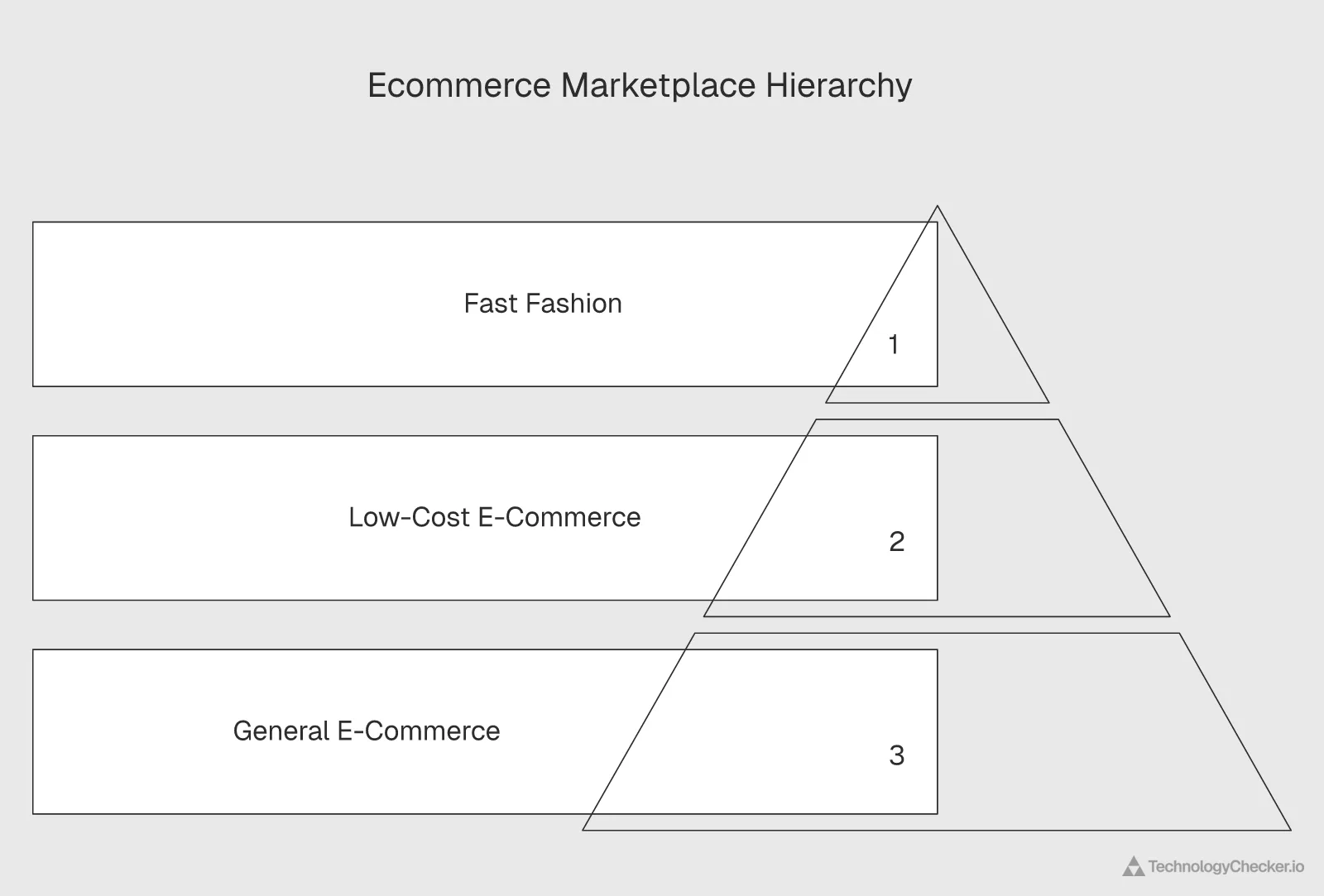 Top 5 marketplaces in each Cloudflare Radar category. Amazon, Shopee, and Shein each hold rank 1 in their category every day of the quarter.
Methodology: how we ranked these marketplaces
Transparency matters more in quarterly reports than almost anywhere else, because the numbers get cited, compared, and used in strategic decisions. Here's exactly how this report was produced.
Data source
All rankings in this report come from the Cloudflare Radar Internet Services API. Radar measures total internet traffic to consumer-facing ecommerce sites. Cloudflare sees about 20% of global web traffic through its network (Cloudflare Radar methodology). That makes Radar one of the most representative public datasets for cross-platform traffic comparison.
Date range
- Primary window: January 1, 2026 to March 31, 2026 (Q1 2026, 90 days)
- Update layer: a clean snapshot on June 1, 2026, plus the full weekly rank series (23 weekly points, December 29, 2025 to June 1, 2026) pulled via Cloudflare Radar's Internet Services timeseries endpoint
- Data aggregation: daily rank per service for the Q1 ranges; weekly rank per service for the trajectory and the June 1 snapshot
June 2026 refresh
For this update we re-pulled all three category rankings on June 1, 2026 and added the weekly timeseries back to January. The weekly view is what corrected two findings from the May 1 update: a single-day snapshot can land on an outlier week, and both Trendyol's Fast Fashion #2 and Walmart's General top-10 turned out to be short-lived when read against the full series. Where a June number reverses an earlier one, we kept the original figure visible and graded the change rather than overwriting it. We also expanded the regional pull from four markets to seven (adding Turkey, Mexico, and India).
July 2026 refresh (Q2 2026 close plus year-over-year)
For this update we re-pulled all three category rankings on the exact Q2 close, June 30, 2026, and, new this quarter, pulled the same three categories for June 30, 2025 to build a like-for-like year-over-year layer. Endpoints: ranking/internet_services/top?serviceCategory={E-commerce|Fast Fashion|Low cost E-commerce}&date=… for the category rankings, ranking/internet_services/timeseries_groups for the weekly series (which resolves only the top five services, a limit we flag where it matters, such as Walmart's re-entry), and ranking/top?location=…&date=2026-06-30 for the seven regional top-100s. Two method notes for transparency. First, the year-over-year figures are point-in-time snapshots at each quarter's close, not 90-day averages, so we lean on the weekly series to separate durable moves from single-date noise. Second, we tested Cloudflare's fastest-rising-domains feed (rankingType=trending_rise, filtered to the Ecommerce category) as a net-new mover axis, but only one marketplace domain (netshoes.com.br) surfaced cleanly, so we built the net-new breakdown from year-over-year top-10 churn instead. Every number in this refresh traces to a dated radar.sh call on July 2, 2026.
August 2026 refresh (July 2026 close plus month-on-month year-over-year)
The "(August 2026 Update)" stamp says when we refreshed. The data covers July 2026. For this pass we pulled ranking/internet_services/top?serviceCategory={E-commerce|Fast Fashion|Low cost E-commerce}&date=… at three primary dates: 2026-07-31 (July close), 2026-06-30 (Q2 close, re-pulled to confirm the published figures still stand) and 2025-07-31 (the like-for-like month a year back). All nine returned data on 2026-08-01.
We then ran targeted spot checks instead of sweeping the month. For each category where the July 31 top 10 differed from the June 30 top 10, we re-pulled intermediate July dates: four for General E-Commerce and Fast Fashion (July 7, 14, 21, 28), two for Low-Cost (July 14, 28), where only two positions had moved. A position that appears on July 31 alone is published with a † and described as a single-date reading. That rule is what stopped us publishing Trendyol at Fast Fashion #2 for a third time.
Three limits worth stating plainly. We did not re-pull the seven regional top-100 domain rankings this month, so the regional section still reads to the June 30 close and is labelled that way. We did not sample every day of July, so a position could have moved and reverted between our dates. And ranking/internet_services/top returns ranks only, with meta.normalization null, so there are no traffic shares to compute here; every number in this report is an ordinal position, never a percentage of market. Every figure traces to a dated radar.sh call on August 1, 2026.
Categories analyzed
Cloudflare Radar maintains three overlapping ecommerce category taxonomies, which we analyzed in parallel.
- E-Commerce (general): broad marketplaces including Amazon, Shopee, eBay, Walmart, Mercado Libre. We filtered out the Shopify platform domain, which Cloudflare classifies here (see methodology note below).
- Low-Cost E-Commerce: discount-oriented platforms including Shopee, Temu, AliExpress, Tokopedia, DHgate, Tmall, Joom.
- Fast Fashion: apparel-focused retailers including Shein, H&M, Zara, Trendyol, Asos, Uniqlo, Falabella.
Each category uses Cloudflare's own service classification. We did not re-classify any service.
Why we excluded Shopify
Cloudflare Radar places Shopify inside its E-Commerce category based on traffic to shopify.com. We removed it from our marketplace rankings because Shopify doesn't match the marketplace definition. It's an ecommerce platform where 5.6M+ merchants run independent stores on their own custom domains.
Cloudflare's ranking would count merchant logins, admin sessions, Shop app interactions, and the shopify.com marketing site. It would not count the shopper traffic across every Shopify store. Mixing that signal into marketplace rankings creates an apples-to-oranges comparison.
For the merchant-platform view of the same commerce market, see our dedicated reports: the Shopify analytics report, our Shopify technology profile, and the Shopify migration patterns analysis. We also treat Shopify's platform traffic separately in the sidebar below.
Regional rankings
For regional dominance analysis, we pulled Cloudflare Radar's top-100 domain rankings (POPULAR ranking type) for seven markets: United States (US), Indonesia (ID), Brazil (BR), Germany (DE), and — new for the June update — Turkey (TR), Mexico (MX), and India (IN). This gives us a cross-continent read on which marketplaces break into each country's overall top 100. One caveat we repeat in the regional section: positions in the #20-100 band move day to day, so we flag single-snapshot reversals rather than declaring them permanent.
Limitations
- Traffic ≠ revenue. A marketplace can rank high on traffic and low on GMV (gross merchandise volume), or vice versa. Walmart is a textbook example.
- Bot traffic filtering varies by Cloudflare's detection models. We've used Radar's default filtered feed.
- Country-level data in the Internet Services category isn't available at the same granularity as the top-100 domain rankings, so regional analysis uses the domain-rank dataset.
- Category taxonomy drift: Cloudflare occasionally adds or reclassifies services. We noted these in footnotes where observed.
Deep dive #1: the general E-Commerce category
Amazon's uncontested rank-1 position is the most predictable data point in this entire report. Across all 90 days of Q1 2026, Amazon held the #1 spot every single day. It's the only marketplace in our dataset with zero rank variance.
The real story is #2 through #10, where Shopee, Temu, eBay, Alibaba, Taobao, Walmart, Shein, Mercado Libre, and AliExpress jockeyed for position.
Sidebar: Shopify's platform traffic (not a marketplace, but worth noting)
We excluded Shopify from the marketplace ranking, but its Cloudflare Radar traffic signal is still worth pulling out. It gives you a parallel read on the same commerce market, from the merchant side instead of the shopper side.
If Shopify were included in Cloudflare's E-Commerce category, shopify.com would rank #2 globally in Q1 2026, ahead of Shopee, eBay, Walmart, and Shein. That traffic comes from a few sources. Merchant admin logins from 5.6M+ active stores checking their dashboards multiple times daily. Shop app traffic (200M+ users, with Shop Pay processing transactions in-app). Storefront preview and checkout flows on shopify.com subdomains during customer journeys. Partner and developer traffic to ecosystem docs, admin API, and the theme store.
Why this matters even though it's not a marketplace: shopify.com getting more daily traffic than Shopee, eBay, or Walmart tells you how active the global Shopify merchant base is. The marketplace world and the platform world compete for the same consumer dollar. One aggregates sellers on one domain. The other distributes them across millions of domains. Neither one wins cleanly.
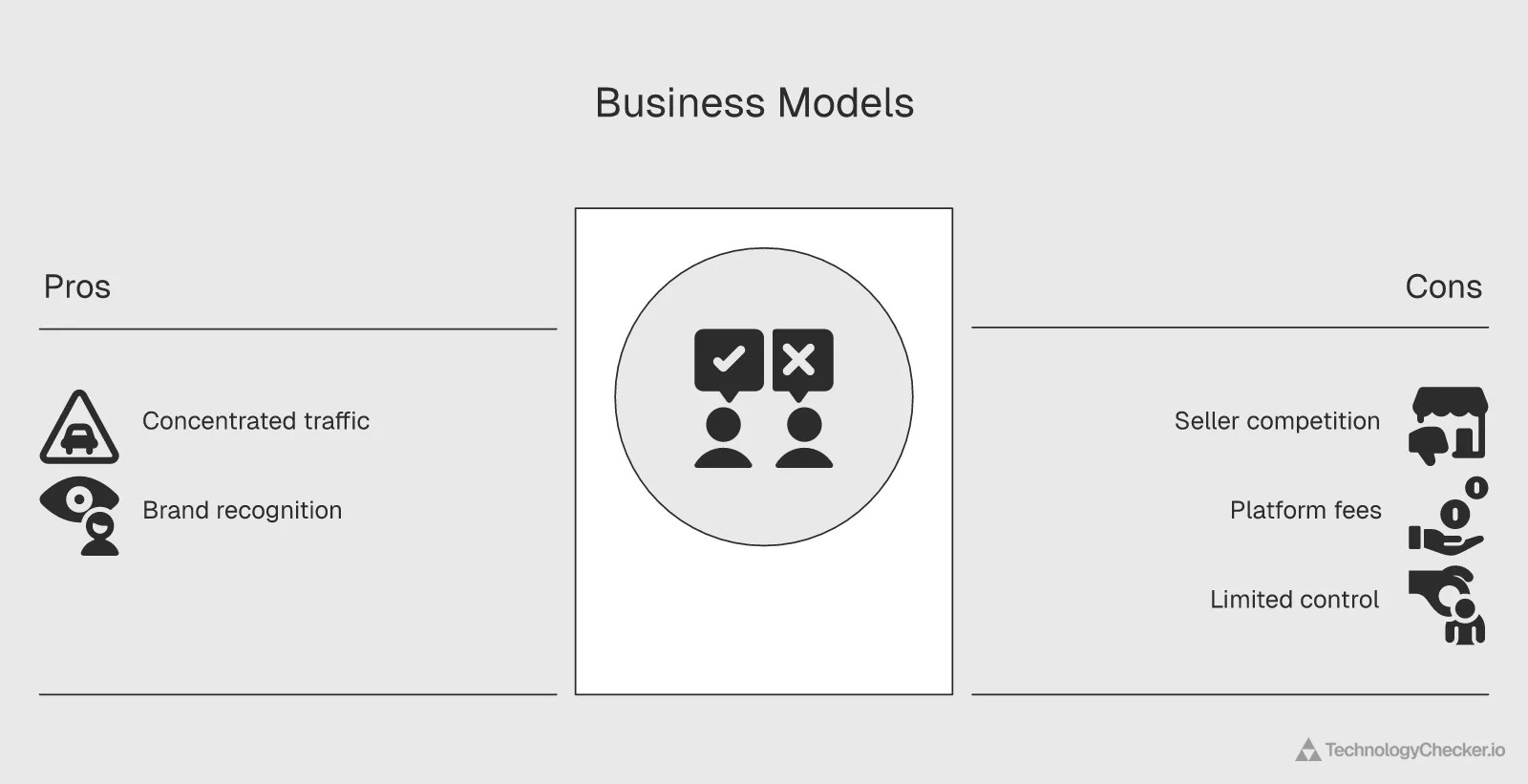 Marketplaces aggregate sellers on one domain; platforms distribute merchants across millions of independent domains. The traffic measurement differs accordingly.
The Walmart paradox
Walmart Inc. generated approximately $681 billion in revenue in FY2025 (Walmart 10-K FY2025), making it by far the world's largest retailer. And yet in Cloudflare Radar's General E-Commerce traffic ranking, Walmart only appeared in the top 10 on 11 specific days out of Q1's 90 days, and never cracked the top 8 during Q1. It jumped to #8 in early April, a recent development we'll watch next quarter.
The cause is structural. Walmart's business is offline-anchored. Industry estimates put roughly 83% of Walmart's revenue coming from physical stores (Statista US retail ecommerce share data). Walmart.com is the #2 US ecommerce site by dollar sales. But as a share of global internet traffic, it's dwarfed by marketplace-native competitors whose entire transaction flow happens online.
Compare this to Amazon. Amazon's revenue model is online-first, and its traffic signature matches. The Walmart paradox (massive revenue leader, modest online traffic footprint) is a reminder that traffic rankings and revenue rankings measure different things. You need both to understand a retail market.
Surprise movers in Q1
- Taobao dropped from consistent #5 in January to #7 in late March, an unusually sharp shift for a top-10 incumbent.
- eBay rose from #7 to #5 during the last week of Q1, ending the quarter on a positive trend.
- Alibaba oscillated between #5 and #7 repeatedly. Its traffic pattern is the noisiest in the top 10.
- Mercado Libre fell out of the top 10 on five separate days in January and February, getting displaced by Wildberries (Russia) and Shop app on specific dates.
Deep dive #2: the low-cost E-Commerce category
This category is the most stable in our entire dataset. The top 3 (Shopee, Temu, AliExpress) held their ranks every single day of Q1 2026. Zero movement. Positions 4 through 6 (Tokopedia, Allegro, DHgate) moved within a 2-position band.
Shopee, the category anchor
Shopee is the only marketplace ranked #1 in any Cloudflare Radar ecommerce category for all 90 days of Q1. Amazon matches that dominance in General E-Commerce, and Shein matches it in Fast Fashion. No one else comes close.
What makes Shopee different from Amazon or Shein is geography. Its traffic is concentrated in Southeast Asia and Latin America. Both regions saw mobile-first commerce explode during 2020 to 2024. Neither has shown signs of plateauing. Our regional data (next section) confirms Shopee appears twice in Indonesia's top 100 domains and twice in Brazil's. No US-based marketplace achieves that footprint anywhere.
Temu vs AliExpress, the cross-border race
Temu's #2 position in Low-Cost E-Commerce is structurally threatening to AliExpress at #3. Both are Chinese cross-border platforms competing for the same consumer: price-sensitive Western buyers willing to wait 7 to 14 days for shipping.
Watch for Q2 2026. If Temu's rank-2 lead widens (for example, AliExpress drops to #4 behind Tokopedia), that signals Temu has won the cross-border consumer category outright. As of Q1 close, AliExpress held firm, but the margin is narrowing.
The Allegro story (Poland)
Allegro at #5 globally is worth pausing on. Allegro is a Polish marketplace that barely registers in North American or APAC press coverage. Its Cloudflare Radar traffic signal puts it ahead of DHgate, Tmall, Takealot, and Banggood. This is a reminder that regional champions can out-traffic global brands when their home market has high ecommerce penetration and limited marketplace competition.
Deep dive #3: the fast fashion category
Shein's #1 position is as uncontested as Amazon's or Shopee's. Every day of Q1 2026, Shein held rank 1 in Fast Fashion. What's more interesting: Shein also appears in General E-Commerce at #9, making it one of only two marketplaces in our dataset to span two Cloudflare Radar ecommerce categories (the other being Shopee).
The Trendyol surprise
Trendyol, a Turkish ecommerce marketplace, ranked #3 in Fast Fashion for most of Q1 2026, ahead of Zara, Asos, and Uniqlo. That's a remarkable signal for a platform that's largely absent from Western commerce press coverage. Trendyol is majority-owned by Alibaba Group, which acquired a controlling stake in 2018 (reported by Reuters). It operates primarily in Turkey, the Middle East, and increasingly Europe.
For technology vendors, this ranking is a prompt. If you're selling commerce infrastructure, Trendyol merchants may be under-served compared to Shein, H&M, or Zara's partner ecosystems.
H&M vs Zara, the incumbent battle
The traditional European fast-fashion rivalry shows up cleanly in our data. H&M ranked #2 or #3 every single day of Q1 2026. Zara ranked between #4 and #8, much more volatile, and slid further in March.
H&M has consistently out-trafficked Zara across the full quarter. That's true even though Inditex (Zara's parent) generated higher total revenue than H&M Group in 2025 (Inditex 2025 annual results). Again: traffic ≠ revenue. But when one incumbent is stable at #2 and the other slides between #4 and #8, something about digital customer acquisition is diverging.
The American retail presence
American fast-fashion brands show up mostly in the lower half. American Eagle held the #5 to #10 range with a US-heavy traffic base. Urban Outfitters emerged in the #9 to #10 range mid-February. Forever 21 was briefly in the top 10 for three weeks in February, then dropped off.
None of these brands consistently break the top 5 in Cloudflare Radar's Fast Fashion category. Fast Fashion's top of market is dominated by non-US brands.
Cross-category players: the "2 of 3" club
Only two marketplaces appeared in more than one of the three Cloudflare Radar ecommerce categories during Q1 2026. Shopee took #3 in General E-Commerce and #1 in Low-Cost. Shein took #9 in General E-Commerce and #1 in Fast Fashion. Everyone else appears in exactly one category.
This matters strategically. Shopee is cross-category because its merchant base sells both high-margin general goods and low-cost imports. It's the only platform where a single consumer session might buy a branded electronics product and a $3 accessory in the same cart. Shein is cross-category because it scaled from a fast-fashion specialist into a broader marketplace (launched Shein Marketplace in 2023, per the company announcement). It now sells electronics, home goods, and beauty alongside apparel, which is why it shows up at #9 in the General E-Commerce taxonomy.
Strategic implication for technology vendors: Shopee and Shein have partner economics that differ most from traditional marketplaces. Their category spread creates different merchant profiles. It also creates different tech-stack requirements.
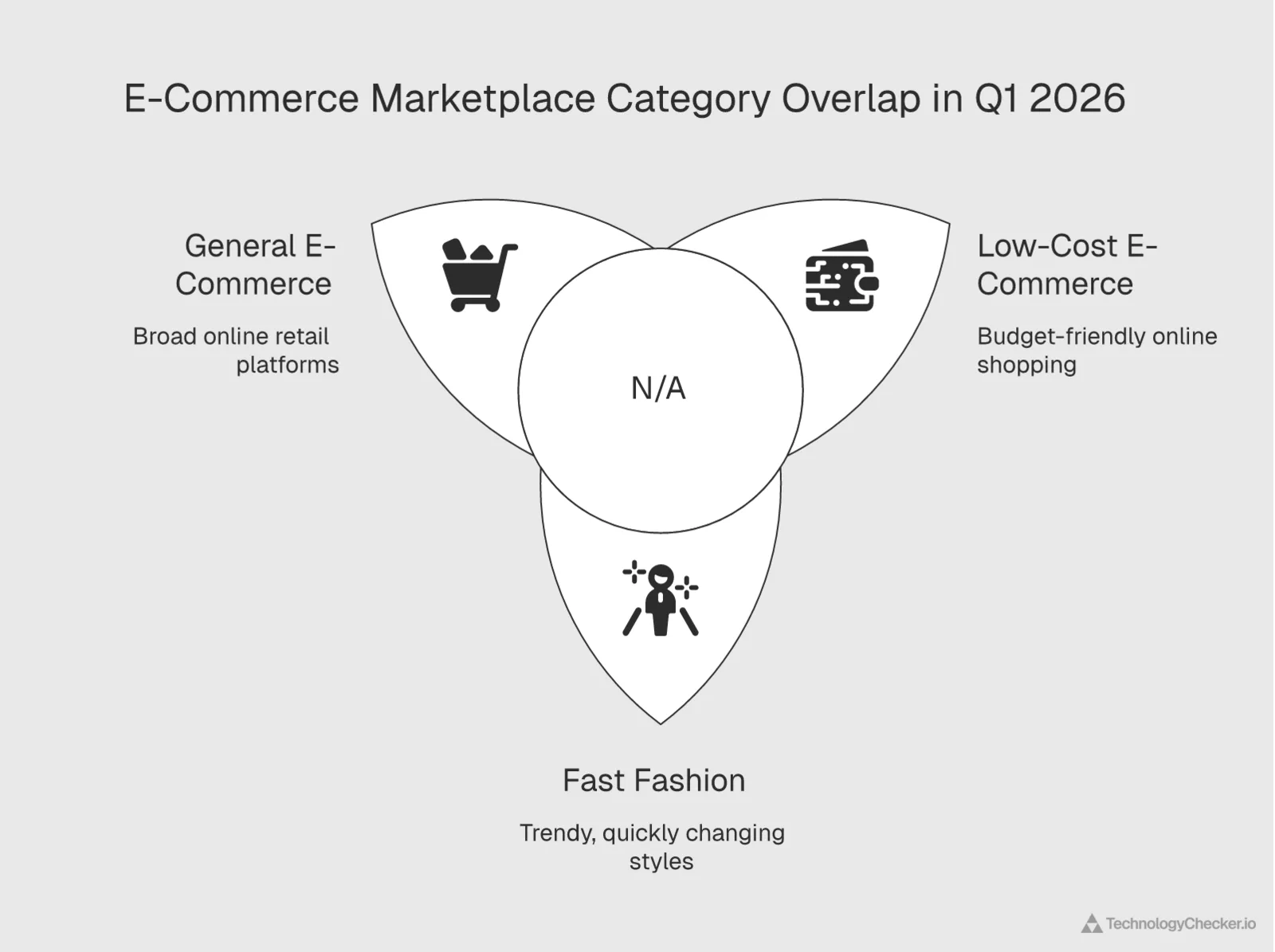 Only Shopee (General + Low-Cost) and Shein (General + Fast Fashion) span two Cloudflare Radar marketplace categories.
Regional dominance map: where each marketplace wins
We pulled Cloudflare Radar's top-100 domain rankings to map regional dominance. The original report covered four markets; for the June update we re-pulled all four on June 1, 2026 and added three more — Turkey, Mexico, and India. The picture is a fragmented global market where different marketplaces own different continents, and several of the June numbers moved enough to flag.
United States (US)
Top-100 marketplace domains on June 1, 2026: only amazon.com, now at #17 (up from #22 in the original Q1 pull). No Shopee, Temu, Shein, Mercado Libre, or Alibaba breaks the US top 100. Walmart.com doesn't either. On pure traffic reach, the US consumer market is Amazon-and-nobody-else, and Amazon's position got stronger since Q1, not weaker. Small US sellers who run their own storefront show up on store builders instead: 9,885 of the companies in our list of who uses Square Online are American, and food businesses make up 24.29% of its matched companies, nearly twice retail's share (September 2026 crawl). Large US retailers run their own storefront stack too: Target, Family Dollar and Wegmans all load Bazaarvoice's ratings and reviews code, and 2,427 of the 3,629 companies that use Bazaarvoice we can match are American (September 2026 crawl).
Indonesia (ID)
Top-100 marketplace domains on June 1, 2026:
- Shopee still appears twice: shopee.co.id at #19 and shopeemobile.com at #38 (both nudged up from #21 and #41)
- Tokopedia slipped to #89 (from #70)
- amazon.com newly cracked the list at #94
Indonesia is still the clearest Shopee stronghold in the dataset, with two top-40 positions in the country's domains. The new wrinkle: Amazon appeared in Indonesia's top 100 for the first time in our tracking, at #94, while local champion Tokopedia gave up 19 places.
Brazil (BR)
Top-100 marketplace domains on June 1, 2026:
- amazon.com at #27 (up from #39)
- shopee.com.br at #72 (down from #38)
- mercadolivre.com.br at #76 (up from ~#100, now on its local domain)
- shopeemobile.com at #90 (down from #26)
This is the regional reversal of the June update. In the original report, Shopee out-ranked Amazon in Brazil — its two domains sat at #26 and #38 versus Amazon's #39, which is where this post's "Shopee out-traffics Amazon in Brazil" line came from. On June 1 that flipped: Amazon climbed to #27 and now sits ahead of both Shopee domains, which fell to #72 and #90. Mercado Libre recovered too, moving onto its local mercadolivre.com.br domain at #76. One caveat I'd stress: domain ranks in the #20-100 band swing day to day, so I'm treating this as a flagged shift to re-check, not a settled handover. But the direction is the opposite of what we reported in April, and that's worth saying plainly. Merchants who run their own storefront have a local option too: Tiendanube, which sells in Brazil as Nuvemshop, is the third-largest store platform among Brazilian companies in our September 2026 crawl, behind Wix and WooCommerce, and 7,952 of the Tiendanube customers we can place by country are Brazilian.
Germany (DE)
Top-100 marketplace domains on June 1, 2026: only amazon.com, at #49. The local amazon.de domain, which sat at #83 in the original pull, dropped out of the top 100. Germany stays an Amazon-and-only-Amazon market — no other marketplace breaks the list — though Amazon's footprint there narrowed to a single domain. Germany's independent web shops show up in our crawl instead: 8,353 of the live domains running the Trusted Shops trustmark end in .de (September 2026 crawl).
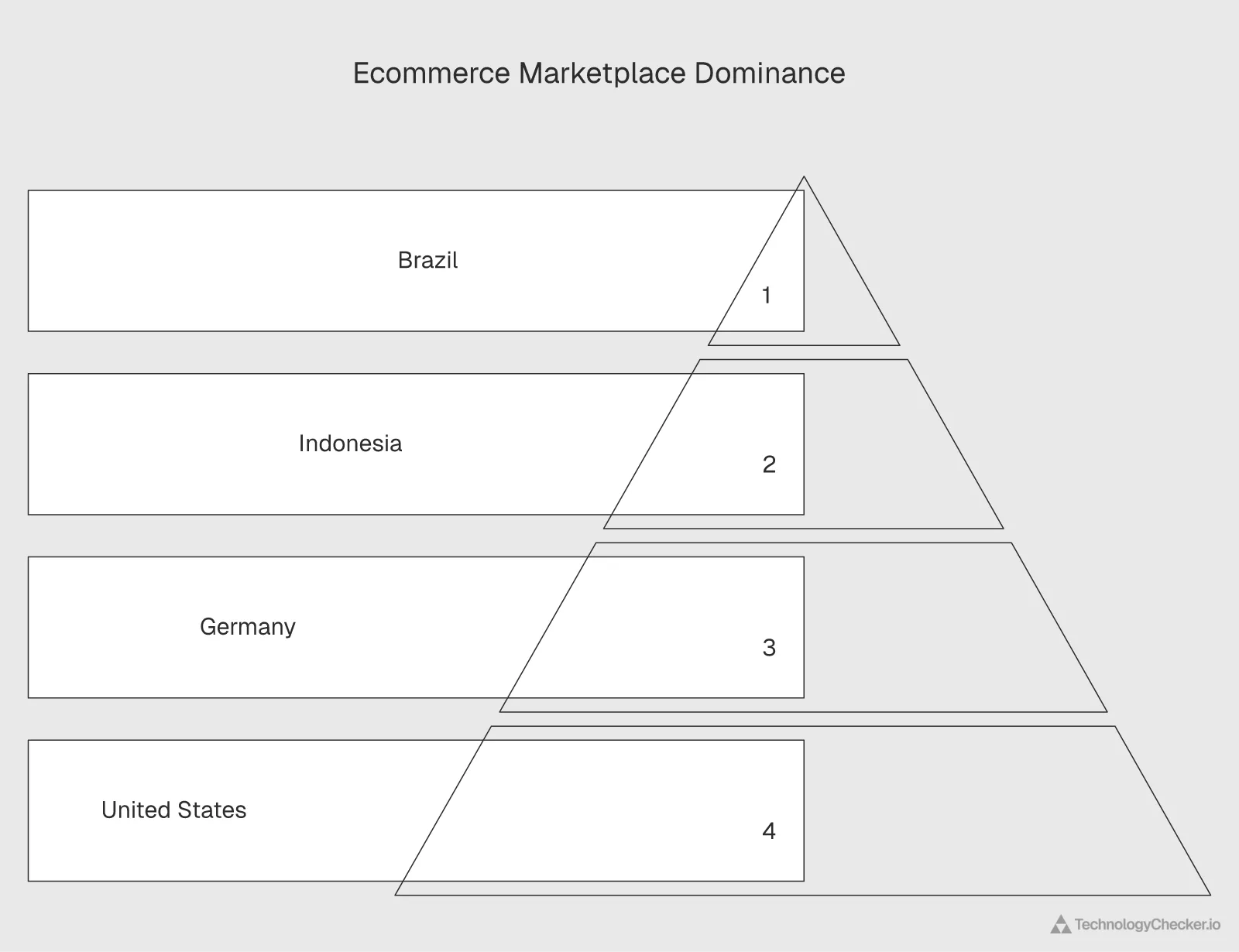 Q1 2026 snapshot of the original four markets. By June 1, Shopee's Brazil position had slipped behind Amazon's — see the Brazil update above.
Turkey (TR) — new for June
Top-100 marketplace domains on June 1, 2026:
- amazon.com at #50
- trendyol.com at #92
- hepsiburada.com at #94
Turkey is the market I most wanted to add, because it tests the Trendyol story directly. Here's the paradox: Trendyol ranks #3 globally in Cloudflare's Fast Fashion category, yet in its home country's overall top-100 domains, trendyol.com sits at #92 — below amazon.com at #50 and barely ahead of local rival hepsiburada.com at #94. That's not a contradiction. It's the traffic-versus-category-rank gap in miniature. A marketplace can lead a narrow category leaderboard and still trail the global giants on raw domain traffic, even at home. Same lesson as the Walmart paradox, pointed the other way.
Mexico (MX) — new for June
Top-100 marketplace domains on June 1, 2026:
- amazon.com at #26 and amazon.com.mx at #53
- mercadolibre.com.mx at #63 and mercadolibre.com at #69
Mexico is where Mercado Libre shows the strength its Latin American reputation implies. Both Amazon and Mercado Libre appear twice in the top 100, the closest thing to a genuine two-horse marketplace race in our regional set. Amazon leads (#26 versus #63), but Mercado Libre's double presence here is a sharp contrast to Brazil, where it manages a single #76 entry. If you assumed Mercado Libre was uniformly strong across Latin America, the data disagrees: it's a Mexico story far more than a Brazil one.
India (IN) — new for June
Top-100 marketplace domains on June 1, 2026:
- amazon.com at #24 and amazon.in at #47
- Quick-commerce fills the rest of the commerce slots: grofers.com (#25), Swiggy (#35), Zepto (#56), and Blinkit (#66)
India breaks the pattern. Amazon appears twice and is the only traditional global marketplace in the top 100. The rest of the commerce traffic isn't marketplaces at all — it's quick-commerce grocery and delivery apps. One absence is worth naming: Flipkart, India's largest homegrown marketplace, does not appear in Cloudflare's top-100 domains for the country. The likeliest explanation is that Flipkart routes most of its traffic off Cloudflare's network, so Radar undercounts it. Read India's row as "Amazon plus a quick-commerce wave," with the caveat that the biggest domestic player is measured elsewhere.
What this regional pattern tells us
- Amazon's reach is widest in the West and still expanding. It's alone in the US and German top 100, it climbed in both since Q1, and on June 1 it newly appeared in Indonesia and overtook Shopee in Brazil's domain ranking.
- Shopee's strongholds are Asia and Latin America, but they aren't unconditional. Indonesia held firm; Brazil softened. The "Shopee out-traffics Amazon" claim that was true in April had reversed by June 1.
- Mercado Libre is a Mexico story, not a pan-Latam one — two top-70 domains in Mexico, one weak entry in Brazil.
- Category rank and domain traffic measure different things, and Turkey proves it. Trendyol is a global Fast Fashion #3 and a #92 domain in its own country. Neither number is wrong; they answer different questions.
- Quick-commerce is changing what "ecommerce traffic" even means in India, where grocery-delivery apps out-traffic every marketplace except Amazon.
Q2 2026 predictions: what to watch
Based on Q1 2026 momentum, here are five calls we'll grade next quarter.
- Walmart crosses into the General E-Commerce top 10 for more than 30 days of Q2. The early-April jump to #8 is the first sustained top-10 presence. If it holds, Walmart completes a genuine digital-traffic inflection.
- Temu pulls further ahead of AliExpress in Low-Cost. If the rank gap widens to 2+ positions (Temu #2, AliExpress #4), that's the cross-border category winner signal.
- Trendyol cracks Fast Fashion top 2 on at least 15 days of Q2. Its Q1 range touched #2 several times. One more incremental gain gets it over H&M consistently.
- Shein's share of General E-Commerce rises from its Q1 range (#8–#10) to a consistent top 7. Shein's marketplace expansion keeps pulling traffic from outside its apparel core.
- Shopee moves from #2 to #3 to a stable #2 in General E-Commerce. With Shopify excluded from our marketplace view, Shopee is the closest contender to Amazon, and its Brazilian and Indonesian strongholds keep expanding.
Interim June 1 grade (Q2 is half over):
- Walmart top 10 for 30+ days — tracking to fail. Walmart was out of the top 10 every week from May 4 through June 1. The April run is looking like a one-month event, not an inflection.
- Temu pulls ahead of AliExpress — no. Both held #2 and #3 in Low-Cost every week; the gap never widened. If anything, the more interesting Low-Cost move was Allegro reclaiming #4.
- Trendyol Fast Fashion top 2 for 15+ days — failed. Trendyol touched #2 on two weeks all quarter and sits at #3 on June 1. H&M owns the slot.
- Shein into General top 7 — no. Shein held #8-#10 in General throughout; it's stable at #8, not climbing toward the core.
- Shopee stable #2 in General — yes (excluding Shopify). Shopee held #2 (excluding Shopify) every week. The honest caveat: with Shopify included in Cloudflare's raw category, Shopee shows as #3.
Four of five Q1 calls are tracking to miss, which is itself the finding: Q1 momentum is a poor predictor of Q2 rankings once you watch the weekly series instead of a single snapshot. We'll publish the full Q2 scorecard in July 2026.
Final Q2 close grade (June 30, 2026): Q2 is over, so here's the scorecard, now with the year-over-year data behind it.
- Walmart top 10 for 30+ days: split decision. After looking dead on June 1, Walmart was back at #8 (raw) in the General category on the June 30 close. The weekly top-five series can't confirm a 30-day run, so this isn't a clean hit, but "Walmart in the top 10 at the quarter's close" is more than the June 1 read suggested. Call it half-right.
- Temu pulls ahead of AliExpress: no, but AliExpress lost worse. The Temu-versus-AliExpress gap in Low-Cost never widened (both held, #2 and #3, all year). The real move was one lane over: AliExpress fell out of the General top 10 entirely over the year. Temu didn't pull ahead; AliExpress pulled back. ⚠️ The second half is superseded by the August update above; preserved as originally published. AliExpress re-entered the General top 10 on three of the five July 2026 dates we sampled, so it flickers rather than having left.
- Trendyol Fast Fashion top 2 for 15+ days: failed, now definitively. Trendyol was #3 in June 2025 and #3 in June 2026. The year-over-year data closes the case: #3 is structural, #2 was always a spike.
- Shein into General top 7: failed, and it went the other way. Shein slipped from #7 (excl. Shopify) in June 2025 to #9 in June 2026. Its General-category traffic softened over the year rather than climbing toward the core.
- Shopee stable #2 in General: met (excluding Shopify). Shopee held #2 (excl. Shopify) into the close and improved its year-over-year standing (up from #3 in June 2025). With Shopify counted in Cloudflare's raw list, it shows as #3.
Net: one clean hit, one split, three misses, and the misses are the finding. Q1 momentum keeps failing to predict Q2, but the year-over-year frame is far more stable than any single quarter, which is the real payoff of adding the 2025 baseline. Full Q3 scorecard in October 2026.
The TechnologyChecker angle: traffic is half the picture
Cloudflare Radar tells us which marketplaces consumers visit. At TechnologyChecker.io, we measure the other side: which marketplaces and platforms merchants build on.
Our detection systems scan 29.9 million active domains monthly, identifying technology signatures across HTTP headers, JavaScript, DNS records, and HTML patterns. Across the ecommerce stack, we track the major platforms (Shopify, which TechnologyChecker detects on 2,378,074 live domains as of the September 2026 crawl, plus Shopify Plus, Magento, WooCommerce on 1,530,153, and BigCommerce), the main payment stacks (Stripe, Shop Pay, Adyen, Klarna, Afterpay, PayPal), the marketing technology layer (Klaviyo, Mailchimp, HubSpot, covered in our marketing automation report), and the analytics/attribution tools (Google Analytics, Shopify's native analytics, Triple Whale).
For ecommerce technology vendors, our data reveals which merchants use which platform, when they switch, and which verified decision-makers drive those choices. That's the layer underneath the consumer-facing marketplace traffic you just read about. It's where most commerce infrastructure decisions actually get made.
Frequently asked questions
What are the top 5 online marketplaces?
By Cloudflare Radar's worldwide traffic ranking in September 2026, Amazon, Shopee, eBay, Temu and Taobao, excluding Shopify (a store platform, not a marketplace). Amazon held #1 on every date we sampled; Shopee and eBay traded #2 and #3, and Temu and Taobao traded #4 and #5. That is traffic rank, not sales: by gross merchandise value the order differs.
What changed in ecommerce marketplace rankings in Q3 2026?
Two positions moved for real. Trendyol held Fast Fashion #2 on every August and September date we sampled, and Allegro (Poland) took Low-Cost #4 from DHgate on four of five September dates. Two more are live contests: eBay sat above Shopee at General #2 on September 7 and 14, and Temu shared General #4 with Taobao. All three category leaders held. Source: Cloudflare Radar, pulled 2026-10-01.
Who has the largest ecommerce marketplace market share in 2026?
Amazon is the largest General E-Commerce marketplace globally, Shopee leads Low-Cost, and Shein leads Fast Fashion. All three held rank 1 in their Cloudflare Radar category at the Q3 2026 close (September 30, 2026), on every September date we sampled, and at every month-end of 2026, which makes fourteen months without turnover at the top of any category. By revenue, Walmart leads global retail, but its online traffic footprint is much thinner: it sat at #7 to #9 in General E-Commerce (excluding Shopify) across September 2026.
Did the top ecommerce marketplaces change in the past year (2025 to 2026)?
Not at the very top. Amazon (General), Shopee (Low-Cost) and Shein (Fast Fashion) held rank 1 on September 30, 2025 and September 30, 2026. The movement was underneath: eBay climbed from #6 to #3 in General (and touched #2 twice in September 2026), Temu slipped from #3 to #4, Allegro rose from #6 to Low-Cost #4 for most of September, and Walmart entered the General top ten. Trendyol sits at Fast Fashion #2 on both dates, but it spent most of the first half of 2026 at #3.
Did Shopee overtake Temu in 2026?
No, and we published that claim in error last month. Shopee was already #1 in Low-Cost with Temu at #2 on July 31, 2025, exactly as on July 31, 2026. Temu's #1 on June 30, 2025 was a brief spell that our baseline date happened to catch. In General E-Commerce it was eBay that passed Temu (eBay #5 to #3, Temu #3 to #4, excluding Shopify).
Which ecommerce marketplaces grew the most over the past year?
On the July 31, 2025 to July 31, 2026 comparison: Falabella (#10 to #6 in Fast Fashion), eBay (#5 to #3 in General), Asos (#6 to #4 in Fast Fashion), Walmart (entered the General top 10), and DHgate (#5 to #4 in Low-Cost). Fashion Nova and Joom newly entered their category top 10s. Shopee is not on this list: it already led Low-Cost a year ago.
Is Shopify a marketplace?
No. Shopify is an ecommerce platform, not a marketplace. It powers 5.6M+ independent merchant stores that run on their own custom domains. Shopify.com itself doesn't host seller listings or aggregate transactions the way Amazon, Shopee, or eBay do. That's why we excluded Shopify from the marketplace rankings in this report. For context on Shopify as a platform, see our Shopify analytics report and Shopify technology profile. Cloudflare Radar classifies shopify.com under its E-Commerce service category, but that ranking measures platform/admin/developer traffic to shopify.com, not consumer marketplace activity.
Does Shopee have more traffic than Amazon?
Globally, no. Amazon held #1 in General E-Commerce every week from Q1 through June 1, 2026, and on every July 2026 date we sampled. Regionally it depends, and the regional figures below are the June 30 reading (we did not re-pull the country top-100s in the August refresh), and it changed during this report's life. In Q1, Shopee out-ranked Amazon in Brazil's top-100 domains (Shopee at #26 and #38 versus Amazon at #39). By the June 1 snapshot that had reversed: Amazon climbed to #27 while Shopee's domains fell to #72 and #90. That reversal held through the June 30 quarter close (amazon.com #38 versus shopee.com.br #61), though Shopee narrowed the gap. Indonesia is where Shopee's lead is clearest and most durable: it holds two top-40 domains (#21 and #41 on June 30) while Amazon's brief #94 cameo there was gone by the close. Domain ranks in the #20-100 band are volatile, so treat the Brazil reversal as a flagged shift rather than a settled one.
Why isn't Walmart in the top 5 for ecommerce?
Walmart generates ~$681B annually, but roughly 83% of revenue comes from physical stores. Walmart.com has strong US traffic, but as a share of global internet traffic it's structurally smaller than marketplace-native competitors. Walmart appeared in Cloudflare Radar's top 10 General E-Commerce on only 11 days of Q1 2026, bumped into the top 10 for about a month from late March to late April (peaking at #8), dropped out again every week from May 4 through June 1, then clawed back to #8 (raw) on the June 30 quarter close. July fits the same shape: in on four of the five dates we sampled, out on July 28. The structural read is that its traffic is too thin for a consistent top-10 slot: it flickers in and out at the #7-8 line rather than holding it.
What's the difference between Cloudflare Radar rankings and GMV rankings?
Cloudflare Radar measures internet traffic to marketplace domains. GMV (gross merchandise volume) measures total dollar value of goods sold. A marketplace can rank high on traffic but low on GMV (if average order values are small) or vice versa. Use both together for a complete picture. This report covers the traffic side.
Did eBay stay ahead of Temu in July 2026?
Yes. eBay held #3 in Cloudflare Radar's General E-Commerce ranking (excluding Shopify) on July 7, 14, 21, 28 and 31, 2026, with Temu at #4 on all five. That answers the question we left open at the Q2 close: eBay's climb from #5 a year earlier is durable, not a one-off snapshot.
Is Trendyol #2 in fast fashion now?
Yes, as of Q3 2026. Trendyol held Fast Fashion #2 on all five September 2026 dates we sampled (September 7, 14, 21, 28 and 30) and on every August date, against #3 at the Q2 close. Earlier this year it reached #2 only on single dates (late March, early May, July 31) and fell back each time, which is why earlier editions of this report declined to call it. It was also #2 in September 2025, so the next quarter will show whether this is a lasting move or a seasonal peak.
What changed in ecommerce marketplace rankings in July 2026?
Little at the top and something at the tail. All three category leaders held rank 1. DHgate passed Tokopedia for Low-Cost #4 on every July date checked, Fashion Nova climbed into the Fast Fashion top 7, Uniqlo fell to #9, and AliExpress returned to the General top 10 on three of five dates. Source: Cloudflare Radar.
How often is this report updated?
We publish updated rankings every quarter and refresh between quarters when a month's data changes something. This edition carries the Q3 2026 close (September 30, 2026) with a September 2025 year-over-year layer and a month-end table for all of 2026; earlier editions are kept in the update history at the end of the post. The next full quarterly edition (Q4 2026) publishes in January 2027. This page stays at the same URL. Bookmark /blog/ecommerce-marketplace-market-share to see the current rankings.
Summary
Ecommerce marketplace market share, based on Cloudflare Radar traffic rankings tracked weekly from January through the June 30, 2026 quarter close, re-pulled at the July, August and September 2026 closes, with year-over-year layers against June 30, July 31 and September 30, 2025. Newest findings first:
- Q3 2026: Trendyol earned Fast Fashion #2. It held #2 on all five September dates and every August date, the first time it has cleared this report's four-date rule. Allegro took Low-Cost #4 on four of five September dates, and eBay contested Shopee for General #2. Amazon, Shopee and Shein extended their #1 streaks to fourteen months.
- July 2026: eBay held #3 on all five dates we sampled. Amazon, Shopee, eBay and Temu occupy the General top four (excluding Shopify) on July 7, 14, 21, 28 and 31, which settles the Q2 cliffhanger. Amazon, Shopee and Shein each held rank 1 in their category on July 31, 2025 and July 31, 2026.
- July 2026: we corrected our own Low-Cost headline. Shopee did not take the #1 from Temu over the year. It already held it on July 31, 2025. The June 30, 2025 baseline caught a brief Temu spell at the top, and eight of the ten Low-Cost slots hold the same occupant a year apart.
- July 2026: the single-date traps kept firing. Trendyol shows Fast Fashion #2 on July 31 alone and #3 on the four other July dates, so we report it as an artifact. AliExpress and Shein trade the last General top-10 slot date to date.
- The top of every category held for a full year. Amazon (General), Shopee (Low-Cost), and Shein (Fast Fashion) each held rank 1 in their category on both June 30, 2025 and June 30, 2026, and across every weekly snapshot of 2026. Fast Fashion's entire top 3 (Shein, H&M, Trendyol) was identical year over year. The Low-Cost top 3 (Shopee, Temu, AliExpress) is the single most stable ranking in the dataset.
- The year's cleanest swaps sit just underneath. eBay overtook Temu in General E-Commerce (eBay #5 to #3, Temu #2 to #4, excl. Shopify), and Shopee took the Low-Cost #1 outright from Temu (holding it every week of Q2). AliExpress fell out of the General top 10 entirely; Kiabi, Fashion Nova, and Joom newly entered their category top 10s. ⚠️ The Shopee handover, the size of Temu's slide and the AliExpress exit are superseded by the August update above; preserved as originally published. The eBay climb holds on both baselines.
- June reversed two of our May reads. H&M reclaimed Fast Fashion #2 from Trendyol (whose #2 was a two-week spike), and DHgate's Low-Cost "lock-in" gave way as Allegro bounced back to #4.
- eBay is the genuine mover. It climbed from a Q1 #5-7 rotation to #3 (excluding Shopify) by June 1, passing Temu — the most durable mid-table shift in the dataset.
- Walmart's April top-10 run was a cameo. Present every week from late March to late April (peaking at #8), then absent every week from May 4 through June 1. The "barely makes top 10" framing was the structural read all along.
- Trendyol (Turkey) stays the most surprising Fast Fashion name at #3, but its home-market domain rank (#92 in Turkey, below Amazon at #50) shows how far category rank can diverge from raw traffic. ⚠️ The #3 is superseded by the Q3 2026 analysis above: Trendyol held #2 on every August and September date sampled. Preserved as originally published.
- Regional patterns fragment sharply. Amazon-only in the US and Germany; Shopee-strongest in Indonesia; Brazil flipped from Shopee-led to Amazon-led in the June 1 domain snapshot; Mexico is Mercado Libre's real stronghold; India is Amazon plus a quick-commerce wave (with Flipkart measured off-network).
- Shopify was deliberately excluded from marketplace rankings. It's an ecommerce platform (5.6M+ independent merchant stores), not a marketplace. We cover Shopify separately in our platform analytics report
For merchant-side data on which technologies power these marketplaces and their sellers, see our Shopify analytics report, marketing automation report, and technology coverage across 40,000+ products.
Update history
Re-pulled all three categories at the Q3 2026 close with five September sample dates and a September 2025 baseline checked on two dates. Trendyol held Fast Fashion #2 on every sampled date (a call earlier editions had rejected), Allegro took Low-Cost #4 from DHgate for most of September, and eBay contested Shopee for General #2. Added a top-five answer, a 2026 month-end table and the September 2026 platform counts.
Updated September 3, 2026 with August data. We re-pulled all three Cloudflare Radar ecommerce category rankings at the August close and, following this report's own rule, checked four separate August dates before calling any move. That rule earned its keep this month.
Nothing changed at the top. Amazon held rank 1 in General E-Commerce, Shopee in Low-Cost E-Commerce and Shein in Fast Fashion, extending all three streaks to thirteen consecutive months. eBay held #3 among marketplaces. The top four positions in General E-Commerce were identical on every August date we sampled.
Everything below rank 4 moved, and most of it was noise. On the August 31 snapshot alone, Cotton:On appears at #4 in Fast Fashion, which would be a striking debut. It is not in the top six on August 10, 17 or 24. Shein appears at #8 in General E-Commerce on August 17 and 31 and is replaced by Walmart on August 24. Neither is a position change; both are what a single-date reading of a volatile tail looks like.
| Category | Rank 1 | Rank 2 | Rank 3 | Rank 4 | Stability |
|---|---|---|---|---|---|
| General E-Commerce (excl. Shopify) | Amazon | Shopee | eBay | Temu | All four held on every August date |
| Low-Cost E-Commerce | Shopee | Temu | AliExpress | DHgate | Top three held all month |
| Fast Fashion | Shein | Trendyol | H&M | unstable | Top three held; rank 4 changed on every date sampled |
Source: Cloudflare Radar — radar/ranking/internet_services/top with serviceCategory set to E-commerce, Low cost E-commerce and Fast Fashion, sampled on 10, 17, 24 and 31 August 2026, pulled 2026-09-03. This endpoint returns ordinal ranks with no normalization and no underlying traffic figure, so it supports statements about order and nothing about magnitude.
Updated August 1, 2026 with July data. We re-pulled all three Cloudflare Radar ecommerce category rankings at the July close (July 31, 2026), then set them against the Q2 close (June 30, 2026) and against the same calendar date a year earlier (July 31, 2025). July does two things to this report. It answers the cliffhanger the Q2 edition left open: eBay sat at #3 in General E-Commerce (excluding Shopify) on every July date we sampled, so its climb is a structural reordering rather than a spring blip. And it breaks one of our own headline claims. On July 31, 2025, Shopee was already #1 in Low-Cost with Temu at #2, exactly as they stand on July 31, 2026. The "Shopee seized the Low-Cost crown from Temu" line we published last month was an artifact of choosing June 30, 2025 as the baseline, a date that happened to land on a brief Temu spell at the top. We correct it in full below rather than quietly deleting it. One framing note: July is a single month and a set of snapshot dates, not a quarter, and we don't treat it as one. Everything published before this section stays exactly where it was.
Updated July 2, 2026 for the Q2 close. We re-pulled all three Cloudflare Radar ecommerce category rankings on June 30, 2026 (the last day of Q2), and this time we added a full year-over-year layer against June 30, 2025. The one-year view is the cleanest read this report has ever had. Every category leader held: Amazon (General), Shopee (Low-Cost), and Shein (Fast Fashion) each sat at rank 1 on both dates, a full year apart. Underneath them, the year rearranged the board. eBay climbed from #5 to #3 in General E-Commerce while Temu slid the other way (#2 to #4). Shopee took the Low-Cost #1 outright from Temu. Fast Fashion's entire top 3, Shein, H&M and Trendyol, was frozen: identical on both dates. And Walmart, which we'd flagged as dropping out on June 1, had clawed back to #8 by the June 30 close. The original Q1 2026 report and the June 1 update layer are preserved in full below; this new Q2-close section sits on top of them. ⚠️ The Low-Cost handover and the size of Temu's General slide are superseded by the August update above; preserved as originally published.

CEO & Co-founder
12+ years of experience
Mehmet is the CEO and co-founder of TechnologyChecker.
- BSc Computer Engineering, Bilkent University
- Certified SaaS Growth Strategist
- Member, British Computer Society (BCS)
Never miss our research