Most Reliable Internet by Country Q3 2026: Who Has the Best Internet?
Q3 2026: Singapore completed 92.6% of TCP connections cleanly, the most reliable. Hungary, Spain and Chile led speed tests. Reliable is not fast.
Published •Updated •Data through September 2026•70 min read


⚠️ This opening paragraph is the original April 2026 finding, preserved as published. It is superseded by the Q3 2026 sections below: Singapore led Q3 2026 at 92.62%, Iraq has recovered to 78.83%, and Myanmar (42.04%) is now the weakest of the 86 countries tracked.
Singapore has the most reliable internet connection in 2026, with 91.52% of all TCP connections completing successfully, according to Cloudflare Radar data across a 28-day measurement window (March 23 to April 20, 2026). Iraq has the lowest at 30.68%. The global average TCP healthy rate is 78.88%, meaning nearly 1 in 5 connections worldwide fails before it finishes.
I spent the past month pulling TCP connection quality metrics from Cloudflare Radar for 83 countries and mapping them against the reset patterns that reveal why those connections fail. What surfaced was a very different ranking from the usual Ookla-style speed charts you see on Wikipedia or travel blogs. A country can have fast last-mile fiber and still drop one in three TCP flows because of a misbehaving middlebox, a firewall, or a regional peering fault. Speed tests don't see any of that.
This post is the ranking, the data, and the analysis. It's the TCP connection quality by country ranking we wish existed when we were picking regions for our own product.
Updated October 1, 2026 with Q3 2026 data (July to September 2026; September is provisional). Earlier editions are preserved below and in the update history, annotated where newer data supersedes them.
Which country has the best internet?
It depends on which "best" you mean. Singapore has the most reliable internet: 92.62% of its TCP connections completed without a reset or timeout in Q3 2026, according to Cloudflare Radar. Hungary has the fastest, at 351.3 Mbps download in Cloudflare speed tests over the 90 days to 30 September 2026. No country tops both lists.
Speed tells you how much data moves once a connection is open. Reliability tells you whether the connection opens and survives at all, and the two rankings barely overlap: Singapore is 23rd of 65 countries on speed, Hungary is 39th of 86 on reliability, and only Denmark and Portugal make both top tens.
| Rank | Most reliable (TCP connections completed cleanly, Q3 2026) | Fastest (speed-test download, 90 days to 30 Sep 2026) |
|---|---|---|
| 1 | Singapore, 92.62% | Hungary, 351.3 Mbps |
| 2 | Israel, 91.07% | Chile, 340.1 Mbps |
| 3 | Denmark, 90.00% | Spain, 333.7 Mbps |
| 4 | Norway, 89.11% | Brazil, 297.6 Mbps |
| 5 | Portugal, 87.40% | France, 279.8 Mbps |
| 6 | Estonia, 86.98% | Portugal, 279.0 Mbps |
| 7 | Slovakia, 86.84% | United States, 271.9 Mbps |
| 8 | Luxembourg, 86.63% | South Korea, 270.6 Mbps |
| 9 | Latvia, 86.23% | Denmark, 270.1 Mbps |
| 10 | Australia, 86.16% | Canada, 264.8 Mbps |
Source: Cloudflare Radar. Reliability: radar/tcp_resets_timeouts/summary (no_match share of flows) for the 86 countries this report tracks, Q3 2026 calendar quarter. Speed: radar/quality/speed/top/locations, window 2026-07-02 to 2026-09-30 (the endpoint snaps to 90 days), limited to the 65 countries with at least 10,000 tests; microstates with a few hundred tests (Liechtenstein 411 Mbps on 127 tests, Monaco 359 Mbps on 116) are left out. Pulled 2026-10-01; September provisional.
When people ask me which country has the best internet, they almost always mean the right-hand column. If you run an application, the left-hand one is the one your users feel. Hungary's speed-test lead says how quickly a download finishes once it starts; its 82.96% reliability rate says roughly one connection in six is reset or times out before it completes.
Q3 2026 analysis: Singapore led the quarter, and the world stayed at 80%
Singapore was the most reliable country on Cloudflare's network in Q3 2026 at 92.62%, ahead of Israel (91.07%) and Denmark (90.00%). Globally, 80.02% of TCP connections completed cleanly, against 80.12% in Q2. The quarter view below sets each country against Q2 2026 and against the same quarter a year earlier.
| Country | Q3 2025 | Q2 2026 | Q3 2026 | vs Q2 | vs Q3 2025 | Status |
|---|---|---|---|---|---|---|
| Singapore | 92.57% | 91.59% | 92.62% | +1.03 | +0.05 | #1 on 3 of 4 checks; Israel led July |
| Israel | 89.37% | 91.35% | 91.07% | −0.28 | +1.70 | #2; slid to 86.64% in the last week of September |
| Denmark | 89.55% | 90.14% | 90.00% | −0.14 | +0.46 | #3; #2 in September |
| Norway | 84.84% | 88.11% | 89.11% | +1.00 | +4.27 | #4; the biggest yearly gain in the top tier |
| Portugal | 87.39% | 87.00% | 87.40% | +0.39 | +0.01 | #5; also top ten on speed |
| Germany | 84.04% | 85.90% | 86.02% | +0.13 | +1.98 | #11 |
| Japan | 84.38% | 86.58% | 85.84% | −0.74 | +1.46 | #13 |
| United States | 83.18% | 85.50% | 85.04% | −0.46 | +1.86 | #21 |
| United Kingdom | 83.56% | 82.86% | 83.00% | +0.14 | −0.57 | #38 |
| Vietnam | 75.07% | 87.11% | 83.96% | −3.14 | +8.90 | Down from 90.95% in January |
| Brazil | 66.94% | 81.03% | 81.75% | +0.72 | +14.81 | Yearly gain is a September 2025 collapse (48.07%) |
| Turkey | 36.54% | 81.75% | 80.87% | −0.88 | +44.33 | Yearly gain is a September 2025 collapse (19.33%) |
| Iraq | 78.57% | 53.10% | 78.83% | +25.73 | +0.26 | Recovered; exam shutdowns from 26 September |
| Bulgaria | 66.83% | 54.20% | 68.95% | +14.74 | +2.12 | Volatile, post_syn still 22.89% |
| China | 49.06% | 63.64% | 59.93% | −3.71 | +10.87 | Gave back part of the Q2 gain |
| Russia | 75.87% | 60.53% | 56.03% | −4.50 | −19.84 | Session drops all summer, then recovery |
| Kenya | 48.24% | 42.17% | 43.48% | +1.31 | −4.76 | 85th of 86 |
| Myanmar | 50.35% | 43.37% | 42.04% | −1.33 | −8.31 | Last of 86; 37.64% in September |
| Global | 76.57% | 80.12% | 80.02% | −0.10 | +3.45 | Flat; the yearly gain is a weak Q3 2025 |
Source: Cloudflare Radar, radar/tcp_resets_timeouts/summary (no_match share of flows), global and with location=, calendar quarters (Q3 2026 = 2026-07-01 to 2026-09-30). Ranks are among the 86 countries this report tracks. Pulled 2026-10-01; September and Q3 2026 provisional. Changes in percentage points.
My read of the quarter is that the top of the table is settled in membership and unsettled in order. Singapore, Israel and Denmark were the top three in both Q2 and Q3, and in Q3 they sat within 2.7 points of each other. Which one is first depends on the month you pick, so I'd plan around the group, not the winner. The bottom is where the real movement is, and this quarter it ran in both directions at once.
Who led: Singapore on three of four checks
A single window can crown the wrong leader, so I checked the top six on four separate dates.
| Country | Jul 2026 | Aug 2026 | Sep 2026 | Sep 24 to 30 |
|---|---|---|---|---|
| Singapore | 90.77% | 93.47% | 93.13% | 92.20% |
| Israel | 92.42% | 91.36% | 89.01% | 86.64% |
| Denmark | 89.54% | 89.89% | 90.65% | 89.61% |
| Estonia | 84.50% | 86.77% | 89.06% | 89.38% |
| Norway | 89.53% | 89.78% | 87.90% | 87.74% |
| Portugal | 87.95% | 87.64% | 86.61% | 85.94% |
Source: Cloudflare Radar, radar/tcp_resets_timeouts/summary with location=, calendar months and the window 2026-09-24 to 2026-09-30. Pulled 2026-10-01.
Singapore led August, September and the final week, and the quarter as a whole. Israel led July and then fell in each check after it, and was fifth of these six in the last week of September. Estonia is the quiet climber: from 84.00% in June to 89.06% in September. Portugal's September dip lines up with a cyberattack Cloudflare annotated on the Portuguese operator MEO (AS3243) on 13 and 14 September.
Russia: four months of dropped sessions, then a recovery
Russia is the largest move in the table. Its healthy rate was 69.73% in the last week of April. Through May, June and July, the share of connections reset straight after the handshake (post_ack) climbed from 18.50% to a peak near 47%, and in the week of 27 July only 42.16% of Russian connections completed cleanly. Then it reversed: post_ack fell to 9.45% by the week of 28 September, and the healthy rate recovered to 77.43%.
| Week of | Healthy (no_match) |
Reset after handshake (post_ack) |
|---|---|---|
| 27 Apr 2026 | 69.73% | 18.50% |
| 1 Jun 2026 | 51.34% | 40.89% |
| 6 Jul 2026 | 45.30% | 46.91% |
| 27 Jul 2026 | 42.16% | 45.24% |
| 17 Aug 2026 | 61.33% | 26.58% |
| 7 Sep 2026 | 70.58% | 16.04% |
| 28 Sep 2026 | 77.43% | 9.45% |
Source: Cloudflare Radar, radar/tcp_resets_timeouts/timeseries_groups?location=RU&aggInterval=1w, May to September 2026. Pulled 2026-10-01.
I can't tell you what caused it. Cloudflare carries no outage annotation for Russia in this period, and I won't guess. What the data does say is which kind of failure it was: sessions were established and then killed, the same post_ack signature this report has tied to stateful filtering and overloaded session-tracking equipment since April. It's also the clearest case yet against my old claim that post_ack problems are structural and slow-moving. Russia went from 18% to 47% and back to 9% inside five months.
What moved, and which of my calls held
| Earlier call | Verdict | Q3 2026 data |
|---|---|---|
| Singapore took the top spot (August edition) | Held | #1 for the quarter and on 3 of 4 checks |
| Global reliability is flat near 80% | Held | Nine months between 79.51% and 80.71% |
| Vietnam has stopped beating the developed-Asia benchmark (July edition) | Confirmed | 83.96%, below Japan (85.84%), the US (85.04%) and South Korea (84.91%); 90.95% in January, 83.58% in September |
Myanmar is the first post_ack counter-example (July edition) |
Did not hold | post_ack back at 44.32%; healthy rate a new low of 37.64% in September |
| Iraq's recovery holds (July edition) | Held, with a seasonal caveat | 78.83% for the quarter; Cloudflare annotated a government-directed exam shutdown round from 26 September to 10 October |
| Kenya is the weakest country tracked (July edition) | Superseded | Myanmar is last at 42.04%; Kenya 43.48% |
Two genuine improvers sit under the noisy yearly column. Turkey's +44.33 and Brazil's +14.81 measure their September 2025 collapses, but Jordan (72.09% to 83.42%), China (49.06% to 59.93%) and Argentina (70.84% to 81.24%) had no single-month crater in last year's quarter, so their gains are real. Bulgaria bounced back 14.74 points from its Q2 low to 68.95%, and its post_syn rate of 22.89% is still the highest of any EU country we track. I'm still calling it volatile rather than fixed.
2026 month by month: the top ten and the world
no_match line is the healthy rate this report ranks; the other lines show at which stage failing connections were reset or timed out. It updates itself, and the table below is the dated record. Source: Cloudflare Radar| Country | Jan | Feb | Mar | Apr | May | Jun | Jul | Aug | Sep | 2026 range |
|---|---|---|---|---|---|---|---|---|---|---|
| Singapore | 94.5 | 92.8 | 92.4 | 91.5 | 91.5 | 91.8 | 90.8 | 93.5 | 93.1 | 3.7 pt |
| Israel | 92.3 | 92.2 | 91.5 | 91.6 | 91.4 | 91.1 | 92.4 | 91.4 | 89.0 | 3.4 pt |
| Denmark | 87.8 | 89.0 | 89.8 | 90.2 | 90.2 | 90.1 | 89.5 | 89.9 | 90.7 | 2.8 pt |
| Norway | 83.8 | 86.3 | 87.0 | 88.2 | 87.4 | 88.7 | 89.5 | 89.8 | 87.9 | 6.0 pt |
| Portugal | 87.1 | 86.4 | 86.5 | 87.0 | 86.4 | 87.6 | 88.0 | 87.6 | 86.6 | 1.5 pt |
| Estonia | 87.0 | 84.8 | 84.8 | 84.8 | 84.6 | 84.0 | 84.5 | 86.8 | 89.1 | 5.1 pt |
| Slovakia | 86.3 | 87.4 | 87.3 | 84.6 | 87.2 | 87.5 | 86.8 | 87.1 | 86.7 | 2.8 pt |
| Luxembourg | 89.0 | 89.0 | 89.3 | 88.8 | 89.5 | 89.9 | 90.0 | 87.1 | 83.2 | 6.8 pt |
| Latvia | 87.7 | 89.5 | 89.3 | 89.1 | 88.8 | 85.5 | 86.5 | 86.2 | 86.0 | 4.0 pt |
| Australia | 85.1 | 85.5 | 85.8 | 86.2 | 85.8 | 86.3 | 86.3 | 86.5 | 85.7 | 1.4 pt |
| Global | 80.0 | 80.7 | 79.9 | 79.5 | 80.7 | 80.2 | 79.9 | 80.2 | 80.0 | 1.2 pt |
Source: Cloudflare Radar, radar/tcp_resets_timeouts/summary (no_match share of flows, %), calendar months, the ten most reliable countries of Q3 2026 plus the global rate. Pulled 2026-10-01; September provisional. Range is the gap between each country's best and worst month of 2026.
The global row is the steadiest line on the page: nine months inside 1.2 points. Every one of the top ten moved more than that. Luxembourg is the one to watch, down from 90.02% in July to 83.19% in September, the largest late-quarter fall in the group.
no_match share from Cloudflare Radar's TCP resets and timeouts data: the share of TCP flows that completed with no reset or timeout at any observed stage. Monthly and quarterly figures use calendar windows. Speed comes from Cloudflare's speed-test endpoints, which always report the 90 days to the end date, so "Q3" speed means 2 July to 30 September; speed ranks only count countries with at least 10,000 tests. Cloudflare's Europe grouping includes Russia and Turkey. Everything here is traffic Cloudflare sees, which leans toward the web rather than peer-to-peer or VPN traffic.July 2026: Israel takes the top spot, and Iraq's recovery finally holds
Updated August 1, 2026 with July data. The August stamp says when I refreshed this. The data below covers July 2026, one closed calendar month, measured against June 2026 and against July 2025 like for like. Everything under the next heading is preserved as published, newest layer first.
Several things moved, and one of them settles a question this report has been chasing since April.
| Country | July 2025 | June 2026 | July 2026 | vs June | vs July 2025 |
|---|---|---|---|---|---|
| Israel | 88.08% | 91.10% | 92.42% | +1.32 | +4.34 — now #1 outright |
| Singapore | 94.24% | 91.76% | 90.77% | −0.99 | −3.47 |
| United States | 83.24% | 85.55% | 84.86% | −0.69 | +1.62 |
| Finland | 82.08% | 83.39% | 82.71% | −0.68 | +0.63 |
| Iraq | 77.31% | 78.64% | 79.47% | +0.83 | +2.16 |
| Bulgaria | 64.18% | 48.40% | 67.37% | +18.97 | +3.19 |
| China | 45.58% | 63.80% | 62.11% | −1.69 | +16.53 |
| Myanmar | 59.18% | 40.69% | 46.72% | +6.03 | −12.46 |
| Kenya | 44.91% | 39.97% | 42.34% | +2.37 | −2.57 |
| Uganda | 47.77% | 47.05% | 47.48% | +0.43 | −0.29 |
| Global | 76.50% | 80.15% | 79.85% | −0.30 | +3.35 (see the caveat below) |
Source: Cloudflare Radar — radar/tcp_resets_timeouts/summary, calendar-month windows with location=, pulled 2026-08-01. "Healthy" is the no_match share, meaning connections that completed without a reset or timeout. PERCENTAGE normalized. Changes are in percentage points.
Read the two change columns against each other before you read either one alone. They disagree on Bulgaria, on Myanmar, and on the global row, and in all three cases the month-over-month column is the one telling you what is happening now.
The global year-over-year gain is mostly a weak July 2025, not a better internet
The global row says +3.35 points, which would be the largest move this metric has made since I started tracking it. I don't think it means what it appears to mean, and the reason is worth publishing rather than burying.
At the Q2 close I reported global reliability as structurally flat, 79.65% in Q2 2025 against 80.11% in Q2 2026. Both of those figures re-pull today unchanged, so nothing's been revised. What happened is that July 2025 was a weak month inside an otherwise normal quarter. Its weekly readings run 78.82%, 75.71%, 75.56%, 75.23%, 78.93%, dipping into the mid-70s for three consecutive mid-month weeks. July 2026's weeks sit in a tight band of 78.82% to 80.25%.
So the honest reading is that reliability is still flat near 80%, and the year-over-year gain measures the hole in last July rather than a climb this July. Had I pulled only the two monthly totals, I'd have published "global internet reliability improved 3.3 points year over year," and it would have been wrong. The quarter view and the weekly detail both say otherwise. It's the same discipline the Iraq section below was built on: one window is a reading, not a verdict.
Iraq: the recovery held, and the caution was right
This is the payoff for having refused to call it earlier. Iraq's series now reads April 30.68%, a June snapshot at 80.33%, the full Q2 quarter at 53.12%, and July 2026 at 79.47%.
At the Q2 close I wrote that the June rebound "did not survive the quarter" and wouldn't describe Iraq as recovered, because a single clean window isn't a verdict. July is the fifth time point and the first full month that holds: 79.08%, 79.09%, 79.19%, 79.66%, 80.72% week by week, stable throughout and drifting slightly upward. That's a sustained recovery rather than a spike, and Iraq now sits within four tenths of a point of the global average.
Both halves of that were worth waiting for. The June rebound really was too early to call, and the recovery underneath it turned out to be real. Iraq's gone from worst-ranked in the April edition to mid-table in a single year.
Israel takes the top spot, and Singapore slipped
At the Q2 close Israel had surged to 91.35% and I called it a tie with Singapore for first. July separates them: Israel 92.42%, Singapore 90.77%, and Israel leads in every week of the month (91.80, 92.68, 92.78, 92.53, 92.05 against Singapore's 90.71, 90.34, 90.41, 90.74, 91.88). The lead's small but consistent, so it's a real change at the top rather than a single-window wobble.
Singapore's own decline is the more interesting half. It's lost 3.47 points year over year while staying second, the first time the long-standing benchmark for connection quality has moved backwards in this report.
Where July argues with the Q2 edition
Bulgaria is oscillating, not steadily worsening. At the Q2 close I reported it down 14.71 points year over year and called the deterioration confirmed. July reads 67.37%, up 18.97 points from June and 3.19 above a year earlier. The weekly series shows what the monthly totals hide: June contained a deep trough, bottoming at 39.33% healthy in the week of June 15 with post_syn resets at 55.92%, and July climbed out of it to 69.77%, 69.24%, 71.09%, then fell back to 64.19% in the closing week. So Bulgaria swings by thirty points inside eight weeks. What has not changed is the filtering signature itself. Bulgaria's July post_syn rate is 24.26% against a global 8.92%, still nearly three times the world figure, which is the thing I actually flagged in April. The tax is still there. The call I got wrong was describing its direction as settled.
China is the biggest gainer in the table, up 16.53 points to 62.11%. Both windows agree on this one: the quarter-over-quarter comparison already showed +14.89 points, so unlike the global row, China's gain doesn't rest on a soft 2025 baseline. It's still well below the global average, so this is a bad-to-less-bad story rather than an arrival. Its post_syn rate fell from 39.09% to 24.47% over the year, which is where the improvement comes from.
Myanmar needs both columns to describe honestly, and only one of them was in the Q2 edition. Year over year it is down 12.46 points to 46.72%, which extends the collapse I reported at the Q2 close. Month over month it is up 6.03 points from June, and the weekly series climbs steadily all month: 43.74%, 45.98%, 50.85%, 52.18%. The post_ack rate that defines Myanmar's failure mode fell from 46.70% to 32.87% across those same weeks. That matters beyond Myanmar, because this report has argued since April that post_ack countries are structural and don't move on a monthly timescale. Myanmar just moved fourteen points in five weeks. One month doesn't overturn the thesis, and Myanmar is still among the worst networks measured, but it's the first real counter-example and I'd rather flag it than let it pass.
For the record on rank: Myanmar is not the weakest country in the July set. Kenya is, at 42.34% healthy, with Myanmar at 46.72%, Uganda at 47.48% and Tanzania at 49.10% above it. Kenya is also the one that got worse in the way that matters, with post_syn climbing from 14.00% a year ago to 24.17% now, on top of a 26.47% post_ack rate. It's the only country in the set carrying both failure signatures at once.
Vietnam, my favorite example, has stopped being one
Since April this post has used Vietnam as the proof that speed rank and reliability rank are different things: a country with modest broadband speeds that beat the United States, South Korea and Japan on connection integrity. In July that gap is gone. Vietnam sits at 84.49%, the United States at 84.86%, South Korea at 85.52% and Japan at 85.73%.
Vietnam and the US are close enough to call level, and the weekly readings cross back and forth. Against Korea and Japan, though, Vietnam is now behind rather than ahead. Some of that is the final week of July, when Vietnam dropped to 81.81% against a global figure that also softened, so I'd want another month before treating it as settled. The claim as this post has stated it since April no longer holds, and the version that survives is narrower: Vietnam still outperforms what its broadband speeds predict, but it no longer beats the developed-Asia benchmark it was introduced to beat.
The speed picture, and why I still won't publish a median
The plan for this update was to finally report a clean year-over-year speed number. For the second refresh running, the data won't support one, and the reason has now been confirmed twice.
Two things blocked it. The first is a measurement-window quirk worth stating plainly: Cloudflare's quality/speed endpoints ignore a one-month request and snap to a rolling 90-day window. Ask for July 2026 and you get May 2 to July 31. So every speed figure below covers a quarter ending July 31, not the calendar month the reliability figures use. Mixing those two would be exactly the error this post keeps warning about.
The second is the sampling artifact I flagged at the Q2 close, and it has not gone away. The speed-test sample grew from 3.52 million tests to 6.19 million over the year, up 76%. Against that, the speed-test mean download rose from 104.11 to 121.79 Mbps, up 17%, while the Internet Quality Index median fell from 15.99 to 13.06 Mbps, down 18%. A mean rising 17% while a median falls 18% is not a description of the world's networks. It's a description of who took a speed test. Publishing either number as "internet speed changed by X" would be wrong, so I'm publishing neither.
The distribution is the honest version, and it does move a little.
| Download bucket | 90 days to Jul 31, 2025 | 90 days to Jul 31, 2026 |
|---|---|---|
| Under 100 Mbps | 53.2% | 47.8% |
| 100 to 500 Mbps | 35.0% | 38.5% |
| 500 to 900 Mbps | 10.9% | 12.6% |
| 900 Mbps and up | 0.9% | 1.2% |
Source: Cloudflare Radar — radar/quality/speed/histogram, metricGroup=bandwidth, 90-day windows ending 2025-07-31 and 2026-07-31 (the endpoint snaps to 90 days). RAW_VALUES normalized, so shares are computed from test counts: 3,523,097 tests in 2025 and 6,187,415 in 2026. Pulled 2026-08-01.
Roughly half of all speed tests still come back under 100 Mbps and about one in eighty clears 900. Those two facts have survived every window I've thrown at them. The near-gigabit share did tick from 0.9% to 1.2%, its first visible movement, but on a sample that grew 76% I'd treat that as a change in the tester population rather than in the networks. Design for the connection half your users actually have.
The one speed-family metric that does honour a calendar month is DNS resolve time, so it's comparable to the reliability figures. In July 2026 South Korea is still fastest at 20.4 ms and Nigeria still slowest at 169.3 ms, a gap of 8.3x, with the global median at 56.7 ms. The mismatch this post identified at the Q2 close holds: China resolves names in 28.0 ms while only 62.11% of its TCP flows complete, and Singapore sits mid-table at 34.7 ms while ranking second in the world for reliability. Fast DNS still doesn't mean reliable TCP.
Source: Cloudflare Radar — radar/quality/iqi/summary?metric=dns (p50) and ?metric=bandwidth, calendar-month windows, RAW_VALUES. Pulled 2026-08-01.
Where reliability stands at the Q2 2026 close: the first full-year view
Updated July 2, 2026. I re-pulled the whole dataset for the full second quarter of 2026 (April 1 to June 30) and, for the first time, pulled the matching quarter one year earlier (Q2 2025). A full 12-month comparison answers a question the April-to-June re-measure could not: how much of this ranking is a durable property of a country's network, and how much is the weather? The short version is that TCP reliability is one of the most stable things I measure, and the single loudest exception is the exact country I told you not to trust on one clean window.
The June 2, 2026 re-measure and the original April 2026 ranking, charts, and tables are preserved unchanged below this section. This is a new quarter-close layer on top of them, not a rewrite of the record.
The ranking held for a year, with the movers at the extremes
The global TCP healthy rate went from 79.65% in Q2 2025 to 80.11% in Q2 2026. Half a point in a year. That flatness is the finding: the mix of clean networks and broken ones that produces a global average is structural, and it does not drift much even as traffic volume grows. The countries at the top were reliable a year ago and they are reliable now.
The one big move at the top is Israel, which climbed 5.15 points to 91.35% and now ties Singapore (91.59%) for the most reliable internet on Cloudflare's network. A year ago Israel sat five points back in the second tier. At the bottom, the story is the opposite of stability, and it is worth its own section below.
⚠️ The tie is superseded by the July 2026 section above; preserved as originally published. In July 2026 Israel leads outright at 92.42% against Singapore's 90.77%, and led in every week of the month.
| Country | Q2 2025 healthy | Q2 2026 healthy | Year over year | What the year says |
|---|---|---|---|---|
| Singapore | 92.71% | 91.59% | −1.12 | Still tied for #1; top-tier is boring |
| Israel | 86.19% | 91.35% | +5.15 | Surged into a tie for #1 |
| Denmark | 91.70% | 90.14% | −1.56 | Top three held |
| Vietnam | 80.99% | 87.10% | +6.11 | The speed-rank-beater got better |
| China | 48.75% | 63.63% | +14.89 | Biggest gainer, still low; handshake filtering eased |
| United States | 83.76% | 85.49% | +1.73 | Solid, still below fifteen others |
| Iran | 84.81% | 79.68% | −5.13 | Recovering from the February shutdown, not fully back |
| Finland | 91.71% | 82.66% | −9.06 | Fell out of the top tier |
| Bulgaria | 68.92% | 54.21% | −14.71 | Worsening confirmed over a full year |
| Myanmar | 67.47% | 43.37% | −24.09 | A year-long structural collapse |
| Iraq | 79.25% | 53.12% | −26.13 | The spring rebound did not hold |
| Uganda | 46.88% | 46.76% | −0.11 | Dead flat: textbook structural failure |
| Global | 79.65% | 80.11% | +0.46 | Reliability is structural, not drifting |
Source: Cloudflare Radar — tcp_resets_timeouts/summary (healthy = no_match share), per country. Q2 2026 = 2026-04-01 to 2026-06-30, Q2 2025 = 2025-04-01 to 2025-06-30. Pulled 2026-07-02.
Iraq proves the rule: a clean window is not a verdict
⚠️ Partly superseded by the July 2026 section above; preserved as originally published. The caution here was right at the time, but July 2026 is the fifth time point and it holds at 79.47%, stable across every week of the month. Iraq has recovered; it just took a full month to say so.
The April analysis called Iraq the worst country on earth at 30.68% healthy and read its 65.93% post_syn rate as a middlebox interference fingerprint. The June re-measure then showed Iraq at 80.33% healthy, above the global average, and I wrote that the interference had stopped by the May window. I was careful to add that one clean window is no more proof of permanence than one bad window was proof of policy.
The full quarter settled the question, and it settled it in favor of caution. Averaged across the entire April-to-June window, Iraq lands at 53.12% healthy with a post_syn rate back up at 40.95%. So Iraq now has four data points inside four months: 30.68% (late-March-to-April), 80.33% (the early-May-to-June snapshot), and 53.12% for the quarter as a whole. The interference did not end. It comes and goes, and the June snapshot happened to catch a quiet stretch. If you had routed real traffic around Iraq on the April reading or back through it on the June reading, the quarter would have made a liar of either decision. Treat a single-window post_syn number as an event, not a verdict. This is the clearest case I have for that rule, and it took a full year of windows to see it.
The calls built on physical infrastructure held exactly as the thesis predicts. Bulgaria, the EU filtering anomaly I flagged in April and said had worsened by June, is worse again over the year: 68.92% down to 54.21% healthy, with post_syn climbing from 21.44% to 38.98%. That is a sustained, measured, worsening reliability tax on anyone serving users through Bulgarian transit, and it has now been trending the wrong way for a full year. Finland, the fiber-rich underperformer, fell out of the top tier entirely: 91.71% a year ago to 82.66% now, with post_syn quadrupling from 3.05% to 11.23%. That is not a snapshot artifact. It is a year-long degradation in a wealthy market with excellent last-mile fiber, which is exactly the kind of thing a reliability metric catches and a speed test never will.
Myanmar is the subtle one, and it is a lesson in reading windows correctly. April to June 2026 looked flat (43.91% to 43.85%), which on its own suggests a country that has bottomed out and stabilized. The year tells a different story: Myanmar was at 67.47% in Q2 2025, and its post_ack rate nearly quadrupled from 11.86% to 44.13% over the twelve months. The recent flatness is the flatness of something that has finished collapsing, not something that was always this low. If I had only compared this quarter to last quarter, I would have missed a 24-point structural decline. Meanwhile the genuinely structural failures barely moved across the whole year: Uganda went from 46.88% to 46.76%, about a tenth of a point, which is what a saturated post_ack network looks like when you watch it for twelve months instead of six weeks.
⚠️ The Myanmar reading here is partly superseded by the July 2026 section above; preserved as originally published. In July 2026 Myanmar rose 6.03 points from June to 46.72% and its
post_ackrate fell from 46.70% to 32.87% across the month, so this is not a network that has "finished collapsing". The Uganda reading holds: July 2026 puts it at 47.48%, still within three tenths of a point of where it sat a year earlier.
The new axis: DNS resolution quality, and why fast DNS is not reliable TCP
For this update I pulled a metric the post has never carried: how long it takes to resolve a DNS name in each country, from Cloudflare's Internet Quality Index (quality/iqi, dns metric, reported as the median resolve time in milliseconds). It matters because DNS is the very first thing that happens on every connection, before the TCP handshake this whole post is about even begins. A slow resolver adds fixed latency to every new origin your users touch, and it is completely invisible to both the reliability ranking and the speed test.
The interesting part is that it does not line up with TCP reliability at all. The two are separate properties of a network.
| Country | Median DNS resolve | TCP healthy (Q2 2026) | The mismatch |
|---|---|---|---|
| South Korea | 23.1 ms | 85.57% | Fastest DNS, only mid-tier reliability |
| China | 27.3 ms | 63.63% | Fast DNS, low reliability |
| United Kingdom | 28.6 ms | 82.86% | Quick resolve, middling flows |
| Germany | 32.2 ms | 85.83% | Strong on both |
| Singapore | 33.5 ms | 91.59% | #1 reliability, only mid-pack DNS |
| Japan | 36.9 ms | 86.59% | Balanced |
| Vietnam | 44.4 ms | 87.10% | Reliable flows, average resolve |
| United States | 46.8 ms | 85.49% | Middle of the pack on both |
| Brazil | 56.3 ms | 81.04% | Slower resolve |
| Global | 58.7 ms | 80.11% | The world median |
| India | 73.6 ms | 78.41% | Slow resolve |
| Kenya | 97.5 ms | 42.17% | Slow on both |
| Iran | 138.1 ms | 79.68% | Very slow resolve, decent flows |
| Nigeria | 175.8 ms | 66.83% | Slowest DNS measured, 7.6x South Korea |
Source: Cloudflare Radar — quality/iqi/summary?metric=dns (median, p50) for resolve time, tcp_resets_timeouts/summary for healthy rate. Q2 2026 = 2026-04-01 to 2026-06-30. Pulled 2026-07-02.
China is the sharpest example: it resolves DNS in 27 milliseconds, second-fastest in this set, while only 63.6% of its TCP flows complete cleanly. The name lookup is quick and the connection that follows it gets reset. Singapore is the mirror image, the most reliable country on earth for TCP flows sitting in the middle of the DNS table at 33.5 ms. That echoes the reliability-versus-responsiveness split I found in the latency section further down, and it extends it: there is a fourth axis here, DNS resolution, and it does not track any of the other three. Nigeria's 175.8 ms median resolve, nearly eight times South Korea's, is the fixed tax that gets added before any of its already-strained TCP flows even start.
The gigabit gap: why the average download speed is a mirage
The plan for this update was to report how much median internet speed improved over the year. The data refused to give a clean answer, and the reason it refused is itself the most useful thing in this section.
Cloudflare exposes speed two ways. The speed-test summary, the optimistic "what a real speed test measured" number, says global mean download rose from 108 Mbps to 120 Mbps over the year, up 11%. The Internet Quality Index, a deliberately conservative lower-bound estimate, says the median connection fell about 21% over the same year. Those cannot both be a real description of what happened to the world's internet, and neither is a real description on its own. What actually happened is that the speed-test sample nearly doubled, from 3.3 million tests to 6.1 million, and the new tests skew toward slower connections in fast-growing markets. The mean gets pulled up by a growing high-speed tail while the median gets pulled down by the growing low-speed mass. The "average speed went up" and "the typical connection got slower" are both artifacts of who took a speed test, not of any single network changing.
The honest way to describe internet speed is the full distribution, so I pulled the download histogram for both quarters.
| Download bucket | Q2 2025 | Q2 2026 |
|---|---|---|
| Under 100 Mbps | 50.7% | 47.6% |
| 100 to 500 Mbps | 36.4% | 38.9% |
| 500 to 900 Mbps | 12.0% | 12.5% |
| 900 Mbps and up | 1.0% | 1.0% |
Source: Cloudflare Radar — quality/speed/histogram (share of download speed tests by 100 Mbps bucket). Q2 2026 = 2026-04-01 to 2026-06-30, Q2 2025 = 2025-04-01 to 2025-06-30. Pulled 2026-07-02.
Read the bottom two rows together. Roughly half of every speed test on the planet still comes back under 100 Mbps, and only about 1% clears 900 Mbps. The gap between the near-gigabit tier and everyone else is a factor of nearly fifty, and it barely moved in a year: the under-100 share shrank three points, the near-gigabit share did not move at all. When a headline quotes a 120 Mbps global average, it is describing a number that almost nobody actually has. The median connection lives in that bottom bucket, and it lived there a year ago too. If you are sizing an application for a global audience, design for the connection half your users actually have, not the average that a thin fast tail invents.
The Q2 2026 bottom line
A full year of data sharpens the original thesis rather than overturning it. Reliability is structural: the global rate held at 80%, the leaders stayed leaders, and the countries whose failures are physical (Uganda, Tanzania, South Africa) did not move. The exceptions all have names and mechanisms: Israel's rise, Finland's and Bulgaria's slow degradation, Myanmar's year-long collapse, and Iraq's on-again-off-again interference that no single window can pin down. DNS resolution turns out to be a fourth independent axis that fast-fiber rankings ignore, and the speed histogram shows the "average download" that dominates this keyword space is a statistic almost no real user experiences. Reliability, responsiveness, raw speed, and now resolve time: four axes, and still no country that tops all four.
Update (June 2, 2026): I re-pulled the entire dataset for a fresh 28-day window, May 5 to June 2, 2026, to see how much of the April ranking was structural and how much was a snapshot of temporary network conditions. The headline: the top of the table barely moved, but two of April's most dramatic "filtering" stories evaporated. The refreshed analysis is the next section; the original April ranking, charts, and tables are preserved beneath it as a dated baseline.
What changed by June 2026
The global TCP healthy rate rose from 78.88% in the April window to 80.57% in the May 5 to June 2 window. That's a real improvement, and most of it came from a single bucket: post_syn resets fell from 10.35% to 8.66% globally. When handshake-stage resets drop across the whole network, it usually means a few large markets stopped interfering with connections during setup. That's exactly what happened.
Singapore (91.58%), Israel (91.36%), and Denmark (90.16%) held the global top three within a tenth of a point of their April scores. Reliability at the top of the table is boring, and boring is the point: the countries that combine dense subsea landings, tight peering, and clean middlebox behavior stay reliable month after month.
TCP Reliability Re-Measured: Healthy Rate by Country, June 2026 Update
A six-week re-measure of the April ranking. Singapore, Israel, and Denmark hold the global top three within 0.1 points. The two countries whose handshake-reset signatures looked like active filtering in April — Iraq (30.68% to 80.33%) and Brazil (66.61% to 85.92%) — both reverted to mid-pack, while Bulgaria's European anomaly worsened to 56.87%.
Source: Cloudflare Radar · May 5 – June 2, 2026
| Label | TCP Healthy Rate (%) |
|---|---|
| Singapore | 91.58% |
| Israel | 91.36% |
| Denmark | 90.16% |
| Vietnam | 87.12% |
| Brazil | 85.92% |
| Iraq | 80.33% |
| Iran | 75.25% |
| Saudi Arabia | 68.54% |
| China | 64.15% |
| Bulgaria | 56.87% |
| Myanmar | 43.85% |
| Kenya | 43.03% |
- Iraq jumped from 30.68% (worst in the world in April) to 80.33% as its post_syn reset signature collapsed from 65.93% to 10.81%
- Brazil's April post_syn spike proved transient: 66.61% to 85.92% healthy in six weeks, with post_syn falling from 24.31% to 5.83%
- Bulgaria's European filtering anomaly worsened: 61.68% to 56.87%, with post_syn now 36.02% — the highest among major economies
- Singapore, Israel, and Denmark held the global top three; Vietnam (87.12%) still beats the US, South Korea, and Japan
The two "filtering" stories that didn't last: Iraq and Brazil
In April, the two loudest alarms in the dataset were Iraq and Brazil. Iraq was the worst country on earth at 30.68% healthy, with 65.93% of all flows resetting immediately after the SYN — a textbook middlebox RST-injection signature. Brazil's 24.31% post_syn rate was the fourth-worst globally, and I flagged it as "surprising, and worth investigating further. This is higher than most ISP-level filtering would produce."
Six weeks later, both signatures are gone. Iraq's healthy rate is now 80.33%, above the global average, and its post_syn rate collapsed from 65.93% to 10.81%. Brazil sits at 85.92% healthy, with post_syn down from 24.31% to 5.83%. Neither country rebuilt its national infrastructure in six weeks. What changed is that whatever was injecting resets during the April window had stopped by the May window.
This is the honest correction the April analysis needs. A post_syn spike is a snapshot of active interference while you are measuring, not a permanent property of a country's network. I was right that Iraq's and Brazil's April signatures pointed at middlebox interference rather than weak infrastructure, but I undersold how transient that interference can be. If you'd picked your edge regions in April on the basis that Iraq was "unusable," you'd have been wrong by June. The lesson: treat a single-window post_syn reading as an event, not a verdict, and re-measure before you route real traffic around it. I can't name the operator or prove the interference is gone for good — one clean window is no more proof of permanence than one bad window was proof of policy — but the signature that defined both countries in April is absent in the latest data.
The anomaly that got worse: Bulgaria
⚠️ Superseded by the July 2026 section above; preserved as originally published. July 2026 reads 67.37% against 64.18% a year earlier, up 3.19 points — the opposite direction. The quarter and month comparisons genuinely disagree, so the accurate statement is that Bulgaria is volatile in the mid-60s with no established trend.
The April call that aged best is the one I was least sure about. I flagged Bulgaria's 30.56% post_syn rate as "a filtering fingerprint I genuinely did not expect inside the EU" and said it was "worth a closer look by anyone routing traffic through Bulgarian ISPs."
It got worse. Bulgaria's healthy rate fell from 61.68% to 56.87%, and its post_syn rate climbed to 36.02% — now higher than China's (23.21%) and far higher than post-recovery Iraq's (10.81%). With Iraq and Brazil back to normal, Bulgaria has the clearest active-interference signature of any economy its size in the dataset. If you serve users through Bulgarian transit, this is no longer a curiosity; it's a measured, worsening reliability tax.
What didn't move: the post_ack cluster
Here's the cleanest pattern in the whole update. The countries whose failures arrive after the handshake — the post_ack cluster — barely budged. Where post_syn signatures proved volatile, post_ack signatures proved structural.
| Country | April healthy / post_ack | June healthy / post_ack |
|---|---|---|
| Myanmar | 43.91% / 43.23% | 43.85% / 43.81% |
| Uganda | 46.51% / 37.14% | 46.36% / 37.94% |
| Tanzania | 51.28% / 32.96% | 52.05% / 30.68% |
None of these moved more than about a point and a half in six weeks. That's the signature of infrastructure, not policy: carrier-grade NAT pools, overloaded session-tracking boxes, and DPI equipment dropping established sessions when state tables fill. You don't fix that with an overnight config change, and you don't see it swing month to month. Kenya is the one mover in this group, and it moved sideways rather than up — its post_ack rate fell from 33.70% to 25.38% while its post_syn rate rose from 17.16% to 24.81%, leaving the healthy rate flat at 43.03%. The cause shifted; the pain didn't.
That split matters when you're deciding where to invest. A high post_syn country might be fine next month with no action on your part. A high post_ack country will still be broken next quarter, and it's exactly where edge termination, HTTP/3, and smart retry logic earn their keep.
Did the top of the table hold?
Mostly. Vietnam — my favorite April example of speed rankings misleading — slipped from 88.20% to 87.12%, but it still beats the United States (85.47%), South Korea (85.78%), and Japan (86.69%) on connection integrity, exactly as it did in April. Finland, the Western European underperformer I flagged, is still underperforming: its healthy rate nudged up to 83.29%, but its post_syn rate is unchanged at 11.51%, still the highest in developed Europe. And Iran continued the recovery that both our Q1 2026 internet outage tracker and our country-level mobile internet analysis documented: its healthy rate rose from 68.73% to 75.25%, with post_ack resets — the residue of filtering during the shutdown recovery — falling from 18.96% to 8.03%.
Grading the April calls
I'd rather show the scorecard than bury it.
| April call | Verdict | June data |
|---|---|---|
| Singapore has the most reliable internet | Held | 91.52% → 91.58%, still global #1 |
| Vietnam beats its speed rank | Held | 87.12%, still ahead of the US, South Korea, Japan |
| Bulgaria is an EU filtering anomaly to watch | Confirmed, worse | post_syn 30.56% → 36.02% |
| Finland underperforms its fiber | Held | post_syn still 11.51%, highest in developed Europe |
| Iran is recovering from the February shutdown | Confirmed | 68.73% → 75.25% healthy |
The post_ack cluster is structural |
Confirmed | Myanmar, Uganda, Tanzania barely moved |
| Iraq is the world's worst, a censorship fingerprint | Reversed | 30.68% → 80.33%; post_syn signature gone |
| Brazil shows aggressive ISP-level filtering | Too strong | The spike was transient; 66.61% → 85.92% |
Two misses out of eight, and they're the same mistake: reading a single window's post_syn spike as a permanent property. Everything driven by physical infrastructure held. Everything driven by transient interference moved. That distinction is the most useful thing this re-measure taught me.
⚠️ This June scorecard is preserved as originally published. July 2026 revises four of its eight grades, and the revisions are set out in full in the July 2026 section above. In short: Singapore is no longer #1 (Israel leads at 92.42%); "Vietnam beats its speed rank" has narrowed to a tie with the United States and a deficit against Japan and South Korea; Bulgaria is oscillating rather than steadily worsening; and the
post_ackcluster produced its first real counter-example, with Myanmar'spost_ackrate falling from 46.70% to 32.87% inside five weeks. The Iraq and Finland grades hold.
Why TCP connection quality matters more than internet speed
Speed tests measure a best-case scenario. Ookla's Speedtest runs a single TCP (or QUIC) stream between your device and a nearby test server, usually hosted by an ISP that has every incentive to make the result look clean. The test tells you how fast that particular connection can pull data once it's established. It doesn't tell you whether the next 99 TCP connections you open will even complete.
The metric that does is TCP healthy rate: the percentage of TCP flows that run from SYN to graceful close without being interrupted by a reset or timeout. Cloudflare publishes this globally, and it's the most honest signal of what users actually experience when they load a SaaS app, join a video call, or checkout on an ecommerce site.
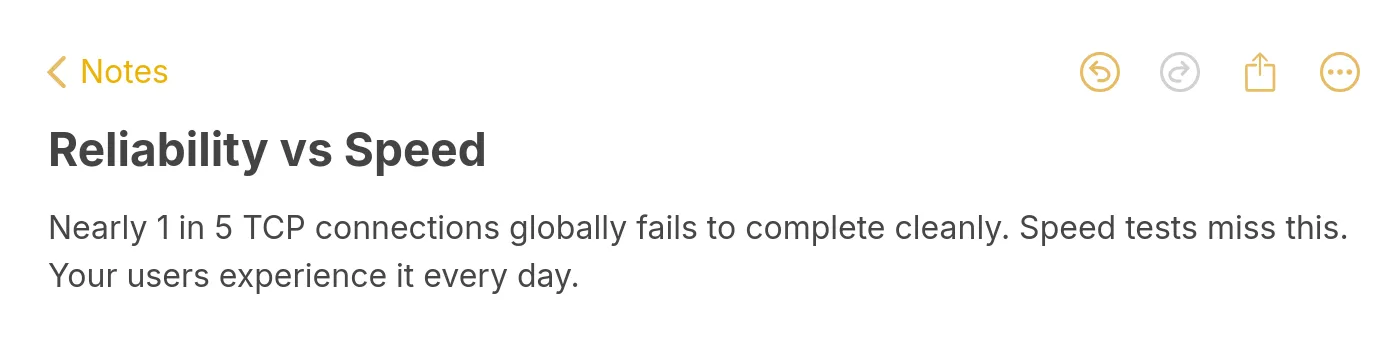
Here's the number that should make infrastructure teams pay attention. The global TCP healthy rate in April 2026 sits at 78.88%. Roughly 1 in every 5 TCP connections globally hits a reset or a timeout before completing cleanly. That failure rate is invisible to every speed ranking on the SERP. For broader context on what flows through Cloudflare's network, see our Q1 2026 web traffic statistics.
When a TCP connection fails, one of three things happens at the application layer:
- The user sees a spinning loader until the browser retries.
- A background API call silently fails and corrupts local state.
- A long-lived connection (video call, database session, WebSocket) drops mid-session.
None of those problems show up in a 30-second speed test. All of them tank retention.
How we measured TCP connection quality across 83 countries
Our dataset comes from Cloudflare Radar's TCP connection quality API, which classifies every TCP flow observed across Cloudflare's network into one of five outcomes:
| Outcome | What it means |
|---|---|
no_match (healthy) |
The flow completed cleanly with no reset or timeout pattern. |
post_syn |
Reset arrived right after the client's initial SYN. Classic middlebox or firewall RST injection. |
post_ack |
Reset arrived after the handshake completed. Usually stateful filtering, DPI, or mid-session drops. |
post_psh |
Reset arrived after the first data push. Less common, often protocol-specific blocking. |
later_in_flow |
Reset arrived mid-stream. Usually congestion, packet loss, or last-mile instability. |
We took the aggregated country-level numbers over a 28-day window from March 23 to April 20, 2026. That window is long enough to absorb short-lived incidents and short enough to reflect current infrastructure. Global healthy rate for the window was 78.88%, with post_syn resets contributing 10.35%, later_in_flow resets 6.74%, post_ack resets 3.18%, and post_psh resets 0.85%. For the responsiveness section (latency, jitter, packet loss, and upload), we separately queried Cloudflare's quality/speed/summary endpoint over a 90-day window ending June 9, 2026 — these are measured millisecond and percent values, distinct from the TCP-flow classification used for the reliability rankings.
A few caveats before the rankings. Cloudflare's network observes traffic to and from sites that use Cloudflare, not the entire internet. That sample is large (we're talking hundreds of billions of flows), but it does tilt toward web traffic (HTTPS, API calls, video streaming origins) rather than, say, peer-to-peer gaming or VPN tunneling. Countries where a large share of traffic is government-filtered or routed through national firewalls will look worse on Cloudflare's sample than on a domestic-only test, because Cloudflare's servers sit outside the filtering boundary. That's a feature, not a bug. It's exactly what your global users experience when they try to reach your non-local app.
We also cross-referenced Cloudflare Radar's outage annotations for any country with an anomalous score. The only relevant annotation in our window was Iran's February 28, 2026 internet shutdown amid military actions, flagged via the Cloudflare Radar Outage Center and covered in detail in our Q1 2026 internet outage tracker. Iran's healthy rate since recovery sits at 68.73%.
Top 20 countries with the most reliable internet connections in 2026
The five most reliable countries for TCP connections in 2026 are:
- Singapore, 91.52%
- Israel, 91.49%
- Denmark, 90.19%
- Latvia, 88.54%
- Vietnam, 88.20%
Here's the full top 20 with region breakdown.
Most Reliable Internet in 2026: Top 20 Countries by TCP Healthy Rate
Singapore leads global TCP connection reliability in 2026 at 91.52%, followed by Israel (91.49%) and Denmark (90.19%). Nordic and Baltic countries dominate the top 10 despite rarely appearing in 'fastest internet' rankings. Vietnam at 88.20% is the biggest surprise, beating South Korea (85.65%) and the United States (85.16%).
Source: Cloudflare Radar · March 23 – April 20, 2026
| Label | TCP Healthy Rate (%) |
|---|---|
| Singapore | 91.52% |
| Israel | 91.49% |
| Denmark | 90.19% |
| Latvia | 88.54% |
| Vietnam | 88.2% |
| Norway | 87.98% |
| Portugal | 87.05% |
| Germany | 86.86% |
| France | 86.75% |
| Japan | 86.52% |
| Italy | 86.3% |
| Australia | 86.25% |
| Netherlands | 86% |
| Canada | 85.92% |
| South Korea | 85.65% |
| Luxembourg | 85.6% |
| Slovakia | 85.36% |
| Switzerland | 85.3% |
| United States | 85.16% |
| Hong Kong | 85.05% |
- Singapore and Israel are effectively tied at 91.52% and 91.49%
- Denmark, Latvia, and Norway all beat South Korea and the United States despite lower average broadband speeds
- Vietnam at 88.20% outranks every G7 nation except Italy and Germany
- The global average TCP healthy rate is 78.88%; every country in this top 20 beats that by 6 to 13 percentage points
| Rank | Country | TCP Healthy Rate | Region |
|---|---|---|---|
| 1 | Singapore | 91.52% | Asia |
| 2 | Israel | 91.49% | Middle East |
| 3 | Denmark | 90.19% | Europe |
| 4 | Latvia | 88.54% | Europe |
| 5 | Vietnam | 88.20% | Asia |
| 6 | Norway | 87.98% | Europe |
| 7 | Portugal | 87.05% | Europe |
| 8 | Germany | 86.86% | Europe |
| 9 | France | 86.75% | Europe |
| 10 | Japan | 86.52% | Asia |
| 11 | Italy | 86.30% | Europe |
| 12 | Australia | 86.25% | Oceania |
| 13 | Netherlands | 86.00% | Europe |
| 14 | Canada | 85.92% | North America |
| 15 | South Korea | 85.65% | Asia |
| 16 | Luxembourg | 85.60% | Europe |
| 17 | Slovakia | 85.36% | Europe |
| 18 | Switzerland | 85.30% | Europe |
| 19 | United States | 85.16% | North America |
| 20 | Hong Kong | 85.05% | Asia |
Singapore's 91.52% is the kind of number that only happens when a country combines dense subsea cable landings, a small geographic footprint, and tight peering discipline. Every major cloud region (AWS, Google Cloud, Microsoft Azure) has a Singapore presence because of exactly this. It's the least-painful place on earth to terminate a TCP session.
Israel at 91.49% is a more surprising result. Israel has strong fiber backbone penetration and an outsized concentration of cloud edge infrastructure for its population size, and the numbers show it.
The Nordic and Baltic overperformance is the other story here. Denmark (90.19%), Latvia (88.54%), and Norway (87.98%) all outrank South Korea (85.65%) and the Netherlands (86.00%) on TCP reliability, despite not appearing in most "fastest internet" rankings. The Nordics made early investments in full-fiber rollouts and tightly regulated their ISPs for uptime guarantees. That shows up here.
The real eyebrow-raiser is Vietnam at 88.20%. Vietnam's average broadband speed is a fraction of South Korea's, but its TCP healthy rate beats it. We'll come back to this in the reliability gap section. It's the clearest example of why speed rankings mislead.
The 10 countries with the worst TCP connection quality
At the other end of the table, the results are brutal. Four of the bottom five countries are in sub-Saharan Africa, and Iraq is an outlier so extreme it distorts the global chart.
Worst Internet Reliability in 2026: Bottom 10 Countries by TCP Healthy Rate
Iraq is the worst national TCP performance globally at 30.68%, with nearly two out of three connections reset immediately after the initial SYN. Four of the bottom five countries are in sub-Saharan Africa. Kenya, Myanmar, Uganda, and Tanzania all sit below 52% healthy connections, a pattern driven by stateful middlebox saturation rather than raw infrastructure weakness.
Source: Cloudflare Radar · March 23 – April 20, 2026
| Label | TCP Healthy Rate (%) |
|---|---|
| Iraq | 30.68% |
| Kenya | 42.48% |
| Myanmar | 43.91% |
| Uganda | 46.51% |
| Tanzania | 51.28% |
| Sri Lanka | 55.36% |
| Morocco | 57.93% |
| Saudi Arabia | 58.34% |
| Pakistan | 58.78% |
| South Africa | 58.9% |
- Iraq's 30.68% is 60 percentage points below Singapore and 48 points below the global average
- Iraq's reset pattern is 65.93% post_syn — a textbook signature of firewall RST injection
- The sub-Saharan African cluster (Kenya, Uganda, Tanzania, South Africa) shares a post_ack reset signature, suggesting common last-mile infrastructure limits
- Saudi Arabia ranks in global top 10 for mobile speed but bottom 10 for TCP reliability
| Rank (from bottom) | Country | TCP Healthy Rate | Region | Dominant Reset Type |
|---|---|---|---|---|
| 1 | Iraq | 30.68% | Middle East | post_syn (65.93%) |
| 2 | Kenya | 42.48% | Africa | post_ack (33.70%) |
| 3 | Myanmar | 43.91% | Asia | post_ack (43.23%) |
| 4 | Uganda | 46.51% | Africa | post_ack (37.14%) |
| 5 | Tanzania | 51.28% | Africa | post_ack (32.96%) |
| 6 | Sri Lanka | 55.36% | Asia | post_ack (25.46%) |
| 7 | Morocco | 57.93% | Africa | post_ack (26.12%) |
| 8 | Saudi Arabia | 58.34% | Middle East | post_ack (7.70%) |
| 9 | Pakistan | 58.78% | Asia | post_ack (20.06%) |
| 10 | South Africa | 58.90% | Africa | post_ack (24.72%) |
Iraq at 30.68% is the worst national TCP performance in our dataset. Nearly two out of every three TCP flows (65.93%) hit a reset immediately after the initial SYN. That pattern doesn't happen by accident. post_syn resets at that volume are a signature of active middlebox interference, usually a state-operated or ISP-operated firewall injecting RST packets to kill connections during the handshake. For comparison, the global average for post_syn resets is 10.35%. Iraq is running six times that rate. Update (June 2, 2026): This signature didn't last — see the June 2026 update section near the top of this post. In a fresh May 5 to June 2 window, Iraq's post_syn rate fell to 10.81% and its healthy rate jumped to 80.33%, above the global average. The April reading captured an interference window, not a steady state.
The African cluster tells a different story. Kenya (42.48%), Uganda (46.51%), Tanzania (51.28%), Morocco (57.93%), and South Africa (58.90%) all sit between 42% and 59% healthy, and their reset signature is overwhelmingly post_ack, not post_syn. Uganda's post_ack rate is 37.14%. Tanzania's is 32.96%. Kenya's is 33.70%. Morocco's is 26.12%. When resets arrive after the handshake, that's almost always stateful infrastructure (often last-mile CPE, carrier-grade NAT, or DPI equipment) dropping sessions mid-flow because state tables overflow or timeouts are mistuned. This is less about censorship and more about under-provisioned network equipment handling high connection counts.
Myanmar's 43.91% is a third pattern again. The country has been in sustained infrastructure crisis since the 2021 military takeover, and the post_ack rate of 43.23% reflects that. Sessions establish, then something (often deliberate) kills them.
Regional breakdown: TCP reliability across Europe, Asia, the Americas, Africa, and the Middle East
Regional averages clarify where the global TCP reliability story really lives.
TCP Connection Quality by Region in 2026: Africa Trails by 28 Points
Developed Asia leads global TCP reliability at 86.1% healthy connections, followed closely by Western Europe at 85.8%. Africa trails every other region at 57.9% — more than 20 points below the global average of 78.88%. The Middle East has the widest intra-regional spread on earth, driven by Israel (91.49%) and Iraq (30.68%) at opposite extremes.
Source: Cloudflare Radar · March 23 – April 20, 2026
| Label | Average TCP Healthy Rate (%) |
|---|---|
| Asia (Developed) | 86.1% |
| Western Europe | 85.8% |
| North America | 81.7% |
| Asia (Emerging) | 75.2% |
| South America | 73.1% |
| Middle East | 71.7% |
| Africa | 57.9% |
- Developed Asia and Western Europe are tied within 0.3 points
- Africa sits 28 points below the leading region — the largest continental gap
- The Middle East regional average hides the biggest spread globally (Israel 91.49% to Iraq 30.68%)
- North America underperforms Europe by 4 points despite higher cloud infrastructure density
| Region | Average TCP Healthy Rate | Notes |
|---|---|---|
| Asia (Developed) | 86.1% | Singapore, Japan, South Korea, Hong Kong, Taiwan all land 82 to 92% |
| Western Europe | 85.8% | Nordic + core EU sit 84 to 90%, Bulgaria is the outlier |
| North America | 81.7% | US and Canada strong; Mexico drags the average |
| Asia (Emerging) | 75.2% | India, Indonesia, Philippines, Thailand, Vietnam cluster 70 to 88% |
| South America | 73.1% | Wide spread: Chile 79%, Brazil 67%, Ecuador 68% |
| Middle East | 71.7% | Israel at 91% is an extreme outlier; Iraq at 31% is worst globally |
| Africa | 57.9% | Most TCP-unstable continent; Kenya, Uganda, Tanzania all below 52% |
Europe is tighter than expected once you look past the top line. Denmark, Norway, Germany, and France all land in the 86 to 90% band, but Bulgaria sits at 61.68%, the worst European score, and 18 points below neighboring Serbia (84.91%) and Romania (79.70%). Bulgaria's post_syn reset rate is 30.56%, the second-highest we measured globally after Iraq. That's a filtering fingerprint I genuinely did not expect inside the EU, and it's worth a closer look by anyone routing traffic through Bulgarian ISPs.
Asia splits hard between developed and emerging economies. Developed Asia (Singapore, Japan, Hong Kong, Taiwan, South Korea) clusters at 82 to 92%. Emerging Asia spreads from Vietnam's impressive 88.20% down to Bangladesh at 71.51% and Pakistan at 58.78%. The regional outlier is China at 61.91%. We'll cover that in the reset patterns section because the signature is too specific to ignore.
The Americas are a two-tier system. The US (85.16%) and Canada (85.92%) are solid. Mexico (74.08%), Brazil (66.61%), and Ecuador (67.55%) pull the continental average down hard. Brazil deserves a callout: its 24.31% post_syn reset rate is the fourth-worst globally, a pattern that hints at aggressive ISP-level filtering rather than raw infrastructure weakness. Update (June 2, 2026): This proved transient. By the May 5 to June 2 window, Brazil's post_syn rate had fallen to 5.83% and its healthy rate recovered to 85.92%. The April spike was an event, not a structural filtering policy.
The Middle East has the biggest intra-regional spread on earth. Israel (91.49%) is at the top. Iraq (30.68%) is at the bottom. That's a 60.81-point gap inside a single region, driven almost entirely by political and censorship factors rather than economic ones.
Africa is where the analysis gets uncomfortable. The continental average is 57.9%, more than 20 points below the global mean. Many of these same markets dominate mobile internet usage by country, so the reset patterns hit a predominantly mobile-first audience. No African country in our sample clears 80%. Egypt leads the region at 79.03%, followed by Algeria at 68.85% and Nigeria at 68.47%. Everything below that tells a story of under-invested last-mile infrastructure, saturated international transit, and stateful filtering equipment operating at its limits.
The reliability gap: countries that beat their speed rank (and countries that fail it)
This is the section I care about most. When we processed the country-level data and compared it to the general shape of Ookla's speed rankings, a specific pattern emerged: some countries punch far above their speed rank on reliability, and others punch far below it.
The Reliability Gap: Countries That Beat or Fail Their Speed Rank on TCP (2026)
Speed rankings and TCP reliability rankings often disagree. Vietnam, Portugal, Italy, Israel, and Latvia all beat much faster countries on TCP healthy rate. Finland, the UK, the US, and Taiwan all underperform their speed rankings. The gap proves peak throughput and connection integrity are separate metrics — and infrastructure teams need both.
Source: Cloudflare Radar · March 23 – April 20, 2026
| Label | TCP Healthy Rate (%) |
|---|---|
| Israel | 91.49% |
| Latvia | 88.54% |
| Vietnam | 88.2% |
| Portugal | 87.05% |
| Italy | 86.3% |
| Canada | 85.92% |
| United States | 85.16% |
| United Kingdom | 83.23% |
| Taiwan | 82.42% |
| Finland | 81.35% |
- Vietnam beats South Korea (85.65%), Japan (86.52%), and the United States (85.16%) despite a fraction of their broadband speeds
- Portugal (87.05%) outperforms Switzerland (85.30%) and Ireland (84.59%) in TCP reliability
- Finland at 81.35% is the biggest Western European underperformer — its post_syn reset rate (11.60%) is higher than peer countries
- The US ranks 19th globally on reliability despite dominating most speed rankings
The biggest over-performers are countries with moderate speed but excellent TCP reliability. Vietnam at 88.20% is the poster child. Vietnam's average broadband speed is well below South Korea's, Japan's, or the US's, yet its TCP healthy rate beats all three. South Korea sits at 85.65%. The US at 85.16%. Japan at 86.52%. Vietnam outranks every one. The reason is prosaic: Vietnam has invested heavily in submarine cable diversity and domestic peering, and its networks aren't under the kind of consolidation pressure that degrades connection integrity in mature markets.
Portugal (87.05%) beats Switzerland (85.30%) and Ireland (84.59%) despite not appearing anywhere near the top of speed rankings. Italy (86.30%) beats the Netherlands (86.00%), despite being a speed laggard within Western Europe for years. Israel (91.49%) is probably the most extreme over-performer globally once you control for broadband speed. Israel's infrastructure investment is disproportionate to its GDP, and it shows. Latvia (88.54%) beats Finland (81.35%), Lithuania (83.11%), and Poland (82.95%) inside the Baltic/Nordic cluster.
The underperformers are countries with strong speed rankings but mediocre TCP reliability. Finland at 81.35% is the most surprising Western European underperformer. Finland's post_syn reset rate is 11.60%, noticeably higher than peers. Finland's fiber rollout is excellent, but something at the middlebox or peering layer is degrading the healthy rate.
The United Kingdom at 83.23% sits below Germany, France, Portugal, Italy, and Austria. The UK's post_syn reset rate (8.38%) is within global norms, but later_in_flow resets (7.47%) suggest distribution-layer instability.
The United States at 85.16% underperforms what you'd expect from a country with its cloud infrastructure density. Fifteen countries rank above the US on TCP reliability. Canada beats the US slightly at 85.92%.
Taiwan at 82.42% underperforms neighboring Japan (86.52%) and Hong Kong (85.05%), with a high post_syn reset rate of 10.21%.
The takeaway from the gap analysis: speed rank and reliability rank are not the same thing. They're correlated, but the correlation is weaker than most people assume. If you're choosing edge regions for a global SaaS deployment based on speed rankings alone, you're picking the wrong inputs.
The third axis: latency, jitter, and packet loss (responsiveness, not speed)
I just spent a section arguing that speed rank and reliability rank are different things. Here's the part that surprised even me when I pulled it: there's a third axis, and it doesn't line up with either of the first two. Call it responsiveness — how quickly and how consistently a connection moves the first packet, not how much total bandwidth it can eventually sustain. It's the layer that decides whether a video call stutters, whether a game feels laggy, whether a checkout button responds the instant you tap it. Cloudflare's quality/speed/summary endpoint exposes it directly: idle latency, latency under load, jitter, and packet loss. I pulled it for the same countries above (90-day window ending June 9, 2026; these are real measured values in ms and percent, not an index).
| Country | Idle latency | Loaded latency | Idle jitter | Packet loss | Upload (Mbps) |
|---|---|---|---|---|---|
| South Korea | 34.2 ms | 124.5 ms | 14.4 ms | 0.07% | 188.6 |
| France | 46.5 ms | 151.3 ms | 16.1 ms | 0.02% | 148.7 |
| Japan | 49.0 ms | 144.5 ms | 18.4 ms | 0.13% | 124.8 |
| Brazil | 50.6 ms | 136.2 ms | 16.7 ms | 0.41% | 132.9 |
| Germany | 52.7 ms | 140.6 ms | 18.7 ms | 0.10% | 47.6 |
| India | 61.8 ms | 249.9 ms | 22.7 ms | 0.16% | 51.2 |
| United States | 62.0 ms | 173.8 ms | 20.1 ms | 0.09% | 74.1 |
| Vietnam | 66.9 ms | 157.4 ms | 17.6 ms | 0.20% | 113.6 |
| Netherlands | 71.7 ms | 176.0 ms | 24.5 ms | 0.16% | 94.1 |
| Singapore | 81.2 ms | 210.6 ms | 31.3 ms | 0.54% | 102.4 |
| Nigeria | 187.8 ms | 522.9 ms | 35.2 ms | 0.22% | 13.5 |
| China | 215.4 ms | 364.9 ms | 53.0 ms | 10.25% | 34.1 |
| Global | 97.8 ms | 250.9 ms | 28.9 ms | 2.30% | 61.1 |
Read it against the reliability table and the disconnect is immediate. South Korea has the best responsiveness in the set — 34 ms idle latency, 14 ms jitter, 0.07% loss — yet it ranks only 15th on TCP reliability (85.65%). Singapore is the inverse: the most TCP-reliable country on earth (91.52%) sits near the bottom of this table for idle latency at 81 ms, higher than India or the US. A flow to a Singapore origin almost always completes cleanly; it just takes longer to feel snappy. Reliability and responsiveness are genuinely separate properties, and a single "best internet" headline can't hold both.
The most operationally useful column is the one people never look at: loaded latency. Idle latency is your ping to an unloaded link — the marketing number. Loaded latency is what happens to that ping when the connection is actually saturated, and the gap between the two is bufferbloat. India is the cautionary tale: a respectable 62 ms idle ping balloons to 250 ms under load — a 4× inflation that turns a usable connection into a video-call nightmare the moment someone else on the network starts an upload. Nigeria runs the same pattern harder (188 ms → 523 ms). If you only ever quote idle latency, you'll badly overpromise what these markets feel like during real use.
Packet loss is where one country stops being a "laggard" and becomes a category of its own. Almost every market here, including the slow ones, keeps loss under 0.6% — Nigeria is only 0.22%, its problems are distance and jitter, not loss. China sits at 10.25%, more than forty times Nigeria's rate and four times the global average. That's the responsiveness fingerprint of the same interference that drags China's TCP healthy rate to 61.91%: it isn't a slow network, it's an actively lossy one, and lossy networks punish exactly the long-lived connections (video, database sessions, WebSockets) that this whole post is about.
Finally, the upload column is the cut that bandwidth rankings bury. Download numbers get all the headlines, but remote work, cloud backups, video calls, and content upload all live on the upstream path. The split here is architectural: South Korea (188 Mbps up), France (149), and Brazil (133) run near-symmetric fiber, while the United States (74 up against 261 down) and Germany (48 up against 166 down) carry the lopsided signature of legacy cable and DSL plant. A team picking a region for an upload-heavy workload should weight that asymmetry far more than the download figure on the box. The takeaway compounds the reliability-gap point from the last section: there are at least three independent axes here — reliability, responsiveness, and raw speed — and no country tops all three. Pick the axis your application actually lives on before you pick a region.
What TCP reset patterns reveal about each country's network infrastructure

The metric we care about most, the TCP healthy rate, is the outcome. The reset type tells you the cause. Three reset fingerprints recur across our dataset, and each one points to a different kind of infrastructure problem.
post_syn dominance = firewall or middlebox RST injection
When post_syn resets dominate a country's reset mix, you're looking at active interference during the TCP handshake. A middlebox (firewall, DPI box, or RST injector) sees the initial SYN, decides it doesn't like the destination, and sends a RST packet back to the client before the server's SYN-ACK can arrive. The connection never completes.
Firewall Fingerprint: Top Countries by post_syn TCP Reset Rate in 2026
When post_syn resets dominate a country's TCP failure mix, it points to active middlebox or firewall interference during the handshake. Iraq leads globally at 65.93% — more than 6x the global average of 10.35%. Bulgaria, China, and Brazil all exceed 24%, signatures consistent with state-operated or ISP-operated RST injection.
Source: Cloudflare Radar · March 23 – April 20, 2026
| Label | post_syn Reset Rate (%) |
|---|---|
| Iraq | 65.93% |
| Bulgaria | 30.56% |
| China | 26.43% |
| Brazil | 24.31% |
| Ghana | 18.41% |
| Kenya | 17.16% |
| Venezuela | 15.48% |
| Armenia | 14.94% |
- Iraq's 65.93% post_syn rate is 6x the global average of 10.35%
- Bulgaria is the largest European anomaly — neighboring Serbia and Romania sit at 6.79% and 6.74%
- China's 26.43% is consistent with long-documented Great Firewall RST injection against Cloudflare-hosted sites
- post_syn dominance = active filtering, not infrastructure weakness. Fix is policy, not physical.
Countries in our dataset with post_syn dominance:
- Iraq, 65.93%. By far the most extreme
post_synsignature globally. - Bulgaria, 30.56%. The largest European anomaly in our dataset.
- China, 26.43%. Consistent with long-documented Great Firewall behavior, particularly against traffic heading to sites using Cloudflare.
- Brazil, 24.31%. Surprising, and worth investigating further. This is higher than most ISP-level filtering would produce.
- Ghana, 18.41%.
- Kenya, 17.16%.
- Venezuela, 15.48%.
- Armenia, 14.94%.
post_ack dominance = stateful middlebox or last-mile filtering
post_ack resets happen after the handshake completes. The connection is established, sometimes data flows, then something kills it. This pattern usually points to stateful infrastructure (carrier-grade NAT, DPI equipment, or overloaded session-tracking boxes) that's either intentionally filtering mid-session or can't keep state tables in sync at scale.
Middlebox Saturation: Top Countries by post_ack TCP Reset Rate in 2026
post_ack resets happen after the TCP handshake completes, pointing to stateful middleboxes, carrier-grade NAT, or DPI equipment dropping sessions mid-flow. Myanmar leads at 43.23%, followed by a sub-Saharan African cluster (Uganda, Kenya, Tanzania). The geographic clustering is strong evidence of shared infrastructure characteristics rather than isolated ISP incidents.
Source: Cloudflare Radar · March 23 – April 20, 2026
| Label | post_ack Reset Rate (%) |
|---|---|
| Myanmar | 43.23% |
| Uganda | 37.14% |
| Kenya | 33.7% |
| Tanzania | 32.96% |
| Morocco | 26.12% |
| Sri Lanka | 25.46% |
| South Africa | 24.72% |
| Pakistan | 20.06% |
| Iran | 18.96% |
| Uruguay | 17.93% |
| Azerbaijan | 14.44% |
- Myanmar's 43.23% reflects sustained infrastructure disruption since the 2021 military takeover
- Uganda, Kenya, Tanzania, and South Africa cluster at 24-37% post_ack — a shared sub-Saharan signature
- Iran's residual post_ack rate follows Cloudflare Radar's February 28, 2026 outage annotation during recovery
- post_ack dominance = stateful equipment limits, not censorship. Fix is capacity and tuning, not policy.
The sub-Saharan African cluster dominates this pattern:
- Myanmar, 43.23%.
- Uganda, 37.14%.
- Kenya, 33.70%.
- Tanzania, 32.96%.
- Morocco, 26.12%.
- Sri Lanka, 25.46%.
- South Africa, 24.72%.
- Pakistan, 20.06%.
- Iran, 18.96%. (See the Cloudflare Radar Outage Center annotation about the February 2026 shutdown. The residual
post_ackrate is consistent with ongoing filtering during recovery.) - Uruguay, 17.93%.
- Azerbaijan, 14.44%.
The geographic clustering (Uganda, Kenya, Tanzania, Morocco, South Africa all in post_ack territory) is the strongest evidence in the dataset that shared infrastructure characteristics (CGNAT pools, common equipment vendors, or regional filtering norms) are driving the resets, not isolated ISP incidents.
later_in_flow dominance = congestion and last-mile instability
When resets happen deep in the flow, neither the firewall nor the middlebox is interfering. The network itself is failing to carry the traffic. This pattern correlates with packet loss, buffer bloat, and saturated last-mile links.
Congestion Fingerprint: Top Countries by later_in_flow TCP Reset Rate in 2026
later_in_flow resets happen deep into an established TCP session, pointing to raw network carrying failures — packet loss, buffer bloat, saturated last-mile links. Unlike post_syn (firewall) or post_ack (middlebox), this pattern is physical. Ecuador leads at 15.80%, followed by Peru, Ukraine, Bangladesh, and several congested Eastern European networks.
Source: Cloudflare Radar · March 23 – April 20, 2026
| Label | later_in_flow Reset Rate (%) |
|---|---|
| Ecuador | 15.8% |
| Peru | 10.78% |
| Ukraine | 10.41% |
| Bangladesh | 10.41% |
| Georgia | 10.19% |
| Slovenia | 10.12% |
| Greece | 9.94% |
| Croatia | 9.86% |
| Hungary | 9.83% |
| Chile | 9.83% |
- Ecuador's 15.80% is 2.3x the global average of 6.74% for later_in_flow resets
- Slovenia, Croatia, Hungary, and Greece share a congestion pattern despite being EU members
- later_in_flow dominance = physical network limits, not filtering. Fix is fiber, peering, and capacity.
- The three reset fingerprints (post_syn, post_ack, later_in_flow) need three different mitigation strategies
Countries where later_in_flow resets are the largest component of the overall failure rate:
- Ecuador, 15.80%.
- Peru, 10.78%.
- Ukraine, 10.41%.
- Bangladesh, 10.41%.
- Georgia, 10.19%.
- Slovenia, 10.12%.
- Croatia, 9.86%.
- Hungary, 9.83%.
- Greece, 9.94%.
- Chile, 9.83%.
The European countries in this group are interesting. They're not filtering-heavy, they just have congested last-mile networks. The fix is physical (more fiber, better peering). The fix for post_syn dominance is policy (fewer middleboxes, less filtering). These are very different problems and they need different mitigation strategies at the application layer.
Why traditional "fastest internet" rankings mislead global SaaS teams
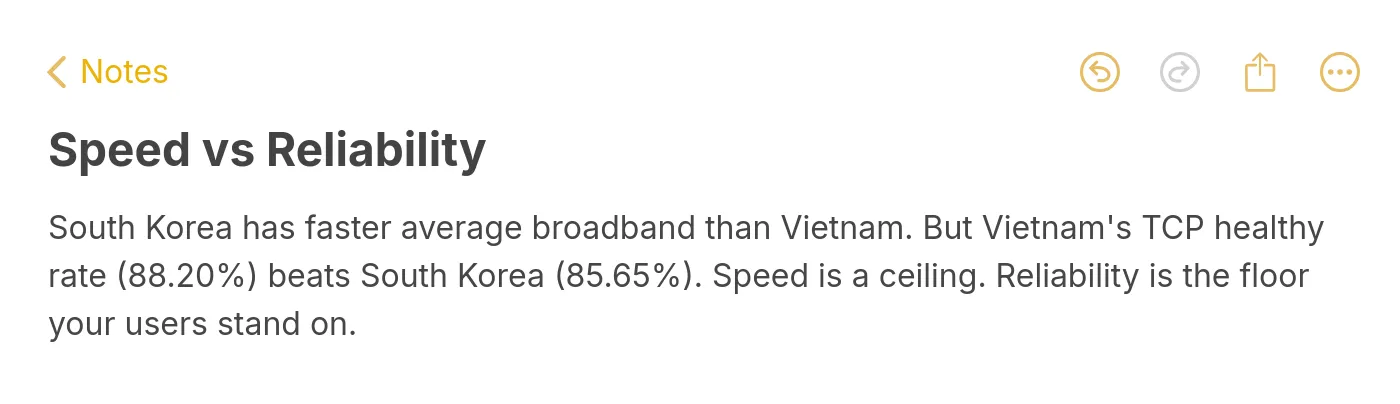
The dominant ranking format in this keyword space (the Speedtest Global Index, Wikipedia's country speed lists, VPN blog roundups) all share one flaw: they measure peak throughput, not connection integrity. They're useful for answering "can my user download a 4K video here?" They're useless for answering "will my SaaS app maintain a reliable session with this user?"
Here's the concrete mismatch. In most published speed rankings you'll see:
- South Korea near the top (because of its average fixed broadband speed).
- Singapore near the top (reliable ranker).
- The UAE and Saudi Arabia in the top 10 (their mobile speeds are genuinely high).
- The US somewhere in the top 10 to 15.
Now look at those same countries on TCP healthy rate:
- South Korea, 85.65% (rank 15 in our data).
- Singapore, 91.52% (rank 1, consistent).
- UAE, 77.12% (below the global average).
- Saudi Arabia, 58.34% (bottom 10).
- United States, 85.16% (rank 19, below Canada).
Saudi Arabia is the most dramatic example. Its mobile speed tests regularly land in global top-10 lists. Its TCP healthy rate is in the bottom 10. What SaaS users in Saudi Arabia experience is lightning-fast downloads intermittently punctuated by session drops and failed API calls. You can't see that in a speed chart.
For infrastructure teams, this matters in three concrete ways.
Region selection is the first. If you're picking a cloud region to serve a country, the speed ranking tells you how fat the pipe is. The TCP healthy rate tells you how likely the pipe is to break mid-transfer. Both matter. Only one of them is usually available to your architecture team.
SLO setting is the second. If you're setting availability SLOs for a region where TCP healthy rate is below 80%, your p99 latency will look terrible regardless of your application code. The underlying network is dropping 20% of flows before your code ever runs.
Monitoring strategy is the third. Traditional synthetic monitoring that pings from inside a cloud region will never detect the reset patterns that dominate real user experience. You need external probes, and you need them from the countries where your users actually live.
How to build reliable global applications on top of variable TCP environments

If your user base includes a meaningful percentage of connections from the bottom half of this ranking, your application architecture needs to assume TCP unreliability as a baseline. Here's what actually works, in rough priority order.
1. Put a global CDN edge in front of every origin
Terminating TLS at a CDN edge close to the user shortens the TCP round-trip that's vulnerable to resets. A connection from Lagos to a Frankfurt origin traverses many more hops than a connection from Lagos to a Cloudflare or Fastly edge node in Lagos or Johannesburg. Fewer hops, fewer places a middlebox can interfere. This is the highest-ROI change for global reliability. Cloudflare, Fastly, Akamai, and AWS CloudFront all do this; the CDN category covers the main options in depth.
2. Adopt HTTP/3 (QUIC) wherever you can
This is the structural fix, not a workaround. HTTP/3 runs over QUIC, which uses UDP rather than TCP and does its own connection establishment, encryption, and reliability inside the protocol. Our analysis of HTTP protocol adoption in 2026 shows HTTP/3 has plateaued at ~30% globally while HTTP/1.x still holds 27.8%. Many of the middleboxes that inject RST packets against TCP flows either don't touch UDP or can't interpret QUIC's encrypted handshake at all. QUIC is specified in RFC 9000, and every major CDN and browser supports it. Turning on HTTP/3 at your edge is a single flag flip that can measurably improve healthy connection rate for users in high-post_syn countries.
⚠️ The HTTP/3 and HTTP/1.x shares in this paragraph are superseded and preserved as originally published. On Cloudflare's revised series, HTTP/3 carried 20.17% of requests in Q3 2026 and HTTP/1.x 27.37% (see the HTTP protocol adoption report).
3. Deploy to multiple cloud regions per market
If you're serving users in emerging Asia, don't route them to a single us-east origin. Use regional deployments. AWS, Google Cloud, and Microsoft Azure all support multi-region deployment with global load balancing. The PaaS category has profiles of the main providers and what regions they cover.
4. Build retry logic that distinguishes reset types
A naive retry loop treats every failure the same. A smarter one looks at whether the failure was on connection establishment (retry with a different path immediately), mid-session (retry the request, not the connection), or at the TLS layer (retry against a different edge). Exponential backoff with jitter is the minimum. Routing retries through a different POP is better.
5. Run synthetic monitoring from diverse geographies
Don't measure reliability from inside your cloud region. Measure it from the countries where your users live. Real user monitoring captures actual session outcomes, and synthetic monitoring from globally distributed probes captures what your infrastructure looks like to someone in Nairobi or Karachi. Both are necessary. Neither is sufficient on its own.
6. Use edge workers for retry and routing logic
Putting smart retry logic at the edge (via Cloudflare Workers or similar serverless edge platforms) keeps the retry close to the user and avoids sending a doomed request back to origin. This is particularly helpful in post_ack countries where the handshake succeeds but the session dies partway through. An edge worker can catch the reset, re-establish through a different path, and complete the request transparently.
7. Measure your healthy rate per user segment, not just globally
Your aggregate healthy rate might be 95%. For your Kenyan users it might be 42%. If you don't segment by country, you'll never see the Kenyan users churning silently. Add country-level breakdowns to your error dashboards. The countries in the bottom half of our ranking deserve their own SLO budgets.
Frequently asked questions
Which country has the most reliable internet connection?
Singapore, on the Q3 2026 quarter: 92.62% of its TCP connections completed without a reset or timeout, ahead of Israel (91.07%) and Denmark (90.00%). The lead is not settled. Israel was ahead in July, and Singapore led August, September and the last week of September. (Source: Cloudflare Radar tcp_resets_timeouts/summary, Q3 2026, September provisional.)
The July 2026 answer, preserved as published: Israel has the most reliable internet connection as of July 2026, with a TCP healthy rate of 92.42%, ahead of Singapore at 90.77%. Israel led in every individual week of the month. This is a change from earlier 2026 editions of this report, when Singapore held the top spot. (Source: Cloudflare Radar tcp_resets_timeouts/summary, July 2026.)
Which country has the worst internet reliability?
Myanmar, at 42.04% healthy in Q3 2026 and 37.64% in September, the lowest of the 86 countries tracked. Kenya (43.48%), Uganda (47.52%), Tanzania (50.02%) and Ethiopia (50.26%) follow. Myanmar's connections fail after the handshake: 44.32% of its flows were reset at the post_ack stage in Q3. (Source: Cloudflare Radar tcp_resets_timeouts/summary, Q3 2026, September provisional.)
The July 2026 answer, preserved as published: As of July 2026 the weakest country measured is Kenya at 42.34% healthy, followed by Myanmar (46.72%), Uganda (47.48%) and Tanzania (49.10%). Kenya is the only one carrying both failure signatures at once, with post_syn at 24.17% and post_ack at 26.47%. Iraq, described below as the worst performer, has since recovered to 79.47%. The rest of this answer is preserved as originally published. (Source: Cloudflare Radar tcp_resets_timeouts/summary, July 2026.)
In the April 2026 window, Iraq had the worst TCP connection quality globally at 30.68%, with 65.93% of all flows resetting immediately after the initial SYN — a signature of active middlebox or firewall interference during connection setup. But that was an interference window, not a steady state: a June 2026 re-measure (May 5 to June 2) shows Iraq recovered to 80.33% as its post_syn rate fell to 10.81%. Then the full second quarter of 2026 (April 1 to June 30) put Iraq back at 53.12% healthy with its post_syn rate near 41%. The June recovery was another temporary window, not a fix, which is why a single reading should be treated as an event, not a verdict. The most persistent poor performers are the post_ack cluster, where failures are structural rather than political — Kenya (43.03%), Myanmar (43.85%), and Uganda (46.36%) all stayed within a point or two of their April scores across six weeks, and over a full year Uganda moved just a tenth of a point. Among major economies, Bulgaria (54.21% for Q2 2026) has the worst active-filtering signature, with a post_syn rate that worsened to nearly 39% across the quarter.
How is TCP connection quality measured?
TCP connection quality is measured by classifying every TCP flow into one of five outcomes: healthy (completed without a reset), post_syn reset (handshake interrupted), post_ack reset (session killed after handshake), post_psh reset (dropped after data push), or later_in_flow reset (mid-stream failure). The "healthy rate" is the percentage of flows that fall into the first category. Cloudflare Radar publishes these numbers per country based on observed traffic across its global network.
Why is TCP reliability different from internet speed?
Speed measures how much data can move over a connection per second once it's established. Reliability measures how often connections are successfully established and maintained at all. A country can have fast fiber (high speed) and aggressive middleboxes (low reliability) at the same time. That's why Saudi Arabia appears in most speed rankings but sits in the global bottom 10 on TCP healthy rate. Speed tests never see the connections that never complete.
Which European countries have the best TCP performance?
In Q3 2026 Denmark leads Europe at 90.00%, followed by Norway (89.11%), Portugal (87.40%), Estonia (86.98%), Slovakia (86.84%) and Luxembourg (86.63%). Bulgaria is still the weakest EU network we track at 68.95%, with a post_syn rate of 22.89%. Russia, which Cloudflare groups with Europe, fell to 56.03% after a summer of sessions dropped after the handshake. (Source: Cloudflare Radar tcp_resets_timeouts/summary, Q3 2026.)
The July 2026 answer, preserved as published: In July 2026 Denmark leads Europe at 89.54%, followed by Norway (89.53%), Portugal (87.95%), Germany (86.73%), Latvia (86.45%) and France (86.25%). The Nordic and Baltic region consistently overperforms on TCP reliability relative to broadband speed rankings, driven by early full-fiber rollouts and tight ISP regulation. Bulgaria is still the weakest major European network, but its July figure of 67.37% is well above the 48.40% it recorded in June, so treat it as volatile rather than steadily declining. Its post_syn rate of 24.26% remains close to three times the global 8.92%. (Source: Cloudflare Radar tcp_resets_timeouts/summary, July 2026.)
The original answer, preserved as published: Denmark leads Europe at 90.19%, followed by Latvia (88.54%), Norway (87.98%), Portugal (87.05%), Germany (86.86%), and France (86.75%). Bulgaria at 61.68% is the worst European performer, with a post_syn reset rate of 30.56% that suggests active middlebox interference. As of the June 2026 re-measure, Bulgaria had worsened further to 56.87% healthy, with its post_syn rate climbing to 36.02%. ⚠️ superseded by the August update above; preserved as originally published.
What causes high TCP reset rates in a country?
Three root causes dominate. Active filtering or censorship comes first: firewalls or DPI equipment injecting RST packets during the TCP handshake, which produces a high post_syn reset rate (Iraq, China, Bulgaria, Brazil fit this pattern). Stateful middlebox saturation comes second: carrier-grade NAT or session-tracking equipment dropping established sessions mid-flow, which produces a high post_ack rate (Uganda, Kenya, Tanzania, Morocco fit this pattern). Last-mile congestion and packet loss come third: under-provisioned networks losing packets deep in the flow, which produces a high later_in_flow rate (Ecuador, Peru, Bangladesh fit this pattern). Each cause has a different signature and a different mitigation.
Did internet reliability improve in 2026?
No. It is structurally flat, and that stability is the point. The global TCP healthy rate was 80.12% in Q2 2026 and 80.02% in Q3, and every month of 2026 has landed between 79.51% and 80.71%. Q3 2026 reads 3.45 points above Q3 2025, but that measures a weak 2025 quarter: September 2025 sat at 74.83% globally, when Turkey fell to 19.33% and Brazil to 48.07%. The movement is at the country level. Norway gained 4.27 points in a year, Jordan, China and Argentina gained more than 10, and Russia lost 19.84. (Source: Cloudflare Radar tcp_resets_timeouts/summary, calendar months and quarters.)
Did Iraq's internet reliability recover?
Yes, and it held through Q3 2026 at 78.83%, against 53.10% in Q2. Iraq still has scheduled interruptions: Cloudflare annotated a government-directed exam shutdown round starting 26 September and running to 10 October, and Iraq's September reading slipped to 77.28%. Expect October to dip for the same reason, and don't read it as a relapse. (Source: Cloudflare Radar tcp_resets_timeouts/summary and outage annotations, Q3 2026.)
Which country improved the most over the past year?
On the raw numbers, Turkey (+44.33 points to 80.87%) and Brazil (+14.81 to 81.75%), but both gains measure collapses in September 2025, when Turkey read 19.33% and Brazil 48.07%. Among countries with no single-month crater in Q3 2025, Jordan improved most (72.09% to 83.42%), followed by China (49.06% to 59.93%) and Argentina (70.84% to 81.24%). (Source: Cloudflare Radar tcp_resets_timeouts/summary, Q3 2025 vs Q3 2026.)
Which country has the fastest DNS resolution?
South Korea had the fastest median DNS resolution of the countries we track in Q3 2026 at 19.8 ms, followed by the UK (27.4 ms), China (28.0 ms) and Germany (29.9 ms). Nigeria was slowest at 165.0 ms, 8.3 times South Korea's. The global median was 56.3 ms. DNS speed is a separate axis from reliability: China resolves quickly but completes only 59.93% of its TCP flows. (Source: Cloudflare Radar quality/iqi/summary?metric=dns, median, Q3 2026.)
What is the average internet speed in 2026, and is it representative?
The speed-test figure is about 125 Mbps in the 90 days to 30 September 2026, up from 106 Mbps a year earlier, but don't use it. Over that year the test sample grew 57%, from 4.05 to 6.35 million tests, and Cloudflare's conservative median moved the other way, from 16.2 to 13.5 Mbps. A figure up 18% beside a median down 17% measures who took a test, not what networks did. Design for the distribution instead: 47.7% of tests come back under 100 Mbps and 1.7% clear 900. (Source: Cloudflare Radar quality/speed and quality/iqi, Q3 2026 vs Q3 2025.)
Why does this report refuse to give a single global speed number?
Because the two Cloudflare speed metrics disagree and the sample is unstable. The speed-test figure rose 18% year over year while the Internet Quality Index median fell 17%, on a sample that grew from 4.05 to 6.35 million tests. Those endpoints also snap any request to a rolling 90-day window. The distribution is the honest answer, and country comparisons inside the same window (below) are the most I'll publish.
Is internet faster in Europe or the USA?
On Cloudflare's speed tests, the United States: 271.9 Mbps download against 177.3 Mbps for Europe in the 90 days to 30 September 2026. US connections also completed more TCP flows cleanly in Q3 2026, 85.04% against 81.88% for Europe. Two caveats. Cloudflare's Europe grouping includes Russia and Turkey, and the fastest single countries are European: Hungary (351.3 Mbps), Spain (333.7) and France (279.8) all beat the US. Idle latency is close, 36.8 ms in Europe and 38.9 ms in the US. (Source: Cloudflare Radar quality/speed/summary and tcp_resets_timeouts/summary, Q3 2026.)
What are the top 20 countries for internet speed?
Among countries with at least 10,000 Cloudflare speed tests in the 90 days to 30 September 2026, ranked by download: Hungary (351.3 Mbps), Chile (340.1), Spain (333.7), Brazil (297.6), France (279.8), Portugal (279.0), the United States (271.9), South Korea (270.6), Denmark (270.1), Canada (264.8), Romania (253.2), Japan (251.6), Poland (244.3), New Zealand (219.0), Ireland (215.5), Belgium (211.5), Sweden (209.1), the Netherlands (207.7), Peru (204.9) and Israel (204.4). Without the 10,000-test floor, Liechtenstein and Monaco would lead on a few hundred tests each. (Source: Cloudflare Radar quality/speed/top/locations.)
One more thing: why this matters for us
TechnologyChecker detects 40,000+ technologies across 29.9 million active domains every month. A nontrivial share of the infrastructure we detect is deployed specifically to work around the kinds of TCP reliability gaps this analysis surfaced: CDN edges in emerging markets, HTTP/3 rollouts, edge workers handling retry logic, region-sharded deployments. If you're building a global application and want to know which technologies the most reliable SaaS platforms are standing up to handle these problems, our pricing page lists the plans that unlock country-level technology adoption data and historical infrastructure trend analysis. Real infrastructure decisions deserve better data than a speed ranking.
Update history
Re-queried every figure on 1 October 2026 for Q3 2026 (September provisional). Added a direct answer to "which country has the best internet" that ranks reliability and speed side by side, a Q3 2026 analysis with a four-date check on the leader, a Russia section, and a 2026 month-by-month table with a live chart. Singapore led the quarter at 92.62%, global reliability held at 80.02%, and Myanmar (42.04%) replaced Kenya as the weakest country tracked. Rewrote the FAQ answers that stated July figures as current and added two speed questions. The August 2026 edition moved here unchanged.
August 2026: Singapore took the top spot, and the global number did not move
Updated September 3, 2026 with August data. Israel held the top of this ranking through July at 92.42%. In August it fell to 91.37% and Singapore passed it at 93.47%, having risen from 90.77% the month before.
Underneath that, the number this report keeps returning to did what it always does. Globally, 80.20% of TCP connections completed without a reset or timeout, against 79.85% in July and 78.43% in August 2025. Three windows, a range of 1.77 points, and no direction.
| Location | Aug 2025 | Jul 2026 | Aug 2026 | MoM | YoY |
|---|---|---|---|---|---|
| Singapore | 91.77% | 90.77% | 93.47% | +2.70 pt | +1.70 pt |
| Israel | 89.84% | 92.42% | 91.37% | −1.04 pt | +1.53 pt |
| Denmark | — | 89.54% | 89.89% | +0.35 pt | — |
| Norway | — | — | 89.78% | — | — |
| Japan | — | — | 86.40% | — | — |
| Germany | — | 86.73% | 86.36% | −0.37 pt | — |
| Switzerland | — | 85.62% | 86.19% | +0.57 pt | — |
| United States | — | 84.86% | 85.19% | +0.32 pt | — |
| United Kingdom | — | 83.21% | 83.36% | +0.15 pt | — |
| Netherlands | — | 85.02% | 83.24% | −1.78 pt | — |
| Brazil | — | 83.57% | 81.27% | −2.30 pt | — |
| Iraq | — | 79.47% | 79.67% | +0.20 pt | — |
| India | — | 77.91% | 78.03% | +0.12 pt | — |
| Nigeria | — | 66.73% | 66.02% | −0.72 pt | — |
| Global | 78.43% | 79.85% | 80.20% | +0.35 pt | +1.77 pt |
Source: Cloudflare Radar — radar/tcp_resets_timeouts/summary, global and with location=, calendar-month windows, pulled 2026-09-03. Normalization: PERCENTAGE. The figure is the no_match share: connections that completed without a reset or timeout at any observed stage. Higher is better.

Data Analyst
5+ years of experience
Emma is a Data Analyst at TechnologyChecker, where she analyses technology adoption data to build better prospect lists and uncover actionable patterns for sales teams.
- BSc Data Science, Cardiff University
- Google Data Analytics Professional Certificate
- Tableau Desktop Certified Associate
Never miss our research