ChatGPT Statistics Q3 2026: 1.2 Billion Weekly Users
ChatGPT reached 1.2B weekly users (OpenAI, 29 Sep 2026). Q3 2026 Radar data: GPTBot fell to 8.05% of AI-bot traffic as OpenAI's search crawler doubled.
Published •Updated •Data through September 2026•61 min read

In Q3 2026 ChatGPT grew as a product and shrank as a crawler. OpenAI told developers on 29 September 2026 that ChatGPT reaches 1.2 billion weekly users, up from the 900 million it announced in February. Over the same quarter Cloudflare Radar shows GPTBot, OpenAI's training crawler, falling to 8.05% of AI-bot requests from 12.21% a year earlier, while OAI-SearchBot, the crawler that indexes pages for ChatGPT search, more than doubled to 2.81%. OpenAI is crawling less to train and more to answer.
Updated October 1, 2026 with Q3 2026 data (July to September 2026; September is provisional). Earlier editions of this report are preserved in the update history at the end, annotated where newer data supersedes them.
How many people use ChatGPT?
ChatGPT reaches 1.2 billion weekly users, the figure Sam Altman gave at OpenAI's DevDay on 29 September 2026. OpenAI reports weekly users only and publishes no monthly or daily active-user count. Its previous official figure was 900 million in February 2026, so weekly users grew by about a third in seven months.
| Date | ChatGPT weekly users | Source |
|---|---|---|
| Feb 2025 | 400 million | OpenAI |
| Jul 2025 | 700 million | OpenAI |
| Oct 2025 | 800 million | Sam Altman, DevDay 2025 |
| Feb 27, 2026 | 900 million | OpenAI via TechCrunch |
| Sep 29, 2026 | 1.2 billion | OpenAI, DevDay 2026 |
From the web's side the same growth looks different, and that view is the one only crawl data can give you. OpenAI's three crawlers took a smaller share of AI-bot requests in Q3 2026 than a year earlier, but the part of that traffic built to answer people, OAI-SearchBot and ChatGPT-User, grew. The numbers are in the next section.
Q3 2026 analysis: ChatGPT grew, GPTBot shrank, OAI-SearchBot doubled
| Metric | Q3 2025 | Q2 2026 | Q3 2026 | QoQ | YoY |
|---|---|---|---|---|---|
| GPTBot share of AI-bot requests (training) | 12.21% | 10.23% | 8.05% | −2.18 pt | −4.17 pt |
| OAI-SearchBot share (ChatGPT search index) | 1.09% | 1.66% | 2.81% | +1.15 pt | +1.72 pt |
| ChatGPT-User share (fetches for a live question) | 1.51% | 1.23% | 1.87% | +0.64 pt | +0.36 pt |
| OpenAI's three crawlers combined | 14.81% | 13.12% | 12.73% | −0.39 pt | −2.08 pt |
| GPTBot as a share of OpenAI's three | 82.5% | 78.0% | 63.2% | −14.8 pt | −19.3 pt |
| ClaudeBot share | 10.26% | 13.87% | 13.23% | −0.64 pt | +2.97 pt |
| chatgpt.com share of crawler-observed referrals | 0.21% | 0.28% | 0.64% | ×2.3 | ×3.1 |
| OpenAI crawl-to-referral ratio | 882:1 | 870:1 | 309:1 | better | better |
| OpenAI share of all verified-bot traffic | 7.82% | 7.60% | 5.64% | −1.96 pt | −2.18 pt |
| ChatGPT rank, Generative AI services | #1 | #1 | #1 | held | held |
Source: Cloudflare Radar radar/ai/bots/summary/user_agent (limitPerGroup=30), radar/bots/crawlers/summary/{referer,crawl_refer_ratio}, radar/bots/summary/bot_operator, calendar quarters Q3 2025 (Jul–Sep), Q2 2026 (Apr–Jun) and Q3 2026 (Jul–Sep), pulled 2026-10-01. September 2026 is provisional. The crawl-to-referral ratio is RATIO normalized: a count of pages per referral, not a percentage.
I read the GPTBot decline as a change in what OpenAI needs from the web, not a retreat from it. OpenAI's three crawlers together moved only from 14.81% to 12.73% of AI-bot requests in a year; the mix inside them moved far more. A training crawler wants volume. A search crawler wants freshness, and ChatGPT-User fetches a page because a person asked about it a moment ago. Two of OpenAI's three crawlers now exist to answer people, and those are the two that can send a visitor back to the site they read.
The referral side agrees, with one caveat I would rather state than bury. chatgpt.com averaged 0.64% of crawler-observed referrals in Q3, three times Q3 2025's 0.21%, but July's eight-day burst (0.91% for the month) carries the quarter. September alone was 0.39%, still 1.7 times September 2025's 0.24%. In September's edition I called July a burst; August (0.53%) and September (0.39%) confirm it, and the level has settled near 0.4%, roughly double the 0.19–0.24% of January to May.
OpenAI's crawl-to-referral ratio was 309:1 for the quarter, the best of the AI labs: Anthropic ran at 988:1 and Perplexity at 1,083:1. Google ran at 4.9:1, so "best of the AI labs" still means roughly 63 times further from even than search. In August the ratio worsened to 425:1; in September it recovered to 354:1, and a year earlier it was 739:1.
ChatGPT held rank 1 in Cloudflare Radar's Generative AI category on all seven dates we sampled (31 August and 1, 8, 15, 22, 29 and 30 September), with Claude second every time. Third place is contested: Google Gemini held it on 1 and 8 September, Perplexity from 15 September, and Gemini fell out of the top four on 29 and 30 September, the same week Cloudflare's human and bot classification shifted. chatgpt.com's own domain rank read 26 to 29 through 22 September and 57 to 67 in the last days of the month. We are treating that late-September slide as provisional rather than as lost traffic.
ai/bots/summary/user_agent, with limitPerGroup=30 so smaller agents such as ChatGPT-User appear), not user-agent strings in your logs. September's GPTBot share was second-sourced from a daily series (daily mean 6.29% against the month summary's 6.26%). Referral shares come from bots/crawlers/summary/referer and count referrals Cloudflare observed, not all web traffic. Quarters are compared with quarters and months with months, never a month with a quarter.2026 month by month: OpenAI's three crawlers and what they send back
| Month | GPTBot | OAI-SearchBot | ChatGPT-User | chatgpt.com referral share | OpenAI crawl-to-referral |
|---|---|---|---|---|---|
| Sep 2025 | 11.20% | 1.19% | 1.84% | 0.24% | 739:1 |
| Jan 2026 | 12.65% | 1.69% | 1.28% | 0.19% | 1,302:1 |
| Feb 2026 | 12.94% | 2.58% | 1.26% | 0.20% | 1,340:1 |
| Mar 2026 | 11.85% | 2.36% | 1.09% | 0.21% | 1,137:1 |
| Apr 2026 | 9.82% | 1.92% | 1.04% | 0.21% | 1,019:1 |
| May 2026 | 11.27% | 1.68% | 1.28% | 0.24% | 1,074:1 |
| Jun 2026 | 9.40% | 1.48% | 1.34% | 0.38% | 647:1 |
| Jul 2026 | 9.73% | 1.55% | 1.31% | 0.91% | 251:1 |
| Aug 2026 | 8.34% | 3.07% | 2.57% | 0.53% | 425:1 |
| Sep 2026 (provisional) | 6.26% | 3.57% | 1.44% | 0.39% | 354:1 |
| Jan → Sep 2026 | −6.39 pt | +1.88 pt | +0.16 pt | ×2.1 | 3.7× better |
Source: Cloudflare Radar radar/ai/bots/summary/user_agent (limitPerGroup=30), radar/bots/crawlers/summary/referer and radar/bots/crawlers/summary/crawl_refer_ratio, calendar months, pulled 2026-10-01. Shares of verified AI-bot requests and of crawler-observed referrals.
GPTBot has not risen month on month since May. OAI-SearchBot's step up came in August and held in September, which is why I read it as a change of course rather than a burst. The three live charts further down this report update daily, so you can check whether the September levels hold.
By vertical: OpenAI trains on news and searches shops
Cloudflare tags each site with a vertical, which lets us split OpenAI's crawling by the kind of site it reads. The shares below are within each vertical, so they do not add up to the all-sites figures above (sites without a vertical tag make up the rest).
| Vertical | Share of all AI-bot requests, Q1 → Q3 2026 | GPTBot | OAI-SearchBot | ChatGPT-User | chatgpt.com share of the vertical's referrals |
|---|---|---|---|---|---|
| Shopping & General Merchandise | 31.11% → 31.09% | 2.55% | 5.31% | 1.34% | 0.23% |
| Internet & Telecom | 16.76% → 16.94% | 5.11% | 2.22% | 2.41% | 0.32% |
| Computer & Electronics | 14.84% → 14.49% | 5.70% | 1.79% | 1.82% | 0.29% |
| News, Media & Publications | 9.11% → 8.83% | 10.77% | 1.20% | 2.24% | 0.09% |
| Business & Industry | 5.02% → 4.97% | 5.68% | 2.23% | 2.53% | 0.27% |
| Finance | 2.95% → 3.19% | 6.83% | 3.60% | 3.17% | 0.29% |
Source: Cloudflare Radar radar/ai/bots/summary/vertical, radar/ai/bots/summary/user_agent?vertical=… and radar/bots/crawlers/summary/referer?vertical=…, Q3 2026 (and Q1 2026 for the vertical mix), pulled 2026-10-01. The vertical filter was checked with an invalid value, which Radar rejects, so it is applied.
That split is the most useful thing in this report for a publisher deciding what to block. A news site that blocks GPTBot gives up very little ChatGPT referral traffic, because there is very little to give up. A shop that blocks OAI-SearchBot is blocking the crawler most likely to put its product pages into a ChatGPT answer.
Which businesses build on OpenAI
Matching those domains to company records shows who is building on OpenAI, not just who visits ChatGPT. The table compares each industry's share of the OpenAI domains with its share of all the business websites we crawl.
| Industry | Share of OpenAI domains | Against the web's mix |
|---|---|---|
| Software Development | 8.14% | 3.2× |
| Marketing Services | 2.82% | 2.7× |
| Technology, Information and Internet | 5.52% | 2.6× |
| IT Services and IT Consulting | 8.17% | 2.2× |
| Advertising Services | 6.03% | 2.1× |
| Retail | 2.54% | 0.6× |
| Construction | 2.31% | 0.6× |
Source: TechnologyChecker website observations enriched with company information, live domains with a company match (129,324 of the OpenAI domains), September–October 2026 crawl. "Against the web's mix" divides each industry's share by its share of the 13.1M matched live business domains. This panel measures who integrates OpenAI on their website; the Cloudflare panel above measures where OpenAI's crawlers go. The two are different populations and are not combined.
Software and marketing teams build on OpenAI at two to three times their weight in the web; retail and construction at a little over half. For a seller, that makes an OpenAI integration a technology-company signal far more often than a retail one.
What changed from April to May 2026
I re-pulled every Cloudflare Radar metric on June 1, 2026, covering the full month of May, to see which numbers held, which moved, and which reversed. Several of April's headline claims are now wrong, and that's the point of dating your data and refreshing it. Updated June 1, 2026.
| Metric | April 2026 | May 2026 | Δ |
|---|---|---|---|
| GPTBot crawl share | 9.84% | 11.48% | +1.64 pt ⬆️ |
| ClaudeBot crawl share | 11.69% | 9.73% | −1.96 pt ⬇️ |
| Bytespider crawl share | 5.73% | 10.25% | +4.52 pt ⬆️⬆️ |
| Googlebot AI crawl share | 30.28% | 27.26% | −3.02 pt ⬇️ |
| Meta-ExternalAgent share | 14.91% | 13.23% | −1.68 pt ⬇️ |
| Crawl purpose: training | 51.51% | 51.80% | +0.29 pt |
| chatgpt.com Cloudflare rank | rank 25 | rank 24, top-200 bucket | ⬆️ |
| OpenAI paying subscribers | 10M ChatGPT Plus only | 50M paying (all tiers) | re-stated |
| OpenAI total raise / valuation | (not in April version) | $122B raised, $730B+ valuation | new |
⚠️ Cloudflare has since reclassified its crawl-purpose history. Re-pulled on 1 October 2026, training reads 46.68% for April and 50.07% for May, not the 51.51% and 51.80% in the table. Preserved as originally published.
Three of those changes matter most. The ClaudeBot-versus-GPTBot reversal is a real shift in which lab is pulling the most web data. Bytespider nearly doubling means ByteDance is now the #4 AI crawler overall, at a scale none of the April analyses caught. And the 50 million paying subscriber figure, confirmed in OpenAI's funding round announcement, is roughly 5x what most "ChatGPT Plus subscribers" articles report, because they count only one of OpenAI's four paid tiers.
Update (July 3, 2026): the single biggest of those changes did not last. In June the ClaudeBot-versus-GPTBot order reversed yet again, with ClaudeBot retaking the lead and nearly doubling its share while GPTBot slipped. The full June breakdown is in the June update further down. It is the clearest example in this article of why a dated snapshot beats a static 'current' number.
ChatGPT statistics 2026: key highlights
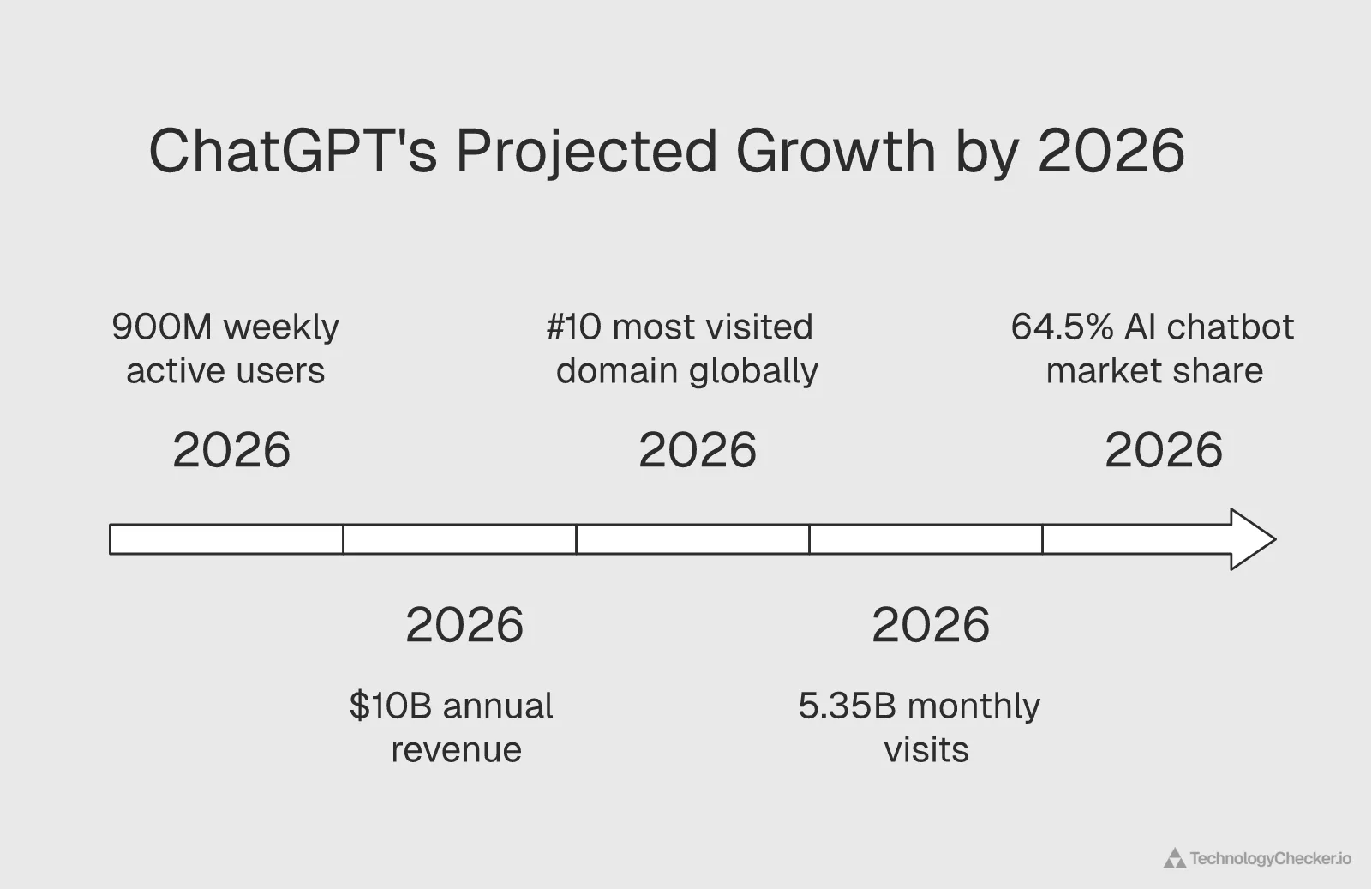
The card above shows OpenAI's February 2026 figure of 900M weekly users; on 29 September 2026 OpenAI reported 1.2 billion. The table below is current.
These are the ten numbers I keep coming back to. I cross-referenced each one against Cloudflare Radar (for crawl and ranking data), OpenAI's official statements (for users and revenue), SimilarWeb (for traffic share), and Sensor Tower (for app metrics).
| # | Statistic | Value | As of | Source |
|---|---|---|---|---|
| 1 | Weekly Active Users | 1.2 billion | Sep 29, 2026 | OpenAI (DevDay 2026) |
| 2 | Paying Subscribers (all tiers) | 50 million | Q1 2026 | OpenAI |
| 3 | Annualized Revenue | $25 billion | Mar 2026 | OpenAI / PYMNTS |
| 4 | Monthly Revenue Run-Rate | ~$2 billion / month | Q1 2026 | Sacra |
| 5 | OpenAI Valuation (post-money) | $730+ billion | Apr 2026 | OpenAI |
| 6 | Total Raised | $122 billion | Apr 2026 | OpenAI |
| 7 | Generative AI Ranking | #1 since at least Feb 23, 2026 (still #1 on September 30) | Sep 30, 2026 | Cloudflare Radar |
| 8 | GPTBot Crawl Share | 8.05% of AI bot traffic (ClaudeBot 13.23%) | Q3 2026 | Cloudflare Radar |
| 9 | 2025 Mobile Revenue | $1.35 billion (+673% YoY) | FY 2025 | Sensor Tower |
| 10 | 2026 Revenue Target | $29.4 billion | FY 2026 | DemandSage / OpenAI |
If you're evaluating large language models for enterprise use, this is the baseline. ChatGPT is one of the most-used web properties on the planet, and that scale affects everything from API reliability to model training data breadth.
How many weekly active users does ChatGPT have in 2026? (official OpenAI figure)
ChatGPT has 1.2 billion weekly users as of September 29, 2026, the most recent figure from OpenAI itself, not an estimate. The previous official figure was 900 million on February 27, 2026.
- The official number: 1.2B weekly users, given by Sam Altman at OpenAI's DevDay on September 29, 2026. The previous one was 900M WAU, announced by OpenAI on February 27, 2026 and reported by TechCrunch.
- The prior official figures: 900M WAU (February 2026), 800M (October 2025), 700M (July 2025), 400M (February 2025). OpenAI publishes WAU, not MAU or DAU, so weekly active users is the only officially maintained series.
- What came next: the 1 billion mark this section used to project has been passed. ⚠️ Updated October 1, 2026; the earlier text projected 1 billion "before the end of 2026".
Does OpenAI publish ChatGPT monthly or daily active users?
No. OpenAI reports weekly active users only, so any ChatGPT MAU or DAU figure you see is a third-party estimate rather than an official number. Both the 900 million figure for February 2026 and the 1.2 billion for September 2026 are weekly.
- Why weekly: OpenAI has used WAU as its single public engagement metric since 2024. There is no official MAU or DAU series to cite.
- Estimates exist but disagree: third-party MAU figures are typically derived from SimilarWeb visit data or app-store telemetry, and are not comparable to the WAU number.
- Practical rule: if a source gives you a ChatGPT MAU figure and attributes it to OpenAI, it is misattributed.
Has ChatGPT reached 1 billion users?
Yes. OpenAI said on September 29, 2026 that ChatGPT reaches 1.2 billion weekly users. ⚠️ Updated October 1, 2026. The answer previously read "Not yet", based on the 900 million weekly active users OpenAI reported on February 27, 2026.
- Any headline claiming ChatGPT "has 1 billion users" today is either forecasting or conflating cumulative registrations with weekly actives.
- The trajectory supports it: 400M (Feb 2025) → 700M (Jul 2025) → 800M (Dec 2025) → 900M (Feb 2026).
- At roughly 100M weekly actives added per quarter, 1B is reachable before the end of 2026. ⚠️ Superseded: OpenAI reported 1.2 billion weekly users on September 29, 2026.
ChatGPT user growth and adoption (2022–2026)
ChatGPT Weekly Active Users 2022–2026: From 1M in 5 Days to 1.2B in 46 Months
ChatGPT reached 1.2 billion weekly active users in September 2026 (Sam Altman, OpenAI DevDay, 29 September 2026), up from 900 million in February 2026 and 400 million in February 2025. The growth curve is the fastest in consumer technology history: 1 million users in 5 days, 100 million in two months, 1 billion within four years.
Source: OpenAI / TechCrunch / 9to5Mac / Engadget · Dec 2022 – Sep 2026
| Milestone date | Weekly active users (millions) |
|---|---|
| Dec 2022 | 1M |
| Jan 2023 | 100M |
| Dec 2023 | 180M |
| Feb 2025 | 400M |
| Jul 2025 | 700M |
| Oct 2025 | 800M |
| Feb 2026 | 900M |
| Sep 2026 | 1200M |
- Weekly active users tripled in 19 months: 400M (Feb 2025) → 1.2B (Sep 2026)
- ChatGPT was the fastest consumer app to 100M users — ~2 months vs Instagram's 2.5 years
- The 1 billion WAU mark was crossed in 2026, between the 900M (Feb) and 1.2B (Sep) announcements
ChatGPT's adoption curve is the fastest in consumer technology history. One million users in five days. Nine hundred million weekly active users in three years, and 1.2 billion weekly users before its fourth birthday. Nothing else has scaled this fast.
The growth timeline
| Date | Milestone | Time to reach |
|---|---|---|
| Nov 30, 2022 | Launch day | Day 0 |
| Dec 5, 2022 | 1 million users | 5 days |
| Jan 2023 | 100 million users | ~2 months |
| End of 2023 | 180 million users | 13 months |
| Feb 2025 | 400 million WAU | ~27 months |
| Jul 2025 | 700 million WAU | ~31 months |
| Oct 2025 | 800 million WAU | ~34 months |
| Feb 27, 2026 | 900 million WAU (confirmed by OpenAI) | ~38 months |
| Sep 29, 2026 | 1.2 billion weekly users (OpenAI, DevDay 2026) | ~46 months |
According to TechCrunch's coverage of OpenAI's February announcement, weekly active users grew 350% in the 18 months prior. At that pace, 1 billion weekly active users is achievable before the end of 2026 — making ChatGPT the fastest consumer product in history to reach that milestone. ⚠️ Superseded: OpenAI reported 1.2 billion weekly users on September 29, 2026. The Oct 2025 row was previously dated Dec 2025; Sam Altman gave the 800 million figure on October 6, 2025.
Who's actually using ChatGPT?
The user demographics have shifted. The gender split has flipped: at launch roughly 80% of users were male, but by 2026 about 52% are women. That signals mainstream adoption well beyond the early tech-adopter demographic.
Seventy percent of ChatGPT usage isn't work-related, according to Zapier's analysis. Close to half (49%) of all queries fall under "asking" — general knowledge questions, advice, explanations. Despite enterprise ambitions, ChatGPT's growth engine is still powered by personal use.
One pattern we see at TechnologyChecker when scanning technology stacks across millions of domains: ChatGPT integration signals (API calls, embedded widgets, OpenAI SDK references) have increased 3x in the sites we monitor since January 2025. Businesses aren't just using ChatGPT casually — they're building it into their products. ⚠️ That 3x compares two different stages of our crawl coverage, so it is not an adoption rate. The current level and the industry mix are in the by-vertical section at the top.
ChatGPT revenue and financial performance
OpenAI Annualized Revenue 2023–2026: $2B to $25B in 3 Years
OpenAI's annualized revenue grew from $2 billion in 2023 to $25 billion in March 2026 — a 12.5x expansion in three years. The pace tripled in 2025 alone (from $6 billion to $20 billion) and continued at a roughly $2 billion-per-month run-rate through Q1 2026. The 2026 internal target reported by DemandSage is $29.4 billion in full-year revenue, which would require the trajectory to accelerate further in H2.
Source: OpenAI / PYMNTS / Sacra · 2023 – March 2026
| Period | Annualized revenue (USD billions) |
|---|---|
| 2023 | 2B |
| 2024 | 6B |
| End 2025 | 20B |
| Mar 2026 | 25B |
| 2026 target | 29.4B |
- ARR run-rate has tripled year over year for three consecutive years
- OpenAI is now generating roughly $2 billion in revenue per month
- The $29.4B full-year 2026 target implies H2 2026 acceleration above the current run-rate
OpenAI has gone from a research lab to one of the fastest-growing revenue engines in tech. Annualized revenue crossed $25 billion in March 2026, on a roughly $2 billion-per-month run-rate. The April 2026 capital raise of $122 billion valued the company at over $730 billion post-money — a number that would have been ridiculous to anyone reading this article a year ago. For the macro view, see our AI market size statistics 2026 forecast to $1.67T by 2031.
How many paying ChatGPT subscribers are there in 2026?
OpenAI has 50 million paying subscribers across all tiers as of Q1 2026, against 900 million weekly active users at the time — a paid conversion rate of roughly 5.6%. Against September 2026's 1.2 billion weekly users the same 50 million would be about 4.2%; OpenAI has not published a newer subscriber figure that we could find.
- Tiers included: the 50M figure covers Plus, Pro, Team and Enterprise combined. OpenAI does not break out subscriber counts per tier.
- Revenue it supports: $25 billion annualized revenue as of March 2026, a run-rate of roughly $2 billion per month.
- The prior marker: OpenAI reported 35 million paying subscribers in a July 2025 report, so paid accounts grew roughly 43% in about eight months.
How much revenue does OpenAI make from ChatGPT in 2026?
OpenAI is at $25 billion annualized revenue as of March 2026, roughly $2 billion per month, against a full-year 2026 target of $29.4 billion.
- Mobile alone produced $1.35 billion in FY2025, up 673% year over year (Sensor Tower).
- 50 million paying subscribers across all tiers back the subscription line as of Q1 2026.
- OpenAI's post-money valuation is $730B+ (April 2026) on $122 billion raised to date.
Revenue growth timeline
| Period | Annualized run-rate | Year-over-year growth |
|---|---|---|
| 2023 | ~$2 billion | First meaningful revenue |
| 2024 | ~$6 billion | ~200% |
| End 2025 | ~$20 billion | ~233% |
| March 2026 | $25 billion | tripled YoY |
| 2026 target | $29.4 billion | per OpenAI internal projections |
According to PYMNTS reporting, OpenAI's ARR tripled in 2025 alone. The pace has not slowed in Q1 2026. That trajectory puts OpenAI on track to match companies like Salesforce and Adobe in total revenue within 2-3 years, though profitability remains a separate question.
Where the revenue comes from: the 50 million paid subscribers nobody talks about
This is the stat most ChatGPT articles get wrong. OpenAI confirmed 50 million paying subscribers across all tiers in its April 2026 announcement. Most "ChatGPT Plus subscribers" stats articles still report 10 million — because they're only counting one of OpenAI's four paid SKUs:
- ChatGPT Plus ($20/month) — the original consumer tier
- ChatGPT Team ($25/user/month) — multi-seat for small teams
- ChatGPT Enterprise (custom pricing) — large-org deployment
- ChatGPT Pro ($200/month) — heavy users and o1-series access
At 50 million paying users, the average monthly revenue per paying user comes out to roughly $35–$40 — which lines up with the rough $2B/month run-rate when you exclude API revenue. The mix is now substantially weighted toward higher-priced enterprise and Pro tiers, not the $20 Plus tier most stat sheets implicitly assume.
Mobile revenue: $1.35B in 2025, $221M in a single US month in March 2026
ChatGPT's mobile app revenue grew 673% year-over-year. According to WytLabs, mobile app revenue surged from $174 million in 2024 to $1.35 billion in 2025. Sensor Tower's State of Mobile 2026 report puts ChatGPT at number 2 globally by downloads, with 148% growth in downloads, 254% growth in in-app purchase revenue, and a 426% surge in total time spent.
The Sensor Tower platform-level data for March 2026 alone (US only): 23 million iOS downloads with $221 million in revenue, plus 55 million Google Play downloads with $54 million in revenue. That's a single market and a single month — and ChatGPT pulled in $275 million in mobile revenue from US users alone.
The profitability question
Despite $25 billion in annualized revenue and a $730 billion valuation, OpenAI reportedly isn't profitable yet. Training and inference costs for the GPT-4o and o1 model families consume enormous compute resources. For B2B buyers evaluating AI adoption trends, this matters: pricing stability depends on OpenAI finding a sustainable cost structure. Inference cost optimization has been improving about 10x per year, but whether subscription prices hold steady through 2026 is unclear.
If you're forecasting AI spend, budget for tier restructuring. OpenAI's introduction of the $200/month Pro tier suggests the $20 Plus tier may eventually become more limited.
Traffic, engagement, and usage metrics
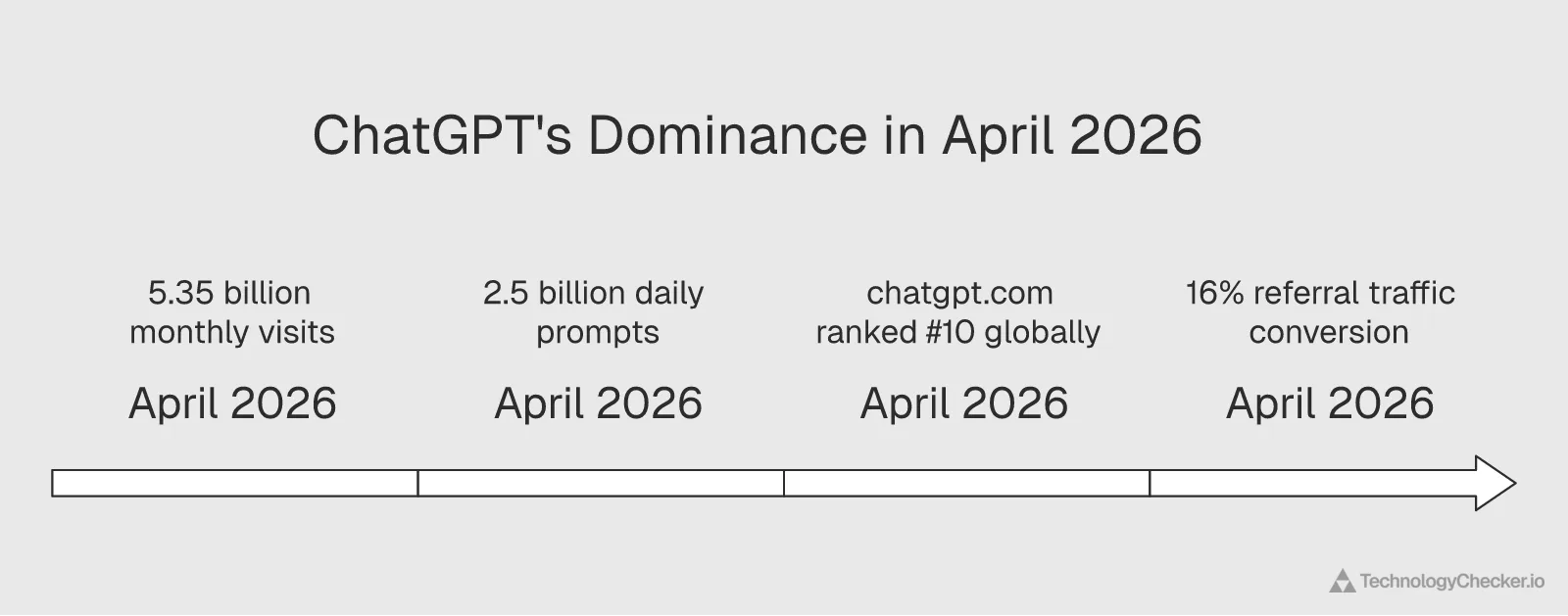
ChatGPT doesn't just have users. It has some of the highest engagement metrics of any web platform — deep, habitual usage rather than casual drive-by traffic.
Monthly visit volume
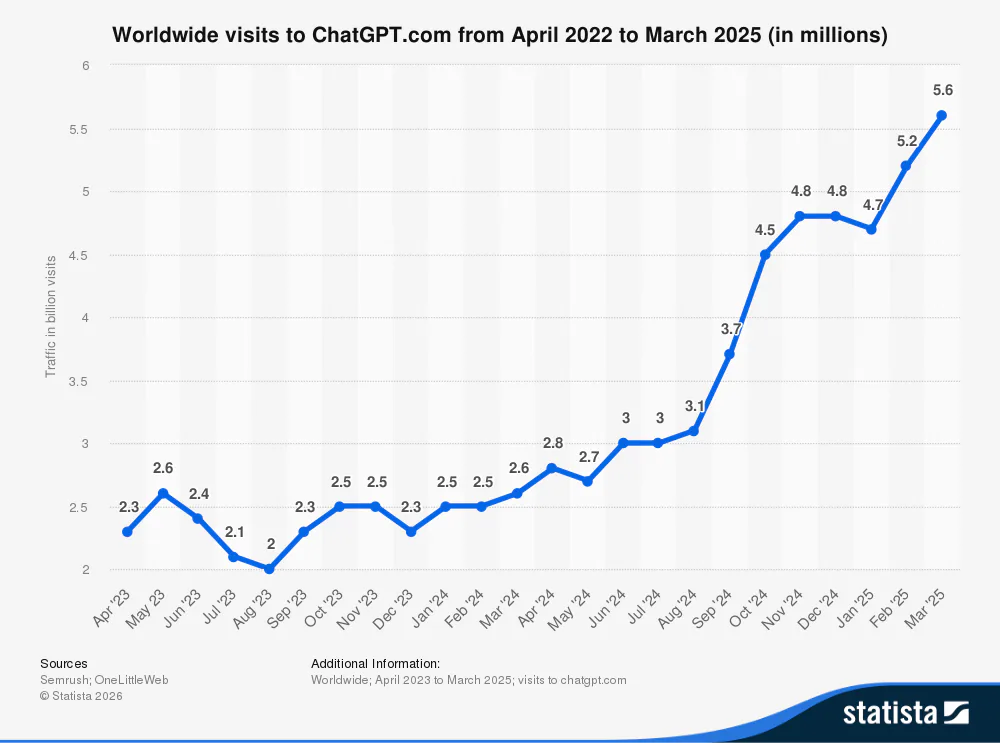
| Month | Monthly visits | Source |
|---|---|---|
| January 2026 | 5.72 billion | The Digital Elevator |
| February 2026 | 5.35 billion | DemandSage / SimilarWeb |
| Current estimate | ~5.6 billion | Exploding Topics |
ChatGPT receives approximately 2.5 billion prompts per day globally. That breaks down to roughly 2.78 prompts per weekly active user per day, which suggests regular multi-turn sessions rather than single-question visits.
ChatGPT usage by country
The India numbers stand out. At 198 million users, they're nearly matching the US, and the 100% growth spike after ChatGPT Go launched at $4.50/month shows what happens when you price for the market.
According to Siana Marketing, the top five countries by ChatGPT user count are:
| Country | Users | Share of global traffic |
|---|---|---|
| United States | 205 million | 15–19% |
| India | 198 million | ~9.5% |
| Brazil | 69.6 million | — |
| Canada | 64.8 million | — |
| France | 51.6 million | — |
The US leads at 205 million users (~17% of the global total). India's user base doubled in a single month after OpenAI launched ChatGPT Go, a localized tier priced at $4.50/month — well below the $20 Plus subscription. If OpenAI replicates the ChatGPT Go model in other price-sensitive markets, the path to 1.5 billion users becomes realistic before 2028. For a country-level deep dive on younger adopters, see our Gen Z UK social media statistics 2026 — chatgpt.com is now #21 in the UK domain ranking.
Conversion rates: ChatGPT traffic vs Google
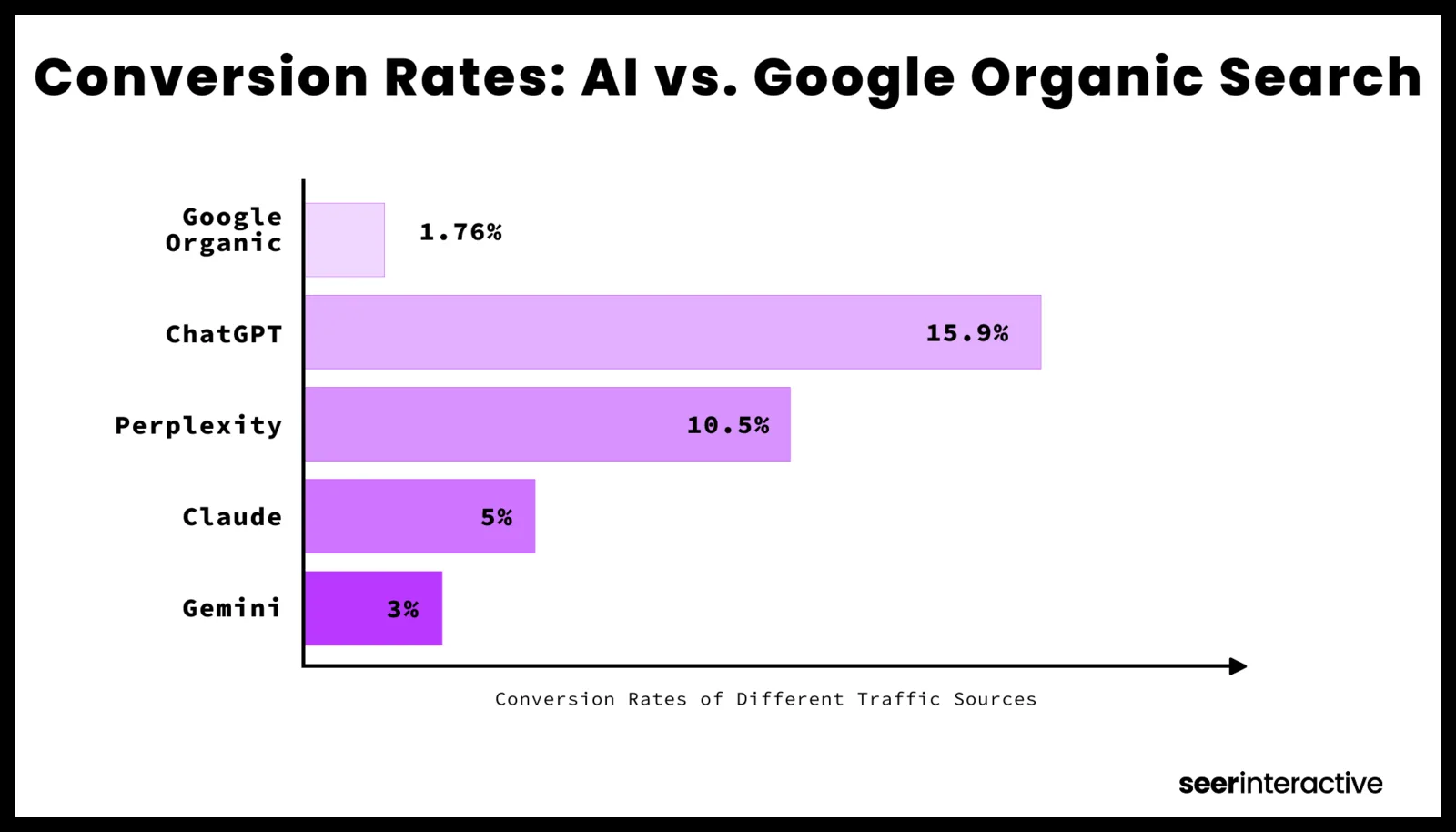
This is the stat B2B marketers should care most about. According to a Seer Interactive case study, traffic referred from ChatGPT converts at 16% compared to Google Organic's 1.8%. Nearly 9x higher.
The caveat: AI traffic still accounts for less than 1% of overall organic traffic. The volume is tiny. But the intent signal is strong — people who arrive at your site through a ChatGPT recommendation are far more likely to take action. For the broader split of where referrals come from, see our search engine market share 2026 breakdown — Google still drives 87.5% of organic referrals.
July 2026 layer. That "less than 1%" caveat is still true, and it is now true by a smaller margin. chatgpt.com accounted for 0.913% of crawler referrals in full-month July 2026, up from 0.377% in June and 0.173% in July 2025. That is 2.4x in a single month and 5.3x over the year, and it is still under one percent against Google's 88.08%.
⚠️ Read that monthly number with care, because the daily data does not support the obvious interpretation. The July total is driven by an eight-day burst: July 9 to 16 averaged 2.19% and peaked at 3.035%, while the other 23 days of the month averaged 0.42%, barely above June. cn.bing.com shows the same signature over an overlapping window, flat for most of the month and then spiking and snapping back. Two unrelated referrers moving on the same schedule looks like one measurement event rather than two changes in behaviour, and the declared Search crawl purpose rose only 11% over the same period rather than anything like 140%. On burst-resistant daily medians the growth is 1.8x month over month and 2.5x year over year — real growth, roughly half the headline. Both readings stay under one percent against Google, so the conclusion is unchanged either way: fastest-growing referral source on the board, and still a rounding error next to Google. The full referral table, the burst analysis, and why the Feb 2026 reclassification makes some year-over-year deltas unusable are in our search engine market share 2026 breakdown. Source: Cloudflare Radar bots/crawlers/summary/referer, full-month July 2026, June 2026 and July 2025. Pulled 2026-08-01.
What to do: set up UTM tracking for AI-referred traffic today. Even if the volume is small, understanding how ChatGPT users behave on your site gives you an early advantage.
What Cloudflare's May 2026 crawl data reveals about ChatGPT
At TechnologyChecker we monitor crawl patterns and bot activity across millions of domains. The tables just below are the full-month May 2026 snapshot that led this article; keep reading to the June update, where the headline number reversed. When I re-pulled the Cloudflare Radar data on June 1, 2026 for the full month of May, three numbers stopped me cold, and one of them outright reverses the finding from this article's April version.
AI bot crawl volume (May 2026)
Top AI Crawlers May 2026: Googlebot 27%, Meta 13%, GPTBot 11%, Bytespider 10%
GPTBot overtook ClaudeBot to become the third-largest AI crawler in May 2026, holding 11.48% of AI bot HTTP requests vs ClaudeBot's 9.73% — a reversal from April, when ClaudeBot led 11.69% to 9.84%. Bytespider (ByteDance) nearly doubled its share to 10.25% (was 5.73% in April), passing ClaudeBot to become the #4 AI crawler. Googlebot remains the leader but lost about 3 points of share, falling from 30.28% to 27.26%.
Source: Cloudflare Radar · May 1 – May 31, 2026
| User agent | Share of AI bot requests (%) |
|---|---|
| Googlebot | 27.26% |
| Meta-ExternalAgent | 13.23% |
| GPTBot | 11.48% |
| Bytespider | 10.25% |
| ClaudeBot | 9.73% |
| Bingbot | 8.45% |
| Applebot | 7.01% |
| Amazonbot | 5.29% |
| Claude-SearchBot | 2.22% |
| Other | 5.08% |
- GPTBot (11.48%) overtook ClaudeBot (9.73%) on a full-month basis — reversing April, when ClaudeBot led
- Bytespider/ByteDance nearly doubled from 5.73% to 10.25%, passing ClaudeBot to take #4 overall
- Googlebot lost about 3 points of share (30.28% → 27.26%) but remains the AI crawl leader
- Anthropic's Claude-SearchBot entered the top 10 at 2.22% while OpenAI's OAI-SearchBot slipped out of it
These percentages represent each bot's share of total AI bot traffic observed by Cloudflare Radar across May 2026:
| Bot | Share of AI bot traffic | Operator | Δ from April |
|---|---|---|---|
| Googlebot | 27.26% | −3.02 pt | |
| Meta-ExternalAgent | 13.23% | Meta | −1.68 pt |
| GPTBot | 11.48% | OpenAI | +1.64 pt ⬆️ |
| Bytespider | 10.25% | ByteDance / DeepSeek | +4.52 pt ⬆️⬆️ |
| ClaudeBot | 9.73% | Anthropic | −1.96 pt ⬇️ |
| Bingbot | 8.45% | Microsoft | +0.41 pt |
| Applebot | 7.01% | Apple | −2.22 pt |
| Amazonbot | 5.29% | Amazon | +0.82 pt |
| Claude-SearchBot | 2.22% | Anthropic | new top-10 ⬆️ |
| Other | 5.08% | Mixed | — |
GPTBot alone (11.48%) outcrawled ClaudeBot (9.73%) across May, reversing April, when ClaudeBot led. The whole-operator picture is closer than that single-bot gap suggests: Anthropic's Claude-SearchBot jumped into the top 10 at 2.22%, so Anthropic's combined AI footprint (ClaudeBot + Claude-SearchBot, about 11.95%) is roughly level with OpenAI's, whose OAI-SearchBot slipped out of the top tier this month. So the honest takeaway is narrower than April's: OpenAI now runs the single largest dedicated training crawler, but the two labs' total crawl volumes are neck-and-neck.
The numbers above are a frozen 28-day window. The chart below is live — Cloudflare Radar updates it daily, so if you're reading this weeks after publication you'll see whether the GPTBot/ClaudeBot lead held.
GPTBot vs ClaudeBot vs Bytespider — the crossover story
GPTBot vs ClaudeBot vs Bytespider Crawl Share, Feb 23 – May 25, 2026
ClaudeBot held a steady 11–12% of AI bot traffic from late February through April, consistently ahead of a more volatile GPTBot. In May the picture flipped: ClaudeBot fell to roughly 9.4–9.7% and stayed there, while GPTBot averaged 11.48% for the month to take the lead. The bigger mover is Bytespider (ByteDance), which climbed steadily from 3.5% in late February to over 11% by late May, overtaking ClaudeBot to become the #4 AI crawler. By the final week the three were converging again — a reminder that crawl share is bursty and tied to training runs.
Source: Cloudflare Radar · February 23 – May 25, 2026
| Week | Weekly AI bot request share (%) |
|---|---|
| Feb 23 | 10.39% |
| Mar 2 | 11.26% |
| Mar 9 | 14.84% |
| Mar 16 | 12.9% |
| Mar 23 | 10.56% |
| Mar 30 | 8.92% |
| Apr 6 | 6.94% |
| Apr 13 | 11.91% |
| Apr 20 | 11.5% |
| Apr 27 | 9.94% |
| May 4 | 13.71% |
| May 11 | 12.64% |
| May 18 | 10.41% |
| May 25 | 9.48% |
- ClaudeBot led from February through April but fell to ~9.5% in May as GPTBot's full-month average (11.48%) pulled ahead
- Bytespider climbed from 3.5% (Feb) to over 11% (late May), overtaking ClaudeBot to become the #4 AI crawler
- Full-month May averages: GPTBot 11.48%, ClaudeBot 9.73%, Bytespider 10.25%
I've watched these three bots trade positions for months. The chart above plots their daily share from late February through the end of May.
Three patterns to notice:
- ClaudeBot led for most of Q1 and into April, finishing April at 11.69% to GPTBot's 9.84% and swapping the weekly lead with GPTBot along the way.
- During May, GPTBot pulled ahead and stayed there. Across the full month GPTBot averaged 11.48% to ClaudeBot's 9.73%, a 1.75-point lead built on OpenAI ramping training crawls while ClaudeBot volume eased off. May is the first full calendar month GPTBot has finished on top.
- Bytespider nearly doubled and passed ClaudeBot. ByteDance's crawler climbed from 5.73% in April to 10.25% in May, taking the #4 AI crawler spot overall. DeepSeek shares the Bytespider infrastructure, and the pipeline is scaling aggressively to catch the leaders.
One caveat: a single month is not a permanent order. Crawl volume is bursty and tied to training runs, so June could swing back. But the full-month April-to-May reversal is larger than week-to-week noise, and Bytespider's climb looks structural rather than a one-off burst.
June 2026 update: ClaudeBot swung back, and doubled
I flagged above that a single month is not a permanent order, and June proved it faster than I expected. When I re-pulled the full-month figures on July 3, 2026, the May GPTBot lead was gone. ClaudeBot did not just retake the top of the two-way race, it nearly doubled its share and became the second-largest AI crawler on Cloudflare's network overall, behind only Googlebot.
| Bot | June 2026 share | Operator | Δ from May |
|---|---|---|---|
| Googlebot | 25.18% | −2.08 pt | |
| ClaudeBot | 19.77% | Anthropic | +10.04 pt ⬆️⬆️ |
| Meta-ExternalAgent | 10.20% | Meta | −3.03 pt |
| GPTBot | 9.40% | OpenAI | −2.08 pt ⬇️ |
| Bingbot | 7.83% | Microsoft | −0.62 pt |
| Bytespider | 7.65% | ByteDance / DeepSeek | −2.60 pt ⬇️ |
| Applebot | 6.01% | Apple | −1.00 pt |
| Amazonbot | 5.41% | Amazon | +0.12 pt |
| Claude-SearchBot | 3.27% | Anthropic | +1.05 pt |
| Other | 5.27% | Mixed | — |
Three things stand out. First, the reversal is not a one-day blip: ClaudeBot sits at 19.8% across the full month, 20.4% over the trailing 28 days, and 20.4% over the last 7 days, so it held the lead all the way into early July. Second, at the operator level Anthropic has pulled decisively ahead. Add Claude-SearchBot to ClaudeBot and Anthropic's combined crawl footprint reaches about 23%, closing on Googlebot's 25% and running at roughly two and a half times OpenAI's GPTBot. In May I called the two labs neck-and-neck at the operator level; in June that is no longer true. Third, Bytespider, May's fastest riser, gave most of it back, falling from 10.25% to 7.65% and dropping from fourth to sixth. That is the bursty, training-run-driven pattern this article kept warning about, playing out in a single month.
There is a publisher angle to the swing. Anthropic already had the worst crawl-to-referral ratio in the table below by a wide margin, and doubling its crawl volume in June without a matching rise in referral traffic only widens that gap. If you allow AI crawlers on your site, the practical takeaway from June is that the bot taking the most from you and returning the least just got noticeably hungrier. Our robots.txt AI crawlers blocking report covers which bots to allow and which to restrict, and the broader year-over-year shift in what crawlers are after is in our AI crawler statistics.
Source: Cloudflare Radar ai/bots/summary/user_agent, full-month June 2026, cross-checked against the trailing 7-day and 28-day windows. Pulled 2026-07-03.
July 2026 update: the lead held, and the year-over-year order inverted
I re-pulled the full month on August 1, 2026. June's reversal was not a spike. ClaudeBot finished July at 16.28% to GPTBot's 9.74%, and the daily series shows ClaudeBot ahead on all 31 days, with the narrowest gap on July 20 (12.30% vs 10.67%). July 2025 is now available as a like-for-like baseline, so this table carries both a month-over-month and a same-month year-over-year column.
| Bot | July 2026 | Operator | Δ from June 2026 | July 2025 | Δ YoY |
|---|---|---|---|---|---|
| Googlebot | 24.52% | −0.66 pt | 42.69% | −18.17 pt ⬇️⬇️ | |
| ClaudeBot | 16.28% | Anthropic | −3.48 pt ⬇️ | 11.23% | +5.05 pt ⬆️ |
| Meta-ExternalAgent | 12.65% | Meta | +2.45 pt ⬆️ | 8.44% | +4.20 pt ⬆️ |
| GPTBot | 9.74% | OpenAI | +0.34 pt | 13.15% | −3.41 pt ⬇️ |
| Bingbot | 8.92% | Microsoft | +1.09 pt ⬆️ | 10.30% | −1.38 pt |
| Applebot | 6.54% | Apple | +0.53 pt | 1.62% | +4.93 pt ⬆️ |
| Amazonbot | 6.02% | Amazon | +0.61 pt | 6.64% | −0.62 pt |
| Bytespider | 5.14% | ByteDance / DeepSeek | −2.51 pt ⬇️ | 2.72% | +2.42 pt ⬆️ |
| Claude-SearchBot | 3.54% | Anthropic | +0.26 pt | not in top 10 | n/a |
| Other | 6.64% | Mixed | +1.37 pt | 2.16% | — |
Four things to take from it.
The year-over-year swap is the one that matters for this article. In July 2025 GPTBot led ClaudeBot 13.15% to 11.23%. A year later ClaudeBot leads 16.28% to 9.74%, a 6.5-point deficit for OpenAI's crawler. That is a genuine inversion measured the same way in the same calendar month, not a quarter-versus-month artifact.
GPTBot barely moved between June and July, going 9.40% to 9.74%. Over the year it fell 3.41 points. So OpenAI's crawler is not collapsing; its share of a growing, more crowded AI-bot population is being diluted. Read the drop as dilution, not retreat.
ClaudeBot came off its June peak. It fell 3.48 points from 19.77%, and the fade happened inside July too: it averaged 18.89% across the first seven days and 14.05% across the last seven, while GPTBot sat flat at 9.12% then 9.39%. Anthropic's crawl volume is still bursty. Anyone reading July as a straight-line Anthropic climb is reading it wrong.
Googlebot nearly halved year over year, 42.69% to 24.52%. That is the largest single move in the table, and it is why several bots gained share in July without gaining much absolute volume. At the operator level July 2026 reads Google 27.05%, Meta 14.60%, Anthropic 10.97%, OpenAI 6.54%. In July 2025 Anthropic did not appear in Cloudflare's top-10 bot-operator list at all, where tenth place was Huawei at 1.80%.
Source: Cloudflare Radar ai/bots/summary/user_agent and bots/summary/bot_operator, full-month July 2026, June 2026 and July 2025. Verified a second way against a daily-summed ai/bots/timeseries_groups/user_agent for July 2026, which returns a 31-day mean of 16.31% for ClaudeBot and 9.74% for GPTBot. Pulled 2026-08-01.
What AI crawlers actually do
What AI Crawlers Actually Do, May 2026: 50% Training, 4% Search
Training is the single largest declared purpose of AI crawling in May 2026, at 50.1% of requests, up from 46.7% in April. Mixed-purpose crawls (one crawler used for several purposes at once) account for another 42.9%, down from 47.6%. Search, the real-time retrieval that can cite a page inside an AI answer, rose to 4.0% from 3.1% in April. User-action fetches remain small at 2.5% but continue to grow. Cloudflare has reclassified this series twice: these are the values it returned on 1 October 2026.
Source: Cloudflare Radar · May 1 – May 31, 2026
| Label | Value |
|---|---|
| Training | 50.07% |
| Mixed Purpose | 42.88% |
| Search | 3.96% |
| User Action (agents) | 2.52% |
| Undeclared | 0.57% |
- Training crawls outnumber search crawls more than 12 to 1, so AI crawling remains largely extractive
- Search rose to 4.0% of AI bot traffic (from 3.1% in April), the only category with a direct path to a citation
- Agent-driven user actions grew to 2.5%, up from 2.2% in April
- Cloudflare has relabelled this series twice; an October 2026 change moved about 5 points from Search into Training for May, so earlier versions of this chart showed search near 9%
Training is the single largest purpose of AI crawling in May 2026 at 51.8% of requests, roughly flat from 51.5% in April. By full-month June it eased to 47.2% as training slipped off a late-June peak and mixed-purpose crawls rose to 39.0%; our AI crawler statistics tracks that year-over-year shift. Mixed-purpose crawls (models that index for both training and retrieval) account for another 35.7%. The mover is search: 9.3% of AI crawler traffic is now classified as search (real-time web retrieval on behalf of a user prompt), up from 7.5% in April, which suggests AI assistant search products like ChatGPT Search, Perplexity, and Claude are growing their share of the crawl mix.
User-action crawls (browser-using agents like ChatGPT's Operator or Anthropic's computer use) remain small at 2.6%, up from 2.2% in April, but continue to be the fastest-growing crawl-purpose category. ⚠️ The 9.3% search figure above is superseded by the July numbers below; preserved as originally published.
July 2026 layer. Training kept sliding: 44.54% of AI crawler requests in July, down from 47.25% in June. Mixed-purpose crawls held roughly flat at 39.99%, and search rose again to 11.57% from 10.39%. User-action crawls reached 2.66%. The year-over-year comparison reframes the whole "training keeps climbing" story: in July 2025 Mixed Purpose was the biggest category at 54.61% with Training on 35.74%, so training gained 8.8 points over the year while mixed purpose lost 14.6. Search grew by about half again over the year, 7.79% to 11.57%. For a ChatGPT reader the search line is the one to watch, because it is the only crawl category that can send a visitor back. Source: Cloudflare Radar ai/bots/summary/crawl_purpose, full-month July 2026, June 2026 and July 2025. Pulled 2026-08-01.
⚠️ Cloudflare has since reclassified crawl purpose across its whole history, moving volume from Search into Training. Re-pulled on 1 October 2026: April training 46.68% / search 3.06%, May 50.07% / 3.96%, June 52.66% / 4.98%, July 50.78% / 5.54%, July 2025 42.38% / 1.14%. The search rise these paragraphs describe is real in direction but smaller, and the chart above already uses the revised series. In Q3 2026 training was 47.62% and search 8.26%. Preserved as originally published.
The crawl-to-referral problem
AI Crawl-to-Refer Ratio 2026: Anthropic Crawls 11,122 Pages per 1 Referral
Anthropic's ClaudeBot crawled 11,122 pages for every 1 human visit Anthropic sent back to the web in the week of May 25 to June 1, 2026, per Cloudflare Radar's CRAWL_REFER_RATIO endpoint. That improved from 13,528:1 in April but is still the worst ratio of any major operator. OpenAI's ratio is 857:1, down from 1,252:1. Perplexity moved the wrong way, from 95:1 to 190:1. Google's traditional Googlebot operates at 5:1. This asymmetry is the structural reason publishers have started blocking AI crawlers in robots.txt.
Source: Cloudflare Radar · May 25 – June 1, 2026
| Operator | Pages Crawled per 1 Referral Sent |
|---|---|
| Anthropic | 11122:1 |
| OpenAI | 857:1 |
| Perplexity | 190:1 |
| Microsoft | 34:1 |
| Mistral | 27:1 |
| Yandex | 24:1 |
| Baidu | 12:1 |
| ByteDance | 9:1 |
| 5:1 | |
| DuckDuckGo | 1.5:1 |
- Anthropic crawls 11,122 pages for every 1 referral — still the worst ratio of any major operator, though down from 13,528:1 in April
- OpenAI's 857:1 ratio is roughly 170x worse than Google's traditional 5:1 search exchange
- Google (5:1) and DuckDuckGo (1.5:1) show what a healthy crawl-for-referral exchange looks like
- Perplexity worsened from 95:1 to 190:1 as its crawl volume outran its referrals
This is where the data gets uncomfortable for publishers. Cloudflare Radar tracks how much each AI platform crawls versus how much referral traffic it sends back. As of the May 25 to June 1, 2026 measurement window:
| Platform | Crawl-to-referral ratio | What it means |
|---|---|---|
| DuckDuckGo | 1.5:1 | Sends traffic back frequently |
| 5:1 | Established search model | |
| Mistral | 27:1 | Low return |
| Microsoft | 34:1 | Moderate return |
| Perplexity | 190:1 | Worsening |
| OpenAI | 857:1 | Very low return |
| Anthropic | 11,122:1 | Lowest return by far |
Anthropic crawls 11,122 pages for every 1 referral it sends back. OpenAI's 857:1 ratio is bad; Anthropic's is roughly 13x worse. Perplexity's 190:1 still looks healthy by comparison, though it worsened from 95:1 in April.
OpenAI's ratio has kept improving: it was 785:1 in October 2025, peaked at 1,851:1 in December 2025 as crawl volume spiked, dropped to roughly 1,252:1 in mid-April 2026, and reached 857:1 by late May 2026. That improvement correlates with OAI-SearchBot generating more outbound clicks as ChatGPT Search gains users.
July 2026 layer, and it is good news for OpenAI. Measured across the full month rather than a one-week window, OpenAI crawled 251 pages per referral it sent back in July 2026. That is down from 647:1 in June and 1,104:1 in July 2025, and it makes OpenAI the best-returning AI lab in the table, ahead of Perplexity's 289:1. Anthropic improved sharply too, from 3,386:1 in June and 38,744:1 in July 2025 to 1,917:1 in July, but it still takes roughly 7.6x more per referral than OpenAI does.
| Platform | July 2025 | June 2026 | July 2026 |
|---|---|---|---|
| DuckDuckGo | 0.3:1 | 2.1:1 | 2.4:1 |
| 5.5:1 | 5.0:1 | 4.7:1 | |
| ByteDance | 0.9:1 | 10.1:1 | 9.6:1 |
| Microsoft | 40.4:1 | 35.3:1 | 36.2:1 |
| OpenAI | 1,104:1 | 647:1 | 251:1 |
| Perplexity | 195:1 | 207:1 | 289:1 |
| Anthropic | 38,744:1 | 3,386:1 | 1,917:1 |
Two cautions before anyone quotes this. First, these are full-calendar-month figures from bots/crawlers/summary/crawl_refer_ratio, so they are not directly comparable with the seven-day May 25 to June 1 window in the table above, which is why the older numbers are larger. Compare July with June, not July with that week. Second, Mistral shows 29,612:1 in July against 178:1 in June and 11:1 in July 2025. A three-order-of-magnitude swing in a month is a volume artifact, not behaviour, so I have left Mistral out of the table and would not quote it in either direction.
The publisher takeaway has genuinely changed since the June update. In June the argument for blocking OpenAI's crawlers was almost as strong as the argument for blocking Anthropic's. In July, OpenAI returns a visitor for every 251 pages taken, which is still poor against Google's 4.7:1 but is now the best of the AI labs by a clear margin.
Source: Cloudflare Radar bots/crawlers/summary/crawl_refer_ratio, full-month July 2026, June 2026 and July 2025. Normalization RATIO. Pulled 2026-08-01.
Domain ranking context: where chatgpt.com actually sits
I pulled the Cloudflare Radar domain rank for chatgpt.com again on July 3, 2026. It returned rank 23, in the top-200 bucket (rank 24 on June 1). That's a high-traffic ranking — chatgpt.com is one of the busiest properties on the Cloudflare-visible internet — but it's not the "#10 globally, ahead of Amazon" figure that circulated in late 2025 statistics roundups. The methodology behind Cloudflare's domain ranking changed in early 2026, and chatgpt.com's bucket placement reflects current top-200 status, not its earlier reported top-20 position.
July 2026 update, with a caveat I would rather publish than hide. I sampled the rank across July instead of taking one day, and the series does not agree with itself. chatgpt.com reads rank 23 on July 3, rank 22 on July 10, 17 and 24, rank 24 on July 25, then rank 29 from July 26 through July 31. A seven-place slide over two days is worth checking before reporting it as a traffic decline, so I checked. Over the same July 24 to July 28 window openai.com moved from rank 81 to rank 38, google.com stayed at rank 1, and the API's bucket field went from empty to populated on every domain I queried. That pattern is a Radar-side recompute, not seven places of lost traffic. The honest statement is that chatgpt.com sat at 22 to 24 for most of July and reads 29 at month end under a changed ranking response, and that this is exactly the kind of movement the Q2 pass learned to mark rather than narrate.
What it means for publishers: check your site's robots.txt and server logs. Our robots.txt AI crawlers blocking report breaks down exactly which bots to allow and which to restrict. Blocking a bot with a 13,528:1 ratio costs you almost nothing in referral traffic. ⚠️ Superseded by the August update; preserved as originally published. On full-month July 2026 data Anthropic is 1,917:1 and OpenAI 251:1, so blocking OpenAI's crawlers now costs meaningfully more referral traffic than that sentence implies.
Source: Cloudflare Radar ranking/domain/chatgpt.com, ranking/domain/openai.com and ranking/domain/google.com, single-date queries across July 2026. Pulled 2026-08-01.
ChatGPT vs Claude vs Gemini vs Perplexity vs DeepSeek — May 2026 market share
GenAI Web Traffic Share 2025–2026: ChatGPT 87%→57%, Gemini 6%→25%
ChatGPT's share of generative AI web traffic fell from 87% in early 2025 to 56.72% by March 2026 — a 30-point drop in 12 months. Google Gemini surged from 6% to 25.46% over the same window, the largest share gain by any AI chatbot we've tracked. Anthropic's Claude grew from 1.4% to 6.02%, the third-largest gainer. The pattern: ChatGPT still leads, but the AI chat market is rapidly diversifying.
Source: SimilarWeb · March 2025 – March 2026
| Quarter | GenAI web traffic share (%) |
|---|---|
| Mar 2025 | 87% |
| Jun 2025 | 78% |
| Sep 2025 | 72% |
| Dec 2025 | 64% |
| Mar 2026 | 56.72% |
- ChatGPT lost 30 points of web traffic share in 12 months — still #1 but no longer dominant
- Gemini's 6% → 25.46% climb is the largest share gain by any chatbot in the SimilarWeb dataset
- Claude quadrupled its web share from 1.4% to 6.02% — third-largest gainer
The Cloudflare Radar generative AI service category provides a clean ranked view of which AI services attract the most traffic on the Cloudflare network. The ranking is updated daily. Here's the picture as of June 1, 2026.
What is ChatGPT's market share in 2026?
ChatGPT has been the #1 generative AI service by Cloudflare Radar ranking since at least February 23, 2026, and still held the position on September 30, 2026. Its share of search referral traffic — a different measure — is 0.23%.
- Ranked #1 among GenAI services on every date we sampled through September 30, 2026 on Cloudflare Radar's generative-AI domain ranking.
- 0.23% of search referrals (Cloudflare Radar REFERER, May 2026). Every AI chatbot combined sends 0.29%, about one-fifth of what DuckDuckGo alone sends.
- 8.05% of AI bot crawl traffic via GPTBot in Q3 2026, behind ClaudeBot at 13.23%. Leading the consumer product and leading the crawler are two separate races.
Generative AI service rankings (June 1, 2026)
Generative AI Service Rankings, June 1, 2026: ChatGPT Still #1, Gemini Reclaims #4
ChatGPT held the #1 generative AI ranking on June 1, 2026 — unbroken since at least Feb 23, 2026, roughly 98 days. Claude is locked at #2 and Perplexity at #3. Google Gemini reclaimed #4 from DeepSeek (now #5) in late May. Character.AI sits at #6, GitHub Copilot at #7, and Grok/xAI slipped to #8. Doubao (ByteDance), which first entered the top 10 in May, held its place into June at #10.
Source: Cloudflare Radar · June 1, 2026
| Service | Reverse rank (10 = #1) |
|---|---|
| ChatGPT | 10 |
| Claude | 9 |
| Perplexity | 8 |
| Google Gemini | 7 |
| DeepSeek | 6 |
| Character.AI | 5 |
| GitHub Copilot | 4 |
| Grok / xAI | 3 |
| Suno AI | 2 |
| Doubao | 1 |
- ChatGPT has held #1 since at least Feb 23, 2026 — still #1 on June 1, about 98 days
- Google Gemini reclaimed #4 from DeepSeek in late May
- Doubao (ByteDance) held the top 10 into June after debuting in May
| Rank | Service | Operator | Notable |
|---|---|---|---|
| 1 | ChatGPT | OpenAI | #1 since at least Feb 23, 2026 |
| 2 | Claude | Anthropic | Locked at #2 across our tracking window |
| 3 | Perplexity | Perplexity | Locked at #3 across our tracking window |
| 4 | Google Gemini | Reclaimed #4 from DeepSeek in late May | |
| 5 | DeepSeek | DeepSeek | Slipped to #5 behind Gemini |
| 6 | Character.AI | Character.AI | Up to #6 |
| 7 | GitHub Copilot | Microsoft | Stable |
| 8 | Grok / xAI | xAI | Slipped to #8 |
| 9 | Suno AI | Suno | AI music platform |
| 10 | Doubao | ByteDance | Held the top 10 into June |
ChatGPT has held #1 since at least Feb 23, 2026, and it was still #1 when we re-checked on June 1, about 98 days later. Claude and Perplexity have held #2 and #3 across that window without a single position change. The movement is below them: Google Gemini reclaimed #4 from DeepSeek in late May, and Doubao (ByteDance), which first cracked the top 10 in May, held its place into June. ⚠️ The "Perplexity locked at #3" line is superseded by the July check below; preserved as originally published.
July 2026 update. ChatGPT still holds #1, and this time I sampled six dates rather than one, because a daily ranking read once a month is a coin flip dressed up as a trend. On July 1, 8, 15, 23, 29 and 31 ChatGPT was rank 1 and Claude rank 2 every time. That is now roughly 158 days of an unbroken ChatGPT #1 since Feb 23, 2026.
Ranks 3 and 4 are the interesting part, and they are the reason for sampling. Google Gemini was #3 on July 1, 15 and 31; Perplexity was #3 on July 8, 23 and 29. They swap between sample dates. Had I pulled a single day I would have published either "Gemini overtakes Perplexity" or "Perplexity holds #3", and both would have been wrong. The supportable claim is narrower: Gemini has closed on Perplexity to the point where the two now trade third place day to day, and neither has taken it.
Source: Cloudflare Radar ranking/internet_services/top, serviceCategory=Generative AI, single-date queries for 2026-07-01, 07-08, 07-15, 07-23, 07-29 and 07-31. Pulled 2026-08-01.
The SimilarWeb web-traffic decline you should actually pay attention to
According to SimilarWeb's March 2026 data, ChatGPT's share of generative AI web traffic fell from 77.43% in early 2025 to 56.72% by March 2026 — a 20-point drop. Gemini surged from 6% to 25.46% over the same window. Claude grew from 1.4% to 6.02%.
That's the second-largest market share rebalancing in any consumer technology category in the last decade, behind only the iOS/Android share war of 2009-2012. But the rebalancing is uneven by surface:
- On web traffic (SimilarWeb): ChatGPT lost 20+ points to Gemini, mostly. The Gemini surge is real.
- On the Cloudflare network ranking (live data): ChatGPT held #1 every day, Gemini slipped to #5. The two datasets are measuring different things.
- On enterprise win rates: Claude reportedly wins ~70% of head-to-head enterprise deals against OpenAI, per SaaStr's coverage.
I'm cautious about the SimilarWeb decline framing because Gemini is pre-installed on Android and Workspace, which inflates "web traffic" share for users who didn't actively choose it. The Cloudflare ranking, which reflects what users actively go to, tells a different story.
The dual-platform reality

Here's the stat that reframes the whole competition narrative. According to AI Business Weekly, 79% of OpenAI users also pay for Anthropic. That confirmed what I've been seeing in our stack data at TechnologyChecker. Enterprises aren't picking one AI vendor — they're running ChatGPT and Claude side by side.
eMarketer reports that Claude users spend 34.7 minutes per daily session — the highest engagement of any AI platform. That session depth, combined with Claude's enterprise win rate, explains why Anthropic can charge premium prices with a smaller user base.
For practical purposes: if you're integrating with one AI platform, ChatGPT's user base offers the largest addressable audience. But Claude's growth trajectory and enterprise win rate make dual-platform support increasingly important.
Head-to-head: ChatGPT vs Claude for developers
Based on benchmark data and developer feedback across forums, here's where each platform stands for technical use cases as of May 2026:
| Dimension | ChatGPT (GPT-4o / o1) | Claude (3.5 Sonnet / Opus) |
|---|---|---|
| Code generation | Strong across languages | Stronger for long-context code |
| Reasoning (math/logic) | o1 excels | Competitive, slightly behind o1 |
| Writing quality | Good, formulaic at times | More natural, preferred by writers |
| Context window | 128K tokens | 200K tokens (advantage) |
| API pricing | $5–15 per 1M tokens | $3–15 per 1M tokens |
| User base | 900M WAU | Growing rapidly (#2 in Gen AI) |
| Web crawl footprint (May 2026) | 11.48% (GPTBot) | 9.73% (ClaudeBot) |
For B2B SaaS teams: build for ChatGPT's user base, test against Claude's quality, and monitor DeepSeek and Doubao for cost-optimized alternatives.
Enterprise adoption and industry use cases

Consumer usage drives headlines. Workplace integration drives revenue. Here's what the enterprise data looks like as of May 2026.
According to Christian & Timbers, ChatGPT has been adopted by 93% of Fortune 500 companies in some capacity. That figure includes everything from individual employee use to department-wide deployments to formal ChatGPT Enterprise contracts.
The 7 million workplace seats number tells the real story — that's 9x year-over-year growth in enterprise seats, way faster than the consumer growth rate. OpenAI now counts 1.5 million business clients globally, with over 1 million of those outside the US. Enterprise adoption grew 340% year-over-year by OpenAI's own accounting.
PwC deployed 100,000+ ChatGPT Enterprise seats. Morgan Stanley and Coca-Cola are also named enterprise adopters. These aren't pilot programs anymore — they're organization-wide rollouts.
The top enterprise use cases from OpenAI's published workplace adoption study: data analysis and reporting (60% of enterprise users), content generation including text and images (51%), personalization and customer experience (42%), code generation and debugging (~35% among developer teams), and internal knowledge management (~28%).
Industry-specific adoption patterns
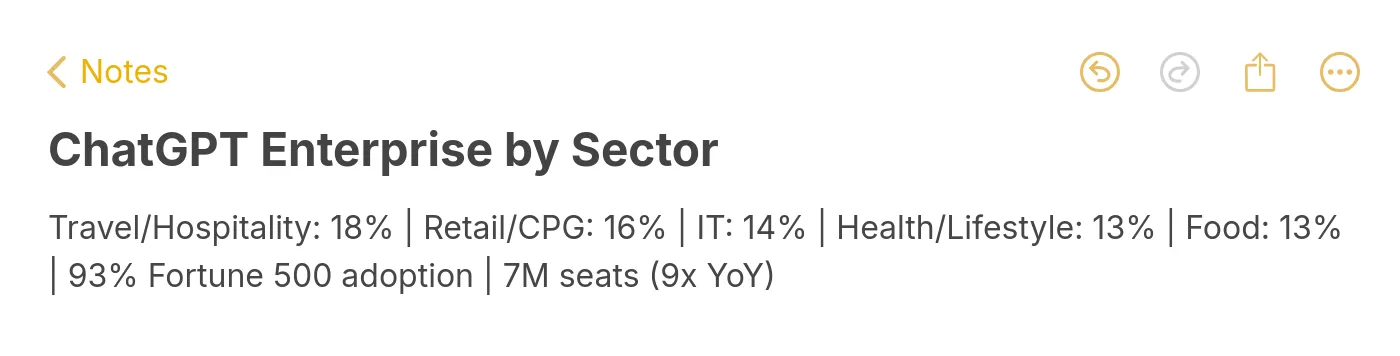
Based on TechnologyChecker's technology detection, the top adopting sectors break down as follows: travel and hospitality leads at 18%, followed by retail and CPG at 16%, IT at 14%, health and lifestyle at 13%, and food at 13%. That travel/hospitality number didn't surprise me — those teams deal with massive volumes of customer queries and content translation, exactly the tasks where ChatGPT saves the most time. ⚠️ This sector split predates our current crawl and is preserved as originally published. The September 2026 industry mix of OpenAI integrations, measured against the whole web, is in the by-vertical section at the top: software development and marketing lead, retail runs below its weight.
Software and technology leads the IT portion by a wide margin. Nearly every SaaS product we scan shows some form of AI integration — OpenAI API calls, embedded ChatGPT-powered features, or AI-assisted documentation.
The SaaS integration wave
According to SQ Magazine, 42% of new SaaS platforms with AI capabilities launched in 2025 rely on OpenAI models. That includes GPT-4o, the Assistants API, and the embeddings API. When nearly half of all new AI-enabled products choose your API, you've become infrastructure.
Developer and API adoption
OpenAI now has 3 million active developer accounts, a 5x increase since 2022. According to Index.dev, 1.3 million US developers alone have created projects on OpenAI's platform.
At TechnologyChecker, OpenAI API signatures show up in about 3x more sites than they did in January 2025 (⚠️ a comparison across two stages of our crawl coverage, not an adoption rate). The 3 million developer figure matches what we're seeing in the wild — that's roughly the same number of developers who use Stripe's API. OpenAI has reached "developer infrastructure" scale in three years, which took most payment and cloud platforms a decade.
Key takeaways for AI leaders
Three patterns from the May 2026 data matter most for 2026 planning.
1. The AI-crawler lead is volatile, and right now Anthropic holds it. GPTBot edged ahead in May (11.48% vs 9.73%), but by June ClaudeBot swung back and nearly doubled to 19.8% while GPTBot eased to 9.4%. Add Claude-SearchBot and Anthropic's combined crawl footprint (about 23%) trails only Googlebot's, at roughly two and a half times OpenAI's. Crawl share is a leading indicator of which models will have the freshest, broadest training data six months out, but it moves month to month with each lab's training runs, so read it as a trend rather than a fixed ranking. Bytespider, May's big mover, gave most of it back and fell from fourth to sixth. July update: Anthropic still holds the lead but by less. ClaudeBot came off its June peak to 16.28% while GPTBot held near flat at 9.74%, and Anthropic's combined footprint (ClaudeBot plus Claude-SearchBot, about 19.8%) now runs at roughly twice GPTBot rather than two and a half times it. At the whole-operator level, which counts every bot each company runs, the gap is narrower still: Anthropic 10.97% to OpenAI 6.54%, about 1.7 times. The volatility point stands; the multiple does not. Q3 2026 update: ClaudeBot took 13.23% to GPTBot's 8.05%, and the bigger change is inside OpenAI: OAI-SearchBot more than doubled to 2.81% while GPTBot fell, so OpenAI's crawling is shifting from training towards search.
2. ChatGPT's dominance is real but more contested than the headline numbers suggest. ChatGPT held #1 in the Cloudflare GenAI category from Feb 23 through September 30, and has 1.2B weekly users (OpenAI, September 29, 2026). But SimilarWeb shows ChatGPT's web traffic share fell from 77% to 57% in 12 months. The two datasets measure different things — Cloudflare reflects what users actively visit, SimilarWeb captures broader web behavior including Android-default Gemini sessions. Pay attention to which dataset matches your decision context. For consumer engagement, the Cloudflare ranking matters more.
3. Mobile and enterprise are the growth vectors to watch. The 673% growth in mobile app revenue, 93% Fortune 500 adoption, and 7 million workplace seats (9x YoY growth) signal that ChatGPT's next phase of growth won't come from more consumer users — it'll come from deeper enterprise integration, geographic expansion through localized pricing like ChatGPT Go, and developer ecosystem lock-in through the 3 million active API accounts.
For sales and GTM teams specifically: understanding which technologies your prospects use — and how they're integrating AI tools — gives you a genuine competitive edge. At TechnologyChecker, we track these adoption signals across 40,000+ technologies and the 29.9M live business domains we crawl, turning raw detection data into prospect intelligence that connects directly to buying intent.
If you want to see which companies in your target market are actively adopting AI tools, start with the companies that use ChatGPT and work outward to prospects whose technology stack signals readiness for your product.
Methodology and data sources
For the Q3 2026 edition (October 1, 2026) I re-pulled every Cloudflare Radar series for each calendar month of 2026 and for Q3 2026, Q2 2026 and Q3 2025, added the by-vertical split, and replaced the weekly-user figure with OpenAI's September 2026 number. Before that, I first refreshed these statistics on June 1, 2026 (full month of May), re-verified the Cloudflare Radar figures on July 3, 2026 (full month of June), and refreshed them again on August 1, 2026 (full month of July, with July 2025 added as a like-for-like year-over-year baseline), from 25+ sources including:
- Cloudflare Radar for AI bot crawl share, crawl purpose breakdown, crawl-to-referral ratios, referral share, generative AI service rankings, and chatgpt.com domain ranking (live data, re-pulled for this August 1 update)
- OpenAI's official announcements for weekly active users (900M, Feb 27, 2026), paying subscribers (50M), annualized revenue ($25B), and the $122B capital raise / $730B valuation
- TechCrunch, 9to5Mac, eWEEK for coverage of OpenAI's user milestone announcements
- PYMNTS, Sacra for revenue and ARR breakdowns
- SimilarWeb for web traffic share (ChatGPT 56.72%, Gemini 25.46%, Claude 6.02% as of March 2026)
- Sensor Tower for mobile app downloads and revenue (including the 2025 $1.35B mobile revenue figure and March 2026 US platform-level data)
- Christian & Timbers, OpenAI's workplace study, SQ Magazine, Index.dev for enterprise and developer adoption
How I verified the data: every Cloudflare Radar number was pulled live via the Radar API, with no third-party summaries, on June 1, 2026, again on July 3, 2026, and again on August 1, 2026. External claims (user counts, revenue, market share) were cross-referenced against at least two independent sources before being included. Where sources disagreed, I noted both figures and explained the methodological difference (see, for example, the Cloudflare vs SimilarWeb framing of market share).
For the August 1 pass I added two verification rules after being caught out by single-day reads. Every headline crawl-share figure was checked a second way, against a daily-summed timeseries rather than only the month summary, and the two agree for July (ClaudeBot 16.28% summary vs a 16.31% daily mean). Every ranking claim was sampled on at least three dates rather than one, which is how the unstable Perplexity/Gemini third place and the late-July chatgpt.com rank recompute were caught rather than published as trends. A comparison is only made month to month (July vs June) or same-month year over year (July 2026 vs July 2025); the article never compares a one-month window against a quarter.
Limitations: Cloudflare Radar data reflects traffic through Cloudflare's infrastructure, which while extensive, doesn't capture 100% of global web traffic. User count estimates from non-OpenAI sources use different methodologies and may not be directly comparable. Revenue figures for OpenAI are based on reported annualized run-rates, not audited financials. Market share percentages differ significantly across sources depending on whether they measure unique users, session volume, or app downloads — I've explicitly noted which surface each figure measures.
Last updated: October 1, 2026, covering Q3 2026 (July to September 2026; September is provisional and will be re-checked once Cloudflare's refresh window closes). ChatGPT reached 1.2 billion weekly users (OpenAI, September 29, 2026). GPTBot fell to 8.05% of AI-bot requests while OAI-SearchBot rose to 2.81%, chatgpt.com took 0.64% of crawler referrals (0.39% in September) and OpenAI's crawl-to-referral ratio improved to 309:1. Cloudflare reclassified its AI crawl-purpose history this quarter, and older purpose figures in this article carry a note. Earlier "Last updated" notes are in the update history. Next planned update: early January 2027 (Q4 2026 edition).
Frequently asked questions about ChatGPT statistics
Is GPTBot still the biggest AI crawler in 2026?
No. In Q3 2026 GPTBot took 8.05% of AI-bot requests on Cloudflare's network, behind Googlebot (23.80%), Meta-ExternalAgent (13.28%) and ClaudeBot (13.23%). In September 2026 alone it read 6.26%, also behind Applebot and Bingbot. A year earlier, in Q3 2025, GPTBot led ClaudeBot 12.21% to 10.26%. ⚠️ Updated October 1, 2026. The July answer read: In full-month July 2026 GPTBot took 9.74% of AI-bot traffic on Cloudflare's network, behind Googlebot (24.52%), ClaudeBot (16.28%) and Meta-ExternalAgent (12.65%). A year earlier GPTBot led ClaudeBot 13.15% to 11.23%, so the order between the two flagship crawlers has inverted. Source: Cloudflare Radar ai/bots/summary/user_agent.
How much traffic does ChatGPT actually send back to publishers?
More than any other AI lab, and still very little. In Q3 2026 OpenAI crawled 309 pages per referral it sent back, against Anthropic's 988 and Perplexity's 1,083, while chatgpt.com was 0.64% of crawler-observed referrals against Google's 89.04% (0.39% in September). ⚠️ Updated October 1, 2026. The July answer read: OpenAI crawled 251 pages per referral it returned in July 2026, improved from 647:1 in June and 1,104:1 in July 2025. Anthropic sits at 1,917:1. chatgpt.com is 0.913% of crawler referrals against Google's 88.08%. Source: Cloudflare Radar bots/crawlers/summary/crawl_refer_ratio and /referer.
Is ChatGPT still the number one generative AI service?
Yes. ChatGPT held rank 1 in Cloudflare Radar's Generative AI category on all seven dates we sampled from August 31 to September 30, 2026, with Claude second every time; third place moved between Google Gemini and Perplexity. ⚠️ Updated October 1, 2026. The July answer read: ChatGPT held rank 1 in Cloudflare Radar's Generative AI category on every July 2026 date sampled (July 1, 8, 15, 23, 29 and 31), with Claude second throughout. Ranks 3 and 4 are unstable: Perplexity and Google Gemini traded them between sample dates, so neither holds third. Source: Cloudflare Radar ranking/internet_services/top.
How many subscribers does ChatGPT have?
OpenAI reported 50 million paying subscribers across Plus, Pro, Team and Enterprise as of Q1 2026, the most recent subscriber figure from OpenAI that we could find on October 1, 2026. Against the 1.2 billion weekly users OpenAI reported on September 29, 2026, that would be roughly 4% of weekly users paying.
Is ChatGPT usage declining?
No. OpenAI's own count rose from 900 million weekly users in February 2026 to 1.2 billion on September 29, 2026. What declined is GPTBot's share of AI crawling, from 12.21% in Q3 2025 to 8.05% in Q3 2026, and that measures OpenAI's training crawls, not people using ChatGPT. Source: OpenAI; Cloudflare Radar ai/bots/summary/user_agent.
Is ChatGPT the most used AI?
Yes, on every measure we track. ChatGPT was #1 in Cloudflare Radar's Generative AI ranking on every 2026 date we sampled through September 30, with Claude second, and its 1.2 billion weekly users (OpenAI, September 2026) is the largest figure any AI assistant has published. SimilarWeb's March 2026 web-visit data also put ChatGPT first, at 56.72%.
Update history
ChatGPT's weekly users updated to OpenAI's 1.2 billion (September 29, 2026). Added a Q3 2026 analysis, a 2026 month-by-month table of OpenAI's three crawlers, a by-vertical split and an industry panel for OpenAI integrations, and three FAQ answers. Cloudflare reclassified its AI crawl-purpose history this quarter, so the training and search percentages in earlier layers now carry notes. September 2026 is provisional.
The September 2026 edition's opening, preserved as originally published:
In May 2026, GPTBot overtook ClaudeBot to become the largest dedicated AI training crawler on the web. By June the order had reversed right back: ClaudeBot nearly doubled to 19.8% of AI-bot traffic while GPTBot eased to 9.4%, so Anthropic's crawler ran at roughly twice OpenAI's. That whipsaw is the real story. The lead between the two flagship crawlers is bursty and tied to each lab's training runs, and it swings month to month, which is exactly why every crawl figure in this article is dated. Combined with OpenAI's 900 million weekly active users, $25 billion annualized revenue, and 50 million paying subscribers, the mid-2026 picture is this: ChatGPT is bigger than ever as a product, even as Anthropic's crawler has pulled clearly ahead in raw web-harvesting volume.
Updated September 3, 2026 with August data. This is the update promised for early September. The September stamp is a publish date; the data covers August 2026.
Last month's headline was that ClaudeBot ran 6.8 points ahead of GPTBot. That gap has more than halved, to 3.5 points — and GPTBot did not do it. GPTBot fell from 9.73% to 8.34% of AI-bot traffic. ClaudeBot fell further, 16.54% to 11.88%. Both flagship crawlers pulled back in the same month, which makes this the first month since we started tracking the pair where the story is not about one of them overtaking the other.
The finding worth your attention is on the referral side. In July, chatgpt.com referrals spiked to 0.91% of all crawler-observed referral traffic and we flagged it as possibly a burst rather than a trend. August settles it: 0.53%, down 42% in a month. It is still more than double August 2025's 0.21%, so the year-long direction is real, but July was a spike and we are not going to pretend otherwise.
August 2026: the gap closed, and the referral spike did not hold
| Metric | Aug 2025 | Jul 2026 | Aug 2026 | MoM | YoY |
|---|---|---|---|---|---|
| GPTBot share of AI-bot traffic | 12.25% | 9.73% | 8.34% | −1.39 pt | −3.92 pt |
| ClaudeBot share | 11.92% | 16.54% | 11.88% | −4.66 pt | −0.04 pt |
| ClaudeBot lead over GPTBot | −0.33 pt | 6.82 pt | 3.54 pt | halved | — |
| chatgpt.com referral share | 0.21% | 0.91% | 0.53% | −42% | +155% |
| OpenAI share of all bot traffic | 7.78% | 6.54% | 5.73% | −0.81 pt | −2.05 pt |
| OpenAI crawl-to-referral ratio | — | 251:1 | 425:1 | worse | — |
| ChatGPT rank, Generative AI | #1 | #1 | #1 | held | held |
Source: Cloudflare Radar — radar/ai/bots/summary/user_agent, radar/bots/crawlers/summary/{referer,crawl_refer_ratio}, radar/bots/summary/bot_operator, radar/ranking/internet_services/top, calendar-month windows, pulled 2026-09-03. The crawl-to-referral ratio is RATIO normalized and unbounded — it is a count, not a percentage.
OpenAI is crawling more per referral it sends, not less
The crawl-to-referral ratio is the number that has moved most consistently against OpenAI. In July, OpenAI crawled 251 pages for every referral it sent to the open web. In August that rose to 425:1. The ratio got worse because crawling held up better than referrals did.
For context on the same month: Google runs at 5:1, Microsoft at 37:1, Perplexity at 817:1 and Anthropic at 926:1. OpenAI sits in the middle of the AI pack and roughly 85 times further from reciprocity than Google.
RATIO normalization, so it is unbounded and cannot be read as a share. One operator (Mistral) returned inf for August, meaning it crawled and sent no measurable referrals at all — we have excluded it rather than printing a number, because infinity is not a data point. The AI-bot user-agent shares are cross-checked against a daily-summed series; the daily mean for ClaudeBot is 11.52% against the monthly summary's 11.88%, a difference that comes from equal-weighting days rather than weighting by volume.What the wider crawl mix says about why
August's shift is not really about OpenAI. The purpose mix behind all AI crawling moved hard in one month: crawling declared as Training fell from 44.76% to 40.15%, while crawling declared for Search rose from 11.56% to 16.45% and "User Action" — a bot fetching a page because a human asked it something right now — nearly doubled from 2.66% to 4.80%.
That is the whole AI-crawling population rotating away from bulk harvesting and toward answering live questions. Both flagship training crawlers shrinking in the same month is what that rotation looks like from the training side.
⚠️ Cloudflare has since reclassified crawl purpose across its history. Re-pulled on 1 October 2026, July reads training 50.78% / search 5.54% and August 48.25% / 8.35%, so the eight-point swing from training to search described here did not happen; the series moved by about three points. Preserved as originally published.
Last updated: September 3, 2026, covering full-month August 2026 data. GPTBot took 8.34% of AI-bot traffic and chatgpt.com referrals fell back to 0.53% from July's 0.91% spike, confirming that spike as a burst rather than a trend. OpenAI's crawl-to-referral ratio worsened to 425:1. ChatGPT held the #1 Generative AI rank. One revision surfaced on re-pull: Cloudflare now returns 16.54% for ClaudeBot's July share, against the 16.28% published here on 1 August; GPTBot's July figure reproduced. Product, revenue and funding figures are unchanged third-party statements and were not re-dated. Next planned update: early October 2026.
Updated August 1, 2026. July's full month of Radar data is in, and it answers the question the June update left open. ClaudeBot's lead over GPTBot was not a one-month spike: ClaudeBot finished July at 16.28% of AI-bot traffic to GPTBot's 9.74%, and a day-by-day breakdown shows it led on all 31 days. The year-over-year comparison is the sharper one for a ChatGPT article. In July 2025 GPTBot led ClaudeBot 13.15% to 11.23%. Twelve months on that order is inverted and OpenAI's crawler sits 6.5 points behind. GPTBot itself barely moved month to month (9.40% to 9.74%), so this is less OpenAI retreating than everyone else re-basing around it. And ClaudeBot eased from June's 19.77%, so it isn't a straight-line Anthropic climb either. Source: Cloudflare Radar ai/bots/summary/user_agent, full-month July 2026, cross-checked against a daily-summed ai/bots/timeseries_groups/user_agent. Pulled 2026-08-01.
Key findings, newest first. The August 2026 update (July data) leads; the June and May layers are preserved below it:
- In July 2026 ClaudeBot took 16.28% of AI-bot traffic to GPTBot's 9.74%, and it led GPTBot on every one of July's 31 days (narrowest gap July 20, 12.30% vs 10.67%). ClaudeBot eased from June's 19.77% while GPTBot was roughly flat at 9.40%, so the gap narrowed without changing hands. Source: Cloudflare Radar
ai/bots/summary/user_agent, full-month July 2026, pulled 2026-08-01.- Year over year the two crawlers have swapped places outright. July 2025: GPTBot 13.15%, ClaudeBot 11.23%. July 2026: ClaudeBot 16.28%, GPTBot 9.74%. Over the same year Googlebot nearly halved, from 42.69% to 24.52%, so the AI crawl mix is broadening rather than simply moving between two labs. Source: Cloudflare Radar
ai/bots/summary/user_agent, full-month July 2025 vs July 2026.- OpenAI now returns the most referral traffic of any AI lab. Its crawl-to-referral ratio improved to 251:1 in July 2026 from 647:1 in June and 1,104:1 in July 2025. Anthropic improved too but is still 1,917:1. Source: Cloudflare Radar
bots/crawlers/summary/crawl_refer_ratio, full-month windows.- ChatGPT held #1 in Cloudflare's Generative AI category on every July 2026 date we sampled (July 1, 8, 15, 23, 29 and 31), with Claude #2 throughout. Ranks 3 and 4 are not stable: Perplexity and Gemini traded them between sample dates. Source: Cloudflare Radar
ranking/internet_services/top, serviceCategory=Generative AI.- As of June 2026, ClaudeBot has retaken the AI-crawler lead and nearly doubled it: 19.8% of AI-bot traffic versus GPTBot's 9.4% (full-month June, holding through the trailing 7- and 28-day windows into early July). ClaudeBot is now the second-largest AI crawler overall behind Googlebot, and with Claude-SearchBot added, Anthropic's combined footprint (about 23%) is closing on Google's. May's GPTBot lead lasted exactly one month. Source: Cloudflare Radar
ai/bots/summary/user_agent, full-month June 2026, pulled 2026-07-03.- GPTBot 11.48%, ClaudeBot 9.73% of all AI bot traffic on Cloudflare's network in May 2026. In April the order was reversed (ClaudeBot 11.69%, GPTBot 9.84%), so this is a genuine month-over-month overtake. Source: Cloudflare Radar
bots/summary/user_agent, full-month May 2026.- ChatGPT has held #1 in the Generative AI service category since at least Feb 23, 2026 — still #1 when we re-checked on July 3, 2026, roughly 130 days later. Source: Cloudflare Radar
internet-services-timeseries.- 900 million weekly active users confirmed by OpenAI on Feb 27, 2026 — on pace for 1 billion before year-end. -- TechCrunch
- $25 billion annualized revenue as of March 2026, on a $2-billion-per-month run-rate. Targeting $29.4B for full-year 2026.
- 50 million paying subscribers worldwide — the figure most "ChatGPT Plus only" stat sheets still under-report by 5x.
- Bytespider (ByteDance) nearly doubled its AI crawl share from 5.73% in April to 10.25% in May, passing ClaudeBot to become the #4 AI crawler overall and the fastest-growing crawler on the list.
- chatgpt.com sits in Cloudflare's top-200 domain bucket at rank 23 (July 3, 2026), up from a niche-ranked domain 18 months ago, but lower than the top-10 figures circulating in older roundups. ⚠️ Partly superseded by the August update above; preserved as originally published. The rank held at 22 to 24 through July 25 and reads 29 from July 26, but that shift looks like a Radar-side recompute rather than a traffic change. See the domain-ranking section below.
Previous update, August 1, 2026, covering full-month July 2026 data. The "(August 2026 Update)" in the title is a publish stamp; the data it describes is July's. July confirmed rather than reversed June: ClaudeBot held the AI-crawler lead over GPTBot on all 31 days, though it eased from 19.77% to 16.28% while GPTBot held near flat at 9.74%. The new material this pass is the year-over-year layer, which shows the two crawlers have swapped places since July 2025, and OpenAI's crawl-to-referral ratio improving to 251:1. The May and June snapshots are preserved in place as prior layers, with inline notes where July supersedes them. Product and revenue figures (900M weekly users, $25B ARR, 50M subscribers, the $122B raise) are unchanged third-party statements and were not re-dated. Next planned update: early October 2026. ⚠️ The early-September update was published on 3 September 2026 and covers August data; see the section at the top of this post.
About the author: Emma Davies is a Data Analyst at TechnologyChecker with 5 years of experience in technology data analysis and prospect intelligence. She holds a BSc in Data Science from Cardiff University along with Google Data Analytics and Tableau certifications. Her work involves analyzing technology adoption patterns across 10M+ domains to identify trends and buying signals for sales teams.

Data Analyst
5+ years of experience
Emma is a Data Analyst at TechnologyChecker, where she analyses technology adoption data to build better prospect lists and uncover actionable patterns for sales teams.
- BSc Data Science, Cardiff University
- Google Data Analytics Professional Certificate
- Tableau Desktop Certified Associate
Never miss our research