AI Adoption Trends Q3 2026: 4 Layers of Cloudflare Radar Data
Cloudflare Radar, Q3 2026: search crawling doubled to 8.3% of AI-bot requests, training eased to 47.6% and Anthropic held #3. September is provisional.
Published •Updated •Data through September 2026•105 min read

Updated October 1, 2026 with Q3 2026 Cloudflare Radar telemetry (July 1 – September 30, 2026). Q3 2026 is the quarter search crawling doubled. Search-purpose crawls were 8.26% of AI-bot requests, against 4.05% in Q2 and 1.32% in Q3 2025, while training, still the largest declared purpose, eased to 47.62%. Anthropic held the #3 bot-operator slot for the quarter and in every week of September, even as its share fell for a third straight month. The crawler block rate, which this post called a plateau in August, set a new high of 38.06% in September.
There is a correction to make first. Cloudflare has re-labelled its crawl-purpose history again, this time moving traffic from "Search" into "Training" in every month we re-checked, back to July 2025. The August figures this post carried (training 40.15%, search 16.45%) now return 48.25% and 8.35%. Mixed purpose and user action reproduce to the decimal, so the labels moved, not the bots.
Q3 2026 analysis: search crawling doubled, training eased
| Crawl purpose (share of AI-bot requests) | Q3 2025 | Q2 2026 | Q3 2026 | QoQ | YoY |
|---|---|---|---|---|---|
| Training | 40.82% | 49.93% | 47.62% | −2.31 pt | +6.80 pt |
| Mixed Purpose | 55.59% | 42.96% | 38.86% | −4.09 pt | −16.72 pt |
| Search | 1.32% | 4.05% | 8.26% | +4.21 pt (2.0x) | +6.94 pt |
| User Action | 1.82% | 2.45% | 3.66% | +1.21 pt | +1.84 pt |
| Undeclared | 0.45% | 0.60% | 1.60% | +0.99 pt | +1.14 pt |
Source: Cloudflare Radar, radar/ai/bots/summary/crawl_purpose, calendar quarters (Q3 2026 = 2026-07-01 to 2026-09-30), pulled 2026-10-01. PERCENTAGE normalization. Every column reflects Cloudflare's classification as of the pull date, including the revision described above.
I read Q3 as the quarter AI crawling tilted from building models toward answering questions. Training is still the biggest declared purpose, but it was one of only two lines to fall quarter on quarter, while search doubled and user action, a bot fetching a page because a person just asked something, rose to 3.66%. Because Cloudflare's revision moved traffic between exactly those two labels, I put more weight on the direction than on the level, and the direction is the same on both versions of the data: search rose in every month from April to September on the revised series, and in each month from May to August as originally published.
The operator and crawler leaderboards moved too:
| Metric (Cloudflare Radar) | Q3 2025 | Q2 2026 | Q3 2026 | QoQ | YoY |
|---|---|---|---|---|---|
| Google, share of all bot traffic | 38.29% | 30.08% | 26.91% | −3.18 pt | −11.38 pt |
| Meta | 16.85% | 14.89% | 17.06% | +2.17 pt | +0.21 pt |
| Anthropic | not in top 9 | 4.91% | 8.84% | +3.93 pt | n/a |
| OpenAI | 7.82% | 7.60% | 5.64% | −1.96 pt | −2.17 pt |
| Microsoft | 6.95% | 5.32% | 5.33% | +0.01 pt | −1.62 pt |
| Googlebot, share of AI-bot requests | 41.94% | 27.49% | 23.80% | −3.69 pt | −18.14 pt |
| Meta-ExternalAgent | 8.35% | 12.70% | 13.28% | +0.58 pt | +4.93 pt |
| ClaudeBot | 10.26% | 13.87% | 13.23% | −0.64 pt | +2.97 pt |
| GPTBot | 12.21% | 10.23% | 8.05% | −2.18 pt | −4.16 pt |
| Crawler 4xx (client-error) rate | 14.39% | 35.79% | 37.26% | +1.47 pt | +22.87 pt |
Source: Cloudflare Radar, radar/bots/summary/bot_operator, radar/ai/bots/summary/user_agent and radar/bots/crawlers/summary/response_status_category, calendar quarters, pulled 2026-10-01. "Not in top 9" means the operator fell outside the returned list for that window, not that its share was zero.
Grading the calls this post carried into Q3:
- "Anthropic is the #3 bot operator." Held. Anthropic was #3 for the quarter (8.84%), for September (7.29%) and in each of September's four weeks. In August we said a third straight month above 10% would make its position structural rather than a burst. It fell below 10% instead (12.69% in June, 10.97% in July, 8.47% in August, 7.29% in September), so I now read the June peak as a burst and the #3 rank as the durable part.
- "ClaudeBot holds #2 among AI crawlers." Now contested. For the quarter Meta-ExternalAgent (13.28%) and ClaudeBot (13.23%) are 0.05 points apart. Meta led in the first two weeks of September and ClaudeBot in the last two.
- "The block rate topped out near 36%." Wrong. After July's 35.79%, the 4xx rate reached 37.80% in August and 38.06% in September, and Q3 averaged 37.26% against 35.79% for Q2.
- "Training's lead over mixed purpose." On the revised series the quarterly lead widened, to 8.76 points from 6.97 in Q2, though September alone narrowed it to 3.41 points.
OpenAI is the operator to watch next. It fell to #5 in September at 4.69%, behind Microsoft's 5.51%, and ranked anywhere from #5 to #8 across the four weeks of the month, so its position is contested rather than settled. How much of all web traffic is bots, and why the often-quoted "51% bots" figure measures something different, is covered in our bot traffic statistics, and the crawl-purpose detail in our AI crawler statistics.
2026 month by month: AI crawl purpose and Anthropic's share
| Month (2026) | Training | Mixed Purpose | Search | User Action | Anthropic, share of all bot traffic |
|---|---|---|---|---|---|
| January | 43.90% | 50.86% | 2.60% | 2.16% | not in top 9 |
| February | 46.21% | 47.80% | 3.42% | 2.13% | not in top 9 |
| March | 48.21% | 45.82% | 3.43% | 2.15% | not in top 9 |
| April | 46.68% | 47.62% | 3.06% | 2.21% | not in top 9 |
| May | 50.07% | 42.88% | 3.96% | 2.52% | not in top 9 |
| June | 52.66% | 39.03% | 4.98% | 2.56% | 12.69% |
| July | 50.78% | 39.80% | 5.54% | 2.66% | 10.97% |
| August | 48.25% | 36.96% | 8.35% | 4.80% | 8.47% |
| September (provisional) | 43.98% | 40.57% | 10.53% | 3.11% | 7.29% |
| January → September | +0.08 pt | −10.29 pt | +7.94 pt | +0.94 pt | n/a |
| September 2025, for reference | 37.48% | 58.62% | 1.44% | 2.14% | not in top 9 |
Source: Cloudflare Radar, radar/ai/bots/summary/crawl_purpose (crawl purpose, share of AI-bot requests) and radar/bots/summary/bot_operator (Anthropic, share of all bot requests), calendar months, all pulled 2026-10-01.
Read across the nine months, the story is less about training than about what it replaced. Training ends September almost exactly where it started January (+0.08 points). Mixed purpose, the ambiguous bucket for bots that crawl for several reasons at once, lost 10.29 points, and most of it (7.94 points) went to search.
By vertical: AI bots crawl the same sites, for different reasons
| Vertical (share of AI-bot requests) | Q1 2026 | Q3 2026 | Change |
|---|---|---|---|
| Shopping & General Merchandise | 31.11% | 31.09% | −0.02 pt |
| Internet and Telecom | 16.76% | 16.94% | +0.18 pt |
| Computer and Electronics | 14.84% | 14.49% | −0.35 pt |
| News, Media, and Publications | 9.11% | 8.83% | −0.28 pt |
| Business and Industry | 5.02% | 4.97% | −0.05 pt |
| Travel and Tourism | 3.92% | 4.06% | +0.14 pt |
| Professional Services | 3.61% | 3.73% | +0.13 pt |
| Finance | 2.95% | 3.19% | +0.24 pt |
| Gambling | 3.09% | 2.81% | −0.28 pt |
| Other | 9.59% | 9.89% | +0.30 pt |
| Crawl purpose within the vertical, Q3 2026 | Training | Mixed Purpose | Search | User Action |
|---|---|---|---|---|
| All verticals | 47.62% | 38.86% | 8.26% | 3.66% |
| Shopping & General Merchandise | 36.69% | 52.43% | 7.22% | 2.38% |
| Internet and Telecom | 44.09% | 45.06% | 5.37% | 4.16% |
| Computer and Electronics | 46.15% | 43.34% | 5.10% | 3.56% |
| Finance | 48.28% | 37.44% | 7.29% | 5.59% |
Source: Cloudflare Radar, radar/ai/bots/summary/vertical and radar/ai/bots/summary/crawl_purpose?vertical=…, calendar quarters, pulled 2026-10-01. "News, Media, and Publications" cannot be isolated with Radar's vertical filter because its name contains commas, so it is left out of the second table.
No vertical's share of AI-bot traffic moved more than 0.35 points between Q1 and Q3. Where AI bots go has barely changed this year. Why they go there has.
I expected retail, the most-crawled vertical, to be the one AI companies mine hardest for training. It isn't. On shopping sites 52.43% of AI-bot requests in Q3 were mixed-purpose and only 36.69% declared training, 10.93 points below the all-vertical figure. The bot mix explains it: Googlebot made 39.65% of AI-bot requests to shopping sites, Amazonbot 10.53% and Bingbot 9.40%, while GPTBot made just 2.55% (8.05% across all verticals). Stores are crawled mainly by search and marketplace companies whose bots serve several purposes at once. Finance is the opposite case, with the highest share of user-action fetches of any vertical in the table (5.59%), which fits people asking AI assistants about specific products and rates, though Radar cannot show the questions themselves.
August 2026: a retired category, and what is left after you account for it
AI_CRAWLER went from 18.82% to 24.98% of bot traffic. That is not a 33% surge in AI crawling. Cloudflare deleted a neighbouring category the same month and its traffic landed here. Two adjacent buckets moving by equal and opposite amounts is the signature of reclassification, and it is worth checking for before publishing any month-over-month move on a categorical breakdown.| Bot category | Aug 2025 | Jun 2026 | Jul 2026 | Aug 2026 |
|---|---|---|---|---|
| SEARCH_ENGINE_CRAWLER | — | — | 26.07% | 25.06% |
| AI_CRAWLER | 17.72% | 17.23% | 18.82% | 24.98% |
| AI_ASSISTANT | not a category | 11.64% | 9.01% | retired |
| AI_SEARCH | not a category | 6.24% | 6.72% | 6.71% |
| PAGE_PREVIEW | — | — | 7.08% | 9.75% |
| SEARCH_ENGINE_OPTIMIZATION | — | — | 11.66% | 12.09% |
| All AI categories combined | 17.72% | 35.11% | 34.55% | 31.69% |
Source: Cloudflare Radar — radar/bots/summary/bot_category, calendar-month windows, pulled 2026-09-03. AI_ASSISTANT and AI_SEARCH did not exist as categories in August 2025, so the combined row is not comparable across that year — the 2025 figure is AI_CRAWLER alone. The August combined figure understates by roughly the 2.67 points that moved into PAGE_PREVIEW, which is not an AI category; adjusted for that, August is approximately 34.4% and flat on July.
Crawl purpose is where the real movement is
| Crawl purpose | Aug 2025 | Jul 2026 | Aug 2026 | MoM | YoY |
|---|---|---|---|---|---|
| Training | 35.45% | 44.76% | 40.15% | −4.61 pt | +4.70 pt |
| Mixed Purpose | 53.23% | 39.80% | 36.96% | −2.84 pt | −16.28 pt |
| Search | 8.82% | 11.56% | 16.45% | +4.89 pt | +7.63 pt |
| User Action | 1.93% | 2.66% | 4.80% | +2.14 pt | +2.86 pt |
| Undeclared | 0.57% | 1.22% | 1.65% | +0.43 pt | +1.08 pt |
Source: Cloudflare Radar — radar/ai/bots/summary/crawl_purpose, calendar-month windows, pulled 2026-09-03. Normalization: PERCENTAGE.
⚠️ Superseded in part by the Q3 2026 update above: Cloudflare has since revised the Training and Search rows of this table. Re-pulled on 1 October 2026, August 2026 returns training 48.25% and search 8.35%, July 2026 50.78% and 5.54%, and August 2025 42.87% and 1.40%. The Mixed Purpose, User Action and Undeclared rows reproduce. Preserved as originally published.
Unlike the category table, this one is measured consistently across all three windows, and it says something clear: the ambiguous middle is draining. "Mixed Purpose" has lost 16.28 points in a year and both training and search have absorbed it. Operators are running narrower, more clearly declared bots than they were twelve months ago.
The bot leaderboard also changed labels, so read it carefully
| Bot operator | Jul 2026 | Aug 2026 |
|---|---|---|
| 27.05% | 26.58% | |
| Meta | 14.60% | 18.65% |
| Anthropic | 10.97% | 8.47% |
| OpenAI | 6.54% | 5.73% |
| Microsoft | — | 5.09% |
Source: Cloudflare Radar — radar/bots/summary/bot_operator, calendar-month windows, pulled 2026-09-03. The other aggregate (20.83% in August) is excluded from ranking because it is a bucket, not an operator.
Anthropic held #3, which is the claim this post has carried since July. Meta gained 4.05 points and is now clearly #2.
One caution on the individual-bot table this post published last month: the bot Cloudflare labelled
Claude-User in July (8.31%, #2) is labelled simply Claude in August (6.19%, #3). Given that
AI_ASSISTANT was retired in the same month, this looks like part of the same relabelling rather than a
2.1-point fall in that bot's traffic. We are not reporting it as a decline.
We've tracked AI adoption across four internet layers every quarter for over a year using Cloudflare Radar data, covering more than 67 million DNS queries per second. The July 2, 2026 update preserved below closed the book on Q2 2026 (April 1 – June 30) and added a year-over-year layer against Q2 2025, and the full-quarter numbers landed harder than any single month did. Training crawls overtook "mixed purpose" to become the #1 declared reason AI bots crawl the web (44.9% of crawls, up from 28.7% a year ago); ClaudeBot passed GPTBot to become the #2 AI crawler (13.9%) as Googlebot's share of AI-bot traffic halved (57.2% to 27.5% year over year); and more than a third of all crawler requests now return a 4xx client error (35.8%, up from 10.2% a year ago) as publishers push back. Below the Q2 close we preserve the original Q1 2026 read and the April and May update layers in full, so the trajectory, and every call we got right or wrong, stays visible. Back in Q1, ChatGPT hit global domain rank #11, AI bot traffic surged 34%, and Claude overtook Google Gemini for the #2 generative AI position; by the Q2 close ChatGPT still holds the #1 generative-AI service rank while chatgpt.com has settled around #23 on the global domain list. The macro layer still cross-references two Statista publications, the Q2 2026 AI dossier (33 pages, study ID 38609) and the September 2025 in-depth AI market analysis (295 pages, study ID 50485), to frame whether the infrastructure curve is the beginning, middle, or end of the wave.
Key findings — July 2026 (July 1–31, 2026 Cloudflare Radar telemetry; like-for-like year-over-year vs July 2025, month-over-month vs June 2026):
- Training crawls stopped climbing: training-purpose crawls came in at 44.54% of AI-bot activity in July, down 2.70 points from June's 47.25% and level with where the Q2 quarter closed (44.86%). Against July 2025 it is still a large gain (35.74%), so the year-over-year direction is up and the month-to-month direction is flat-to-down. Mixed purpose fell to 39.99% from 54.61% a year ago ⚠️ Revised by Cloudflare since: July 2026 now returns training 50.78% and July 2025 42.38%. Preserved as originally published.
- Search is now the fastest-growing crawl reason, not training: search-purpose crawls hit a series high of 11.57% in July (10.39% in June, 7.79% in July 2025). Every month of Q2 and July has set a new high for this line ⚠️ Revised by Cloudflare since: July 2026 search now returns 5.54% and July 2025 1.14%. Search still rises in every month from April 2026 onward. Preserved as originally published.
- Anthropic is the #3 bot operator at 10.97%, running about 1.7x OpenAI's 6.54%. In July 2025 Anthropic did not appear in the top nine at all and OpenAI was #3 at 8.27%. Google fell to 27.05% from 38.71% a year earlier
- Claude-User is the #2 individual bot on the web at 8.31%, behind GoogleBot (12.88%) and ahead of Meta-ExternalAgent. It held #2 on 26 of July's 31 days. At the Q2 close it was #8 at 3.81%
- ClaudeBot held #2 among AI crawlers at 16.28%, giving back part of June's 19.77% spike but staying well above its 13.87% Q2 average and its 11.23% of July 2025. It was #2 on 29 of 31 days; Googlebot was #1 on all 31 at 24.52%
- The block rate topped out rather than kept climbing: 4xx responses were 35.79% of crawler requests in July, matching the Q2 quarter figure to two decimals and slightly below June's 36.47%. Against July 2025's 14.04% it is 2.5x ⚠️ Reversed at the Q3 2026 close: 37.80% in August and 38.06% in September. Preserved as originally published.
- The "frozen top 6" thawed: Grok / xAI displaced GitHub Copilot in the generative-AI service ranking and Gemini traded #3 with Perplexity twice inside July. Over the full year only ChatGPT (#1) and Claude (#2) held their positions
- Correction published this pass: re-pulling April and May 2026 on August 1 returns training at 42.28% and 44.79%, not the 51.5% and 51.80% we published in those layers. Cloudflare reclassified roughly seven points of traffic from "training" into "mixed purpose". Details, method, and what it changes are in the section below
Earlier layer preserved — Q2 2026 close (April 1 – June 30, 2026 Cloudflare Radar telemetry; year-over-year vs Q2 2025; published July 2, 2026):
- Training overtook "mixed purpose" as the #1 declared crawl reason: training-purpose crawls hit 44.9% of AI-bot activity for the full quarter, up from 41.4% in Q1 and 28.7% a year ago — while "mixed purpose" collapsed from 65.1% (Q2 2025) to 43.0%. The crossover happened inside Q2: AI bots stopped hiding intent behind "mixed" and now openly crawl to train
- The crawler leaderboard reordered as Googlebot's grip halved: Googlebot fell from 57.2% of AI-bot traffic a year ago to 27.5% this quarter, and ClaudeBot rose to #2 (8.3% → 13.9% YoY), passing GPTBot (11.4% → 10.2%). Bytespider (ByteDance) more than tripled (2.4% → 7.9%), Applebot went 8x (0.9% → 7.4%), and Meta-ExternalAgent doubled (6.3% → 12.7%)
- The block rate tripled: 35.8% of all crawler requests now return a 4xx client error (blocked, forbidden, rate-limited, or not-found), up from 10.2% a year ago and roughly flat vs Q1's 34.1%. Successful 2xx responses fell from 80.5% to 49.2% YoY — the clearest sign publishers are fighting back
- The operator league shifted: among all bots Cloudflare tracks, Google's share slid from 46.8% (Q2 2025) to 30.1%, while Anthropic entered the top 5 (4.9%) for the first time and Claude-User — Anthropic's real-time fetch-on-demand agent — climbed to #8 among individual bots, ahead of Google's AdsBot
- Search crawls nearly doubled (4.6% → 9.1% YoY) as retrieval bots (Claude-SearchBot) grew, narrowing the pure-training-vs-everything-else gap
- Retail stayed the most-crawled industry and widened its lead: 26.0% of AI-bot traffic a year ago, 29.3% this quarter
- Layers 1, 2 and 4 held their May reads: the .ai-adjacent "other" TLD bucket stayed reset at 14.3% (the Q1 domain gold rush did not bind), chatgpt.com settled at #23 on the global domain list (down from Q1's #11 but stable since May's #25), and the GenAI top 6 froze — ChatGPT, Claude, Perplexity, Gemini, DeepSeek, GitHub Copilot — exactly as the May read predicted. ⚠️ The "top 6 froze" half of this call is superseded by the August 2026 update (now in the update history below); the freeze lasted one quarter, not two. Preserved as originally published.
Earlier layers preserved below (updated June 1, 2026 with full-month May 2026 Cloudflare Radar telemetry):
- May reshuffled the AI crawler order: Bytespider (ByteDance) surged from 5.7% to 10.3% of AI bot traffic to become the #4 crawler, GPTBot rebounded to 11.5% (reversing its Q1-into-April slide), Applebot retreated to 7.0%, and Meta-ExternalAgent eased to 13.2%
- chatgpt.com slipped to #25 on Cloudflare's global domain list in May while amazon.com reclaimed #11 — yet ChatGPT held the #1 generative AI service rank, so the domain-popularity signal and the service-traffic signal diverged
- The .ai-adjacent "other" TLD bucket kept unwinding to 14.3% in May, now below where Q1 began (14.7%), and NXDOMAIN fell under 10% (9.88%) for the first time in the series — the Q1 "domain gold rush" did not bind
- Gemini retook the #4 generative AI spot from DeepSeek, GitHub Copilot climbed to #6, and Windsurf AI and QuillBot pushed into the top 12
- Training-purpose crawls held at ~52% and retail held the #1 crawled-industry spot (28.7%) through May — the two most durable Q1 reads. ⚠️ The ~52% training figure is superseded: the same calendar-month query returns 44.79% for May today. Retail at 28.7% still reproduces exactly. Preserved as originally published.
- The "other" TLD category (which includes .ai domains) grew 20% within Q1, from 14.7% to 17.6% of DNS queries, while .com declined from 60.8% to 58.9%
- chatgpt.com ranked #11 globally in Q1, sitting between fbcdn.net and amazon.com — the first AI-native platform in the top 15 at the time
- AI bot traffic increased ~34% over the quarter, with training-purpose crawls growing from 42% to 52% of all bot activity. ⚠️ The 52% endpoint is superseded: the last week of March 2026 now returns 41.99% training. See the correction in the August 2026 update (now in the update history below). Preserved as originally published.
- Meta-ExternalAgent emerged as the fastest-growing AI crawler (+43% within Q1), while GPTBot traffic dropped 30%
- DeepSeek shot from rank #9 to #4 among GenAI services in just three weeks during late January
- Applebot saw a 5x traffic surge by late March
- Statista forecasts the global AI market to grow from $94.81B (2020) to $1.675T (2031) — a 17.7x expansion, with GenAI alone hitting $442B by 2031
- Global business AI adoption jumped from 20% (2017) to 72% (2024) — the +17-point gain between 2023 and 2024 is the steepest single-year jump in the IDC/McKinsey series (IDC; McKinsey via Statista)
- U.S. AI investment hit $471B in May 2025 — roughly 4x China's $119B and more than the next 8 countries combined (Spherical Insights via Statista)
- China (58%) and India (57%) are the only countries where AI deployment exceeds "still exploring" — the U.S. sits at 25% deployed / 43% exploring (Vention via Statista)
- The AI cybersecurity market is forecast to grow 5.5x ($24.3B → $133.8B, 2023-2030) — and organizations with extensive AI security automation save $1.9M per breach vs no automation (IBM; Ponemon Institute via Statista)
- 53% of new unicorn births in 2025 were AI startups, up from 6% in 2015 (CB Insights via Statista)
- Enterprise AI adoption jumped 23 points in a single year (55% → 78% from 2023 to 2024), with developing markets posting the biggest gain (+28 points)
AI adoption in July 2026: training stopped climbing, Anthropic took the #3 operator slot
July 2026 closed on July 31. This section covers a single calendar month, so it compares two ways only: month over month against June 2026, and like for like against the same month in 2025. That July 2025 baseline is new here. Every earlier layer in this post compared quarters or compared a month against a quarter, which is not the same measurement. The Q2 2026 column in the table below is a bridge for the reader, labelled as a quarter, and it is never a trend endpoint. Updated August 1, 2026.
⚠️ Superseded in part by the Q3 2026 update above: Cloudflare revised the training and search lines again after this section was written. Re-pulled on 1 October 2026, July 2026 returns training 50.78% and search 5.54%, June 2026 52.66% and 4.98%, and July 2025 42.38% and 1.14%. The tables and figures below are preserved as originally published.
On the naming: the "(August 2026 Update)" stamp in the title says when we refreshed. The data covers July 2026. That is the same convention the previous pass used, where Q2 data published on July 2 carried a "(July 2026 Update)" stamp.
First, a correction: the 52% training figure no longer exists in Cloudflare's data
Before the July numbers, here is something we found while pulling them. The April and May layers in this post report training-purpose crawls at 51.5% and 51.80%, and the Q1 layer reports training growing "from 42% to 52%" across the quarter. Re-running the identical calendar-month queries on August 1, 2026 returns different answers.
| Calendar-month query | Training, as we published it | Training, re-pulled 2026-08-01 | Mixed purpose, as published | Mixed purpose, re-pulled |
|---|---|---|---|---|
| March 2026 (final week) | ~52% (our "Q1 close") | 41.99% | not published | 48.28% |
| April 2026 | 51.5% | 42.28% | 38.3% | 47.55% |
| May 2026 | 51.80% | 44.79% | 35.71% | 42.71% |
| June 2026 | 47.2% | 47.25% (unchanged) | 39.0% | 39.03% (unchanged) |
Two details make this a reclassification rather than a broad revision. The search and user-action lines for the same months reproduce to two decimals (May search 9.33%, May user action 2.58%, both exactly as we published them), and the training and mixed-purpose deltas are equal and opposite: May moved 7.01 points out of training and 7.00 points into mixed purpose. We then cross-checked the summary endpoint against the daily timeseries_groups view for all four months, and the two agree (May daily mean: training 44.72%, mixed purpose 42.79%). So Cloudflare moved a block of AI-bot traffic from the training bucket into the mixed-purpose bucket for the months up to and including May, at some point between our June 1 pull and our July 2 pull.
This also corrects something we wrote on July 2. The Q2 section below explains the gap between the 44.9% quarter figure and the 51.8% May figure as a calendar-quarter-versus-rolling-month artifact. It isn't one. Re-pulling calendar May today gives 44.79%, so the gap was a revision in the data, not an effect of window length. We had the right suspicion and the wrong cause.
What survives the correction: training did overtake mixed purpose, and on the current series it did so in May 2026 (44.79% vs 42.71%). Its high point so far is June at 47.25%. It never reached 52% on the data Cloudflare serves today. The self-consistent monthly series, all pulled on the same day, runs 43.93% (March), 42.28% (April), 44.79% (May), 47.25% (June), 44.54% (July). Read that way, training is range-bound in the low-to-mid 40s and July sits in the middle of its own five-month range.
Source: Cloudflare Radar — ai/bots/summary/crawl_purpose and ai/bots/timeseries_groups/crawl_purpose, calendar-month windows, all re-pulled 2026-08-01. PERCENTAGE normalization, used directly. The Q1 2026 and Q2 2026 quarter aggregates in the sections below re-pull unchanged.
The four-layer July 2026 scorecard
| Layer / metric | July 2025 | Q2 2026 (quarter, bridge only) | June 2026 | July 2026 | MoM | YoY |
|---|---|---|---|---|---|---|
| L1 · .com share of DNS queries | 63.65% | 61.07% | 61.29% | 63.08% | +1.80 pt | −0.57 pt |
| L1 · NXDOMAIN rate | 11.39% | 10.28% | 10.50% | 10.76% | +0.26 pt | −0.63 pt |
| L1 · DNS queries over plain UDP | 86.21% | 84.41% | 83.69% | 84.48% | +0.80 pt | −1.72 pt |
| L2 · chatgpt.com share of crawler referrals | 0.173% | 0.275% | 0.377% | 0.913% | 2.4x | 5.3x |
| L3 · Training crawl purpose | 35.74% | 44.86% | 47.25% | 44.54% | −2.70 pt | +8.80 pt |
| L3 · Mixed-purpose crawls | 54.61% | 42.96% | 39.03% | 39.99% | +0.96 pt | −14.62 pt |
| L3 · Search-purpose crawls | 7.79% | 9.13% | 10.39% | 11.57% | +1.18 pt | +3.78 pt |
| L3 · User-action crawls | 1.38% | 2.45% | 2.56% | 2.66% | +0.10 pt | +1.28 pt |
| L3 · Googlebot (share of AI-bot traffic) | 42.69% | 27.49% | 25.18% | 24.52% | −0.66 pt | −18.17 pt |
| L3 · ClaudeBot | 11.23% | 13.87% | 19.77% | 16.28% | −3.48 pt | +5.05 pt |
| L3 · Meta-ExternalAgent | 8.44% | 12.70% | 10.20% | 12.65% | +2.45 pt | +4.20 pt |
| L3 · GPTBot | 13.15% | 10.23% | 9.40% | 9.74% | +0.34 pt | −3.41 pt |
| L3 · Bytespider (ByteDance) | 2.72% | 7.91% | 7.65% | 5.14% | −2.51 pt | +2.42 pt |
| L3 · Applebot | 1.62% | 7.36% | 6.01% | 6.54% | +0.53 pt | +4.93 pt |
| L3 · Crawler 4xx (client-error) rate | 14.04% | 35.79% | 36.47% | 35.79% | −0.68 pt | +21.75 pt |
| L3 · Crawler 2xx (success) rate | 73.50% | 49.21% | 47.23% | 47.66% | +0.43 pt | −25.84 pt |
| L3 · Most-crawled industry (Retail) | 26.21% | 29.27% | 30.25% | 28.47% | −1.77 pt | +2.27 pt |
| L3 · Bot share of all HTTP requests | 30.76% | 33.21% | 34.79% | 34.75% | −0.04 pt | +3.98 pt |
| L4 · GenAI #1 service | ChatGPT | ChatGPT | ChatGPT | ChatGPT | Held | Held |
Source: Cloudflare Radar — dns/summary/{tld,response_code,protocol}, bots/crawlers/summary/{referer,response_status_category}, ai/bots/summary/{crawl_purpose,user_agent,industry}, http/summary/bot_class, ranking/internet_services/top. July 2026 = 2026-07-01→07-31, June 2026 = 2026-06-01→06-30, Q2 2026 = 2026-04-01→06-30, July 2025 = 2025-07-01→07-31. All pulled 2026-08-01, all PERCENTAGE normalization used directly. Radar flags a 1.1.1.1 resolver incident on 2025-07-14 inside the July 2025 DNS window, so treat the L1 year-over-year column as indicative rather than exact.
One metric we could not give a year-over-year figure. chatgpt.com's global domain rank returns no result for any July 2025 date we queried (ranking/domain/chatgpt.com responds with a null rank), so there is no like-for-like baseline to compare against and we are not going to invent one. For July 2026 alone the rank ran #24 on July 1, #23 on July 8, #21 on July 15, #22 on July 22, then #29 on both July 29 and July 31. So chatgpt.com sat in the low 20s for three weeks, roughly where the Q2 close left it at #23, and slipped to #29 in the final week. One week is not a trend, and we'll grade it against August.
Layer 3: the plateau is the story, and search is the line that's actually moving
Training-purpose crawls are the number this post has led with since April, and July is where that line stops going up. Training finished the month at 44.54%, down 2.70 points from June's 47.25%. Set against July 2025's 35.74% the year-over-year gain is real and large (+8.80 points), but the month-to-month direction is now flat-to-down, and the daily view backs that up: across the 31 days of July, training ranged from 40.51% to 48.20% with a mean of 44.56%, never once approaching the 52% this post used to report.
The line that is genuinely moving is search. Search-purpose crawls reached 11.57% in July, a series high, after 10.39% in June and 9.33% in May, against 7.79% in July 2025. May, June and July each set a new high in turn. Anthropic's Claude-SearchBot is now the #9 AI crawler at 3.54%, up from 2.22% in May. The Q1 read that "search is a small slice of the bot economy" has been softening for three months and July is where I'd call it retired. Retrieval, not training, is the fastest-growing declared crawl reason on the web right now.
The block rate answered its own question by not moving. 4xx client errors were 35.79% of crawler requests in July, matching the Q2 quarter figure to two decimals and sitting slightly below June's 36.47%. Month by month the readings run 35.57% (April), 35.21% (May), 36.47% (June), 35.79% (July), so four straight months inside a two-point band. The year-over-year comparison is still stark (14.04% in July 2025, so 2.5x), but publishers are not tightening further month to month, they're holding the line where they set it.
| Crawler response (all crawlers) | July 2025 | Q2 2026 | June 2026 | July 2026 |
|---|---|---|---|---|
| 2xx (success) | 73.50% | 49.21% | 47.23% | 47.66% |
| 4xx (blocked / forbidden / rate-limited / not-found) | 14.04% | 35.79% | 36.47% | 35.79% |
| 3xx (redirect) | 11.32% | 12.51% | 13.89% | 14.46% |
| 5xx (server error) | 1.14% | 2.49% | 2.41% | 2.09% |
Source: Cloudflare Radar — bots/crawlers/summary/response_status_category, PERCENTAGE of crawler requests. Windows as above, pulled 2026-08-01.
Anthropic is the #3 bot operator, and Claude-User is the #2 bot on the web
The operator table is where July's real movement is. Anthropic did not appear in the top nine operators in July 2025, and it still did not appear in April or May 2026. It arrived at 12.69% in June and sits at #3 with 10.97% in July, running about 1.7x OpenAI's 6.54%. Google slid to 27.05% from 38.71% a year earlier. We verified the operator shares a second way against the daily bots/timeseries_groups/bot_operator view, which puts Google at a 27.06% daily mean and Anthropic at 10.83%, agreeing with the summary endpoint on both the level and the ordering.
| Bot operator (all bots) | July 2025 | Q2 2026 | June 2026 | July 2026 |
|---|---|---|---|---|
| 38.71% | 30.08% | 28.24% | 27.05% | |
| Meta | 17.94% | 14.89% | 12.77% | 14.60% |
| Anthropic | not in top 9 | 4.91% | 12.69% | 10.97% |
| OpenAI | 8.27% | 7.60% | 6.90% | 6.54% |
| Microsoft | 6.22% | 5.32% | 5.10% | 5.45% |
| Amazon | 3.68% | 3.71% | 4.29% | 4.73% |
| Apple | not in top 9 | 4.32% | 3.50% | 3.44% |
| Ahrefs | 2.57% | 2.91% | 3.09% | 3.43% |
| Baidu | not in top 9 | 3.96% | 2.76% | 3.07% |
Source: Cloudflare Radar — bots/summary/bot_operator, PERCENTAGE of all bot requests. Windows as above, pulled 2026-08-01. "Not in top 9" means the operator fell outside the returned list for that window, not that its share was zero.
Drop to individual bots and the picture gets sharper. Claude-User, Anthropic's fetch-on-demand agent, is now the #2 individual bot on the entire web at 8.31%, behind GoogleBot (12.88%) and ahead of Meta-ExternalAgent (6.72%) and GPTBot (5.26%). At the Q2 close we reported Claude-User at #8 and 3.81%, and flagged it as worth watching. It held #2 on 26 of July's 31 days in the daily series. This is not a training crawler. It fetches a page in real time because a person asked Claude about it, which means a meaningful share of all bot traffic on the web is now a human waiting for an answer. That behavior barely registered a year ago.
Among AI crawlers specifically, ClaudeBot held #2 at 16.28% after June's 19.77% spike, and was #2 on 29 of 31 days (Meta-ExternalAgent took the slot on the other two). Googlebot was #1 on all 31 days at 24.52%, but the gap between #1 and #2 has closed from 13.6 points at the Q2 close to 8.2 points in July. Bytespider fell to 5.14% from 7.65% in June, which puts ByteDance back roughly where it was before the May surge.
Layer 4: the "frozen top 6" thawed
On July 2 we wrote that the generative-AI top 6 had frozen. It did not stay that way. Sampling the ranking across July shows the top two locked and everything below them trading places.
| Snapshot | #1 | #2 | #3 | #4 | #5 | #6 |
|---|---|---|---|---|---|---|
| July 31, 2025 | ChatGPT | Claude | GitHub Copilot | Character.AI | Windsurf AI | Perplexity |
| July 8, 2026 | ChatGPT | Claude | Perplexity | Gemini | DeepSeek | GitHub Copilot |
| July 15, 2026 | ChatGPT | Claude | Gemini | Perplexity | DeepSeek | GitHub Copilot |
| July 22, 2026 | ChatGPT | Claude | Perplexity | Gemini | DeepSeek | Grok / xAI |
| July 31, 2026 | ChatGPT | Claude | Gemini | Perplexity | DeepSeek | Grok / xAI |
Source: Cloudflare Radar — ranking/internet_services/top?serviceCategory=Generative AI, daily snapshots, pulled 2026-08-01.
Gemini and Perplexity swapped #3 and #4 twice inside four weeks, and Grok displaced GitHub Copilot in the top 6 on the two later snapshots. So the freeze lasted one quarter, not two, and our July 2 call gets graded a partial miss: the top two held, the "top 6" framing was too strong.
The year-over-year view is the more interesting one. Over the full year only ChatGPT (#1) and Claude (#2) kept their positions. Gemini climbed from #8 to #3, DeepSeek from #9 to #5, and Grok from #10 to #6, while GitHub Copilot fell from #3 to #8, Character.AI from #4 to #9, and Windsurf AI from #5 out of the top 10 entirely. The coding assistants and companion apps that filled the 2025 top 5 have been displaced by frontier chat models. That is a cleaner statement of what consolidated than anything the quarterly snapshots gave us.
Grading the three questions we set for Q3
We closed the Q2 section with three questions. July answers two of them and complicates the third.
- "Does the 4xx block rate keep climbing or top out near 36%?" It topped out. 35.79% in July against 36.47% in June and 35.79% for the Q2 quarter. Called correctly. ⚠️ Reversed at the Q3 2026 close: the 4xx rate rose to 37.80% in August and 38.06% in September. Graded in the Q3 2026 analysis above.
- "Does ClaudeBot hold #2, or does the June surge push it toward Googlebot?" Both, partly. ClaudeBot held #2 on 29 of 31 days at 16.28%, giving back some of June's 19.77% but staying above its Q2 average, and the gap to Googlebot narrowed from 13.6 points to 8.2. The curve bent without breaking.
- "Does training's lead over mixed purpose widen?" No. The gap narrowed from 8.22 points in June to 4.56 points in July. We asked the wrong question anyway: the correction above shows training was never on the 52% trajectory we thought, and the line that has actually been climbing since May is search.
Two questions carry into August:
- Does Claude-User hold #2 among all bots, or was July an Anthropic release cycle? Anthropic did not appear in the top nine bot operators in April or May 2026, then landed at 12.69% in June and 10.97% in July. A third straight month above 10% would make this structural rather than a burst.
- Does chatgpt.com's slip to #29 in the last week of July hold? Three weeks in the low 20s and one week at #29 is not enough to call. August decides whether that was a compositional wobble in Radar's popular-domains list or a real softening.
AI Adoption in Q2 2026: The Full-Quarter Close (April–June, vs Q1 and vs 2025)
Q2 2026 closed on June 30. This section aggregates the full calendar quarter (April 1 – June 30) rather than a single month, and for the first time adds a year-over-year layer against the same window in 2025. The quarter view smooths the month-to-month churn the layers below document, and it surfaces three milestones that no single monthly snapshot made obvious: training crawls became the dominant declared crawl purpose, ClaudeBot became the #2 AI crawler, and the crawler block rate settled above a third. Updated July 2, 2026.
A note on the numbers: these are calendar-quarter aggregates, so a few differ from the rolling monthly figures in the preserved layers below (for example, training-purpose crawls average 44.9% across the full quarter, versus the 51.8% May-only reading we reported in June). Where the two differ, the calendar-quarter figure is the like-for-like one to compare against 2025.
⚠️ Superseded by the August 2026 update (now in the update history below); preserved as originally published. The explanation in the paragraph above is wrong. The 44.9%-versus-51.8% gap was not a quarter-versus-month artifact. Re-pulling calendar May 2026 on August 1 returns 44.79% training, so the May figure itself was reclassified by Cloudflare after we published it. The quarter aggregates in this section re-pull unchanged; the monthly layers below do not.
The four-layer Q2 2026 scorecard
| Layer / metric | Q2 2025 | Q1 2026 | Q2 2026 | YoY change |
|---|---|---|---|---|
| L1 · .com share of DNS queries | ~61% | ~59% | 61.0% | Flat |
| L1 · "other" TLD bucket (incl. .ai) | ~15% | 17.6% (Q1 peak) | 14.3% | Rush unwound |
| L1 · NXDOMAIN rate | ~10% | 10.7% | 10.3% | Flat |
| L2 · chatgpt.com global domain rank | outside top 15 | #11 | #23 | Off the Q1 peak |
| L3 · Training crawl purpose | 28.7% | 41.4% | 44.9% | +16.1 pts |
| L3 · "Mixed purpose" crawls | 65.1% | 48.0% | 43.0% | −22.1 pts |
| L3 · Search-purpose crawls | 4.6% | 8.0% | 9.1% | ~2x |
| L3 · Googlebot (share of AI-bot traffic) | 57.2% | 35.2% | 27.5% | Halved |
| L3 · ClaudeBot | 8.3% | 11.3% | 13.9% | Rose to #2 |
| L3 · GPTBot | 11.4% | 12.5% | 10.2% | Slipped |
| L3 · Bytespider (ByteDance) | 2.4% | 3.5% | 7.9% | ~3.3x |
| L3 · Applebot | 0.9% | 3.6% | 7.4% | ~8x |
| L3 · Crawler 4xx (client-error) rate | 10.2% | 34.1% | 35.8% | ~3.5x |
| L3 · Most-crawled industry (Retail) | 26.0% | 28.3% | 29.3% | Widened lead |
| L4 · GenAI #1 service (ChatGPT) | #1 | #1 | #1 | Held |
Source: Cloudflare Radar — dns/summary/{tld,response_code}, ranking/domain/chatgpt.com, ai/bots/summary/{crawl_purpose,user_agent,industry}, bots/crawlers/summary/response_status_category, ranking/internet_services/top. Q2 2026 = 2026-04-01→06-30, Q1 2026 = 2026-01-01→03-31, Q2 2025 = 2025-04-01→06-30. Pulled 2026-07-02. L1/L2 2025 figures are approximate reference points from the rolling series; all L3 figures are direct calendar-quarter pulls.
Layer 3, the headline: training crawls took over, and 1 in 3 requests now gets blocked
Two Layer 3 numbers define the quarter. The first is a crossover. A year ago, AI bots overwhelmingly declared "mixed purpose" (65.1%) rather than admitting they crawl to train (28.7%). That inverted during Q2 2026: training reached 44.9% and passed mixed purpose (43.0%) to become the single most common declared crawl reason, with search-purpose crawls nearly doubling year over year to 9.1%. Read plainly, AI crawlers stopped hedging. The web is being read to build models, and the operators increasingly say so.
⚠️ On the series Cloudflare serves as of 1 October 2026, Q2 2026 reads training 49.93% and search 4.05%, with mixed purpose (42.96%) unchanged. Preserved as originally published; see the Q3 2026 update above.
The second number is the pushback. A year ago, 80.5% of crawler requests succeeded (2xx) and only 10.2% returned a 4xx. This quarter, successful responses fell to 49.2% and 4xx client errors climbed to 35.8%: more than one in three crawler requests now hits a block, a forbidden path, a rate limit, or a dead URL. The jump happened mostly between Q2 2025 and Q1 2026 (10.2% → 34.1%) and then held (34.1% → 35.8%), so this is now a stable plateau, not a spike. One honesty caveat: a 4xx bucket lumps deliberate 401/403 blocks together with 404s and 429 rate-limits, so it overstates "intentional blocking" somewhat. But a 3.5x jump in a year, against a 31-point fall in successful crawls, is the clearest signal in the dataset that the publisher-versus-crawler standoff we documented in our robots.txt blocking analysis has moved from rhetoric to response codes.
| Crawler response (all crawlers) | Q2 2025 | Q1 2026 | Q2 2026 |
|---|---|---|---|
| 2xx (success) | 80.5% | 50.9% | 49.2% |
| 4xx (blocked / forbidden / rate-limited / not-found) | 10.2% | 34.1% | 35.8% |
| 3xx (redirect) | 8.8% | 12.2% | 12.5% |
| 5xx (server error) | 0.5% | 2.7% | 2.5% |
Source: Cloudflare Radar — bots/crawlers/summary/response_status_category, PERCENTAGE of crawler requests. Windows as above.
The AI-crawler leaderboard reordered: Googlebot halved, ClaudeBot passed GPTBot
Across the full quarter, Googlebot's share of AI-bot traffic fell to 27.5%, less than half its 57.2% of a year ago and down from 35.2% in Q1. It is still #1, but the field around it has gone multipolar. The biggest structural shift is Anthropic: ClaudeBot rose to #2 (13.9%), up from 8.3% a year ago, passing both Meta-ExternalAgent (12.7%) and GPTBot (10.2%). OpenAI's crawler is the only major one to lose share year over year (11.4% → 10.2%), while ByteDance's Bytespider more than tripled (2.4% → 7.9%) and Applebot rose roughly eightfold off a tiny 2025 base (0.9% → 7.4%).
| AI crawler | Q2 2025 | Q1 2026 | Q2 2026 | YoY |
|---|---|---|---|---|
| Googlebot | 57.2% | 35.2% | 27.5% | Halved |
| ClaudeBot (Anthropic) | 8.3% | 11.3% | 13.9% | Rose to #2 |
| Meta-ExternalAgent | 6.3% | 13.9% | 12.7% | Doubled |
| GPTBot (OpenAI) | 11.4% | 12.5% | 10.2% | Slipped |
| Bingbot | 7.0% | 9.2% | 8.1% | Up |
| Bytespider (ByteDance) | 2.4% | 3.5% | 7.9% | ~3.3x |
| Applebot | 0.9% | 3.6% | 7.4% | ~8x |
| Amazonbot | 3.8% | 4.9% | 5.1% | Up |
Source: Cloudflare Radar — ai/bots/summary/user_agent, PERCENTAGE of AI-bot requests. Windows as above.
The operator league: Google's bot dominance is eroding
Rolling the crawlers up to the companies behind them (across every bot Cloudflare tracks, not just AI ones) shows the same story from a different angle. Google's total bot share fell from 46.8% a year ago to 30.1%, a 17-point slide, as its search-crawl volume normalized and AI operators scaled up. Meta held around 15%, OpenAI eased to 7.6%, and Anthropic broke into the top five for the first time at 4.9%; it wasn't in the top ten a year ago.
| Bot operator (all bots) | Q2 2025 | Q1 2026 | Q2 2026 |
|---|---|---|---|
| 46.8% | 35.4% | 30.1% | |
| Meta | 14.6% | 16.6% | 14.9% |
| OpenAI | 8.7% | 9.3% | 7.6% |
| Microsoft | 5.2% | 6.1% | 5.3% |
| Anthropic | not top 10 | not top 10 | 4.9% |
Source: Cloudflare Radar — bots/summary/bot_operator, PERCENTAGE of all bot requests. Windows as above.
One individual-bot detail worth flagging: Claude-User, Anthropic's fetch-on-demand agent (it retrieves a page in real time when a Claude user asks about it), is now the #8 individual bot on the web at 3.8%, ahead of Google's AdsBot. That is a different behavior from a training crawler: real-time retrieval tied to a live user query, and its top-10 presence is the same "search is waking up" signal the crawl-purpose data shows. ⚠️ Overtaken by the August 2026 update (now in the update history below): in July 2026 Claude-User is the #2 individual bot at 8.31%. This Q2 quarter figure is preserved as originally published.
Layers 1, 2 and 4 confirmed their May reads
The other three layers moved little across Q2, which is itself the finding. On Layer 1 (DNS), the .ai-adjacent "other" TLD bucket held at 14.3% for the full quarter, right where May left it and below where Q1 began (14.7%), so the Q1 "domain gold rush" narrative stayed retired, with .com steady near 61% and NXDOMAIN easing to 10.3%. On Layer 2, chatgpt.com sat at global rank #23 on the July 2 snapshot, stable in the low-20s since May's #25, well off Q1's #11 but not collapsing; the domain-popularity signal and the service-usage signal remain diverged. On Layer 4, the generative-AI service ranking froze exactly as the May read predicted: ChatGPT #1, Claude #2, Perplexity #3, Gemini #4, DeepSeek #5, GitHub Copilot #6, with Doubao climbing to #7. Consolidation at the top held for a second straight quarter. ⚠️ Superseded by the August 2026 update (now in the update history below): the freeze broke in July, when Grok displaced GitHub Copilot in the top 6 and Gemini traded #3 with Perplexity twice. Preserved as originally published.
What Q2 confirmed, and what we're watching for Q3
Q2 resolved the open questions June left us. Bytespider did not give back its gain: it held around 8% for the quarter, confirming a sustained ByteDance training push rather than a one-off crawl run. Search crawls did keep climbing (9.1% for the quarter, a series high), so the shift toward retrieval is real, not noise. And chatgpt.com stabilized in the low-20s rather than recovering toward the top 15.
Three questions carry into Q3 2026:
- Does the 4xx block rate keep climbing or top out near 36%? Two quarters of ~35% suggests a plateau, but if publishers deploy more aggressive AI-specific rules the rate could resume rising, the clearest single number to watch for the crawler-versus-publisher standoff. (Answered by July: it topped out at 35.79%. Graded in the August 2026 update (now in the update history below).) ⚠️ Reversed at the Q3 2026 close; see the Q3 2026 analysis above.
- Does ClaudeBot hold #2, or does the June surge (19.8% for that month alone) push it toward Googlebot? Anthropic's crawl share has risen every quarter for a year; Q3 tests whether that curve bends. (Answered by July: held #2 at 16.28%, gap to Googlebot down to 8.2 points. Graded above.)
- Does training's lead over "mixed purpose" widen? June already showed training at 47.2% vs mixed at 39.0%. If Q3 extends that, "mixed purpose" is on its way to a minority declaration and intent-transparency in crawling becomes the norm. (Answered by July: no, the gap narrowed to 4.56 points. Graded above.)
The layers below preserve the original Q1 2026 read and the April and May update passes in full, including the calls we later reversed, so the full trajectory stays auditable.
How Did Q1 2026 AI Adoption Trends Evolve Through May 2026?
According to Cloudflare Radar AI insights, the AI crawler order reshuffled again in May 2026. Bytespider (ByteDance) surged to 10.25% of AI bot traffic to become the #4 crawler, GPTBot rebounded to 11.48% (recovering most of its April dip), Applebot retreated to 7.01%, and Meta-ExternalAgent eased to 13.23%. We re-pulled all four layers for the full month of May 2026. The .ai-adjacent "other" TLD bucket kept contracting, from 15.0% in April to 14.33% (now below where Q1 began), and NXDOMAIN fell under 10% for the first time in the series. On the service side, Gemini retook the #4 generative AI spot from DeepSeek, and chatgpt.com slipped to #25 on the global domain list. Updated June 1, 2026.
I've been pulling these four-layer datasets every quarter for over a year now, and the thing May taught me is how much faster the crawler layer churns than the quarterly view suggests. In April I'd flagged Applebot as crossing from trend to structural, and GPTBot as structurally weaker. May reversed both reads: Applebot fell back to 7%, GPTBot rebounded past 11%, and the crawler nobody was watching, ByteDance's Bytespider, doubled to become the #4 bot on the web. The "other" TLD bucket never restored its Q1 trajectory either; it kept sliding to 14.3%. The lesson I'm taking into June is that one month of crawler movement is a draft, not a finding.
Which Cloudflare Radar Metrics Changed Most Between Q1 2026 and May 2026?
| Metric | Q1 2026 | April 2026 | May 2026 | Net direction |
|---|---|---|---|---|
| Layer 1 — DNS | ||||
| .com query share | 58.9% (Q1 end) | 60.22% | 60.80% | Held high |
| .net query share | 12.31% (avg) | 11.63% | 11.75% | Flat |
| "Other" TLDs (incl. .ai/.app/.xyz) | 17.6% (Q1 end) | 15.0% | 14.33% | Kept unwinding |
| .io query share | 1.76% (Q1 end) | 1.77% | 1.66% | Slight slip |
| .ru query share | 2.16% (mid-Mar spike) | 2.10% | 2.02% | Settled at baseline |
| NXDOMAIN rate | 10.74% | 10.48% | 9.88% | Eased below 10% |
| Layer 2 — global domain rank | ||||
| chatgpt.com (Radar popular list) | #11 | not refreshed | #25 | Slipped; amazon.com retook #11 |
| Layer 3 — AI bot user agents | ||||
| Googlebot | 35.0% | 30.28% | 27.26% | Kept easing |
| Meta-ExternalAgent | 14.2% (avg) | 14.91% | 13.23% | Eased off the gain |
| GPTBot | 12.3% (avg, ended 8.6%) | 9.84% | 11.48% | Rebounded |
| Bytespider | 3.5% | 5.73% | 10.25% | Surged to #4 |
| ClaudeBot | 11.3% | 11.69% | 9.73% | Eased |
| Bingbot | 9.1% | 8.04% | 8.45% | Steady |
| Applebot | 3.9% avg, peaked 10.2% | 9.23% | 7.01% | Retreated |
| Amazonbot | 4.8% | 4.47% | 5.29% | Edged up |
| Claude-SearchBot | (not top 10) | (OAI-SearchBot 1.91%) | 2.22% | New search crawler in top 10 |
| Layer 3 — crawl purpose | ||||
| Training ⚠️ | 45.4% (avg, ended 52%) | 51.5% | 51.80% | Held the surge |
| Mixed Purpose ⚠️ | 44.1% | 38.3% | 35.71% | Kept declining |
| Search | 8.0% (avg, ended 6.3%) | 7.5% | 9.33% | Rose to series high |
| User Action | 2.1% | 2.2% | 2.58% | Flat |
| Layer 3 — bot industry mix | ||||
| Retail | 28.2% | 28.9% | 28.71% | Held lead |
| Computer Software | 13.6% | 12.96% | 13.44% | Flat |
| IT & Services | 5.8% | 5.78% | 5.87% | Flat |
| Internet | 5.0% | 5.20% | 5.41% | Slight rise |
| Adult Entertainment | (not top 5) | (not top 5) | 3.12% | New top-5 entrant |
| Telecommunications | (not top 5) | 3.85% | 2.88% | Slipped but held |
| Layer 4 — GenAI service rank | ||||
| Gemini vs DeepSeek | #5 vs #4 | not refreshed | #4 vs #5 | Gemini retook #4 |
| GitHub Copilot | #9 | not refreshed | #6 | Climbed |
⚠️ The rows marked with a warning sign are superseded by the August 2026 update (now in the update history below). Re-pulling the same calendar months on 2026-08-01 returns training at 42.28% for April and 44.79% for May, not 51.5% and 51.80%; Cloudflare reclassified roughly seven points of traffic from "training" into "mixed purpose" after these layers were published. Mixed Purpose for the same months re-pulls at 47.55% (April) and 42.71% (May). Every other row in this table reproduces exactly, including the DNS, user-agent, industry and Layer 4 figures. The table is preserved as originally published.
Which Q1 and April Narratives Did May Reverse, Confirm, or Extend?
1. The Applebot "structural" call was premature, and May reversed it. In April we wrote that Applebot had "fully crossed from trend to structural" at 9.23% and was plausibly a top-three crawler. May undercut that: Applebot fell to 7.01%, dropping behind Bingbot (8.45%) and well behind GPTBot (11.48%). The Q1 read that Apple was "training something far bigger than what shipped" may still be true, but the crawl share is not the steady, rising line a structural shift would show. We were a month early. Applebot's share is better described right now as volatile than structural.
2. GPTBot's decline did not extend, it rebounded. In April we called OpenAI's crawl position "structurally weaker, now established, not a one-month read." May contradicted that: GPTBot recovered to 11.48%, within a point of its Q1 average and back ahead of every crawler except Googlebot and Meta. The data-sufficiency-versus-publisher-resistance debate from Q1 stays open, but the "OpenAI is structurally retreating from the crawl economy" framing was wrong. One quarter of decline followed by a rebound looks more like crawl-budget cycling than a structural pullback.
3. The real May story is Bytespider. The crawler that actually changed the hierarchy was the one we weren't tracking closely. ByteDance's Bytespider went from 3.5% in Q1 to 5.73% in April to 10.25% in May, nearly doubling month over month to become the #4 AI crawler on the web, ahead of ClaudeBot and Bingbot. When a single crawler doubles its share in a month, the company behind it is usually scaling a training run. ByteDance is the name to add to the Meta/OpenAI/Apple watch list.
4. The "other" TLD bucket confirmed its reversal. This is the one Q1 narrative that has now fully resolved. Q1 read the "other" bucket (which includes .ai/.app/.xyz domains) growing from 14.7% to 17.6% as a proxy for the AI domain rush. April pulled it back to 15.0%; May took it to 14.33%, below where Q1 began. The 20% in-quarter surge did not bind to sustained query volume. NXDOMAIN easing under 10% (9.88%, down from 10.74% in Q1) confirms speculative domain activity cooled rather than converted. The "domain gold rush" was the weakest of our Q1 reads, and the May data retires it.
Which Q1 2026 AI Crawler Findings Held Through May?
Training-purpose crawls held at 51.80% in May, almost exactly the Q1 close of 52% and April's 51.5%. The "more foundation models are coming" read remains the most durable signal in the whole stack — model builders did not pull back across two full months of Q2. ⚠️ Superseded by the August 2026 update (now in the update history below): those three figures re-pull today at 44.79% (May), 41.99% (final week of March) and 42.28% (April). The underlying "model builders did not pull back" read survives on the corrected series, but the ~52% level does not. Preserved as originally published. One shift worth noting: search-purpose crawls rose to 9.33%, their highest in the series, and Anthropic's Claude-SearchBot entered the top 10 (2.22%) as OpenAI's OAI-SearchBot dropped out. The Q1 read that "search is a small slice of the bot economy" is starting to soften.
Retail kept its lead as the most-crawled industry at 28.71%, essentially flat across Q1, April, and May. The "if you're in e-commerce, AI bots are your second-largest traffic source after Google" read continues to apply. Computer Software, IT, and Internet held their Q1 ranks. Adult Entertainment appeared in the May top five at 3.12%, displacing the Telecommunications entry April had surfaced. Both fit the same pattern as Q1's gambling anomaly: unusually structured, data-rich sites that reward crawling. These low-ranked industry slots churn month to month and are best read as normalization noise.
Unlike April, we do have GenAI service ranking telemetry for May, so we refresh Layer 4 below. The short version: the top three (ChatGPT, Claude, Perplexity) are unchanged, Gemini retook #4 from DeepSeek, and GitHub Copilot, Windsurf AI, and QuillBot all climbed — consolidation at the top, fragmentation in the middle.
What May Resolved, and What We're Watching for June 2026
May answered all three questions April left open, and not in the direction April expected:
- Did the "other" TLD bucket recover or stay reset? It stayed reset, and then some, sliding to 14.33% (below Q1's 14.7% start). The Q1 domain gold rush did not bind to real query volume. Resolved: reset confirmed.
- Did Applebot pass GPTBot? No. Applebot retreated to 7.01% while GPTBot rebounded to 11.48%. The order did not just hold, it widened. Resolved against the April thesis.
- Did Meta-ExternalAgent re-accelerate? No. Meta eased to 13.23%, below its April level. The +43% Q1 surge looks like it found a ceiling rather than a floor, which pushes the next Llama-release timeline read further out.
Three new questions for June:
- Does Bytespider keep climbing or give the gain back? ByteDance went from 5.73% to 10.25% in a month. If June holds above 10%, this is a sustained ByteDance training push; if it falls back, it was a single large crawl run.
- Does Claude-SearchBot's top-10 entry mark a real shift toward search crawls? Search-purpose crawls hit a series high of 9.33% in May. If June extends that, the bot economy is rebalancing from pure training toward retrieval.
- Is chatgpt.com's drop to #25 compositional or real? Cloudflare's popular-domains list now surfaces more infrastructure domains (googleapis, gstatic, amazonaws) in the top 10. June will show whether chatgpt.com stabilizes in the 20s or recovers toward the top 15.
Every major AI adoption report published this quarter relied on surveys. McKinsey's State of AI surveyed executives. Microsoft's AI Economy Institute polled populations across countries. Deloitte's State of AI in the Enterprise asked CIOs about their roadmaps. Their numbers are useful. But they measure what people say they're doing with AI, not what's actually happening on the wire.
Our approach was different. We pulled passive internet telemetry from Cloudflare's DNS infrastructure, covering 92 days of actual internet behavior. No surveys. No self-reporting. Just raw traffic.
The AI hype cycle has 4 measurable internet layers
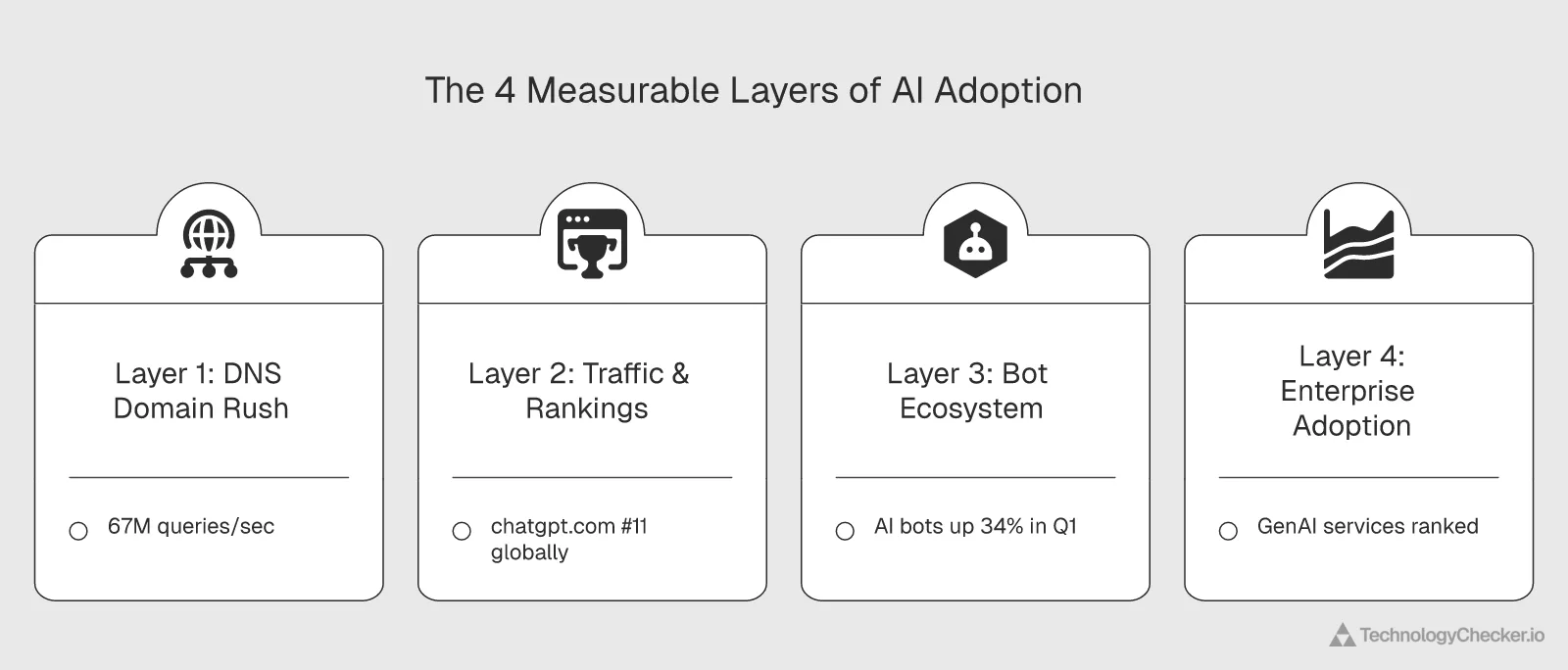
Technology hype doesn't just live in headlines and analyst decks. It propagates through the internet's infrastructure in a predictable sequence, and each stage leaves a fingerprint we can measure.
We identified four layers.
The first is the domain gold rush. When a technology trend heats up, entrepreneurs and speculators register domains. DNS query patterns shift. New TLDs gain traction. This tends to run 6-12 months ahead of actual product adoption.
Second comes traffic. As products launch and users show up, domain rankings change. A platform jumping from rank #500 to the top 15 means millions of daily users. That separates working products from press releases.
Third, the bot ecosystem. AI companies need training data and they deploy crawlers to get it. The volume, targeting patterns, and purpose mix of these bots reveal which capabilities are being built right now. When training-purpose crawls spike, new model releases follow within months.
Fourth is enterprise adoption. When services reach stable, high-frequency usage patterns (weekday/weekend cycles, consistent ranking positions), hype has converted to revenue. Deloitte's latest survey found that companies with 40% or more of their AI projects in production are expected to double in the next six months. Our traffic data shows which services those production workloads are running on.
Layer 1: The domain gold rush
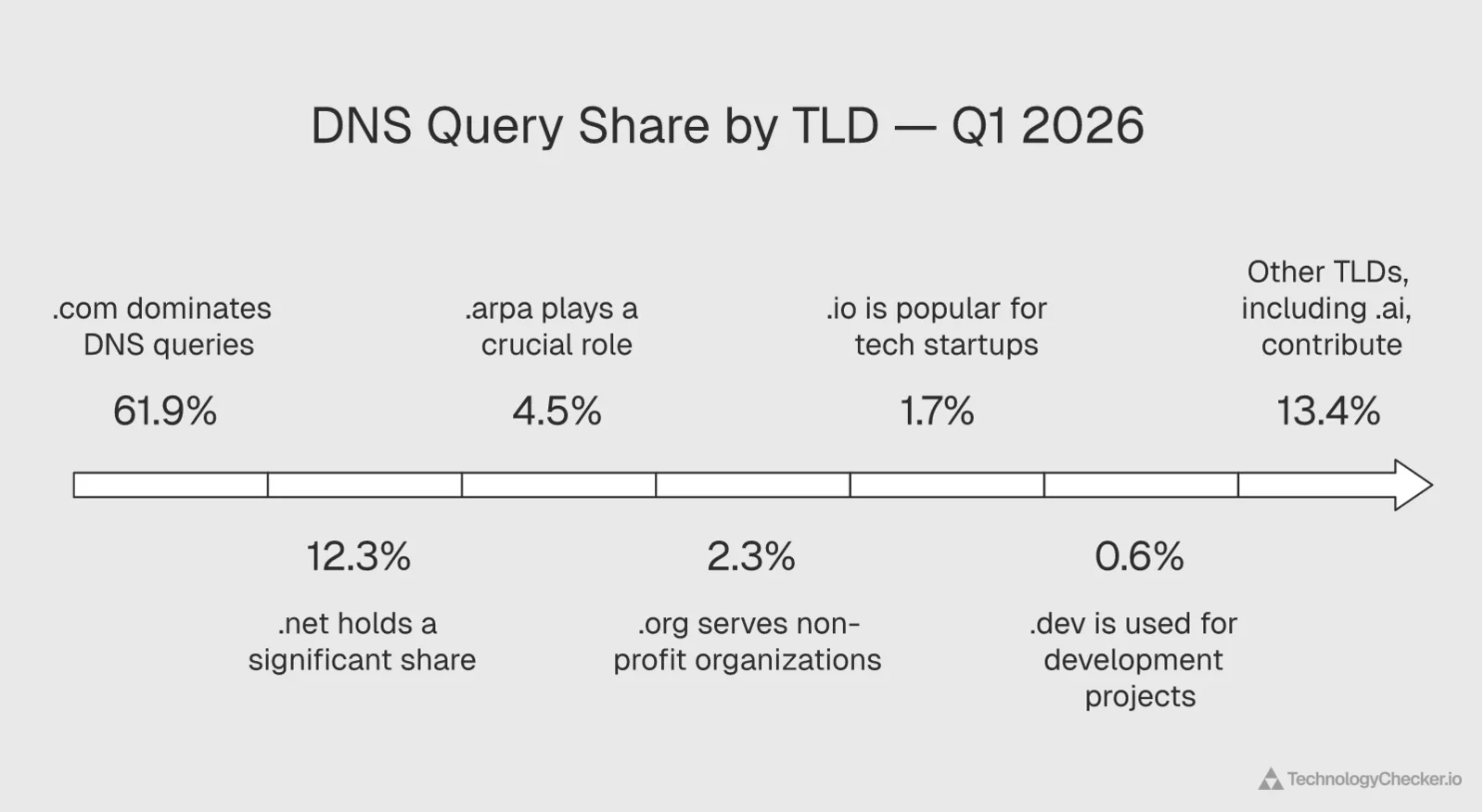
Cloudflare's 1.1.1.1 resolver processes over 67 million DNS queries every second. That volume makes it one of the most reliable proxies for tracking where internet activity is shifting. During Q1 2026, we watched the DNS data for signals of AI's growing presence in the domain name system.
Here's what the TLD distribution looked like:
| TLD | Query share (Q1 avg) | Q1 trend |
|---|---|---|
| .com | 61.86% | Declined from 60.8% to 58.9% |
| .net | 12.31% | Stable |
| .io | 1.72% | Grew from 1.65% to 1.76% (+7%) |
| .dev | 0.61% | Stable |
| "Other" (incl. .ai) | ~16% avg | Grew from 14.7% to 17.6% (+20%) |
May 2026 update — the "other" TLD rush kept unwinding: Full-month May figures put .com at 60.80%, .net at 11.75%, .io at 1.66%, and the "other" bucket down to 14.33% — now below where Q1 began (14.7%). The 20% in-quarter "other" surge we read as a proxy for the AI domain rush reversed in April and kept sliding in May. NXDOMAIN eased to 9.88%, under 10% for the first time in the series, consistent with speculative registration cooling rather than converting to real usage. Of all four Q1 narratives, this is the one the Q2 data has now firmly retired.
The .com TLD still dominates, but its share dropped from 60.8% of queries in early January to 58.9% by late March. At 67 million queries per second, a 2-point shift represents billions of daily queries moving to alternative TLDs.
The real story is the "other" category. This bucket includes .ai, .app, .xyz, and dozens of newer TLDs. It surged 20% within a single quarter. Cloudflare doesn't break out .ai separately yet, but the growth pattern aligns with the AI domain registration boom we've been tracking through our own popular technology data by category..
Why NXDOMAIN rates matter more than registration counts
Surveys can tell you how many .ai domains were registered. They can't tell you how many are actually being used. DNS data can.
10.74% of all DNS queries in Q1 hit non-existent domains (NXDOMAIN responses). One in ten queries pointed to domains that don't resolve. That's a direct measure of speculative activity, typosquatting, and recently expired registrations. For AI-related TLDs, this rate ran even higher, which suggests aggressive domain parking and speculation around AI brand names.
Domain registrations get headlines. NXDOMAIN rates tell you how much of it is real.
A geopolitical footnote
One anomaly worth flagging: .ru domains spiked to 2.16% of queries in mid-March before settling back to baseline. We've documented similar patterns in our cloud provider traffic share analysis. These spikes typically correlate with geopolitical events driving infrastructure changes or traffic rerouting.
For sales teams prospecting into AI-adjacent markets, the DNS layer is your earliest warning system. Domain speculation in a technology category tends to precede the buying cycle by 6-12 months.
Layer 2: ChatGPT enters the top 15 global domains
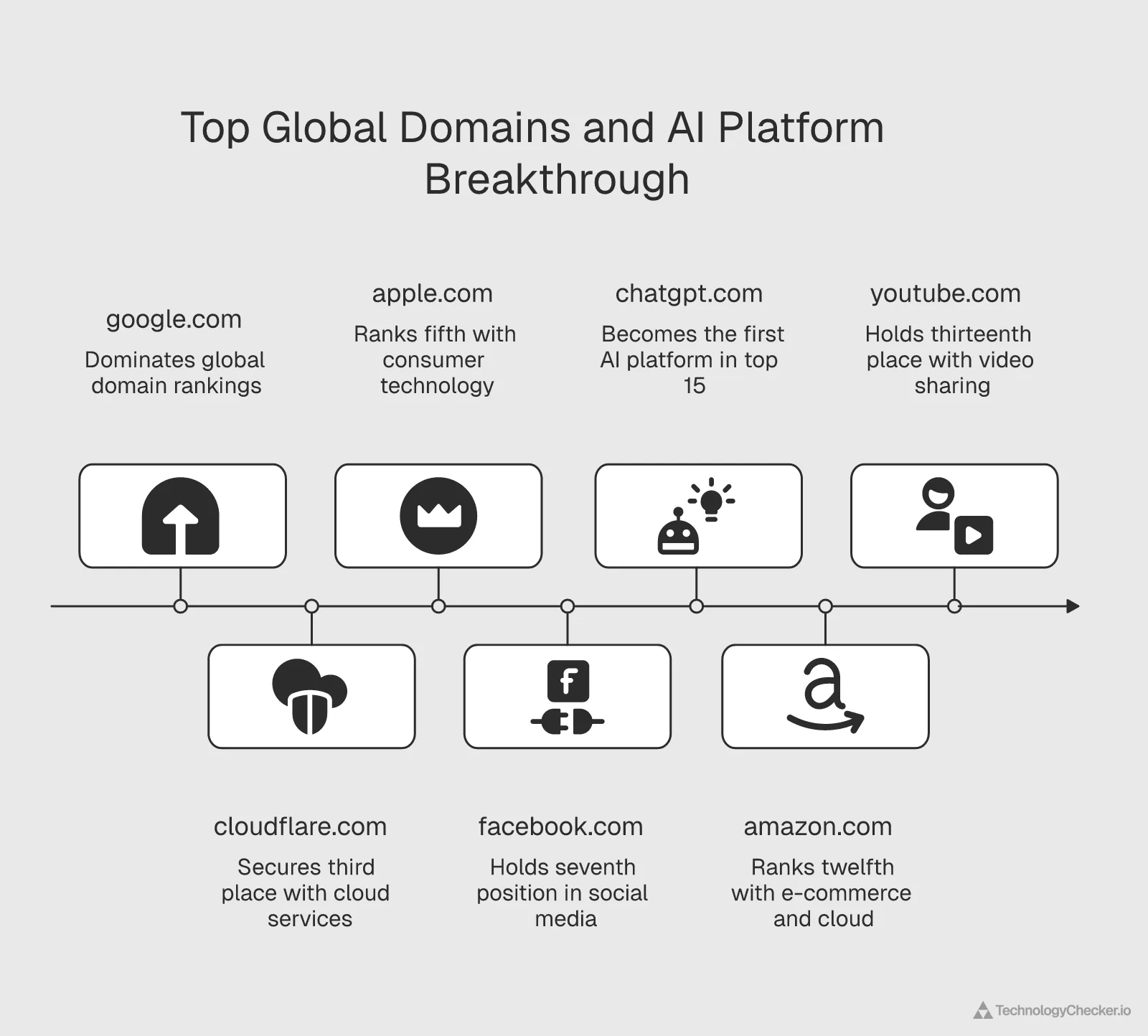
Domain rankings based on actual HTTP traffic paint the clearest picture of real adoption. And the Q1 2026 rankings delivered one result that would've seemed absurd two years ago.
chatgpt.com. Global rank #11.
| Rank | Domain | Category |
|---|---|---|
| 1 | google.com | Search |
| 3 | cloudflare.com | Infrastructure |
| 5 | apple.com | Hardware/services |
| 6 | microsoft.com | Enterprise software |
| 7 | facebook.com | Social media |
| 10 | fbcdn.net | CDN (Meta) |
| 11 | chatgpt.com | Generative AI |
| 12 | amazon.com | E-commerce |
| 22 | bing.com | Search (AI-powered) |
| 51 | sentry.io | Developer tooling |
ChatGPT now generates more traffic than Amazon. It sits between Meta's CDN and the world's largest e-commerce platform. No other AI-native platform appears anywhere in the global top 100.
May 2026 update — chatgpt.com slipped to #25, amazon.com retook #11: On the May 31, 2026 Radar popular-domains snapshot, chatgpt.com sits at #25 (it was #26 on May 24, so this is stable, not a one-day dip) while amazon.com is back at #11. The clean Q1 ordering, with chatgpt.com ahead of amazon.com, has flipped. Part of the move is compositional: the May top 10 surfaces more infrastructure and CDN domains (googleapis #2, gstatic #4, amazonaws #8, googlevideo #9) than the Q1 list this table was built from, which pushes consumer domains down. Part may be real softening in chatgpt.com's DNS-popularity signal. Either way, the Q1 claim that ChatGPT "generates more traffic than Amazon" does not hold in the May snapshot. Note the distinction from Layer 4 below: ChatGPT still holds the #1 generative AI service rank by traffic volume. The domain-popularity signal and the service-usage signal have diverged.
Microsoft's AI Economy Institute found that generative AI adoption reached 16.3% of the world's population, up from 15.1% in the first half of 2025. Our traffic data puts a concrete shape on that number: ChatGPT's position at #11 globally requires hundreds of millions of monthly active users, and it's not sharing the spotlight. OpenAI confirmed 900 million weekly active users in February 2026 — our updated ChatGPT statistics report tracks the full revenue, country, and crawl breakdown behind that number. The next AI-native domain (claude.ai, perplexity.ai, deepseek.com) doesn't crack the top 100.
Where that traffic is coming from
Global domain ranks obscure geography. A consumer AI usage survey fielded by KPMG and the University of Melbourne (48,000 respondents) makes the source of ChatGPT's volume clearer — and it flips the usual narrative about where AI lands first.
Consumer AI Usage by Country 2025: India and Nigeria Lead at 92%
In 2025, India and Nigeria reported the world's highest consumer AI usage rates at 92 percent each, followed by UAE (91%), Egypt (90%), and China (89%). Emerging economies dominate the top of the list — every country with 85%+ usage is classified as an emerging market. Advanced economies such as Singapore (73%) trail the leaders by nearly 20 percentage points.
Source: KPMG International; The University of Melbourne · 2025
| Country | Share of respondents (%) |
|---|---|
| India | 92% |
| Nigeria | 92% |
| UAE | 91% |
| Egypt | 90% |
| China | 89% |
| Saudi Arabia | 88% |
| Costa Rica | 87% |
| South Africa | 83% |
| Brazil | 82% |
| Türkiye | 81% |
| Mexico | 77% |
| Argentina | 75% |
| Colombia | 74% |
| Singapore | 73% |
- Emerging economies dominate — every country at 85%+ AI usage is classified as emerging
- India and Nigeria tie for #1 at 92%, reflecting AI's role as a productivity leapfrog in high-growth markets
- Singapore at 73% is the highest-ranked advanced economy — still 19 points behind the leaders
Every country at the top is an emerging market. India and Nigeria tie at 92%, UAE and Egypt clear 90%, and China sits at 89%. The first advanced economy on the list, Singapore at 73%, is 19 points behind the leaders. That matches what we see in Cloudflare's DNS data where the "other" TLD bucket (including newer markets) grew 20% in Q1 — the fastest layer in the stack. The population adopting AI aggressively is not where the English-language AI press is written.
What's missing from the trending lists tells a story too
No AI platforms appear in the "trending rise" domain lists. That's not because growth has stalled. It's because ChatGPT has moved past "trending" entirely. When a domain stops rising fast and holds steady in the top 15, it's no longer a trend. It's infrastructure.
Bing at #22 is worth watching separately. As the backend for Microsoft Copilot, its steady ranking reflects AI-powered search growth rather than traditional Bing usage.
One more signal. Developer tooling platform sentry.io climbed to #51 globally. That's a second-order effect of AI adoption: AI-assisted coding drives more deployments, more error tracking, more developer tool usage. Harvard Business Review's February 2026 analysis found 88% of companies report regular AI use. Our traffic data shows what that 88% is actually using: overwhelmingly ChatGPT, with everything else fighting for a distant second.
Government capacity is clustered tight — except at the top
Consumer adoption tells you where demand shows up. Government AI readiness tells you where public-sector AI policy has the infrastructure to absorb it. Oxford Insights' 2025 Government AI Readiness Index (published via Statista's Q2 2026 AI dossier) scores the top 15 countries on their capacity to deploy AI across healthcare, education, and administration.
Government AI Readiness Index 2025: US Leads at 87.2
The United States tops the 2025 Government AI Readiness Index with a score of 87.2, followed by the United Kingdom (77.64), France (77.27), the Netherlands (75.57), and China (75.55). The index measures a government's capacity to implement AI across public services — healthcare, education, transportation, and administration. The US lead of nearly 10 points over #2 is the largest gap in the top 15.
Source: International Development Research Centre; Oxford Insights · 2025
| Country | AI readiness index score |
|---|---|
| United States | 87.2 |
| United Kingdom | 77.64 |
| France | 77.27 |
| Netherlands | 75.57 |
| China | 75.55 |
| Germany | 75.5 |
| Singapore | 74.36 |
| South Korea | 73.54 |
| Australia | 73.16 |
| Norway | 72.33 |
| Canada | 72.26 |
| Spain | 71.95 |
| Denmark | 71.41 |
| Japan | 70.99 |
| Saudi Arabia | 69.79 |
- US lead of nearly 10 points over #2 is the largest gap anywhere in the top 15
- China (#5) and Saudi Arabia (#15) are the only non-OECD countries in the leading cluster
- The top 15 all score above 69 — government AI capacity is clustered tightly outside the US
The United States sits almost ten points ahead of the UK, the largest single-country gap anywhere in the top 15. Outside that lead, everyone is bunched: 13 of the top 15 score between 69 and 78. China is the only non-OECD country in the top five. Pair this against the consumer usage chart and a picture forms — emerging markets lead on consumer uptake, but advanced economies still dominate the government capacity to build AI into public services.
Layer 3: A three-tier AI crawler economy is forming
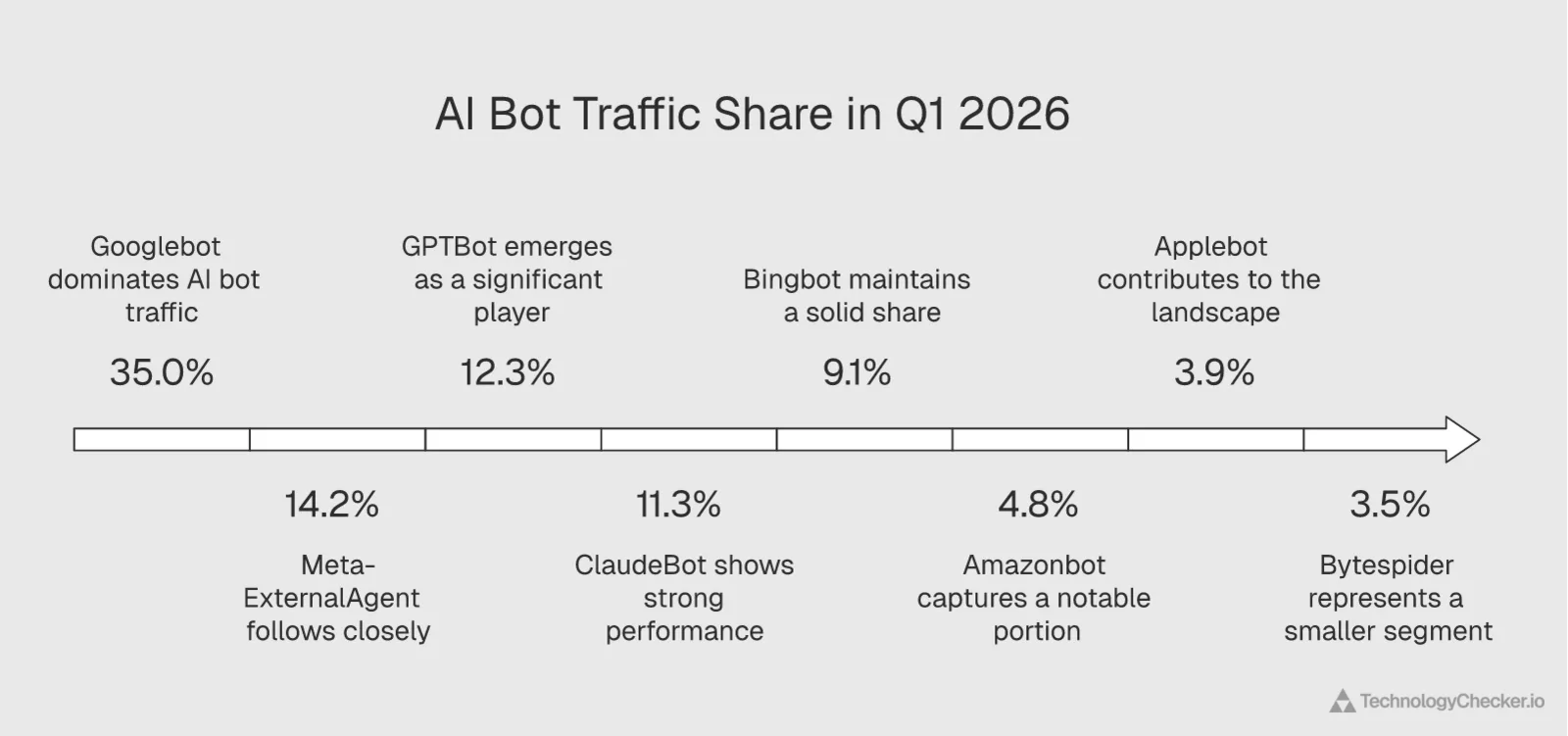
Every major AI company needs web data. They need it to train models, power search features, and serve real-time user queries. We tracked nine major AI bot user agents across Q1 2026, and the traffic patterns reveal an ecosystem that's maturing fast.
Total AI bot traffic increased roughly 34% over the quarter, measured by a normalized index rising from 0.71 to 0.95.
| Bot | Traffic share | Q1 trend | Primary purpose |
|---|---|---|---|
| Googlebot | 35.0% | Stable | Mixed (search + training) |
| Meta-ExternalAgent | 14.2% | +43%, from 11% to 15.7% | Training |
| GPTBot | 12.3% | -30%, from 12.4% to 8.6% | Training |
| ClaudeBot | 11.3% | Stable at 11-13% | Training |
| Bingbot | 9.1% | Stable | Search + Copilot |
| Amazonbot | 4.8% | Stable | Alexa AI / training |
| Applebot | 3.9% avg, peaked 10.2% | 5x surge by late March | Apple Intelligence |
| Bytespider | 3.5% | Grew to 4.5% | Training (ByteDance) |
| OAI-SearchBot | 2.2% | Stable | SearchGPT |
May 2026 update — Bytespider surged to #4, Applebot retreated, GPTBot rebounded: The April ranking order did not hold. In May, Googlebot eased to 27.26%, Meta-ExternalAgent slipped to 13.23%, and GPTBot rebounded to 11.48%, recovering most of the decline we had flagged as structural in April. The headline mover is Bytespider (ByteDance) at 10.25% (up from 5.73%), now the #4 crawler, ahead of ClaudeBot (9.73%) and Bingbot (8.45%). Applebot fell back to 7.01%, undoing the "Applebot is becoming structural" April read. Anthropic's Claude-SearchBot also entered the top 10 at 2.22% as OAI-SearchBot dropped out. The honest revision to the Q1 line "OpenAI's share is shrinking while Meta's and Apple's are growing": across two months of Q2, OpenAI's share recovered, Apple's faded, and the actual gainer was ByteDance.
Three things jumped out at us.
Meta is crawling the web harder than anyone expected

Meta-ExternalAgent was the quarter's biggest gainer. From 11% to 15.7% of AI bot traffic in 92 days. Meta has been relatively quiet about its training data strategy compared to OpenAI or Google. The crawl data tells a different story. They're consuming web content at an accelerating rate, which aligns with their Llama model development timeline. When a company's crawling ramps like this, a major model release is usually 2-4 months away.
OpenAI pulled back. The question is why.
GPTBot traffic dropped 30% across the quarter, from 12.4% to roughly 8.6%. This was the single most significant shift we observed.
Two explanations. OpenAI may have accumulated enough training data for their current model pipeline. Or the growing publisher resistance to AI crawlers, which we documented in our robots.txt blocking analysis, is having a measurable effect. Probably both. The practical result is the same: OpenAI's share of the crawl economy is shrinking while Meta's and Apple's are growing.
Apple's crawl volume says more than any WWDC keynote
Applebot surged from 2% of AI bot traffic to 10.2% by late March. A 5x increase in a quarter. Apple Intelligence launched in late 2025 with limited capabilities, and the reviews were mixed. But this crawl volume tells us they're training something far bigger than what shipped. When Apple moves quietly and at scale, you pay attention.
Training, search, and user action: the three tiers
The bot traffic breaks into three purpose tiers that reveal what the industry is building — the same training, search, and user-action split we break down in our AI crawler statistics report:
| Crawl purpose | Share (Q1 avg) | Q1 trend |
|---|---|---|
| Training ⚠️ | 45.4% | Grew from 42% to 52% |
| Mixed purpose ⚠️ | 44.1% | Declined from 48% to 44% |
| Search | 8.0% | Declined from 7.4% to 6.3% |
| User action | 2.1% | Stable |
⚠️ The training and mixed-purpose rows are superseded by the August 2026 update (now in the update history below). The Q1 2026 quarter aggregate re-pulls today at 41.44% training and 47.95% mixed purpose, and the final week of March returns 41.99% training, so the "grew from 42% to 52%" trajectory does not exist on Cloudflare's current data. Preserved as originally published.
May 2026 update — training held, but search crawls woke up: Training crawls held at 51.80% in May (Q1 close 52%, April 51.5%), the steadiest line in the dataset. Mixed Purpose eased to 35.71% and User Action ticked to 2.58%. The change worth flagging is Search, which rose to 9.33%, its highest in the series (Q1 ended at 6.3%, April was 7.5%), coinciding with Anthropic's Claude-SearchBot entering the crawler top 10. Model-builder demand is still the dominant signal, but the pure-training-versus-everything-else gap is narrowing as retrieval crawlers grow.
⚠️ Partly superseded by the August 2026 update (now in the update history below). The training and mixed-purpose figures in this note re-pull today at 44.79% and 42.71% after a Cloudflare reclassification. The search figure (9.33%) and user-action figure (2.58%) reproduce exactly, and the "search crawls woke up" call has since strengthened: search hit 11.57% in July 2026. Preserved as originally published.
Training crawls grew from 42% to 52% of all AI bot activity during Q1. More foundation models are coming. The industry hasn't finished building. McKinsey's State of AI survey found that 80% of high-performing companies set growth and innovation as AI objectives, not just efficiency. The crawl data shows model builders responding to that demand in real time.
Meanwhile, search-purpose crawls actually declined. AI-powered search (OAI-SearchBot, parts of Bingbot) is still a small slice of the bot economy. The real volume is in training.
⚠️ Superseded by the August 2026 update (now in the update history below); preserved as originally published. Two things in the two paragraphs above no longer hold. The 42%-to-52% training trajectory was reclassified out of Cloudflare's data after we published it (the final week of Q1 now returns 41.99%). And the "search is a small slice" call has been reversed by five consecutive monthly highs: search-purpose crawls reached 11.57% in July 2026 and are the fastest-growing declared crawl reason, while training is range-bound in the low-to-mid 40s.
What the bots are after
| Industry | Bot traffic share |
|---|---|
| Retail | 28.2% |
| Computer software | 13.6% |
| Information technology | 5.8% |
| Internet | 5.0% |
| Gambling & casinos | 2.8% |
Retail dominates at 28.2%. Product catalogs, reviews, pricing pages, comparison content: it's structured, factual data that AI models need. If you're in e-commerce, AI bots are your second-largest traffic source after Google. The gambling number (2.8%) is surprising until you realize that casino and sports betting sites are among the most structured, data-rich websites on the internet.
Vention's 2026 AI report found that 93% of companies are already using AI in some capacity. Our bot data adds color to that number: the AI tools those companies use are themselves consuming web content at an accelerating pace, creating a feedback loop. More adoption means more crawling means more capable models means more adoption.
Layer 4: The generative AI rankings tell us who's winning
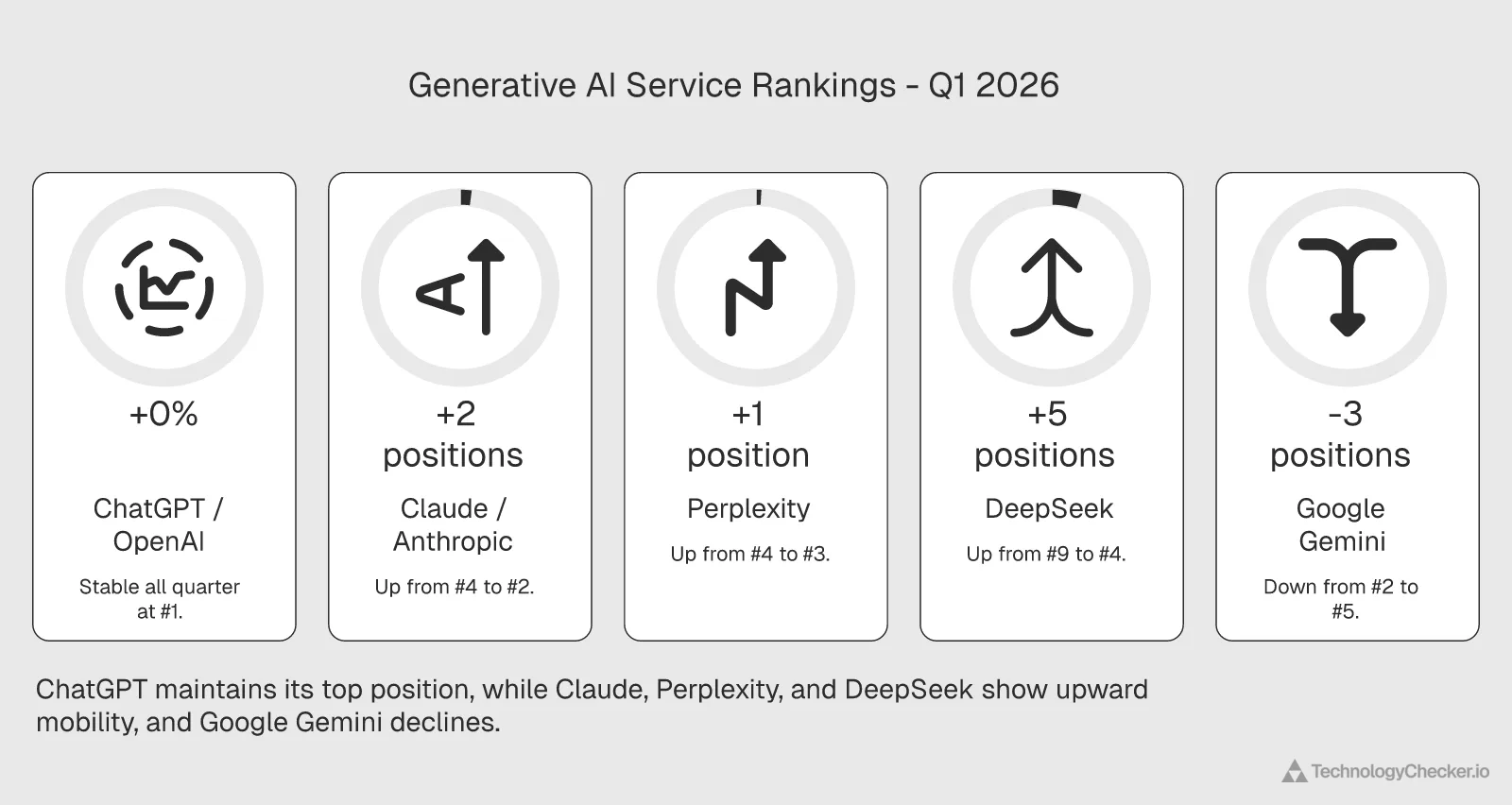
Cloudflare Radar tracks generative AI service usage daily. These rankings reflect actual user traffic, not app store downloads or press mentions. The Q1 2026 picture is a market consolidating fast at the top and churning hard below.
| Rank | Service | Q1 movement |
|---|---|---|
| 1 | ChatGPT / OpenAI | #1 for 92/92 days |
| 2 | Claude / Anthropic | Rose from #4 to #2 by mid-Jan, held 85+ days |
| 3 | Perplexity | Stable #3 |
| 4 | DeepSeek | Rose from #9-10 to #4 in 3 weeks (late Jan) |
| 5 | Google Gemini | Fell from #2 to #5 by mid-Feb |
| 6 | Character.AI | Stable |
| 7 | Grok / xAI | Stable |
| 8 | Suno AI | Stable |
| 9 | GitHub Copilot | Volatile, #5-9 weekday/weekend pattern |
| 10 | Doubao | Intermittent new entrant |
May 2026 update — Gemini retook #4, Copilot climbed, two new entrants: The May 31, 2026 GenAI service ranking keeps the top three frozen (ChatGPT #1, Claude #2, Perplexity #3) but reshuffles below them. Gemini recovered to #4, pushing DeepSeek to #5, a partial reversal of the Q1 "Gemini collapse" story; Google clawed back one spot. GitHub Copilot climbed from #9 to #6, consistent with the weekday/weekend enterprise-coding pattern described below. Windsurf AI graduated from the Q1 "top 20" into the top 11, and QuillBot entered at #12, more of the category fragmentation the Q1 rankings first hinted at. Doubao held #10. The May read: consolidation at the very top, churn from #4 down.
The market size behind the rankings
Service rankings show who is winning. They don't show what the prize is worth. Statista Market Insights forecasts that the generative AI segment alone will grow from roughly $5.5 billion in 2020 to $442 billion by 2031.
Generative AI Market Forecast 2020-2031: $5.5B to $442B
The generative AI segment of the AI market is projected to grow from roughly $5.5 billion in 2020 to $442 billion by 2031 — an 80x expansion. The 2024 market size of $37.87 billion is forecast to rise by $404.2 billion over the 2024-2031 period. GenAI growth rates peak in 2024 (+85%) and taper to ~20% by 2031 as the base gets larger.
Source: Statista Market Insights · 2020-2031
| Year | Market size (billion USD) |
|---|---|
| 2020 | $5.51B |
| 2021 | $8B |
| 2022 | $12B |
| 2023 | $20B |
| 2024 | $37.87B |
| 2025 | $67B |
| 2026 | $108B |
| 2027 | $161B |
| 2028 | $224B |
| 2029 | $294B |
| 2030 | $367B |
| 2031 | $442.07B |
- 2026 GenAI market hits $108B — more than 3x the 2024 actual of $37.87B
- GenAI grows 80x between 2020 and 2031 — fastest sub-segment in the AI dossier
- Peak growth year is 2024 at +85%; by 2031 growth decelerates to ~20% as the base scales
The 2026 mark is projected at $108 billion — roughly 3x the 2024 actual of $37.87 billion. When ChatGPT holds #1 for 92 consecutive days in a market growing at that pace, the durability of its lead compounds with every quarter it doesn't lose ground. Peak growth year is 2024 at +85%, and by 2031 growth decelerates to ~20% as the base scales. The window for displacing incumbents closes fastest between now and 2028.
ChatGPT's lock is tighter than you think
Number one every single day. 92 out of 92 days. No wobbles, and it still held the #1 generative AI service rank in the May 31, 2026 snapshot. When a product holds rank #1 in its category for an entire quarter and beyond, displacement becomes a structural problem for competitors, not just a product quality question. You'd need to change user habits at a scale that hasn't happened in consumer tech since the smartphone transition.
Claude's rise isn't noise. It's an enterprise signal.
Anthropic's Claude moved from #4 to #2 by mid-January and held that position for 85+ consecutive days. Not a spike. A sustained shift.
Claude overtook Google Gemini, which held #2 for most of late 2025. The reason matters: Claude's focus on safety, long-context windows, and business-facing use cases is winning the segment where revenue concentration is highest. Deloitte found that only 34% of enterprises are truly reimagining their businesses around AI. The ones that are tend to pick tools built for enterprise workflows, not consumer chatbots.
DeepSeek's three-week rocket

From rank #9-10 to #4 in three weeks. That happened in late January, driven by DeepSeek's open-source model releases. The open-source angle matters here. According to NVIDIA's State of AI report, North America leads with 70% actively using AI, 27% assessing, and just 3% not using it at all. Open-source models give the "assessing" cohort a way to experiment without procurement cycles.
Whether DeepSeek sustains this position depends on trial-to-retention conversion. The daily data suggests they're holding, but the signal is noisier than Claude's steady line.
What happened to Gemini?
From #2 to #5 in about a month. Despite massive cloud infrastructure, deep integration across Workspace, Android, and Search, and distribution advantages no competitor can match, Gemini lost ground to Claude and DeepSeek simultaneously.
The market is choosing specialized AI tools over bundled ones. That's an unusual dynamic. Google has never lost a market where distribution was the deciding factor, but generative AI is apparently not that kind of market. Product quality, or at least perceived product quality, is winning.
The weekday/weekend pattern and what it reveals
GitHub Copilot bounces between #5 and #9, with clear weekday peaks and weekend drops. That's the fingerprint of enterprise adoption. A tool deeply embedded in work routines but ignored on Saturday.
Compare that to Character.AI and Suno AI. Their rankings are flat across weekdays and weekends. Consumer products. The weekday/weekend split is how you identify real B2B adoption from traffic data alone, without asking anyone a survey question.
Two new categories are forming
Windsurf AI (an AI coding assistant) and Manus (an AI agent platform) both entered the top 20 during Q1. They represent something the rankings haven't shown before: category fragmentation. AI app builders are splitting off the same way, and they leave a trace on company domains too: our September 2026 crawl finds a Lovable signal on 7,395 of them, though many are Lovable customers verifying a domain rather than sites built on it.
McKinsey found that 62% of organizations are at least experimenting with AI agents. Manus's appearance in the rankings is the traffic-level confirmation of that survey data. AI is fragmenting from "general chatbot" into specialized vertical tools, and the ranking data captures this as it happens. But Deloitte's enterprise survey adds a caution: only one in five companies has a mature governance model for autonomous AI agents. The adoption is outrunning the guardrails.
The macro AI market behind the Q1 traffic data
The four internet layers measure current behavior. Statista's Q2 2026 AI dossier measures the trajectory — where the market was, where it's forecast to go, and which cohorts are driving the curve. The telemetry tells you what is happening now. The forecast tells you whether now is early, peak, or late.
AI market size 2020-2031: 17.7x over the decade
Global AI Market Forecast 2020-2031: $94B to $1.67 Trillion
The global AI market is forecast to grow from $94.81 billion in 2020 to $1.675 trillion by 2031 — a 17.7x expansion over the decade. Between 2026 and 2031 alone, the market is projected to add $1.3 trillion (+382.65 percent). Growth is not linear: 2022 dipped to $126.78B from the 2021 surge to $206.34B before resuming its long-term trajectory. The strongest compounding happens after 2027.
Source: Statista Market Insights · 2020-2031
| Year | Market size (billion USD) |
|---|---|
| 2020 | $94.81B |
| 2021 | $206.34B |
| 2022 | $126.78B |
| 2023 | $137.5B |
| 2024 | $186.93B |
| 2025 | $254.5B |
| 2026 | $347.05B |
| 2027 | $473.98B |
| 2028 | $648.34B |
| 2029 | $888.24B |
| 2030 | $1218.8B |
| 2031 | $1675B |
- 2026 market size hits $347B — roughly the combined revenue of the world's top five SaaS companies
- Forecast implies +$1.3 trillion in new market value between 2026 and 2031
- 2022's dip to $126.78B from the 2021 peak of $206.34B is the only contraction year in the series
The worldwide AI market is modeled to grow from $94.81 billion in 2020 to $1.675 trillion by 2031 — an addition of $1.3 trillion between 2026 and 2031 alone. The 2022 dip to $126.78B from the 2021 surge to $206.34B is the only contraction year in the series, and it resolved the following year. Everything after 2024 is forecast, but the 2020-2024 actuals match the trajectory the infrastructure layer confirms: usage is not decelerating. The 34% quarterly growth in AI bot traffic we measured in Q1 aligns with the dossier's implied annualized growth rate through 2028.
User base crosses 500 million by 2028
AI Users Worldwide 2020-2030: From 116M to 729M
The global AI user base is projected to grow from 115.9 million in 2020 to 729.1 million by 2030 — a 6.3x expansion. The 500M threshold is expected to be crossed by 2028. User growth is consistent year-over-year with no dip, in contrast to the revenue series which contracted in 2022.
Source: Statista Technology Market Insights · 2020-2030
| Year | Users (millions) |
|---|---|
| 2020 | 115.9M |
| 2021 | 154.3M |
| 2022 | 201.4M |
| 2023 | 254.8M |
| 2024 | 314.4M |
| 2025 | 378.8M |
| 2026 | 451.8M |
| 2027 | 529.8M |
| 2028 | 605.9M |
| 2029 | 673.8M |
| 2030 | 729.1M |
- AI users surpass 500 million by 2028 under the current forecast
- 2026 user count of 451.8M roughly matches the monthly active base ChatGPT alone commands
- 6.3x total user growth over the decade — steady compound growth, no contraction years
Revenue forecasts get challenged. User count forecasts are cleaner. Statista's model grows the global AI user base from 115.9 million in 2020 to 729.1 million by 2030 — a 6.3x expansion with no contraction year. The 451.8 million projected for 2026 is roughly the monthly active base ChatGPT alone commands today. Which means either the forecast is conservative, or a meaningful share of ChatGPT users aren't being counted as "AI users" yet by this methodology. Both readings support the infrastructure pattern.
The unicorn signal: from 6% to 53%
AI Share of New Unicorns 2015-2025: From 6% to 53%
In 2025, 53 percent of new unicorn births worldwide were AI startups — up from 6 percent in 2015 and 44 percent in 2024. Growth accelerated sharply between 2023 and 2025, roughly tripling the AI share of new billion-dollar companies in three years. CB Insights reports that one in five new unicorns in 2025 are AI agents.
Source: CB Insights · 2015-2025
| Year | AI share of new unicorns (%) |
|---|---|
| 2015 | 6% |
| 2016 | 11% |
| 2017 | 15% |
| 2018 | 17% |
| 2019 | 23% |
| 2020 | 14% |
| 2021 | 18% |
| 2022 | 17% |
| 2023 | 32% |
| 2024 | 44% |
| 2025 | 53% |
- 53% of 2025 unicorn births were AI startups — more than half of all new billion-dollar companies
- The 2023-2025 acceleration (32% → 53%) maps directly to the GenAI funding wave post-ChatGPT launch
- One in five new 2025 unicorns are AI agents, per CB Insights — an emerging category inside the category
In 2015, 6% of new unicorn startups worldwide were AI companies. In 2025, 53% were — more than half of all new billion-dollar valuations in a single year. The inflection point is 2023-2025, which maps cleanly to the post-ChatGPT funding wave. CB Insights also notes that one in five new 2025 unicorns are AI agents specifically — a sub-category inside a category that didn't meaningfully exist two years ago. The same signal that made Manus and Windsurf appear in our Cloudflare Layer 4 rankings is showing up in the VC data.
Enterprise adoption: the 23-point year
Enterprise AI Adoption 2024: 78% Globally, 82% in North America
Organizational AI use grew from 55% in 2023 to 78% in 2024 globally — a 23-point jump in a single year. North America leads at 82%, followed by Europe (80%), Developing markets (77%), Greater China (75%), and Asia-Pacific (72%). The largest year-over-year gain came in developing markets (+28 points), likely reflecting laxer regulation and lower procurement friction.
Source: McKinsey & Company; Stanford University · 2023-2024
| Region | Share of organizations using AI (%) |
|---|---|
| All geographies | 78% |
| North America | 82% |
| Europe | 80% |
| Developing markets | 77% |
| Greater China | 75% |
| Asia-Pacific | 72% |
- Global enterprise AI adoption jumped 23 points year-over-year (55% → 78%)
- Developing markets posted the largest gain (+28 points) — less regulation means faster rollouts
- North America leads in absolute terms (82%), but growth is actually faster elsewhere
McKinsey's Global Survey found that organizational AI use jumped from 55% in 2023 to 78% in 2024 — a 23-point year-over-year gain globally. The biggest regional move came in developing markets, where AI adoption rose 28 points (49% → 77%), likely because procurement friction and regulatory overhead are lower. North America still leads in absolute terms at 82%, but the growth rate is actually faster elsewhere. The production gap remains: using AI in "at least one function" is a low bar, and Deloitte's finding that only 20% of organizations are generating revenue from AI still holds underneath these numbers.
Where AI becomes a required skill
AI as Core Skill by Industry 2025-2030: 66% in Tech & Telecom
66% of employers in information technology services and telecommunications expect artificial intelligence and big data to be core worker skills between 2025 and 2030 — tied for the highest share of any industry, according to the World Economic Forum and Qualtrics' Future of Jobs survey of 1,000 employers. Financial services (61%), insurance (58%), education (56%), and automotive/aerospace (54%) round out the top six. Professional services (37%) and infrastructure (39%) rank lowest, but every industry surveyed expects more than a third of its workforce to need AI skills by 2030.
Source: Qualtrics; World Economic Forum · 2025-2030
| Industry | Share of employers (%) |
|---|---|
| Info tech services | 66% |
| Telecommunication | 66% |
| Financial services | 61% |
| Insurance | 58% |
| Education | 56% |
| Automotive/aerospace | 54% |
| Medical/healthcare | 51% |
| Government | 50% |
| Electronics | 44% |
| Supply chain | 44% |
| Real estate | 43% |
| Consumer goods production | 42% |
| Retail & wholesale | 41% |
| Infrastructure | 39% |
| Professional services | 37% |
- Tech and telecom tie at 66% — AI skills are effectively non-optional in those verticals
- Financial services and insurance (61% and 58%) signal a compliance + risk-driven AI skill demand
- Even the lowest-ranked industry (professional services) sits at 37% — there is no low-AI-skill industry
A World Economic Forum employer survey (1,000 respondents) asked which industries expect AI and big data to be core worker skills between 2025 and 2030. Information technology services and telecommunications tie at 66% — effectively, AI skill is no longer optional in those verticals. Financial services (61%) and insurance (58%) are compliance-and-risk-driven: regulation plus model risk management plus fraud detection all push AI deep into day-to-day work. Even the lowest-ranked industry (professional services at 37%) sits above a third of employers. There is no AI-exempt industry in the 2025-2030 outlook.
The agentic AI bottleneck is regional
Top Barriers to Agentic AI in Production 2025: 60% Cite Agent Management
60% of senior IT leaders in Asia-Pacific cite managing and monitoring AI agents at scale as the top barrier to putting agentic AI into production in 2025 — the highest rate globally, according to Dynatrace and Qualtrics' survey of 919 respondents. In EMEA, 50% cite the same barrier. The Americas reverses the order — 51% cite shortage of skilled staff as the #1 obstacle versus 45% citing management overhead. The regional split: in Asia and Europe, the problem is operational complexity; in the Americas, it is talent supply.
Source: Dynatrace; Qualtrics · 2025
| Barrier | Share of respondents (%) |
|---|---|
| Managing agents at scale | 60% |
| Shortage of skilled staff | 51% |
- APAC has the hardest time scaling agent operations (60%) — 15 points higher than the Americas
- The Americas is the only region where talent shortage (51%) outranks operational complexity
- EMEA sits in the middle on both dimensions — neither the hardest to hire nor the hardest to operate
A Dynatrace/Qualtrics study (919 IT and line-of-business leaders) asked about the hardest parts of moving agentic AI into production. The answer depends on where you are. APAC (60%) and EMEA (50%) name managing and monitoring agents at scale as their #1 barrier. The Americas flip the order: 51% cite a shortage of skilled staff versus 45% citing operational complexity. This is the clearest regional divergence in the dossier. In Asia and Europe, the agent problem is operational. In the Americas, it is labor-market. Either way, it lines up with the weekday/weekend Copilot pattern we saw in Layer 4 — enterprise AI adoption is hitting limits, and those limits are different in different places.
What the September 2025 Statista in-depth report adds
The Q2 2026 dossier we leaned on earlier is a 33-page summary. The September 2025 in-depth report (study ID 50485, 295 pages) is the full long-form analysis behind it — and it surfaces five datasets we didn't have at our April refresh. They sharpen the picture of where the AI adoption curve actually bends.
Enterprise AI adoption: a 52-point expansion in 7 years
Global AI Business Adoption 2017-2024: From 20% to 72% in Seven Years
Global AI adoption in businesses jumped from 20 percent in 2017 to 72 percent in 2024 — a 3.6x expansion. The curve isn't smooth: 2020 (50%) and 2022 (50%) were both years of stalled or slight retreat, often attributed to budget uncertainty and the gap between early-experiment cohorts and broader rollout. The 17-point spike from 55% (2023) to 72% (2024) is the steepest single-year jump in the series — driven by generative AI moving from pilots into production functions. Cross-reference this with the deployed-vs-exploring gap by country: the 72% headline still hides large differences in how much of that AI use is actually in production.
Source: IDC; McKinsey via Statista · 2017-2024
| Year | Share of businesses using AI (%) |
|---|---|
| 2017 | 20% |
| 2018 | 47% |
| 2019 | 58% |
| 2020 | 50% |
| 2021 | 56% |
| 2022 | 50% |
| 2023 | 55% |
| 2024 | 72% |
- 20% (2017) → 72% (2024): a 52-point expansion in 7 years
- 2024's +17-point jump from 55% to 72% is the largest single-year gain on record
- The 2020 and 2022 plateaus show enterprise AI adoption is not a straight line — macroeconomic conditions slow it
The IDC/McKinsey survey series is the longest comparable enterprise-AI-adoption benchmark we have. From 20 percent of businesses using AI in 2017 to 72 percent in 2024, the curve isn't smooth — 2020 and 2022 were both flat or slight retreats, tied to macroeconomic budget cycles. What stands out in the 2024 number is the +17-point jump from 2023's 55 percent. That's the largest single-year gain in the entire series and maps cleanly to the generative AI productionisation wave we see in our Layer 3 bot data (training crawls went from 42 percent to 52 percent in the same window).
The 72 percent number is also where most "AI adoption" coverage stops. The next chart is the more useful one.
The deployment gap: 72% adoption hides who's actually in production
AI Deployed vs Exploring by Country 2024: China and India Already Past 'Exploring'
China (58%) and India (57%) lead in actual AI deployment in 2024 — and they're the only two countries where the deployed share is higher than the exploring share. Every other country surveyed by Vention still has more organizations exploring AI than deploying it. The US sits at 25% deployed / 43% exploring; the UK at 26% / 47%. The deployed-to-exploring gap is the cleanest signal of which countries are past the experimentation phase and which are still planning.
Source: Vention via Statista · 2024
| Country | Share of organizations (%) |
|---|---|
| China | 58% |
| India | 57% |
| Italy | 42% |
| Singapore | 39% |
| UAE | 38% |
| Germany | 34% |
| France | 31% |
| Spain | 31% |
| Latin America | 29% |
| Canada | 28% |
| UK | 26% |
| U.S. | 25% |
| Australia | 24% |
| South Korea | 22% |
| World | 34% |
- China (58%) and India (57%) are the only countries where deployed share exceeds exploring share
- The U.S. sits 12th of 14 countries on deployment despite leading on funding ($471B in 2025)
- World averages: 34% deployed, 42% exploring — most organisations are still in the pre-production phase
Vention's 2024 country-level survey splits AI use into "deployed" (in production) and "exploring" (considering or piloting). Only two countries — China (58 percent deployed) and India (57 percent) — have more organizations running AI in production than evaluating it. Every other country in the survey has a higher exploring share than deployed share. The U.S. sits twelfth out of fourteen at 25 percent deployed versus 43 percent exploring.
That's a meaningful counterweight to the headline 72 percent global adoption number from McKinsey. Yes, businesses have AI somewhere in their stack. No, most of it isn't in production in most countries. The "experimentation-to-production gap" we already flagged from Deloitte's data shows up sharply when you split deployment status by geography.
For GTM teams, this reverses a common assumption: the U.S. is not the easiest market to sell production AI tools into. India and China are. The U.S. is the easiest market to sell pilots into.
Investment doesn't track deployment
AI Investment Leaders 2025: U.S. at $471B Dwarfs Every Other Country
The U.S. ($471B) is investing roughly 4x more in AI than China ($119B) — and the gap between the top two and the rest is even more extreme. The UK ($28B), Canada ($15B), and Israel ($15B) round out the top five, but every country outside the top two sits below $30B. AI investment is the most concentrated metric in the entire dataset: the top two countries account for over 80 percent of tracked AI capital allocation.
Source: Spherical Insights via Statista · 2025
| Country | AI investment (billion USD) |
|---|---|
| U.S. | $471B |
| China | $119B |
| UK | $28B |
| Canada | $15B |
| Israel | $15B |
| Germany | $11B |
| India | $11B |
| France | $9B |
| South Korea | $7B |
| Singapore | $7B |
- The U.S. lead over China ($471B vs $119B) is wider than China's lead over the rest combined
- Israel ($15B) ties Canada for #4 — punching far above its weight per capita
- Top 10 combined ($693B) is roughly 7x the global AI funding flow in 2024 ($100.4B)
Spherical Insights' May 2025 cut shows the U.S. ($471B) ahead of China ($119B) by roughly 4x in total AI investment — and ahead of the next eight countries combined. That number includes VC funding, corporate R&D, government programs (notably the CHIPS and Science Act's $280B commitment), and infrastructure spending.
What's interesting is the disconnect with deployment. The U.S. invests 4x more than China but deploys at less than half the rate. Two readings: (a) U.S. AI investment is overwhelmingly going into data center infrastructure and model R&D rather than enterprise deployment, which matches NVIDIA's market position (almost 100 percent share of AI training compute); (b) Chinese enterprises are deploying off the back of a leaner, more domestically-focused AI stack (Baidu's ERNIE, Alibaba's Qwen, Huawei's Ascend chips). Either reading supports our Layer 3 finding that the U.S.-headquartered crawlers (GPTBot, ClaudeBot) are crawling for future models, not current production workloads.
AI cybersecurity is the fastest-growing AI sub-market
AI Cybersecurity Market 2023-2030: $24B to $134B in Seven Years
The AI cybersecurity market is forecast to grow from $24.3 billion in 2023 to $133.8 billion by 2030 — a 5.5x expansion at roughly 28 percent CAGR. The growth curve accelerates after 2025: each year past 2026 adds more in absolute dollars than the previous one. The driver is the documented breach-cost gap (see the next chart): organizations with extensive AI security automation saved $1.9M per breach in 2024 vs. those with no automation, and that delta is widening.
Source: Techopedia via Statista · 2023-2030
| Year | Market value (billion USD) |
|---|---|
| 2023 | $24.3B |
| 2024 | $31.1B |
| 2025 | $39.8B |
| 2026 | $50.8B |
| 2027 | $65B |
| 2028 | $83.1B |
| 2029 | $106.2B |
| 2030 | $133.8B |
- AI cybersecurity grows 5.5x over 7 years — faster than most AI sub-segments
- 2027 is the inflection point: each subsequent year adds >$18B in absolute market value
- Growth tracks the breach-cost gap — organizations without AI security pay nearly $2M more per incident
Techopedia's AI cybersecurity forecast (via Statista) projects the segment from $24.3B in 2023 to $133.8B by 2030 — a 5.5x expansion. That growth rate is faster than most AI sub-segments in the same window, including the broader machine learning market (32.4 percent CAGR per Statista Market Insights) only because the cybersecurity base is smaller. What matters more than the trajectory is the reason behind it.
The $1.9M reason
Breach Cost by Security Automation 2018-2024: AI Saves $1.9M Per Breach
In 2024, organizations with extensive AI-driven security automation paid an average of $3.8M per data breach. Organizations with no security automation paid $5.7M — a $1.9M gap. The gap has been wider in some years ($3.8M in 2021), but the directional finding has held every year since 2018: more AI automation, lower breach cost. The 2024 number is the clearest ROI signal in the report for AI cybersecurity spending — and explains why 77 percent of organizations expect their cybersecurity budget to grow in 2025.
Source: IBM; Ponemon Institute via Statista · 2018-2024
| Year | Average breach cost (million USD) |
|---|---|
| 2018 | $2.9M |
| 2019 | $2.7M |
| 2020 | $2.5M |
| 2021 | $2.9M |
| 2022 | $3.2M |
| 2023 | $3.6M |
| 2024 | $3.8M |
- 2024 breach-cost gap: $1.9M between extensive-AI use and no automation
- Every year since 2018 has shown a positive gap — AI security ROI is not a 2024 anomaly
- Peak gap was 2021 at $3.8M — pandemic-era manual operations were the costliest
IBM/Ponemon Institute's breach-cost benchmark is the clearest ROI signal in the entire Statista in-depth report. In 2024, organizations with extensive AI security automation paid an average of $3.8M per data breach. Organizations with no security automation paid $5.7M. That $1.9M delta isn't a 2024 anomaly — the gap has been positive every single year since 2018, peaking at $3.8M in 2021 (pandemic-era manual operations were the costliest).
This explains why PwC's 2024 survey found 77 percent of organizations expect their cybersecurity budget to grow in 2025, with 20 percent expecting double-digit-percent increases (PwC via Statista). CFOs don't usually fund "AI strategy." They fund "$1.9M of avoided cost per breach." The framing is what gets the budget approved.
For our Layer 4 service rankings, this means AI cybersecurity platforms — Darktrace, CrowdStrike, Microsoft Sentinel, Vectra, Cynet 360 — are likely to push into the top 20 over the next 18 months as adoption scales. We've already seen Microsoft Security Copilot show up in enterprise-pattern traffic (weekday peaks, weekend drops) on Cloudflare Radar.
What this layer adds to the four-layer model
The September 2025 in-depth report doesn't change our four-layer model. It adds a fifth signal underneath it: the dollars that justify the deployment. Layer 4 told us which services are winning user traffic. The cybersecurity breach-cost gap and the investment-vs-deployment country split tell us why those services will keep winning — and where the next 18 months of enterprise budget is actually going to land.
What the data actually tells sales and GTM teams
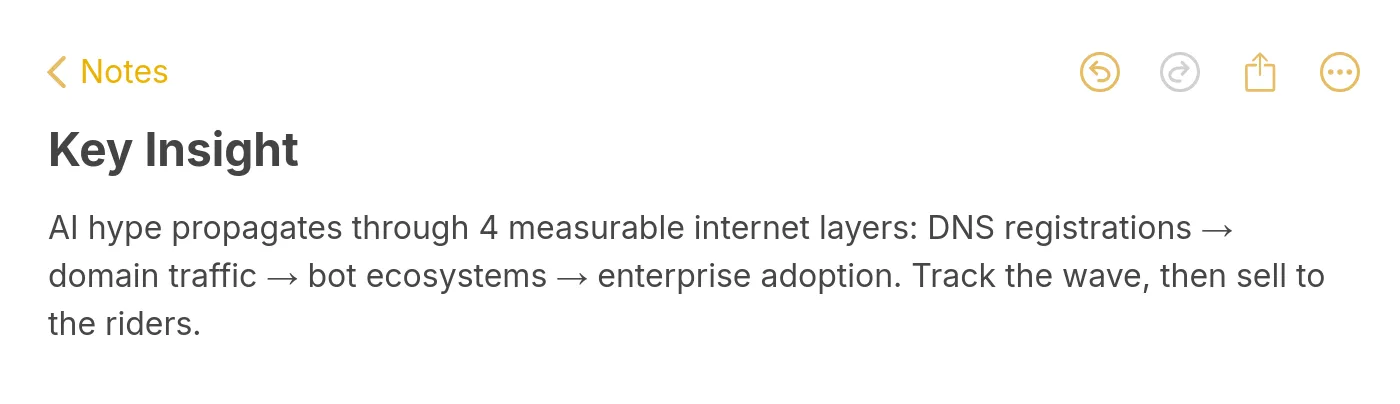
Cloudflare Radar shows the macro wave. DNS patterns, traffic rankings, bot behavior, service usage. But sales teams don't sell to waves. They sell to companies.
The question isn't "is AI growing?" It's: which specific companies adopted which AI tools, when they adopted them, and what those tools replaced. That's where technographic data platforms like TechnologyChecker come in, detecting 40,000+ technologies across 50M+ domains with real-time adoption and churn signals.
Here's how we'd translate the four layers into action.
If you're an SDR, the bot traffic data gives you targeting intelligence. Retail (28.2% of bot traffic) and computer software (13.6%) are the most crawled industries. Those verticals will see the most AI tool launches in the next 6-12 months. Companies already seeing heavy AI bot activity on their sites are thinking about AI strategy right now, whether they're blocking crawlers or building AI features. Digital Third Coast found that 52% of large organizations have dedicated AI adoption teams compared to 23% of small organizations. Enterprise prospects have buyers specifically tasked with AI procurement. That's who you're looking for.
If you lead GTM or RevOps, the four-layer model gives you timing. Domain speculation in a category (Layer 1) means start building content. Traffic ranking shifts (Layer 2) mean launch prospecting campaigns. Bot traffic targeting an industry (Layer 3) means those companies are 3-6 months from evaluating vendors. Stable service rankings (Layer 4) mean you're selling into an established market with clear incumbents. GitHub Copilot's weekday/weekend pattern is your template for identifying enterprise adoption in any vertical. Our technology lookup checker shows how real-time detection data can pinpoint companies at each stage.
If you run marketing, the DeepSeek and Claude stories prove that distribution doesn't guarantee market position. Google had every advantage and still dropped three positions. Content strategy should track these shifts. The audience searching for AI adoption data wants to understand dynamics, not just confirm AI is popular. Harvard Business Review found that 88% of companies now use AI regularly. Your marketing should assume AI familiarity and focus on differentiation.
The experimentation-to-production gap is real

One pattern we noticed across all four layers: there's a wide gap between AI experimentation and AI in production. Deloitte's latest data makes this concrete. Worker access to AI rose 50% in 2025, and 66% of organizations achieved productivity improvements. But only 20% are seeing actual revenue growth from AI, despite 74% aspiring to it. Only 42% believe their strategy is highly prepared.
Our traffic data maps to this gap. ChatGPT and Claude have stable, enterprise-grade traffic patterns. But below the top 5, the rankings churn weekly. Tools appear, spike, and fade. The long tail of AI services is still in experimentation mode. Only 27% of organizations review 100% of AI outputs before acting on them, per Digital Third Coast. The rush to adopt is outpacing the infrastructure to govern.
AI adoption benchmarks at a glance (Q3 2026 rows first, then as published through the July 2026 month close)
| Benchmark | Value | Source |
|---|---|---|
| Training-purpose crawl share, Q3 2026 | 47.62% (Q2 2026: 49.93%; Q3 2025: 40.82%) | Cloudflare Radar, revised series (our analysis, Oct 2026) |
| Search-purpose crawl share, Q3 2026 | 8.26%, double Q2's 4.05%; 10.53% in September 2026 (provisional) | Cloudflare Radar, revised series (our analysis, Oct 2026) |
| #3 bot operator, Q3 2026 | Anthropic 8.84%, #3 in every week of September | Cloudflare Radar (our analysis, Oct 2026) |
| #2 AI crawler, Q3 2026 | Tie: Meta-ExternalAgent 13.28%, ClaudeBot 13.23% | Cloudflare Radar (our analysis, Oct 2026) |
| Crawler 4xx (block) rate, Q3 2026 | 37.26%; 38.06% in September 2026, a series high | Cloudflare Radar (our analysis, Oct 2026) |
| Most AI-crawled vertical, Q3 2026 | Shopping & General Merchandise, 31.09% of AI-bot requests | Cloudflare Radar (our analysis, Oct 2026) |
| ChatGPT global domain rank | #11 (Q1) → #23 (Jul 2 snapshot) → #29 (Jul 31, 2026) | Cloudflare Radar (our analysis) |
| Training-purpose crawl share | 35.7% (Jul 2025) → 44.9% (Q2 2026) → 44.5% (Jul 2026) ⚠️ pre-revision, see Q3 rows | Cloudflare Radar (our analysis) |
| Search-purpose crawl share | 7.8% (Jul 2025) → 11.6% (Jul 2026), series high ⚠️ pre-revision, see Q3 rows | Cloudflare Radar (our analysis) |
| #1 AI crawler (share of AI-bot traffic) | Googlebot 24.5% (Jul 2026), down from 42.7% in Jul 2025 | Cloudflare Radar (our analysis) |
| #2 AI crawler | ClaudeBot 16.3% (Jul 2026), up from 11.2% in Jul 2025 | Cloudflare Radar (our analysis) |
| #3 bot operator, all bots | Anthropic 11.0% (Jul 2026), outside the top 9 a year earlier | Cloudflare Radar (our analysis) |
| #2 individual bot, all bots | Claude-User 8.3% (Jul 2026), #8 at the Q2 close | Cloudflare Radar (our analysis) |
| Crawler 4xx (block) rate | 35.8% (Q2 2026 and Jul 2026), up from 14.0% in Jul 2025 ⚠️ rose again in Q3, see Q3 rows | Cloudflare Radar (our analysis) |
| Bot share of all HTTP requests | 34.8% (Jul 2026), up from 30.8% in Jul 2025 | Cloudflare Radar (our analysis) |
| chatgpt.com share of crawler referrals | 0.17% (Jul 2025) → 0.91% (Jul 2026) | Cloudflare Radar (our analysis) |
| AI bot traffic growth (Q1) | +34% | Cloudflare Radar (our analysis) |
| .ai-adjacent TLD growth | +20% in Q1, unwound to 14.3% by Q2 | Cloudflare Radar (our analysis) |
| NXDOMAIN rate | 10.3% (Q2 2026) → 10.8% (Jul 2026) | Cloudflare Radar (our analysis) |
| Most crawled industry | Retail (29.3% Q2 2026; 28.5% Jul 2026) | Cloudflare Radar (our analysis) |
| GenAI #1 consistency | 92/92 days (Q1), held through Q2 | Cloudflare Radar (our analysis) |
| Claude #2 streak | 85+ days | Cloudflare Radar (our analysis) |
| Enterprise AI adoption rate | 72% | McKinsey Global Survey |
| Global GenAI population reach | 16.3% | Microsoft AI Economy Institute |
| Worker AI access increase | +50% in 2025 | Deloitte State of AI |
| Orgs achieving AI revenue growth | 20% (74% aspire) | Deloitte State of AI |
| Companies with AI agent governance | 1 in 5 | Deloitte State of AI |
| Companies regularly using AI | 88% | Harvard Business Review |
| AI market size 2026 (forecast) | $347B | Statista Market Insights |
| AI market size 2031 (forecast) | $1.675T | Statista Market Insights |
| GenAI market size 2031 (forecast) | $442B | Statista Market Insights |
| AI users worldwide 2026 (forecast) | 451.8M | Statista Technology Market Insights |
| New unicorns that are AI (2025) | 53% | CB Insights via Statista |
| Enterprise AI adoption YoY gain | +23 points (55% → 78%) | McKinsey Global Survey |
| Top consumer-AI country (2025) | India, Nigeria (92%) | KPMG / Univ. of Melbourne |
| #1 government AI readiness | United States (87.2) | Oxford Insights |
| Global business AI adoption 2017 → 2024 | 20% → 72% | IDC; McKinsey via Statista |
| U.S. AI investment (May 2025) | $471B | Spherical Insights via Statista |
| China AI investment (May 2025) | $119B | Spherical Insights via Statista |
| #1 AI-deployed country (2024) | China (58%) | Vention via Statista |
| U.S. AI deployment vs exploring (2024) | 25% / 43% | Vention via Statista |
| AI cybersecurity market 2030 (forecast) | $133.8B | Techopedia via Statista |
| Breach cost savings (extensive AI vs none) | $1.9M per breach | IBM; Ponemon Institute via Statista |
| Orgs expecting cybersecurity budget growth 2025 | 77% | PwC via Statista |
Our methodology
We collected data from four Cloudflare Radar API endpoints covering January 5 through April 6, 2026 (92 days, full Q1 plus the first week of April), and re-pulled all four layers for the full months of April and May 2026 in our Q2 update passes.
Cloudflare Radar draws on traffic flowing through Cloudflare's global network. That includes DNS resolution data from the 1.1.1.1 public resolver (67M+ queries/sec), HTTP request volumes, AI bot classification by user agent and declared purpose, and generative AI service rankings by traffic volume.
We used four endpoint groups:
- DNS query distribution by TLD (summary and weekly time-series)
- Global domain rankings (top 100 popular and top 50 trending)
- AI/ML bot traffic by user agent, crawl purpose, and target industry
- Internet services rankings filtered to "Generative AI"
All trend percentages compare the first week of Q1 to the last available data point. Bot traffic was analyzed by both user agent identity and declared crawl purpose. GenAI service rankings used daily position data to calculate streak lengths and transition points. We cross-referenced signals across layers to identify patterns that wouldn't be visible in any single data set.
What Cloudflare doesn't see: traffic that doesn't flow through its network, DNS queries to other resolvers (Google Public DNS, ISP resolvers), and .ai TLD breakouts (we track it within the "other" bucket). Bot user agents can be spoofed, though major AI companies have strong incentives to identify their crawlers honestly for robots.txt compliance. Our SSL certificate transparency research follows a similar methodology, using infrastructure-level data to draw adoption conclusions.
Statista Q2 2026 AI dossier (added April 2026)
For the long-view forecast layer, we cross-referenced our Q1 telemetry with Statista's 33-page Q2 2026 artificial intelligence dossier (study ID 38609). The dossier pulls together 27 curated datasets from Statista Market Insights (AI market sizing and segment forecasts through 2031), CB Insights (AI share of unicorn births), KPMG/University of Melbourne (consumer AI usage by country, 48,000 respondents), Oxford Insights (Government AI Readiness Index), McKinsey & Company / Stanford University (enterprise AI adoption by region), the World Economic Forum (AI as a core worker skill by industry), Dynatrace/Qualtrics (agentic AI barriers), Deloitte (talent strategy adjustments), and the Digital Education Council (faculty views on AI in education).
Attribution format in the dossier: the chart header lists the original data provider as "Source(s)"; Statista is the aggregator. Each chart embedded in this post preserves that attribution via the chart card's Source: X via Statista header line. "Read more" links in the chart panels point back to this article; the underlying Statista chart URLs are available via the dossier.
Statista in-depth AI market analysis, September 2025 (added May 2026)
The May 2026 refresh adds five additional datasets sourced from Statista's 295-page in-depth artificial intelligence market analysis (study ID 50485, published September 2025). The in-depth report is the long-form source behind the Q2 2026 dossier and includes data dimensions the dossier summarises but doesn't reproduce in full:
- IDC; McKinsey via Statista — Global AI adoption rate in businesses, 2017-2024 (20% → 72%)
- Vention via Statista — AI deployed vs exploring by country, 2024 (China and India are the only countries past the deployment threshold)
- Spherical Insights via Statista — Leaders in AI investment by country, as of May 2025 (U.S. $471B; China $119B)
- Techopedia via Statista — AI cybersecurity market value, 2023-2030 ($24.3B → $133.8B)
- IBM; Ponemon Institute via Statista — Average breach cost by security automation level, 2018-2024 ($1.9M gap between extensive AI use and no automation)
Each chart card embedded in this post uses the original source as the primary attribution, with "via Statista" appended to mark the aggregation chain. The September 2025 in-depth report shares some sources with the Q2 2026 dossier (CB Insights, McKinsey, WEF), so where a chart in this post draws from both we cite the primary research source.
June 2026 telemetry refresh
For this update we re-pulled all four Cloudflare Radar layers for the full month of May 2026: DNS TLD distribution and response codes, AI bot traffic by user agent, crawl purpose, and industry, the generative AI service ranking, and the popular-domains list. Where May contradicted a Q1 or April read, we flagged the reversal in place rather than overwriting the original call, so the trajectory stays visible. The macro Statista layer is forecast and survey data that does not change month to month, so those datasets and their charts are unchanged from the May 2026 refresh.
July 2026 telemetry refresh (Q2 2026 close)
For the July 2, 2026 update we added a full calendar-quarter close. Rather than pull another single month, we aggregated the entire Q2 2026 window (April 1 – June 30) and, for the first time in this series, pulled the same window one year earlier (Q2 2025, April 1 – June 30) to give every Layer 3 metric a like-for-like year-over-year comparison, plus Q1 2026 (January 1 – March 31) for quarter-over-quarter momentum. The endpoints used: ai/bots/summary/{crawl_purpose,user_agent,industry,content_type}, bots/summary/{bot_operator,bot,bot_category}, bots/crawlers/summary/response_status_category, dns/summary/{tld,response_code}, ranking/domain/chatgpt.com, and ranking/internet_services/top. All Layer 3 figures in the Q2 close section are direct calendar-quarter percentage pulls; because these are quarter aggregates, a few differ from the rolling monthly readings preserved below (most notably training-purpose crawls at 44.9% for the quarter versus the 51.8% May-only figure). We flagged that difference in place rather than reconcile it silently. As before, the macro Statista forecast and survey layer does not change month to month and is unchanged from the earlier refreshes.
August 2026 telemetry refresh (July 2026 month close)
For the August 1, 2026 update we pulled four windows rather than three: July 2026 (July 1–31), June 2026 (June 1–30) for month-over-month momentum, Q2 2026 (April 1 – June 30) as a bridge to the section above, and July 2025 (July 1–31) for the first like-for-like month-against-same-month comparison this series has had. A single month is a noisier sample than a quarter, so we only compare July against another month, never against a quarter figure. Endpoints used: ai/bots/summary/{crawl_purpose,user_agent,industry}, ai/bots/timeseries_groups/{crawl_purpose,user_agent}, bots/summary/{bot_operator,bot}, bots/timeseries_groups/{bot_operator,bot}, bots/crawlers/summary/{response_status_category,referer}, dns/summary/{tld,response_code,protocol}, http/summary/bot_class, ranking/domain/chatgpt.com, and ranking/internet_services/top. Every endpoint returned PERCENTAGE normalization, so shares are used directly with no recomputation.
Three method notes for this pass. First, we cross-checked every headline figure against a second view of the same data, comparing the calendar-month summary endpoint against the daily timeseries_groups aggregation. They agree throughout (July training: 44.54% summary versus a 44.56% daily mean; July Googlebot: 24.52% versus 24.54%), which is what let us state the April/May reclassification as a finding rather than a suspicion. Second, ranking/domain/chatgpt.com returns a null rank for every July 2025 date we queried, so Layer 2 has no year-over-year baseline and we published the July 2026 figures alone rather than substituting a nearby date. Third, Radar flags a 1.1.1.1 resolver incident on July 14, 2025 inside our July 2025 DNS window, so the Layer 1 year-over-year column is indicative rather than exact.
One figure class we deliberately did not refresh: the first-party technology detection counts this site publishes elsewhere. Our detection crawl has not completed a pass since March 28, 2026, so any "current" detection count would be a March number wearing an August date. The Cloudflare Radar layers in this post are unaffected, and the Statista forecast and survey layer is annual data that does not change month to month.
October 2026 telemetry refresh (Q3 2026 close)
For the October 1, 2026 update we pulled every 2026 calendar month from January to September plus September 2025, and three calendar quarters: Q3 2026 (July 1 – September 30), Q2 2026 for quarter-over-quarter momentum, and Q3 2025 for year over year. Quarters are compared only with quarters and months only with months. Endpoints used: ai/bots/summary/{crawl_purpose,user_agent,vertical}, ai/bots/summary/crawl_purpose and user_agent filtered by vertical, ai/bots/timeseries_groups/crawl_purpose (daily, for the September cross-check, and weekly for the live chart), bots/summary/{bot_operator,bot_category}, and bots/crawlers/summary/response_status_category. Every response was PERCENTAGE normalized.
Three method notes. First, all of these were re-pulled on the same day, which is how the second crawl-purpose revision showed up: training and search moved by equal and opposite amounts while the other buckets reproduced, the signature of re-labelling rather than a change in bot behaviour. Second, the Anthropic rank was checked on four weekly windows in September as well as the monthly and quarterly totals, because a rank that holds on one date can fail on the next. Third, September had closed only hours before the pull, so September and the Q3 totals are provisional. The vertical filter cannot select "News, Media, and Publications" because the name contains commas, which Radar reads as a list separator, so that vertical appears only in the share table.
The first-party figures in this update (Shopify and WooCommerce) come from our crawl as of October 1, 2026, which is current again after the stall noted above.
Frequently asked questions
What changed in AI adoption in Q3 2026?
Search crawling doubled. On Cloudflare Radar, search-purpose crawls were 8.26% of AI-bot requests in Q3 2026 (July–September), up from 4.05% in Q2 and 1.32% in Q3 2025, while training eased to 47.62% from 49.93%. Anthropic held #3 among bot operators at 8.84%, and the crawler 4xx block rate rose to 37.26%. September figures are provisional. Source: Cloudflare Radar, ai/bots/summary/crawl_purpose and bots/summary/bot_operator, Q3 2026 vs Q2 2026 and Q3 2025.
What are the top 3 AI bots?
By share of AI-bot requests in Q3 2026, Googlebot leads at 23.80%, and Meta-ExternalAgent (13.28%) and ClaudeBot (13.23%) are effectively tied for #2: Meta led in the first two weeks of September and ClaudeBot in the last two. GPTBot is #4 at 8.05%, down from 12.21% in Q3 2025. Source: Cloudflare Radar, ai/bots/summary/user_agent, Q3 2026.
What changed in AI adoption in July 2026?
Training-purpose crawls stopped climbing. They finished July at 44.54% of AI-bot activity, down from 47.25% in June and level with the Q2 quarter close, though still well above July 2025's 35.74%. Search-purpose crawls hit a series high of 11.57%. Anthropic became the #3 bot operator at 10.97%, roughly 1.7x OpenAI. Source: Cloudflare Radar, ai/bots/summary/crawl_purpose and bots/summary/bot_operator, July 2026 vs July 2025. ⚠️ Cloudflare has since revised the training and search figures in this answer: July 2026 now returns training 50.78% and search 5.54%, July 2025 training 42.38%. Preserved as originally published; see the Q3 2026 analysis at the top.
Which company's AI bots crawl the web the most right now?
Google, with 27.25% of all bot traffic in September 2026 (provisional) and 26.91% for Q3 2026, down from 38.29% in Q3 2025. Meta is #2 at 17.54% in September, and Anthropic is #3 at 7.29%, a rank it held in every week of the month even as its share fell from 12.69% in June. OpenAI slipped to #5 at 4.69%, behind Microsoft. Among AI crawlers, Googlebot leads with 23.80% for Q3, and Meta-ExternalAgent and ClaudeBot are tied for #2. Source: Cloudflare Radar, bots/summary/bot_operator and ai/bots/summary/user_agent, September and Q3 2026.
Did the AI crawler block rate keep rising in 2026?
Yes, after a pause. 4xx client errors were 35.79% of crawler requests in July 2026, which this post read as a plateau, then 37.80% in August and 38.06% in September, a series high. For Q3 2026 the rate was 37.26%, against 35.79% in Q2 and 14.39% in Q3 2025. A 4xx bucket mixes deliberate blocks with not-found and rate-limit responses, so it slightly overstates intentional blocking. Source: Cloudflare Radar, bots/crawlers/summary/response_status_category, 2026 calendar months and quarters.
What are the AI adoption trends in 2026?
Through the Q3 2026 close, three shifts define AI adoption at the infrastructure level. Search-purpose crawling doubled in a quarter, to 8.26% of AI-bot requests from 4.05% in Q2, while training, still the largest declared purpose, eased to 47.62%. The bot-operator league reshuffled: Google fell to 26.91% of bot traffic from 38.29% a year earlier, Meta rose to 17.06%, and Anthropic, outside the top nine a year ago, held #3 at 8.84%. And publishers kept pushing back, with the crawler 4xx rate at a series-high 38.06% in September. Cloudflare revised its training and search history in October 2026, so earlier figures in this post differ from the current series. Survey data such as McKinsey's 72% enterprise adoption points the same way. Source: Cloudflare Radar, Q3 2026 vs Q2 2026 and Q3 2025.
What are AI crawlers used for in 2026, training or search?
Mostly training, but search is the line that moves. In Q3 2026 training was 47.62% of AI-bot requests, mixed purpose 38.86%, search 8.26% and user action 3.66%. Search doubled from Q2 (4.05%) and rose in every month from April to September, reaching 10.53% in September (provisional) against 1.44% in September 2025. Cloudflare revised the training and search history in October 2026, so the July and August figures earlier in this post show more search and less training than the current series. Source: Cloudflare Radar, ai/bots/summary/crawl_purpose, 2026 calendar months and quarters.
What percentage of AI crawler requests get blocked in 2026?
38.06% of all crawler requests returned a 4xx client error in September 2026 (provisional), a series high, and 37.26% across Q3 2026, against 35.79% in Q2 and 14.39% in Q3 2025. Successful 2xx responses were 46.68% for Q3. The 4xx bucket includes 401/403 blocks alongside 404 not-found and 429 rate-limits, so it slightly overstates deliberate blocking. Source: Cloudflare Radar, bots/crawlers/summary/response_status_category, Q3 2026.
Which company's bots crawl the web the most in 2026?
Across all bots Cloudflare tracks, Google leads with 26.91% of bot traffic in Q3 2026, down from 30.08% in Q2 and 38.29% in Q3 2025. Meta is #2 at 17.06% and Anthropic #3 at 8.84%; a year earlier Anthropic was outside the top nine. OpenAI fell to 5.64%, level with Microsoft at 5.33%. Narrowing to AI crawlers, Googlebot leads at 23.80%, Meta-ExternalAgent and ClaudeBot are tied for #2 near 13.2%, and GPTBot is #4 at 8.05%. Source: Cloudflare Radar, bots/summary/bot_operator and ai/bots/summary/user_agent, Q3 2026 vs Q3 2025.
What are AI adoption trends by industry?
In Q3 2026, shopping and general merchandise sites took 31.09% of AI-bot requests, followed by internet and telecom (16.94%) and computer and electronics (14.49%), and no vertical's share moved more than 0.35 points from Q1 2026. What differs by vertical is why bots crawl: on shopping sites 52.43% of AI-bot requests were mixed-purpose and 36.69% declared training, against 38.86% and 47.62% across all verticals (Cloudflare Radar, ai/bots/summary/vertical and crawl_purpose by vertical, Q3 2026). The industry figures that follow come from Radar's separate industry breakdown, as published for July 2026. Our AI bot traffic analysis shows retail leads all industries at 28.47% of crawler traffic in July 2026, up from 26.21% in July 2025 but down from June's 30.25%, followed by computer software (13.32%), internet services (5.38%), and information technology (5.21%). Across the full Q2 2026 quarter retail was 29.3%, against 28.3% in Q1 and 26.0% a year earlier. The fifth slot churns month to month: it was gambling and casinos in Q1, telecommunications in April, and adult entertainment (3.72% in July) since late Q2, all of which share the same trait of unusually structured, data-rich sites that reward crawling. The top four are stable. These numbers reflect where AI companies direct their training resources, and the industries crawled most heavily tend to see the most AI-powered products in the next 6-12 months.
How does AI adoption vary by country?
Our Cloudflare Radar analysis focuses on global aggregates, but two geographic signals stood out in Q1. The .ru TLD spiked to 2.16% of DNS queries in mid-March, reflecting geopolitical infrastructure shifts. And Doubao's intermittent appearance in the GenAI top 10 signals Chinese AI platforms beginning to expand globally. NVIDIA's State of AI report found North America leads with 70% actively using AI, 27% assessing, and just 3% not using it. Most top-ranked AI platforms (ChatGPT, Claude, Perplexity) are headquartered in the US with predominantly North American traffic patterns, but DeepSeek and Doubao suggest that's changing.
What are the latest AI growth statistics?
From our Q1 2026 data: AI bot traffic grew 34% in 92 days. Training-purpose crawls reached 52% of all AI bot activity. chatgpt.com held global rank #11, with more traffic than Amazon at the time. Meta-ExternalAgent grew 43% within the quarter. Applebot surged 5x. On the service side, Claude took #2, DeepSeek reached #4, and Gemini dropped to #5. MIT Sloan Management Review's Thomas Davenport and Randy Bean identified potential AI bubble deflation as a 2026 theme. Our traffic data shows the opposite at the infrastructure level: usage is still accelerating. The disconnect might be that public market sentiment is cooling while actual adoption keeps climbing. Updated for the Q2 2026 close: across the full quarter (April–June, year over year vs 2025), ClaudeBot rose to the #2 AI crawler at 13.9% (from 8.3%), Googlebot's share of AI-bot traffic halved to 27.5% (from 57.2%), training crawls overtook "mixed purpose" to lead all crawl reasons at 44.9% (from 28.7%), the crawler 4xx block rate reached 35.8% (from 10.2%), Retail widened its most-crawled-industry lead to 29.3%, and chatgpt.com settled at #23 on the global domain list. Updated for the July 2026 month close: training eased to 44.54% while search-purpose crawls set a series high at 11.57%, Anthropic became the #3 bot operator at 10.97%, Claude-User became the #2 individual bot on the web at 8.31%, the 4xx block rate flattened at 35.79%, and bots reached 34.75% of all HTTP requests. ⚠️ The training and search figures in this answer predate Cloudflare's October 2026 revision (July 2026 now returns training 50.78% and search 5.54%). Preserved as originally published.
Where can I find an AI adoption graph for 2026?
This article contains six static layer visualizations (DNS query share by TLD, global domain rankings, AI bot traffic by user agent, crawler purpose distribution, generative AI service rankings, and a GTM strategy summary) plus 14 interactive charts covering the macro AI market. The Cloudflare Radar layers draw on data from January 5, 2026 through the July 31, 2026 refresh, with a like-for-like July 2025 comparison window added in the August 2026 pass. For additional technology tracking data, see our industry statistics insights and technology category breakdowns. The Q3 2026 update adds a live Cloudflare Radar chart of AI crawl purpose by week, plus month-by-month and vertical tables through September 2026.
What do recent reports say about AI adoption trends in 2026?
The major reports this cycle include McKinsey (72% enterprise adoption, 62% experimenting with AI agents), Deloitte (worker AI access up 50%, but only 20% achieving revenue growth), Microsoft (16.3% global population using GenAI), NVIDIA (70% of North American companies actively using AI), and HBR (88% regular use). Our research adds the infrastructure dimension. Real traffic flows, actual crawler behavior, daily service rankings. Where surveys tell you what companies plan to do, traffic data shows what they're actually doing today.
What percentage of companies are using AI?
It depends on how you define "using." Vention's 2026 report puts it at 93% of companies using AI in some form, with 80% using it directly in operations. McKinsey's Global Survey says 72% have adopted at least one AI capability. HBR says 88% report regular use. Our Cloudflare Radar data adds a different dimension: ChatGPT held the #1 generative AI service rank on every date we sampled through July 31, 2026, and chatgpt.com reached global domain rank #11 in Q1 (easing to #25 by late May and running #21 to #29 across July 2026 as more infrastructure domains filled the top 10). But Deloitte's data reveals the nuance beneath those headline numbers. Only 20% of organizations are actually generating revenue from AI, despite 74% aspiring to. The gap between "using AI" and "getting business value from AI" remains wide.
How fast is the AI market growing?
Our infrastructure-level data shows AI-related internet activity growing at roughly 34% per quarter (Q1 2026), measured by AI bot traffic volume. The "other" TLD bucket that includes .ai domains grew 20% within Q1 alone. Bots are now 34.75% of all HTTP requests Cloudflare sees, up from 30.76% in July 2025. On crawl purpose, we published a "42% to 52%" training figure in earlier layers that Cloudflare has since reclassified; on the current series training runs 42.28% (April) to 47.25% (June) to 44.54% (July 2026), so model development is sustained rather than accelerating, and the line that is accelerating is search-purpose crawling at a series-high 11.57%. Microsoft's AI Economy Institute found that global generative AI adoption reached 16.3% of the world's population, up from 15.1% in H1 2025. Source: Cloudflare Radar, ai/bots/summary/crawl_purpose and http/summary/bot_class, July 2026 vs July 2025. ⚠️ The monthly training and search figures in this answer predate Cloudflare's October 2026 revision; on the current series training runs 46.68% (April), 52.66% (June) and 50.78% (July 2026). Preserved as originally published.
Which AI has the highest market share?
By actual traffic volume, ChatGPT is the clear leader. It held the #1 generative AI service position for all 92 days of Q1 2026 and still held #1 in the May 31, 2026 snapshot. No other AI service comes close. Claude (Anthropic) held a stable #2 for 85+ days and remained #2 in May. Perplexity locked in #3. In Q1, DeepSeek had risen to #4 and Gemini fell to #5; by May that order reversed, with Gemini back at #4 and DeepSeek at #5. As of the July 31, 2026 snapshot the order below the top two is ChatGPT #1, Claude #2, Gemini #3, Perplexity #4, DeepSeek #5, Grok #6. Gemini and Perplexity swapped #3 and #4 twice inside July, so treat those two positions as contested rather than settled. Over the full year only ChatGPT and Claude held their ranks: Gemini climbed from #8 to #3, DeepSeek from #9 to #5, and Grok from #10 to #6, while GitHub Copilot fell from #3 to #8. One caveat on the domain side: chatgpt.com ranked #11 among all global domains in Q1, slipped to #25 by late May, and ran between #21 and #29 across July 2026, so the domain-popularity signal softened even as the service-traffic lead held.
Is ChatGPT losing market share?
On the service side, no. ChatGPT held the #1 generative AI service position every single day of Q1 2026 and still held #1 on every July 2026 date we sampled, a full year after it held #1 in July 2025. On the domain side, there is a real shift to flag honestly: chatgpt.com fell from Q1's global domain rank of #11 (ahead of amazon.com) to #25 by late May, ran between #21 and #23 for most of July 2026, then sat at #29 on both July 29 and July 31. Part of that is compositional, as Cloudflare's popular-domains list now surfaces more infrastructure and CDN domains in the top 10, and part may be a softer DNS-popularity signal. One week at #29 is not enough to call a trend. The takeaway: ChatGPT's lead in generative AI usage is intact, but the Q1 claim that chatgpt.com was a top-15 global domain no longer holds. There is one thing pointing the other way, and it is the fastest-moving number in this post: chatgpt.com's share of crawler referrals went from 0.173% in July 2025 to 0.913% in July 2026, a 5.3x rise, and 2.4x in the single month from June. It is still a rounding error against Google's 88.08%, but it is the only referral source moving like that.
Why do 85% of AI projects fail?
The often-cited failure rates (85%, 90%) come from Gartner estimates about enterprise AI projects not reaching production. Our traffic data offers a partial explanation. Below the top 5 GenAI services, the rankings churn weekly: tools spike, plateau, and fade. This pattern mirrors the experimentation-to-production gap that Deloitte quantified: 66% of organizations achieved productivity improvements from AI, but only 20% are generating revenue. Only one in five companies has a mature governance model for AI agents. The problem isn't that AI doesn't work. It's that most organizations adopt faster than they can operationalize. They're running before they've figured out how to walk.
How big will the AI market be by 2031?
Statista Market Insights forecasts the worldwide AI market to grow from $94.81 billion in 2020 to $1.675 trillion by 2031 — a 17.7x expansion. The 2026 mark is $347 billion, roughly the combined revenue of the world's top five SaaS companies. The generative AI segment alone is projected to grow 80x over the same period, from $5.5 billion to $442 billion. Our infrastructure telemetry is consistent with that trajectory: AI bot traffic rose about 34% in Q1 2026, bots are now 34.75% of all HTTP requests (up from 30.76% a year earlier), and training-purpose crawls went from 35.74% of AI-bot activity in July 2025 to 44.54% in July 2026. Growth rates decelerate after 2027 as the base scales, but absolute dollar additions peak late: $1.3 trillion in new market value is forecast between 2026 and 2031 alone. ⚠️ Training figures superseded: on Cloudflare's current series July 2025 is 42.38% and July 2026 50.78%. Preserved as originally published.
Which country uses AI the most?
By consumer usage rate, India and Nigeria tied for #1 in 2025 at 92%, according to a KPMG and University of Melbourne survey of 48,000 respondents. The UAE (91%), Egypt (90%), China (89%), and Saudi Arabia (88%) follow. Every country above 85% is classified as an emerging market — the highest-ranked advanced economy, Singapore, sits at 73%. By government AI readiness, the United States leads at 87.2, nearly ten points ahead of the UK. The consumer-usage picture and the government-capacity picture tell different stories about where AI's center of gravity lives.
What share of new unicorns are AI companies?
According to CB Insights (via Statista's Q2 2026 AI dossier), 53% of new unicorn startups worldwide in 2025 were AI companies — up from 6% in 2015 and 44% in 2024. The inflection point is 2023-2025, mapping directly to the post-ChatGPT funding wave. One in five 2025 unicorns are specifically AI agents, a category that didn't meaningfully exist two years ago. The appearance of Windsurf AI and Manus in our Q1 2026 Cloudflare Layer 4 rankings is the traffic-level confirmation of this fundraising data.
Which countries have actually deployed AI vs are still exploring it?
Vention's 2024 country survey (via Statista's September 2025 in-depth AI report) is the clearest split available. Only China (58% deployed, 30% exploring) and India (57% / 27%) have more organizations running AI in production than evaluating it. Every other country in the survey — including the U.S. (25% / 43%), UK (26% / 47%), Germany (34% / 44%), and France (31% / 44%) — has a higher exploring share than deployed share. That's a meaningful counterweight to the global 72% adoption number, which combines both groups. The world averages are 34% deployed and 42% exploring.
How much do AI cybersecurity tools actually save companies?
IBM and the Ponemon Institute (via Statista's September 2025 in-depth report) put the 2024 average breach cost at $3.8M for organizations with extensive AI security automation and $5.7M for organizations with no automation — a $1.9M gap per breach. The gap has been positive every year since 2018, peaking at $3.8M in 2021. The forecast for the AI cybersecurity market is $24.3B in 2023 growing to $133.8B by 2030, a 5.5x expansion driven primarily by this documented ROI. PwC found that 77% of organizations plan to increase their cybersecurity budget in 2025.
How much is the U.S. actually investing in AI compared to China?
As of May 2025, Spherical Insights (via Statista) tracks total U.S. AI investment at $471 billion versus China at $119 billion — roughly a 4x gap. The U.S. invests more than the next eight countries combined. The figure includes VC funding, corporate R&D, government programs (notably the CHIPS and Science Act's $280B commitment), and infrastructure spending. The disconnect: the U.S. invests 4x more than China but has less than half the AI deployment rate (25% deployed vs China's 58%), suggesting U.S. AI capital is going more into infrastructure and R&D than into enterprise production deployments.
Is AI more hype than reality?
Both, depending on which layer you're measuring. At the DNS level (Layer 1), there's genuine speculation: 10.74% of DNS queries hit non-existent domains in Q1, and the "other" TLD bucket (including .ai) grew 20% in a quarter before unwinding to 14.3% by May. That's hype activity, and the May reversal shows how much of it was speculative. But at the traffic level (Layer 2), ChatGPT is not hype: it held the #1 generative AI service rank on every date we sampled through July 31, 2026, and chatgpt.com ran between #21 and #29 among all global domains across July. That scale requires hundreds of millions of active users. At the bot level (Layer 3), training crawls have held in the low-to-mid 40s for five straight months and finished July at 44.54%, which is real infrastructure investment rather than announcements, and bots are now 34.75% of all HTTP requests. And at the service ranking level (Layer 4), the top two held for a full year, though the #3 through #6 positions traded places repeatedly inside July. MIT Sloan's Thomas Davenport flagged "AI bubble deflation" as a 2026 theme. Our data says the bubble may be deflating in public markets, but the underlying usage is still accelerating. ⚠️ The 44.54% training figure predates Cloudflare's October 2026 revision (July 2026 now returns 50.78%). Preserved as originally published.
Update history
Added the Q3 2026 analysis, a January–September 2026 month-by-month table, a vertical breakdown, and a live crawl-purpose chart. Cloudflare re-labelled its crawl-purpose history from Search into Training back to July 2025; the affected figures in older sections are flagged in place. The August call that the crawler block rate had topped out was reversed by the Q3 data.
Updated September 3, 2026 with full-month August 2026 Cloudflare Radar telemetry. The most important thing in this month's data is a measurement change, and if you read the numbers without it you will reach the wrong conclusion.
Cloudflare retired the AI_ASSISTANT bot category in August 2026. It was 9.01% of bot traffic in July and does not exist in the August response at all. Its traffic reappears in two places: AI_CRAWLER rose 6.16 points and PAGE_PREVIEW rose 2.67 points, which together account for 8.83 of the missing 9.01. So the headline that August produces, "AI crawler traffic jumped 33% in a month", is a category merge rather than growth. Add the AI buckets together and AI bot traffic has been flat near 34% for three straight months.
The genuine movement this month is in crawl purpose. Training fell from 44.76% to 40.15% while Search rose from 11.56% to 16.45% and User Action nearly doubled to 4.80%. Anthropic held its #3 bot-operator slot at 8.47%. ⚠️ Training and Search superseded: Cloudflare has since revised August 2026 to training 48.25% and search 8.35% (user action 4.80% and Anthropic 8.47% reproduce). See the Q3 2026 analysis at the top. Preserved as originally published.
Updated August 1, 2026 with full-month July 2026 Cloudflare Radar telemetry. July is the first month in this series that has a clean like-for-like baseline one year back (July 2025), so a single month can now carry a real year-over-year claim instead of a month-against-quarter comparison. Two things happened. The "training keeps climbing" story this post has run since April is over: training-purpose crawls finished July at 44.54%, down from June's 47.25% and level with where the Q2 quarter closed. And Anthropic became the #3 bot operator on the web at 10.97%, running roughly 1.7x OpenAI's crawl volume, while Claude-User is now the #2 individual bot behind GoogleBot alone. We also found that Cloudflare has quietly reclassified about seven points of AI-bot traffic out of "training" and into "mixed purpose" for April and May 2026, which means the ~52% training figure we published in June no longer exists in Cloudflare's data. The correction and the evidence are in the next section. Every earlier layer below is preserved exactly as published, with the superseded calls flagged in place.

Data Analyst
5+ years of experience
Emma is a Data Analyst at TechnologyChecker, where she analyses technology adoption data to build better prospect lists and uncover actionable patterns for sales teams.
- BSc Data Science, Cardiff University
- Google Data Analytics Professional Certificate
- Tableau Desktop Certified Associate
Never miss our research