Most Popular Platforms & Technologies by Category: Q3 2026
Cloudflare Radar DNS rankings, Q3 2026: 14 of 16 category leaders held every date we sampled since July 2025. Music and Video Streaming flipped on 24 Sep.
Published •Updated •Data through September 2026•82 min read

Updated October 1, 2026 with Q3 2026 data. I re-pulled all 16 categories on 16 dates, from July 31, 2025 to September 30, 2026, including four September sample dates. Fourteen of the sixteen category leaders were identical on every one of them. The other two flipped on the same day: on September 24, 2026, Netflix passed YouTube in Video Streaming and Spotify passed Apple Music in Music & Audio Streaming. That was also the week 13 of the 16 top fives reshuffled at once, so I treat both as provisional until October confirms them. Older layers of this report are preserved in the update history at the end, as published.
ChatGPT has held #1 in Generative AI for 53 consecutive weeks. Facebook hasn't slipped from #1 in Social Media once. Amazon's grip on E-commerce? Equally unshaken. But below these locked-in leaders, the most popular platforms by category in 2026 paint a messier picture: rapid climbs, surprise entries, and regional players most Western analysts don't even track.
I've been monitoring Cloudflare Radar's weekly rankings since they started publishing category data, and the 52-week trend lines are far more interesting than any single snapshot. Here's what actually happened. For the macro view across our own 29.6M-domain dataset, see Technology Trends 2026: 39 Forecasts Checked.
Key findings from Cloudflare Radar DNS data, Q1 2026:
- Eight platforms held #1 in their category for all 53 tracked weeks. Not a single week of challenge for any of them.
- Claude climbed from #9 to #2 in Generative AI in 12 months. That's the biggest move of any platform in any category.
- Discord appeared in Gaming for the first time in January 2026 and immediately took #2. Steam vanished from the top 10 in the same week.
- Globo, a Brazilian media company, outranks the BBC, CNN, and NY Times in global DNS traffic. Yes, really.
- Stripe, a B2B payments company, generates more DNS traffic than PayPal and every bank on earth.
- X (Twitter) dropped out of the Social Media top 5 in 18 of 52 weeks. No other major platform shows that kind of instability.
- Shopee is the only platform ranking top 3 in two separate categories at the same time.
What are the most popular technologies by category in Q3 2026?
By Cloudflare Radar's DNS-based rankings for Q3 2026, the most popular platform in each category is Google overall, Facebook in social media, WhatsApp in messaging, Amazon in e-commerce, ChatGPT in generative AI, Stripe in financial services and Outlook in email. Fourteen of the sixteen leaders held on every date sampled since July 2025. Music and Video Streaming are contested.
| Category | #1, Q3 2025 | #1, Q2 2026 | #1, Q3 2026 | Status |
|---|---|---|---|---|
| Overall | Held | |||
| Social Media | Held | |||
| Video Streaming | YouTube | YouTube | YouTube to Sep 23, Netflix from Sep 24 | Contested (provisional) |
| Messaging | Held | |||
| E-commerce | Amazon | Amazon | Amazon | Held |
| Low cost E-commerce | Shopee | Shopee | Shopee | Held |
| Fast Fashion | Shein | Shein | Shein | Held |
| Financial Services | Stripe | Stripe | Stripe | Held |
| Cryptocurrency Services | Binance | Binance | Binance | Held |
| Generative AI | ChatGPT / OpenAI | ChatGPT / OpenAI | ChatGPT / OpenAI | Held |
| Outlook | Outlook | Outlook | Held | |
| Jobs | Indeed | Indeed | Indeed | Held |
| Metaverse & Gaming | Roblox | Roblox | Roblox | Held |
| News | Globo | Globo | Globo | Held |
| Weather | Weather.com | Weather.com | Weather.com | Held |
| Music & Audio Streaming | Apple Music (Jul 31), Spotify (Aug 31, Sep 30) | Spotify (Apr 30), Apple Music (May 31, Jun 30) | Apple Music to Sep 23, Spotify from Sep 24 | Contested (6 changes in 16 months) |
Source: Cloudflare Radar, radar/ranking/internet_services/top with serviceCategory, one call per category per date. Q3 2025: Jul 31, Aug 31, Sep 30 2025. Q2 2026: Apr 30, May 31, Jun 30 2026. Q3 2026: Jul 31, Aug 31, Sep 7, 14, 21, 28 and 30 2026, plus daily checks from Sep 22 to Oct 1 for four categories. Pulled 2026-10-01. Ordinal ranks from 1.1.1.1 DNS traffic, with no volume behind them.
Q3 2026 analysis: fourteen crowns held, two flipped on one day
The quarter's headline is how little moved at #1. Across sixteen sample dates spanning fifteen months, Google, Facebook, WhatsApp, Amazon, Shopee, Shein, Stripe, Binance, ChatGPT, Outlook, Indeed, Roblox, Globo and Weather.com never lost their categories once.
The 24 September reshuffle
Between the September 21 and September 28 snapshots, 13 of the 16 categories changed somewhere in their top five. Daily checks place the start on September 24: YouTube held Video Streaming on September 22 and 23, and Netflix led on every day from the 24th to October 1. Music followed the same calendar, with Apple Music on the 22nd and 23rd and Spotify from the 24th. Several Google services slipped at the same moment in unrelated categories: YouTube to #2 in Video Streaming, Gemini out of the Generative AI top five, and YouTube Music out of the Music top five.
When four Google-owned services move on the same day in four different leaderboards, I read it as a change in how the resolver traffic was counted, not as people abandoning YouTube for Netflix in a week. Our bot traffic report found Radar's bot share stepping up by about two points on that same day across the US, Germany and Singapore. Two measurements moving together on one date is one event, not two. I'd hold off on naming Netflix the video leader until October shows whether the new order survives.
Below #1: the moves that held all quarter
- E-commerce: Shopify held #2 behind Amazon on every Q3 date. On September 30, 2025 it was #5.
- Generative AI: Claude held #2 on every 2026 date sampled, up from #4 on September 30, 2025. Perplexity held #3 on August 31 and on every September date.
- Overall: AWS replaced Instagram in the top five by August 31 and stayed there through September.
- Contested, not moved: Financial Services #2 alternated between Alipay and TradingView, and Metaverse & Gaming #2 went Discord (January to July), PlayStation (August to September 21) and Xbox (September 30).
2026 month by month: where the leaderboards moved
| Month end | Music #1 | Video #1 | Gen AI #2 / #3 | E-commerce #2 | Gaming #2 | Overall #3 |
|---|---|---|---|---|---|---|
| Sep 2025 | Spotify | YouTube | Gemini / Perplexity | Shopee | PlayStation | Microsoft |
| Jan 2026 | Spotify | YouTube | Claude / Gemini | Shopee | Discord | Apple |
| Feb 2026 | Spotify | YouTube | Claude / Perplexity | Shopee | Discord | Apple |
| Mar 2026 | Spotify | YouTube | Claude / Perplexity | Shopify | Discord | Apple |
| Apr 2026 | Spotify | YouTube | Claude / Perplexity | Shopify | Discord | Apple |
| May 2026 | Apple Music | YouTube | Claude / Perplexity | Shopify | Discord | Apple |
| Jun 2026 | Apple Music | YouTube | Claude / Gemini | Shopify | Discord | Apple |
| Jul 2026 | Apple Music | YouTube | Claude / Gemini | Shopify | Discord | Apple |
| Aug 2026 | Apple Music | YouTube | Claude / Perplexity | Shopify | PlayStation | Apple |
| Sep 21, 2026 | Apple Music | YouTube | Claude / Perplexity | Shopify | PlayStation | Apple |
| Sep 30, 2026 (provisional) | Spotify | Netflix | Claude / Perplexity | Shopify | Xbox | AWS |
Source: Cloudflare Radar, radar/ranking/internet_services/top, month-end snapshots, pulled 2026-10-01. The other ten category leaders were the same on every date in this table.
Where every category stands at the July 31, 2026 snapshot
Two notes on method before the table, because both change how you should read it.
First, Cloudflare's internet-services ranking is a single-day snapshot, not a monthly average. The July 31, 2026 pull covers a one-day window ending on that date. July here is one date, not a quarter, so I checked every rank change below against the surrounding days before publishing it. Three of the "changes" the July 31 snapshot appeared to show didn't survive that check, and I've flagged them rather than quietly dropping them.
Second, this layer uses a July 2025 baseline, while the Q2 layer further down uses June 2025. Same method, different anchor date. In one category the anchor turns out to be the entire story.
| Category | Top 5 at July 31, 2026 | vs the Q2 close (June 30, 2026) | #1 vs July 31, 2025 |
|---|---|---|---|
| Generative AI | ChatGPT / Claude / Google Gemini / Perplexity / DeepSeek | same five; Gemini and Perplexity traded #3 all month † | ChatGPT, held |
| E-commerce | Amazon / Shopify / Shopee / eBay / Temu | no change | Amazon, held |
| Social Media | Facebook / Instagram / TikTok / Snapchat / LinkedIn | no change; X still #6 | Facebook, held |
| Messaging | WhatsApp / QQ / Telegram / Rakuten Viber / WeChat | no change (all 10 slots frozen) | WhatsApp, held |
| Cryptocurrency | Binance / OKX / Coinbase / Coingecko / Bybit | Kraken fell #4 to #8, Blockchain.com left the top 10 | Binance, held |
| Gaming | Roblox / Discord / PlayStation / Xbox / Epic Games | no change; Steam #6 all month | Roblox, held |
| News | Globo / ESPN / NY Times / BBC / Lesoir † | NY Times and BBC swapped #3 and #4 again | Globo, held |
| Fast Fashion | Shein / Trendyol / H&M / Asos / Fashion Nova † | Zara fell out of the top 5 to #7 | Shein, held |
| Low-Cost E-commerce | Shopee / Temu / AliExpress / DHgate / Tokopedia | DHgate and Tokopedia swapped #4 and #5 | Shopee, held |
| Outlook / Gmail / Mail.ru / Yahoo Mail / GMX | no change | Outlook, held | |
| Financial Services | Stripe / TradingView / Alipay / PayPal / Binance | Alipay and PayPal swapped #3 and #4 | Stripe, held |
| Weather | Weather.com / AccuWeather / Wunderground / Tides & Currents / Windy | Tides & Currents and Windy swapped #4 and #5 | Weather.com, held |
| Jobs | Indeed / HeadHunter / Glassdoor / AnywhereWorks / Dayforce HCM | SEEK fell #5 to #10; Dayforce rose #6 to #5 | Indeed, held |
| Video Streaming | YouTube / Netflix / Roku / Prime Video / Twitch | Prime Video and Twitch swapped #4 and #5 | YouTube, held |
| Music & Audio | Apple Music / Spotify / SoundCloud / Pandora / YouTube Music | no change | Apple Music, held |
| Overall | Google / Facebook / Apple / Microsoft / Instagram | no change | Google, held |
† The ordering shown for that row is the July 31 snapshot, and it did not hold on the adjacent days. See the blip check below before citing it. Source: Cloudflare Radar — radar/ranking/internet_services/top?serviceCategory={category}, snapshots dated 2025-07-31, 2026-06-30 and 2026-07-31.
All 16 #1s held, and the one exception was a baseline artifact
Sixteen categories crowned the same platform on July 31, 2026 as on July 31, 2025: ChatGPT, Amazon, Facebook, WhatsApp, Binance, Roblox, Globo, Shein, Shopee, Outlook, Stripe, Weather.com, Indeed, YouTube, Apple Music, and Google. Not one leadership change in the whole dataset over a full year.
That is one better than the 15-of-16 this report published at the Q2 close, and the difference isn't new movement. It's the baseline. The Q2 layer used June 30, 2025, where Temu held Low-Cost E-commerce #1 and Shopee sat at #2. I checked what happened next: Shopee was back at #1 on July 7, 2025 and led on July 15, July 25, July 30 and August 15 as well.
So Temu's #1 lasted days, not a year. The Q2 layer's call that Shopee "took the crown from Temu over the year" is directionally fine, since Shopee is plainly the durable leader, but it credited Temu with a reign it never had. A single-day baseline caught Temu on one of the few days it was ahead. That is a caution worth carrying into every year-over-year claim in this report: pick a different anchor date and one of the sixteen headlines changes.
Source: Cloudflare Radar — radar/ranking/internet_services/top?serviceCategory=Low cost E-commerce, snapshots dated 2025-06-30, 2025-07-07, 2025-07-15, 2025-07-25, 2025-07-30 and 2025-08-15.
The blip check: three of July's "changes" didn't survive the adjacent days
This report has argued since May that one month of a top-5 entry is noise. July shows the same problem one level down, at the scale of a single day. Before publishing the table above I re-pulled every category that appeared to move, at July 28, 29 and 30. Three results collapsed.
- Fast Fashion's #2. The July 31 snapshot puts Trendyol above H&M. On July 28, 29 and 30, H&M is #2 and Trendyol #3. The pair is trading places daily, so treat Shein / H&M / Trendyol as the durable top three. What is real in this category: Fashion Nova held #5 on all four days, and Zara sat at #7 on all four, down from #5 at the Q2 close.
- News's #5. The July 31 snapshot shows Lesoir, a Belgian paper, entering at #5. It appears on no other day I sampled. July 28 has CNN at #5, July 29 has CNN, July 30 has Yahoo Finance. The honest read is that News #5 is unowned, and CNN is drifting: it was #5 at the Q2 close and sits at #7 on the July close.
- Generative AI's #3, in reverse. Here the snapshot flatters the wrong platform, which is the more dangerous version of the same error. See below.
Source: Cloudflare Radar — radar/ranking/internet_services/top, snapshots dated 2026-07-28, 2026-07-29, 2026-07-30 and 2026-07-31.
Generative AI: Gemini's #3 didn't hold, and Perplexity took it back
The Q2 layer of this report called Gemini's climb "the cleanest trend in the category" and asked whether it would stall at #3 or go after Claude at #2. July answers: it stalled, and then it went backwards.
Sampling the category across the month gives a clear picture. Gemini is #3 on July 1. From July 5 onward, Perplexity is #3 and Gemini is #4 on July 5, 9, 13, 17, 21 and 25. Only the July 31 snapshot flips back to Gemini at #3. Every one of those pulls has ChatGPT #1 and Claude #2, untouched.
Publishing the July 31 snapshot alone would have said "Gemini holds #3," and that would have been wrong about the month. So: Perplexity retook #3 within the first week of July and held it for almost all of it, and the #3 slot is now a contested pair rather than a Gemini position. Grading the Q2 call, it was right on the snapshot dates it used and wrong about the trajectory it inferred from them. Claude was never pressured.
Source: Cloudflare Radar — radar/ranking/internet_services/top?serviceCategory=Generative AI, snapshots dated 2026-07-01, 07-05, 07-09, 07-13, 07-17, 07-21, 07-25 and 07-31.
Over the full year, the category's shape changed more than its leaders did.
| Service | July 31, 2025 | July 31, 2026 | Move over the year |
|---|---|---|---|
| ChatGPT | #1 | #1 | held |
| Claude | #2 | #2 | held |
| Google Gemini | #8 | #3 | up 5 |
| Perplexity | #6 | #4 | up 2 |
| DeepSeek | #9 | #5 | up 4 |
| Grok / xAI | #10 | #6 | up 4 |
| Doubao | outside top 10 | #7 | entered |
| GitHub Copilot | #3 | #8 | down 5 |
| Character.AI | #4 | #9 | down 5 |
| Suno AI | outside top 10 | #10 | entered |
| Codeium / Windsurf AI | #5 | outside top 10 | dropped out |
| QuillBot | #7 | outside top 10 | dropped out |
Source: Cloudflare Radar — radar/ranking/internet_services/top?serviceCategory=Generative AI, 2025-07-31 vs 2026-07-31. Character.AI and GitHub Copilot traded #3 and #4 day to day in July 2025; the ranks shown are the July 31, 2025 snapshot.
Read the top five of each year side by side and the story isn't about ranks at all. July 2025: ChatGPT, Claude, GitHub Copilot, Character.AI, Codeium/Windsurf. That's two coding assistants and a companion app sharing the leaderboard with two chat assistants. July 2026: ChatGPT, Claude, Gemini, Perplexity, DeepSeek. Five general-purpose assistants, no exceptions. The coding tools and the companion app didn't just slip a place or two, they were pushed to #8 and #9 or out of the top 10 entirely.
One correction to a claim in the Q2 layer below, which measured Claude climbing from #3 to #2 over the year. On a July-to-July baseline Claude was #2 in both snapshots, so its #2 is a full-year hold rather than a climb. Same platform, same data source, different anchor date.
The biggest July-to-July moves
Biggest risers:
| Platform | Category | July 2025 → July 2026 |
|---|---|---|
| Discord | Gaming | outside top 10 → #2 |
| Google Gemini | Generative AI | #8 → #3 |
| DeepSeek | Generative AI | #9 → #5 |
| Grok / xAI | Generative AI | #10 → #6 |
| Falabella | Fast Fashion | #10 → #6 |
| Glassdoor | Jobs | #6 → #3 |
| Bitget | Cryptocurrency | #10 → #7 |
| Overall | #10 → #7 | |
| Dayforce HCM | Jobs | #8 → #5 |
| Shopify | E-commerce | #4 → #2 |
Biggest fallers:
| Platform | Category | July 2025 → July 2026 |
|---|---|---|
| SEEK (AU) | Jobs | #4 → #10 |
| Cornerstone OnDemand | Jobs | #3 → #9 |
| GitHub Copilot | Generative AI | #3 → #8 |
| Character.AI | Generative AI | #4 → #9 |
| Uniqlo | Fast Fashion | #5 → #9 |
| Steam | Gaming | #3 → #6 |
| CNN | News | #4 → #7 |
| Zara | Fast Fashion | #4 → #7 |
| Fox News | News | #6 → #9 |
| TikTok | Overall | #7 → #10 |
Source: Cloudflare Radar — radar/ranking/internet_services/top, all 16 serviceCategory values, 2025-07-31 vs 2026-07-31.
Sixteen platforms left a top 10 they were in a year ago. The ones worth naming: Codeium/Windsurf AI and QuillBot in Generative AI, Talent.com and Greenhouse in Jobs, Shein in E-commerce (while holding Fast Fashion #1), Apple TV+ in Video Streaming, and the Wall Street Journal in News.
Two of the riser rows say the same thing this report has said since Q1, so I'll say it once. Discord and Shopify are both infrastructure climbing past destinations: Discord is where gaming conversation lives rather than where games are bought, and Shopify's DNS volume comes from checkout calls on other people's storefronts. Neither climbed because more people typed their name into a browser.
The categories that didn't move at all
Music & Audio Streaming keeps its title as the most static category we track, and the July-to-July lens strengthens the claim rather than softening it. The entire top nine (Apple Music, Spotify, SoundCloud, Pandora, YouTube Music, Deezer, Boomplay, SiriusXM, iHeartRadio) sits in identical order on July 31, 2025 and July 31, 2026, and Audible held #10 on both dates too. The only slot that wobbles at all is that #10, where Mixcloud briefly appeared on July 30.
Three others are close behind. Messaging was frozen across all ten slots between the Q2 close and the July close, and across every adjacent day I checked. Weather's top three is unchanged for the full year. And the Overall cross-category ranking, which spans every service on the internet, recorded exactly two changes in twelve months: WhatsApp rose from #10 to #7 and TikTok fell from #7 to #10. Its top six (Google, Facebook, Apple, Microsoft, Instagram, AWS) is identical to a year ago.
Jobs is the opposite case, and it got worse. SEEK was still #4 on July 5, out of the top 5 by July 19, and #10 on July 31. Talent.com, which vanished from the top 10 in June, reappeared at #7 on July 19 and was gone again by July 31. Workday moved from #9 to #5 to #8 inside the same month. Only the top three (Indeed, HeadHunter, Glassdoor) held on every date I sampled, and even Glassdoor and AnywhereWorks swapped #3 and #4 on July 29. Below #3, the snapshot date now decides the answer in this category, which is worth knowing before anyone cites a Jobs ranking from it.
Source: Cloudflare Radar — radar/ranking/internet_services/top?serviceCategory=Jobs, snapshots dated 2026-07-05, 2026-07-19, 2026-07-29, 2026-07-30 and 2026-07-31.
What July settled from the questions this report left open
The Q2 layer closed with three open questions. July answers all three, and one of them against us.
"Is Steam done in Gaming, or does it trade #5 with Epic Games indefinitely?" Epic held #5 on July 5, 12, 19, 26 and 31, with Steam at #6 on every one of those dates. That is Epic's second consecutive month at #5, so the Epic / Steam / Steam / Epic alternation now reads Epic / Steam / Steam / Epic / Epic. Steam is out of the top 5 but firmly at #6, so the Q1 "Steam vanished" framing stays retired. The top four (Roblox, Discord, PlayStation, Xbox) still haven't moved a single position.
"Does Gemini's climb stall at #3, or pressure Claude at #2?" It stalled and reversed, as set out above. Claude was never challenged.
"Which of June's fresh entrants survive a second month?" Split down the middle. Fashion Nova held Fast Fashion #5 on every July date I sampled, so June's entry was real. Kraken did not: it entered Cryptocurrency at #4 in June and sat at #8 by the July close, with Blockchain.com dropping out of the top 10 altogether as Coingecko took #4 and Bybit #5. This report's working rule that roughly half of one-month top-5 entries reverse landed at exactly half this round.
One more thing the Q2 pass got right and July confirms: the Q2 layer noted that the June 30 quarter close had barely rewritten the June 23 numbers. I re-pulled all 16 categories at June 30, 2026 as part of this refresh, and every figure in the Q2 table below reproduced exactly. Cloudflare has not revised that series. Where this update disagrees with the Q2 layer, it's because the world moved or the baseline date changed, not because the underlying data was rewritten underneath us.
Where every category stands at the Q2 2026 close (June 30), and what a full year changed
I pulled all 16 categories twice for this update: once at the June 30, 2026 quarter close, and once at June 30, 2025, exactly a year earlier. Two things about that comparison before the numbers. First, these are point-in-time snapshots at each quarter's close, not 90-day averages, so a category leader that wobbled mid-year but ended where it started reads as "unchanged" here. Second, "same #1 a year apart" is a looser test than the "forever #1 club" further down this post, which counts platforms that held #1 in every single tracked week. A platform can top both June snapshots and still have lost a week or two in between.
With that framing, here is the headline: 15 of the 16 category #1s are exactly where they were in June 2025. The single exception is Low-Cost E-commerce, where Shopee overtook Temu for #1 over the year. Below those anchors, the one-year lens exposes far more movement than any month-to-month snapshot did, because a full year lets slow climbers (Gemini, Shopify) and slow faders (Character.AI, Steam) travel much further than a four-week window ever shows.
⚠️ Partly superseded by the August 2026 update above; preserved as originally published. The 15-of-16 count is correct for a June 30, 2025 baseline, but it depends entirely on that date. On a July 31, 2025 baseline all 16 #1s held, because Shopee had already retaken Low-Cost E-commerce by July 7, 2025. Temu's lead lasted days.
| Category | Top 5 at the Q2 2026 close (June 30) | #1 vs a year ago |
|---|---|---|
| Generative AI | ChatGPT / Claude / Gemini / Perplexity / DeepSeek | ChatGPT, held |
| E-commerce | Amazon / Shopify / Shopee / eBay / Temu | Amazon, held |
| Social Media | Facebook / Instagram / TikTok / Snapchat / LinkedIn | Facebook, held |
| Messaging | WhatsApp / QQ / Telegram / Rakuten Viber / WeChat | WhatsApp, held |
| Cryptocurrency | Binance / OKX / Coinbase / Kraken / Blockchain.com | Binance, held |
| Gaming | Roblox / Discord / PlayStation / Xbox / Epic Games | Roblox, held |
| News | Globo / ESPN / BBC / NY Times / CNN | Globo, held |
| Fast Fashion | Shein / H&M / Trendyol / Asos / Zara | Shein, held |
| Low-Cost E-commerce | Shopee / Temu / AliExpress / Tokopedia / DHgate | Shopee, took it from Temu |
| Outlook / Gmail / Mail.ru / Yahoo Mail / GMX | Outlook, held | |
| Financial Services | Stripe / TradingView / PayPal / Alipay / Binance | Stripe, held |
| Weather | Weather.com / AccuWeather / Wunderground / Windy / Tides & Currents | Weather.com, held |
| Jobs | Indeed / HeadHunter / Glassdoor / AnywhereWorks / SEEK | Indeed, held |
| Video Streaming | YouTube / Netflix / Roku / Twitch / Prime Video | YouTube, held |
| Music & Audio | Apple Music / Spotify / SoundCloud / Pandora / YouTube Music | Apple Music, held |
| Overall | Google / Facebook / Apple / Microsoft / Instagram | Google, held |
Source: Cloudflare Radar — radar/ranking/internet_services/top?serviceCategory={category}, snapshots dated 2025-06-30 and 2026-06-30.
This is the fresh "current" power map; the March 31, 2026 version further down stays as the Q1 baseline.
The leaders that held #1 for a full year
Fifteen categories crowned the same platform in June 2026 as in June 2025: ChatGPT, Amazon, Facebook, WhatsApp, Binance, Roblox, Globo, Shein, Outlook, Stripe, Weather.com, Indeed, YouTube, Apple Music, and Google. That's a stronger version of the lock-in thesis this report has argued since Q1. These platforms don't merely hold #1 week to week. A full year of new model launches, funding rounds, and product pushes went by, and not one of them was displaced at the top.
Two of those holds are more interesting than a simple "leader stays leader." Apple Music has now ranked above Spotify for the full year, despite Spotify's larger paid audience, which turns the "infrastructure inversion" from a snapshot curiosity into a durable pattern (Apple's music domains resolve across every iPhone and Mac whether or not the user subscribes). And Stripe held Financial Services #1 for the year over PayPal and every bank, the same embedded-payments effect measured across four quarters instead of one.
Generative AI: the whole top five turned over below ChatGPT
No category moved more over the year. ChatGPT never left #1, but every other seat in the top five changed hands, and the platform that was #2 a year ago (Character.AI) fell to #9.
| Service | June 2025 | June 2026 | Move over the year |
|---|---|---|---|
| ChatGPT | #1 | #1 | held |
| Claude | #3 | #2 | up 1 |
| Google Gemini | #6 | #3 | up 3 |
| Perplexity | #7 | #4 | up 3 |
| DeepSeek | #9 | #5 | up 4 |
| GitHub Copilot | #4 | #6 | down 2 |
| Grok / xAI | outside top 10 | #7 | entered |
| Doubao | outside top 10 | #8 | entered |
| Character.AI | #2 | #9 | down 7 |
| Suno AI | outside top 10 | #10 | entered |
Source: Cloudflare Radar — radar/ranking/internet_services/top?serviceCategory=Generative AI, 2025-06-30 vs 2026-06-30.
Character.AI's #2-to-#9 slide is the single biggest fall anywhere in the dataset. A year ago it was the largest consumer AI platform after ChatGPT; today four assistants and two developer tools sit above it. Three names from last June's top 10 (Codeium/Windsurf, QuillBot, and Hugging Face) dropped out of the top 10 entirely, replaced by Grok, Doubao, and Suno AI. The read is the same one the monthly layers kept pointing at, now with a full year behind it: ChatGPT's lead is untouchable, but everything below it is a genuinely open, fast-moving race.
The biggest single moves of the year
Across all 16 categories, these are the largest one-year rank changes. Note how many of the risers are infrastructure or distribution plays rather than destination brands, the recurring theme of this whole report.
Biggest risers:
| Platform | Category | June 2025 → June 2026 |
|---|---|---|
| Discord | Gaming | outside top 10 → #2 |
| Shopify | E-commerce | #6 → #2 |
| DeepSeek | Generative AI | #9 → #5 |
| Glassdoor | Jobs | #7 → #3 |
| Google Gemini | Generative AI | #6 → #3 |
| Overall | #10 → #7 |
Biggest fallers:
| Platform | Category | June 2025 → June 2026 |
|---|---|---|
| Character.AI | Generative AI | #2 → #9 |
| Steam | Gaming | #3 → #6 |
| SEEK | Jobs | #2 → #5 |
| Fox News | News | #5 → #8 |
| Temu | E-commerce | #2 → #5 |
| Nubank | Financial Services | #4 → #7 |
Source: Cloudflare Radar — radar/ranking/internet_services/top, all 16 serviceCategory values, 2025-06-30 vs 2026-06-30.
Discord's climb from unranked to #2 in Gaming is the biggest single entry. A year ago it was not in the tracked gaming top 10 at all; today only Roblox outranks it. That squares with the January 2026 arrival this report flagged at the time, now measured across a full year rather than one surprising week. Shopify's #6-to-#2 rise tells the E-commerce infrastructure story from the other side: the platform that powers millions of storefronts climbed four spots on checkout and app-integration DNS volume, not on anyone visiting shopify.com.
The anchors that didn't move: Music's frozen top nine
If Generative AI is the year's most volatile category, Music & Audio Streaming is its most stable. The entire top nine (Apple Music, Spotify, SoundCloud, Pandora, YouTube Music, Deezer, Boomplay, SiriusXM, and Audible) sits in exactly the same order it did a year ago; only the #10 slot changed (iHeartRadio replaced NetEase Cloud Music). Weather and Email are close behind, with frozen top threes and only minor reshuffles below. These are the categories where switching costs and device defaults are highest, and the one-year lens confirms it more cleanly than any monthly snapshot: people don't change the music, weather, or email service wired into their phone.
The one crown that changed hands: Shopee over Temu
The lone #1 change in the whole dataset is Low-Cost E-commerce, where Shopee overtook Temu for the top spot over the year (Temu led in June 2025, Shopee leads in June 2026). This is the same swap our separate ecommerce marketplace market share report found from Cloudflare's marketplace ranking, arrived at independently here from the category DNS ranking. When two different lenses agree on a leadership change, it is a real shift rather than a measurement quirk. Below the crown, positions #3 to #5 (AliExpress, Tokopedia, DHgate) held all year.
⚠️ Superseded by the August 2026 update above; preserved as originally published. Shopee is the durable leader here, but "changed hands over the year" overstates Temu's tenure. Shopee was back at #1 by July 7, 2025 and led on every 2025 and 2026 date sampled since. Temu's June 30, 2025 lead was a matter of days, and the single-day baseline happened to land on one of them.
The last week of Q2 barely moved
Because the previous refresh in this post landed on June 23, it is worth confirming that the June 30 quarter-close snapshot did not quietly rewrite it. It did not. The only changes in that final week of Q2 were #4-and-#5 slot swaps in eight categories (eBay and Temu traded back in E-commerce, BBC and NY Times in News, PayPal and Alipay in Financial Services, DHgate and Tokopedia in Low-Cost, and so on). Every #1, #2, and #3 held from June 23 to June 30, and the Generative AI and Gaming top fives didn't move a single seat. That is exactly the blip-versus-signal pattern this report keeps documenting: the durable structure lives in the top three, and the bottom of each top five jitters week to week without meaning much. The year-over-year moves above are signal; the last-week shuffles are noise.
What changed in the June 23, 2026 refresh?
The sections from here down are preserved as the earlier record: the June 23 refresh, the May layer, the Q1 baseline, and every per-category deep dive. The Q2-close and one-year view above is the current snapshot; the layers below show how the year got there.
I re-pulled all 16 categories from Cloudflare Radar's Internet Services Rankings on June 23, 2026, three weeks after the May 31 snapshot. The headline: Google Gemini climbed to #3 in Generative AI, Steam dropped back out of Gaming's top 5 after two months, and Uniqlo collapsed from #4 to #9 in Fast Fashion. Three categories we called "confirmed" in May reversed in June. Updated June 23, 2026.
This refresh is the clearest test yet of the rule we set in May: one month of a top-5 entry is noise, two consecutive months is signal. June broke that rule once. Steam held Gaming #5 for two straight months (April and May), which we called structural, then slipped out of the tracked top 5 in June as Epic Games returned. Two months is a stronger signal than one, but it isn't a guarantee. I've revised the Gaming section below to say so plainly.
| Category | May 31, 2026 (#1–#5) | June 23, 2026 (#1–#5) | What moved |
|---|---|---|---|
| Generative AI | ChatGPT / Claude / Perplexity / Gemini / DeepSeek | ChatGPT / Claude / Gemini / Perplexity / DeepSeek | Gemini overtook Perplexity for #3 (its third straight climb: #5 → #4 → #3) |
| Gaming | Roblox / Discord / PlayStation / Xbox / Steam | Roblox / Discord / PlayStation / Xbox / Epic Games | Epic Games retook #5; Steam dropped out of the tracked top 5 after two months in it |
| Fast Fashion | Shein / H&M / Trendyol / Uniqlo / Asos | Shein / H&M / Trendyol / Asos / Fashion Nova | Uniqlo collapsed to #9; Asos rose to #4 and Fashion Nova entered at #5 |
| Jobs | Indeed / SEEK / HeadHunter / Talent.com / Glassdoor | Indeed / HeadHunter / Glassdoor / SEEK / AnywhereWorks | Talent.com fell out of the top 10; Glassdoor rose to #3; AnywhereWorks re-entered at #5 |
| Financial Services | Stripe / Alipay / TradingView / PayPal / Binance | Stripe / TradingView / Alipay / PayPal / Binance | TradingView retook #2; Binance held #5 for a third straight month |
| E-commerce | Amazon / Shopify / Shopee / eBay / Temu | Amazon / Shopify / Shopee / Temu / eBay | Temu retook #4 from eBay, the third #4/#5 swap of the year |
| News | Globo / ESPN / BBC / NY Times / CNN | Globo / ESPN / NY Times / BBC / CNN | NY Times retook #3 from BBC; Globo and ESPN unmoved |
| Low-Cost E-commerce | Shopee / Temu / AliExpress / Allegro / Tokopedia | Shopee / Temu / AliExpress / DHgate / Tokopedia | DHgate retook #4; Allegro fell to #6 (the DHgate/Allegro seesaw continues) |
| Cryptocurrency | Binance / OKX / Coinbase / 2miners.com / CoinGecko | Binance / OKX / Coinbase / Kraken / CoinGecko | Kraken entered at #4; 2miners.com fell to #6 |
Four categories didn't move at all. Social Media held Facebook / Instagram / TikTok / Snapchat / LinkedIn with X still parked at #6. Messaging kept WeChat at #5 over Signal, confirming May's shift. Email (Outlook / Gmail / Mail.ru / Yahoo Mail / GMX) is now frozen for a seventh straight month, and Weather didn't budge. Every one of the eight "forever #1" leaders held #1 again.
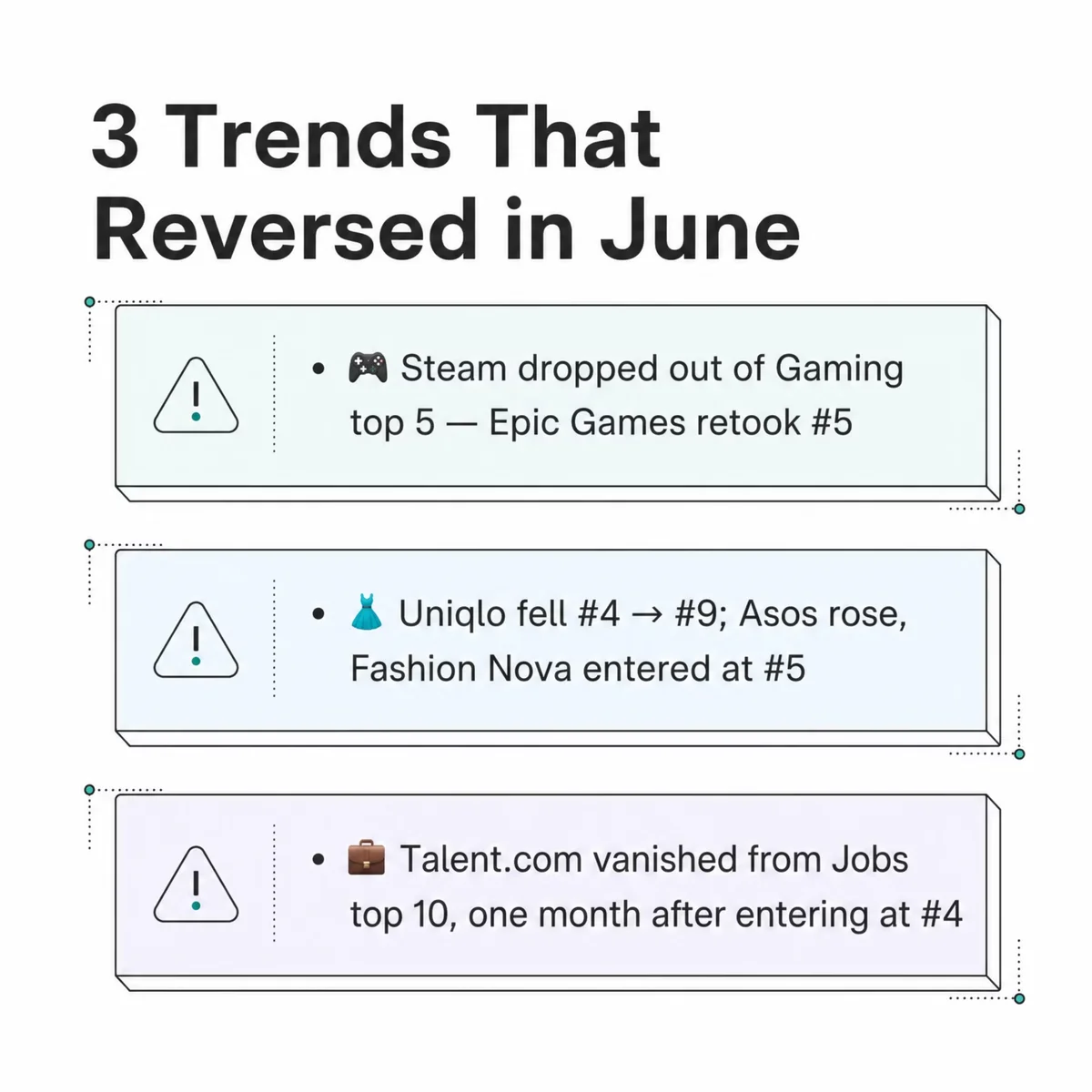
A few honest corrections to the May read:
- Steam's return wasn't permanent. Epic Games retook #5 in June and Steam dropped out of the tracked top 5. The "two consecutive months equals structural" call held for May but not June. Treat the #5 gaming slot as a genuine Steam-versus-Epic toss-up, not a settled Steam return.
- Uniqlo was a one-month blip after all. May's new Fast Fashion #4 fell to #9 in June, while Asos rose to #4 and Fashion Nova entered at #5. This matches the CoinMarketCap, DHgate, and Zara pattern: roughly half of one-month top-5 entries reverse.
- Talent.com vanished. May's new Jobs #4 fell out of the top 10 entirely in June. HeadHunter returned to #2 and Glassdoor climbed to #3. Jobs is now the most volatile category we track.
- Gemini's climb is the real durable trend. Gemini has moved #5 → #4 → #3 across three monthly snapshots, overtaking DeepSeek in May and Perplexity in June. A steady three-step climb is the strongest movement signal in the dataset.
I also added three categories Cloudflare tracks that this report hadn't covered before: Video Streaming, Music & Audio Streaming, and the Overall cross-category ranking. They sit in their own section near the end of this post, and one of them produced the most counterintuitive #1 in the entire dataset.
How Did Top Platform Rankings Change Between Q1 2026 and May 2026?
According to Cloudflare Radar's Internet Services Rankings, by the end of May 2026 Steam had held its return to the Gaming top 5 for a second straight month, Google Gemini retook #4 in Generative AI from DeepSeek, and Binance kept its newly won place in the Financial Services top 5. We re-pulled the rankings for the May 31, 2026 snapshot (the last full month before this June update) to see which Q1 storylines stuck, which April moves held, and which April newcomers turned out to be one-month blips. Updated June 1, 2026.
Every Monday I pull the rankings for these 13 categories. The single clearest lesson from the May data is the difference between a one-month entry and a durable shift. Steam was outside the Gaming top 10 for 13 consecutive weeks of Q1, re-entered at #5 in April, and has now held #5 through May — two months makes that a structural return, not a methodology blip. Doubao tells the opposite-but-encouraging version: it fell out of the AI top 10 to #11 in April, which made us call its Q1 entry "provisional," then climbed back to #10 in May. The "China's biggest AI push goes global" narrative survives, just as an on-the-bubble presence rather than a settled fixture.
Every single one of the eight "forever #1" platforms held its lead for another month — ChatGPT, Amazon, Facebook, WhatsApp, Roblox, Globo, Shein, and Stripe all still untouched. But below those leaders, May reshuffled harder than April did: the Generative AI top 5 changed order for the first time since Q1, and two of the categories we called permanently static back in Q1 finally moved.
Which Top-5 Rankings Shifted Between Q1 2026 and May 2026?
| Category | Q1 2026 (#1–#5) | May 2026 (#1–#5) | Shift |
|---|---|---|---|
| Generative AI | ChatGPT / Claude / Perplexity / DeepSeek / Gemini | ChatGPT / Claude / Perplexity / Gemini / DeepSeek | Gemini overtook DeepSeek for #4 — first top-5 order change since Q1. Below: Doubao re-entered the top 10 at #10, Grok slipped to #8 |
| E-commerce | Amazon / Shopify / Shopee / Temu / eBay | Amazon / Shopify / Shopee / eBay / Temu | eBay and Temu swapped #4/#5; Taobao (#6) and Alibaba (#7) sit just outside |
| Social Media | Facebook / Instagram / TikTok / Snapchat / LinkedIn | Facebook / Instagram / TikTok / Snapchat / LinkedIn | No change — X stays out at #6 for a third straight snapshot |
| Messaging | WhatsApp / QQ / Telegram / Rakuten Viber / Signal | WhatsApp / QQ / Telegram / Rakuten Viber / WeChat | WeChat entered #5, Signal fell to #6 — first top-5 change in this category all year |
| Cryptocurrency | Binance / OKX / Coinbase / 2miners.com / CoinGecko | Binance / OKX / Coinbase / 2miners.com / CoinGecko | CoinGecko retook #5 — April's CoinMarketCap entry reversed (CoinMarketCap fell to #8) |
| Gaming | Roblox / Discord / PlayStation / Xbox / Epic Games | Roblox / Discord / PlayStation / Xbox / Steam | Steam held #5 for a second month; Epic Games stays at #6 |
| News | Globo / ESPN / NY Times / BBC / CNN | Globo / ESPN / BBC / NY Times / CNN | BBC held #3 for a second month; Fox News slid from #6 to #9 |
| Fast Fashion | Shein / H&M / Trendyol / Falabella / Asos | Shein / H&M / Trendyol / Uniqlo / Asos | Uniqlo entered #4; Zara fell back to #6 and Falabella to #7 |
| Low-Cost E-commerce | Shopee / Temu / AliExpress / Tokopedia / Allegro | Shopee / Temu / AliExpress / Allegro / Tokopedia | Allegro retook #4 — April's DHgate entry reversed (DHgate fell to #6) |
| Outlook / Gmail / Mail.ru / Yahoo Mail / GMX | Outlook / Gmail / Mail.ru / Yahoo Mail / GMX | No change — sixth straight month frozen | |
| Financial Services | Stripe / TradingView / Alipay / PayPal / Nubank | Stripe / Alipay / TradingView / PayPal / Binance | Binance held #5 (second month); Alipay and TradingView swapped #2/#3; Nubank stays #6 |
| Weather | Weather.com / AccuWeather / Wunderground / Windy / Tides & Currents | Weather.com / AccuWeather / Wunderground / Windy / Tides & Currents | No change |
| Jobs | Indeed / HeadHunter / SEEK / AnywhereWorks / Glassdoor | Indeed / SEEK / HeadHunter / Talent.com / Glassdoor | SEEK rose to #2, Talent.com entered #4; AnywhereWorks dropped to #6 |
Which Q1 2026 Narratives Did May Reverse, Confirm, or Extend?
1. Steam's Gaming return is confirmed, not a bounce. In Q1 we wrote that Steam dropped out of the Gaming top 10 the same week Discord appeared, and noted that the timing made us "suspect a classification change in Cloudflare's methodology." April had Steam re-enter at #5; May settles it by holding Steam at #5 a second month. A one-month re-entry could be noise, but two consecutive months is structural. The Q1 "Discord replaced Steam" narrative is now retired: Discord is a genuine top-2 gaming platform on DNS volume, but Steam's distribution business is big enough to sit in the top 5 alongside it. If you wrote off Steam audiences for Q2 prospecting based on Q1 data, that call was wrong.
2. April's "new entrants" mostly reversed; the structural shifts held. This is the cleanest lesson in the May data. Three of April's headline newcomers turned out to be one-month blips: CoinMarketCap, which entered Cryptocurrency at #5 in April, fell to #8 as CoinGecko retook #5; DHgate, April's new Low-Cost E-commerce #5, fell to #6 as Allegro returned to #4; and Zara, which cracked the Fast Fashion top 5 in April, slid back to #6. The moves we framed as structural, by contrast, all held: Binance kept Financial Services #5, Steam kept Gaming #5, and all eight forever-#1 leaders stayed put. The working rule for anyone using these DNS rankings: a single month of top-5 entry is noise; two consecutive months is signal.
3. Two "never changes" categories finally changed. In Q1 we named Messaging, Weather, Jobs, and Email as the four static categories locked in by high switching costs. May broke two of them. WeChat displaced Signal for #5 in Messaging — the first top-5 change there in over a year. And Jobs reshuffled hard: SEEK rose to #2, HeadHunter slipped to #3, Talent.com entered at #4, and AnywhereWorks dropped out of the top 5 to #6. Weather and Email stayed frozen. We were too confident calling all four immovable. The honest read now: two were genuinely locked (Weather, Email) and two simply hadn't moved yet.
4. The AI top 5 reshuffled for the first time since Q1, and Doubao came back. Gemini overtook DeepSeek for #4 — the first position change inside the Generative AI top 5 since the Q1 baseline. And Doubao, which had dropped to #11 in April, re-entered the top 10 at #10 in May. Both moves are consistent with the same reading: the AI leaderboard's top three (ChatGPT, Claude, Perplexity) are locked, but slots four through ten are now genuinely competitive month to month.
Which Q1 2026 Category Leaders Held Through May?
Every member of the Q1 forever-#1 club held #1 in May: ChatGPT (Generative AI), Amazon (E-commerce), Facebook (Social Media), WhatsApp (Messaging), Roblox (Gaming), Globo (News), Shein (Fast Fashion), and Stripe (Financial Services). Combined, that's roughly 60–61 consecutive weeks of unchallenged leadership across eight categories. The "once a platform reaches #1, network effects make it very hard to displace" observation from the Q1 cross-category section now has two extra months of supporting evidence.
Which New Platforms Entered Multiple Top-5 Rankings in May 2026?
In Q1 we noted Shopee was "the only platform in Cloudflare's entire dataset that ranks top 3 in two separate categories at the same time" (E-commerce #3 and Low-Cost E-commerce #1). That's still true in May. The second cross-category platform that emerged in April also held: Binance ranks #1 in Cryptocurrency Services AND #5 in Financial Services for a second straight month. April's entry could have been a one-month artifact; two months means Binance's DNS volume — driven by global trading flows and consumer crypto wallet apps — is a durable presence in mainstream Financial Services, not a blip. No new third cross-category platform appeared in May.
How Does the May 2026 Update Affect Q1 2026 Findings?
The Q1 sections below remain the right baseline for understanding where the year started. Where May figures shifted the picture in a specific category, we've added inline May 2026 update notes alongside the relevant Q1 tables, and we've kept the April waypoint visible wherever a move reversed. The methodology, scope, and reading frame haven't changed; only the latest snapshot has.
I run our customer success team from London. We work with B2B SaaS companies whose go-to-market motions depend on knowing which platforms their prospects actually run. When AI usage diversifies, our customers' qualification criteria need to update. When Steam holds the gaming top 5 for a second month, our gaming-vertical clients need to know their audience-targeting assumptions are intact. These rankings aren't just trivia. They're the operating environment we help our customers navigate every week.
How we compiled this data
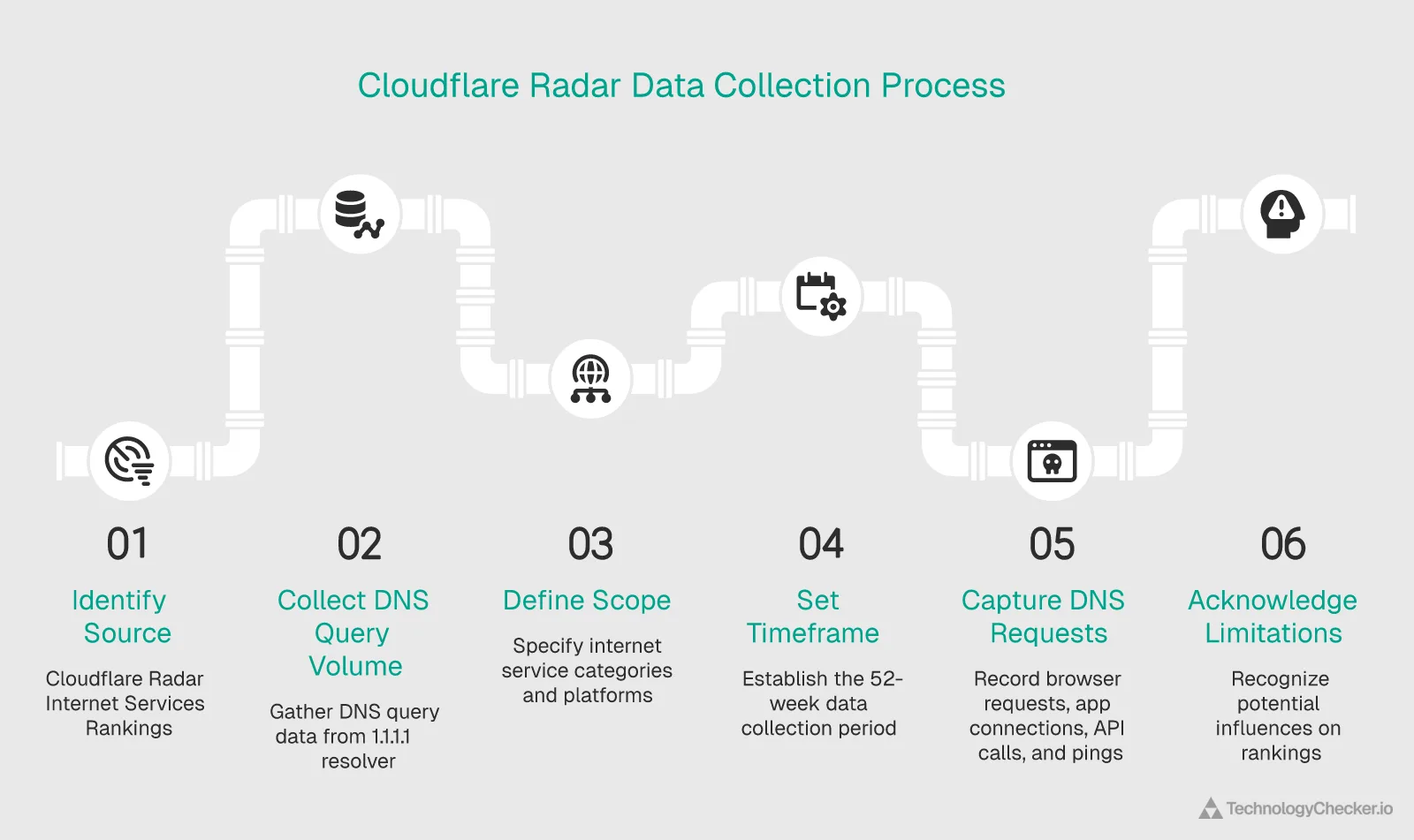
All of this comes from Cloudflare Radar's Internet Services Rankings, which tracks DNS query volume across Cloudflare's 1.1.1.1 resolver and its broader network.
Data source: Cloudflare Radar Internet Services Rankings, accessed March 31, 2026 for the Q1 baseline and re-pulled at the April 30, May 31, June 23, June 30, 2026 (Q2 close), and July 31, 2026 snapshots for the update layers, plus June 30, 2025 and July 31, 2025 snapshots for the two year-over-year layers
Snapshot, not average: the ranking endpoint returns a one-day window ending on the requested date. It is a snapshot, not a monthly or quarterly mean, so "July 2026" in the August layer means the July 31, 2026 snapshot rather than an average of the month.
Blip check (added August 2026): every rank change published in the August layer was re-pulled at the adjacent days (July 28, 29 and 30, 2026) and, for the categories with a live open question, at weekly intervals across the month. Changes that appeared on only one day are labelled as artifacts rather than published as movement. Three were caught this way.
Scope: 16 internet service categories, ranked by relative DNS query volume. This report tracks all 16 (the original 13 plus Video Streaming, Music & Audio Streaming, and the Overall ranking, added in the June 23 refresh)
Timeframe: 52 weeks of trend data (March 31, 2025 to March 30, 2026) for the baseline, plus April 30, May 31, June 23, and June 30, 2026 snapshots for the update layers, and a June 30, 2025 snapshot one year before the Q2 close for the year-over-year comparison
What DNS traffic actually measures: Every time you open an app, load a website, or trigger an API call, your device resolves a DNS query. That means DNS volume captures far more than website visits. It includes app connections, background pings, payment processing calls, and anything else that hits a domain. When someone buys something on a Stripe-powered store, that's a DNS query for Stripe's domain. When a kid opens Roblox, that's a persistent DNS connection. This is why some "invisible" platforms rank higher than household names.
What this doesn't capture: DNS rankings can be influenced by CDN setups, DNS architecture choices, and how aggressively an app pings home. Services can appear in multiple categories. And if a platform drops below the tracking threshold for a given week, it shows as "unranked," not zero.
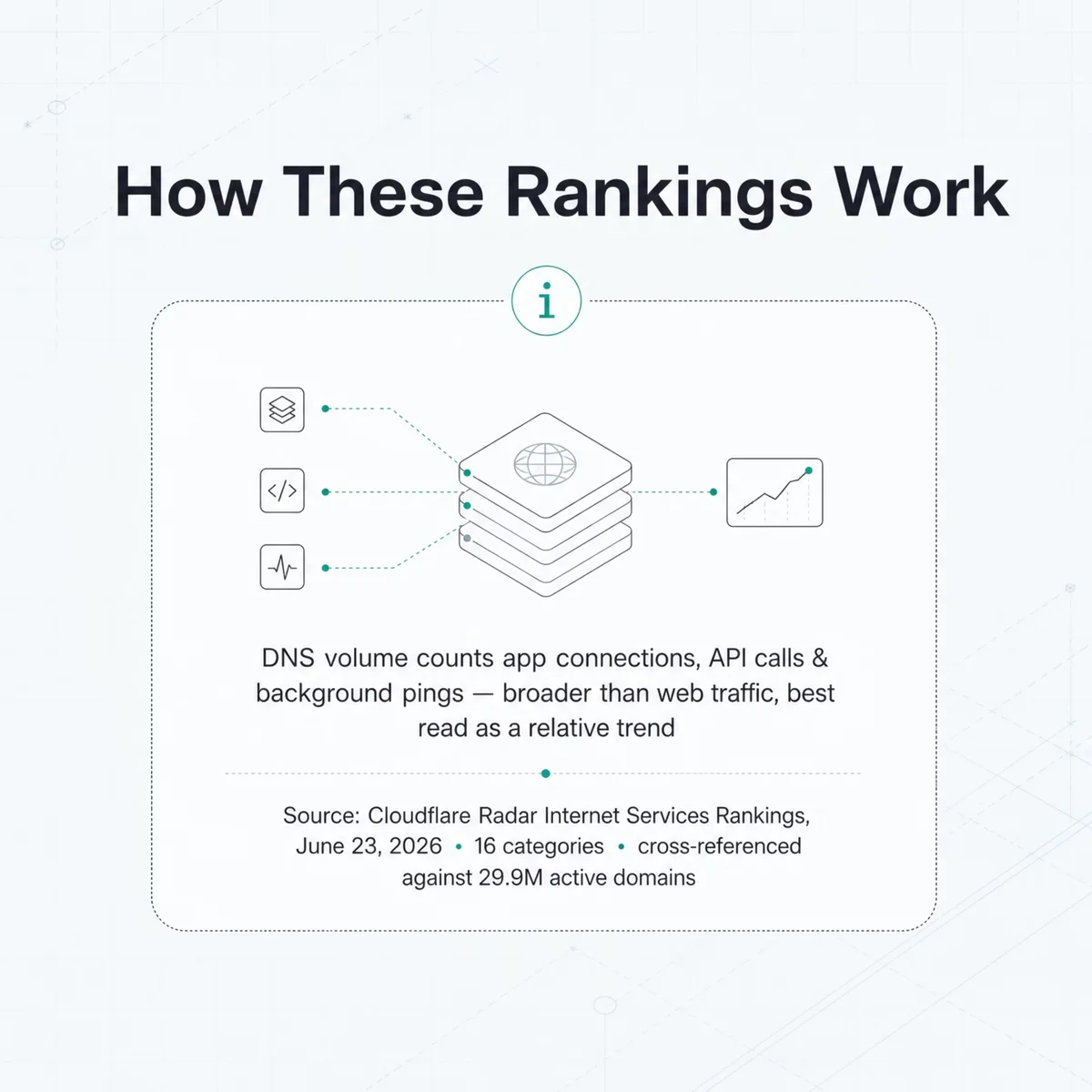
Worth noting: I cross-reference this data against what we see in our own crawls at TechnologyChecker. We crawl 29.9M live business domains for technology signals, so we have a separate (and very different) view of platform deployment. Where the two datasets agree, I'm more confident in the finding. Where they diverge, I'll say so.
The complete power map: all 13 categories ranked
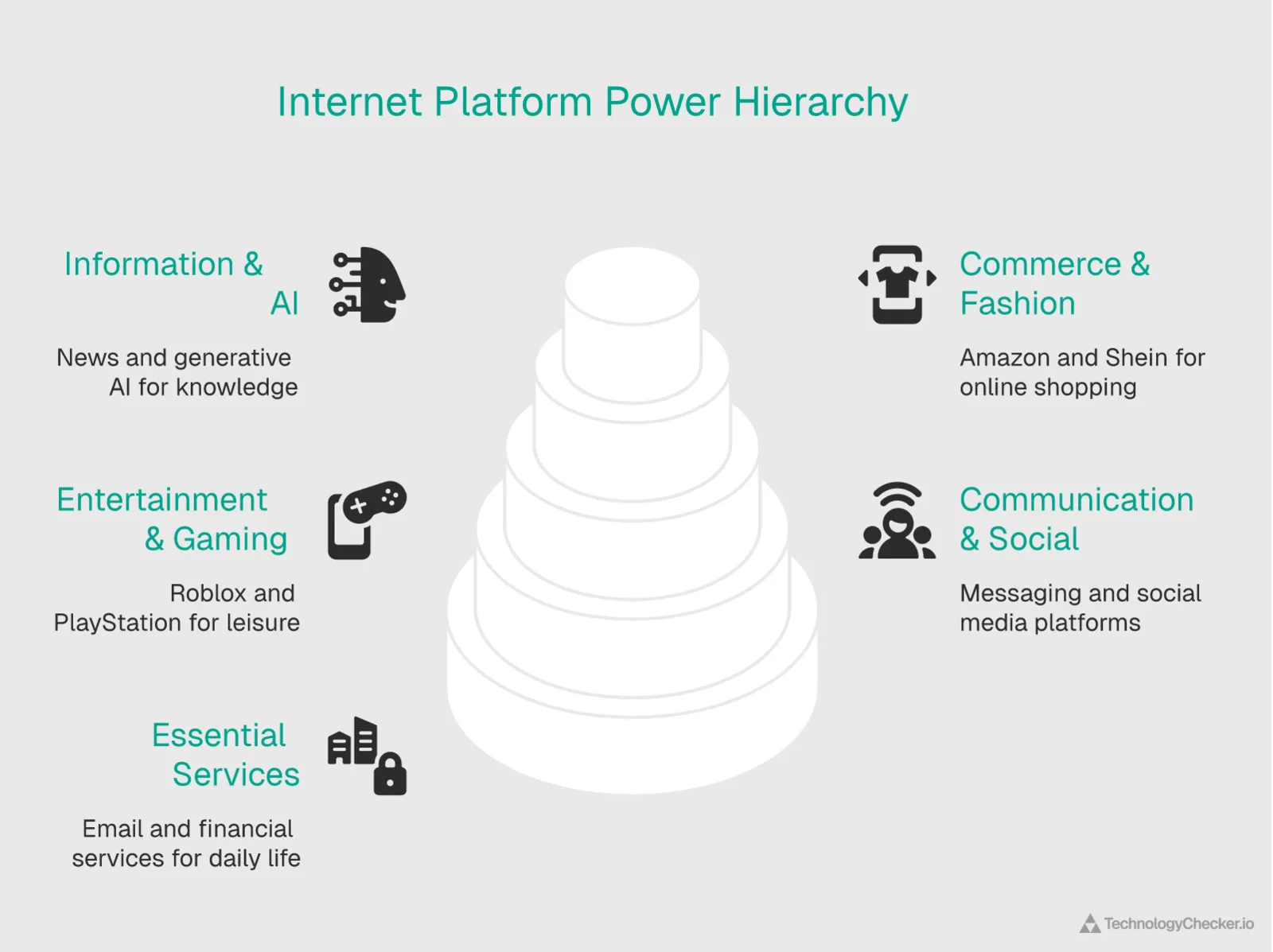
Here's the full picture. Every category, top 5 platforms, as of March 31, 2026:
| Category | #1 | #2 | #3 | #4 | #5 |
|---|---|---|---|---|---|
| Generative AI | ChatGPT | Claude | Perplexity | DeepSeek | Google Gemini |
| E-commerce | Amazon | Shopify | Shopee | Temu | eBay |
| Social Media | TikTok | Snapchat | |||
| Messaging | Telegram | Rakuten Viber | Signal | ||
| Cryptocurrency | Binance | OKX | Coinbase | 2miners.com | CoinGecko |
| Gaming | Roblox | Discord | PlayStation | Xbox | Epic Games |
| News | Globo | ESPN | NY Times | BBC | CNN |
| Fast Fashion | Shein | H&M | Trendyol | Falabella | Asos |
| Low-Cost E-commerce | Shopee | Temu | AliExpress | Tokopedia | Allegro |
| Outlook | Gmail | Mail.ru | Yahoo Mail | GMX | |
| Financial Services | Stripe | TradingView | Alipay | PayPal | Nubank |
| Weather | Weather.com | AccuWeather | Wunderground | Windy | Tides & Currents |
| Jobs | Indeed | HeadHunter | SEEK | AnywhereWorks | Glassdoor |
A few things jump out immediately. Globo above BBC and CNN? Stripe above PayPal? Roblox ahead of PlayStation and Xbox? The DNS lens produces rankings that feel counterintuitive until you understand what DNS volume actually measures. More on that below.
Seven stories are hiding inside this table.
The AI race: Claude's climb from #9 to #2 in 12 months
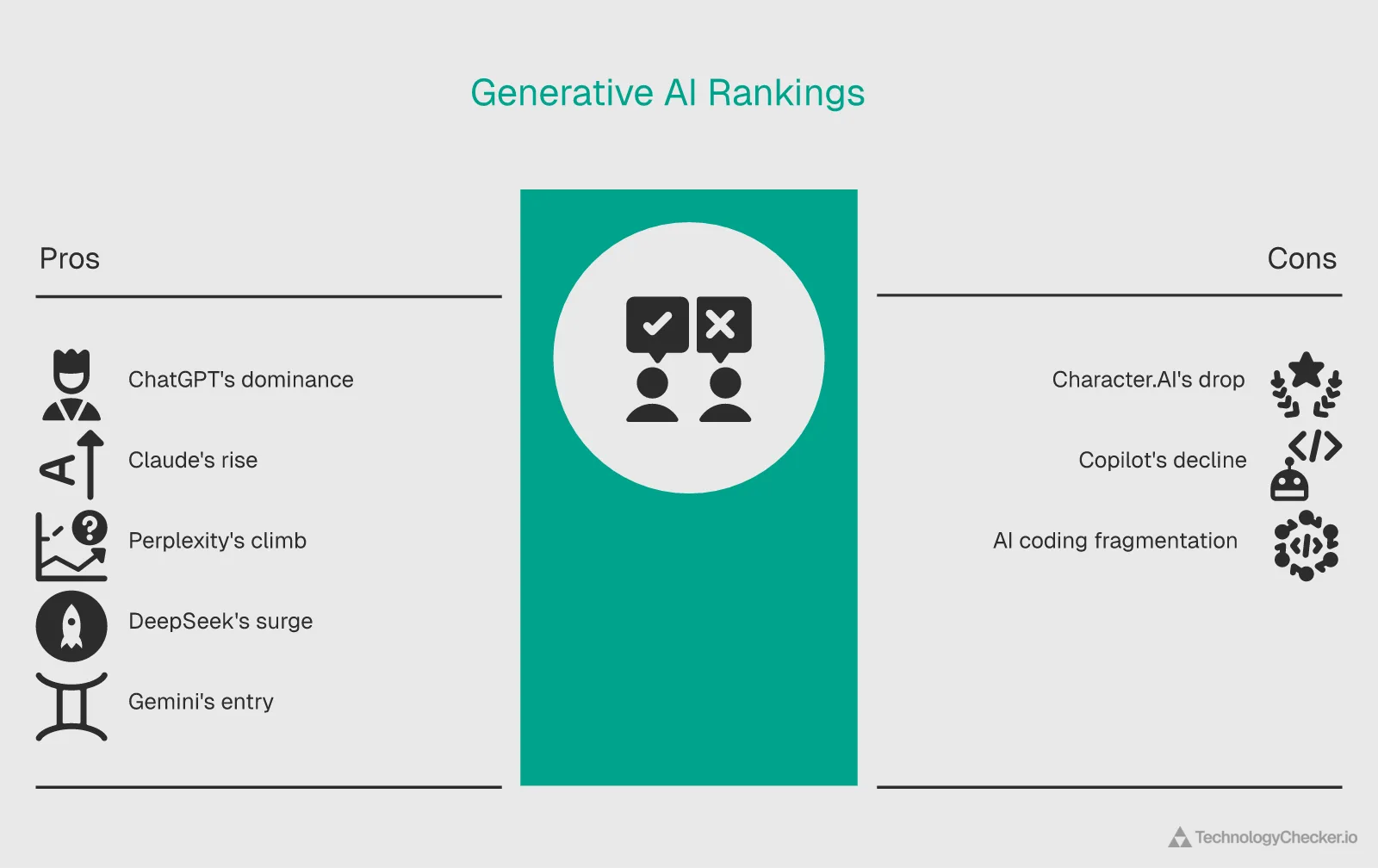
Generative AI had more ranking movement than any other category this year. ChatGPT owned #1 every single week, but everything below it was in constant flux.
Claude's trajectory is the headline. In March 2025 it was #9. By June, #3. By December, it hit #2 for the first time. It's held #2 for 11 of the last 14 weeks. That's a climb of 7 positions in 12 months, which no other platform in any category matched.
| Service | Mar 2025 | Mar 2026 | Change |
|---|---|---|---|
| ChatGPT | #1 | #1 | — |
| Claude | #9 | #2 | ↑ 7 |
| Perplexity | #8 | #3 | ↑ 5 |
| DeepSeek | #5 | #4 | ↑ 1 |
| Google Gemini | Unranked | #5 | New |
| Character.AI | #2 | #6 | ↓ 4 |
| GitHub Copilot | #6 | #9 | ↓ 3 |
May 2026 update — Gemini retook #4, Doubao climbed back into the top 10: The top three (ChatGPT / Claude / Perplexity) held, but Google Gemini overtook DeepSeek for #4 — the first top-5 order change in this category since Q1. Below them: GitHub Copilot held #6, Character.AI recovered to #7 (from #8 in April), Grok/xAI eased to #8, Suno AI held #9, and Doubao re-entered the top 10 at #10 after slipping to #11 in April. Windsurf AI moved to #11, QuillBot to #12. The reshuffle keeps confirming the Q1 read: ChatGPT's lead is untouchable, but everything from #4 down is genuinely contested month to month.
June 23, 2026 update — Gemini took #3, overtaking Perplexity: The June snapshot reads ChatGPT / Claude / Gemini / Perplexity / DeepSeek. Gemini's climb is now the cleanest trend in the category: #5 in Q1 and April, #4 in May, #3 in June. It passed DeepSeek in May and Perplexity in June, two months running. Below the top five, Grok/xAI rose to #7, Doubao climbed to #8 (its highest yet, up from #10 in May), and Character.AI eased to #9 with Suno AI at #10. ChatGPT and Claude haven't moved off #1 and #2 for a single week all year. See the quarter-long trajectory table later in this post for the week-by-week picture.
The losers tell an interesting story too. Character.AI fell from #2 to #6. It was the biggest consumer AI platform after ChatGPT a year ago, and now it's behind four competitors. GitHub Copilot dropped from #6 to #9, which happened right as Codeium/Windsurf AI entered and then exited the top 10. The AI coding assistant market is splintering, not consolidating.
DeepSeek's story is different. It bounced between #5 and #10 for most of 2025, then jumped to #4 in late January 2026 when its R1 model got global attention. It's held #4 for 9 straight weeks since. That kind of spike-then-hold pattern usually means the attention converted into habitual usage, not just curiosity.
One new name to watch: Doubao, ByteDance's AI chatbot, entered at #10 in March 2026. That's China's biggest push into the global consumer AI rankings so far.
May 2026 update: Doubao climbed back to #10, re-entering the top 10 after its one-month dip to #11 in April. The Q1 "biggest push into global rankings" framing holds, but as an on-the-bubble presence: Doubao has bounced between #10 and #11 across three snapshots, so treat it as a genuine but marginal top-10 platform rather than a settled fixture or a structural Chinese-AI breakthrough.
Why this matters for prospecting
A year ago, "this company uses AI" basically meant "they have ChatGPT." Now it could mean Claude, Perplexity, DeepSeek, or Gemini. When we detect AI integrations on websites through our technology scans, we're seeing the same diversification. Companies using 2+ AI platforms tend to be more technically mature buyers. If you're selling to AI-forward teams, tracking which specific tools they've adopted tells you a lot more than knowing they "use AI."
Social media: Facebook won't budge, and X can't stop flickering
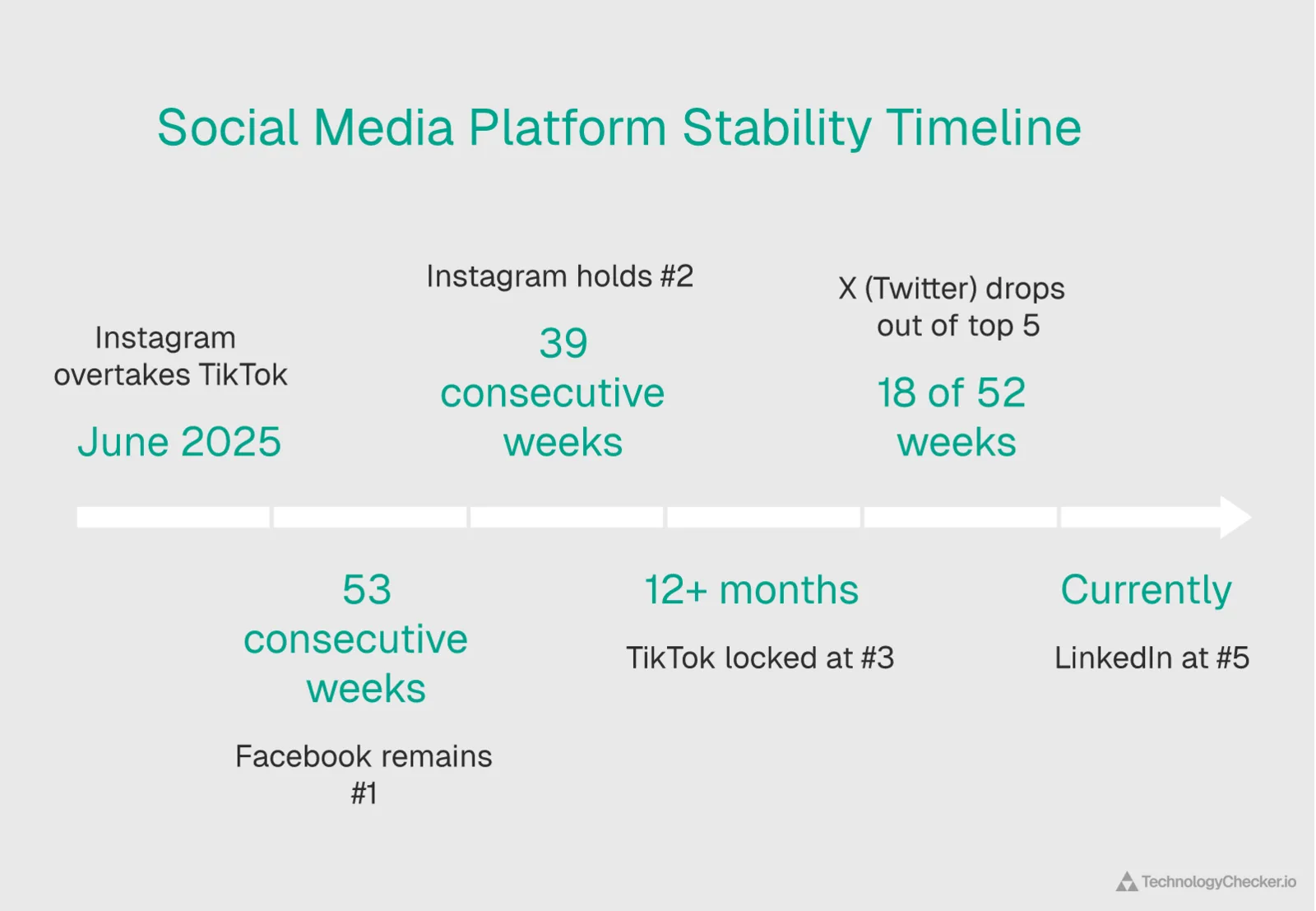
Facebook: #1 for 52 straight weeks. Zero dips. In an era when TikTok gets all the press, Facebook still generates more DNS traffic than any other social platform. That disconnect between media narrative and actual usage data is one of the most persistent patterns in internet analytics.
Instagram overtook TikTok for #2 back in late June 2025. It's been there for 39 consecutive weeks now. Over 31,000 companies using Instagram on their websites confirm this isn't just social traffic — brands are actively putting Instagram on the web properties they own. TikTok is locked at #3, Snapchat at #4. None of them moved even one position in over a year.
The interesting part is position #5. X (Twitter) and LinkedIn have been swapping that spot every other week for six months. But here's the thing that stands out: X disappeared from the top 5 completely in 18 of 52 weeks. That's a third of the year. No other platform in any of the 13 categories shows that kind of on-off pattern. Every other major platform either holds its rank or drifts gradually. X blinks in and out.
As of March 31, 2026? X is out. LinkedIn holds #5.
With 3.2 billion monthly active users (per Dreamgrow's 2026 report), Facebook's user base still dwarfs everyone. The platform doesn't dominate headlines anymore, but it dominates the internet's actual traffic. Meanwhile, X's instability tells you its traffic is event-driven: it spikes around breaking news and political moments, then drops back. That's not the pattern of a platform people check out of habit.
For B2B teams: LinkedIn's steady DNS presence confirms what most GTM leaders already feel. It's the reliable professional platform. If your outreach strategy depends on X, this data suggests the ground under it is less stable than LinkedIn, Instagram, or even Snapchat.
According to Sprout Social's 2026 research, TikTok, Instagram, and YouTube now account for over 60% of product discovery, surpassing Google. That's worth thinking about if you're deciding where to put your brand-building budget.
E-commerce: the three-way war below Amazon
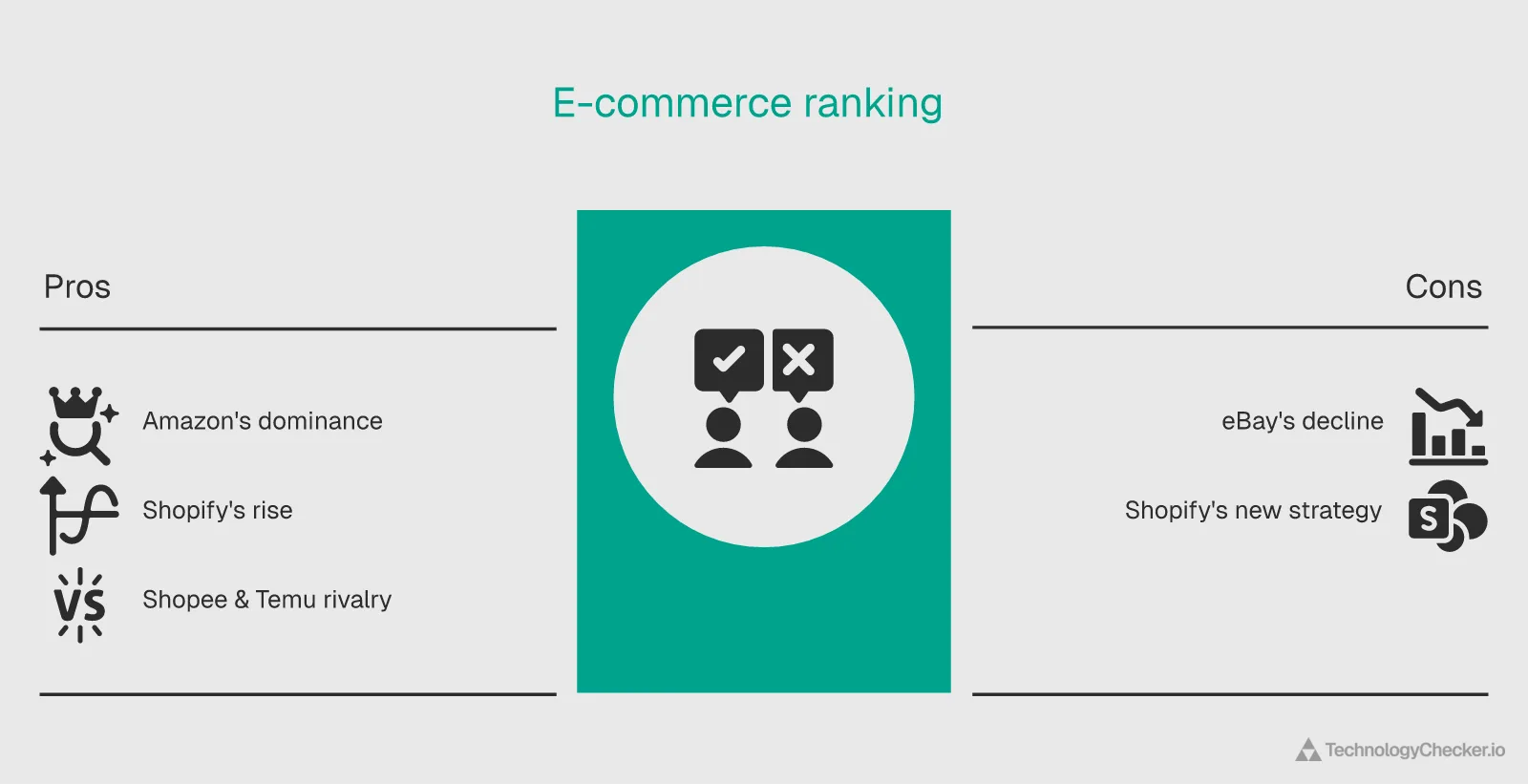
Amazon at #1, 53 weeks straight. No surprise there. The real story is Shopify's rise to #2, and what it tells us about how e-commerce infrastructure is shifting.
Shopify wasn't even a consistent top-5 presence until late 2025. Then from November onward, it climbed fast. By February 2026 it reached #2, and it's held that position since.
Here's why that's weird: Shopify isn't a destination site like Amazon. People don't go to shopify.com to browse products. This DNS traffic comes from the millions of Shopify-powered storefronts that resolve Shopify's domains for checkout, payment processing, and app integrations. Shopify's DNS ranking is an infrastructure metric, not a brand metric.
We see the same thing in our own data. Shopify is the #1 e-commerce platform in our technology detection, with a 46% market share in its category across 2.4 million detected domains. Companies like FedEx, Ford, Nokia, and S&P Global run Shopify-powered stores. That's not a platform for small merchants anymore; it's enterprise infrastructure with a long tail of SMBs underneath it.
Below Shopify, the fight between Shopee and Temu has been going on all year. They've traded the #3 and #4 spots repeatedly, with both briefly holding #2 at different points. eBay has been pushed to the edges. It dropped out of the top 5 for most of the past 6 months and just barely re-entered at #5 this week.
The consolidation pattern is clear: e-commerce is splitting between marketplace giants (Amazon, Shopee, Temu) and infrastructure platforms (Shopify). Legacy auction models like eBay are getting squeezed from both sides. Our WooCommerce detection data shows a similar story: merchants are migrating away from self-hosted platforms toward either Shopify's managed infrastructure or marketplace distribution.
If you sell to e-commerce businesses, Shopify merchants are the high-value segment. They tend to run modern tech stacks, adopt new tools faster, and spend more on SaaS per domain than merchants on older platforms.
The Shopee paradox: one company, two categories
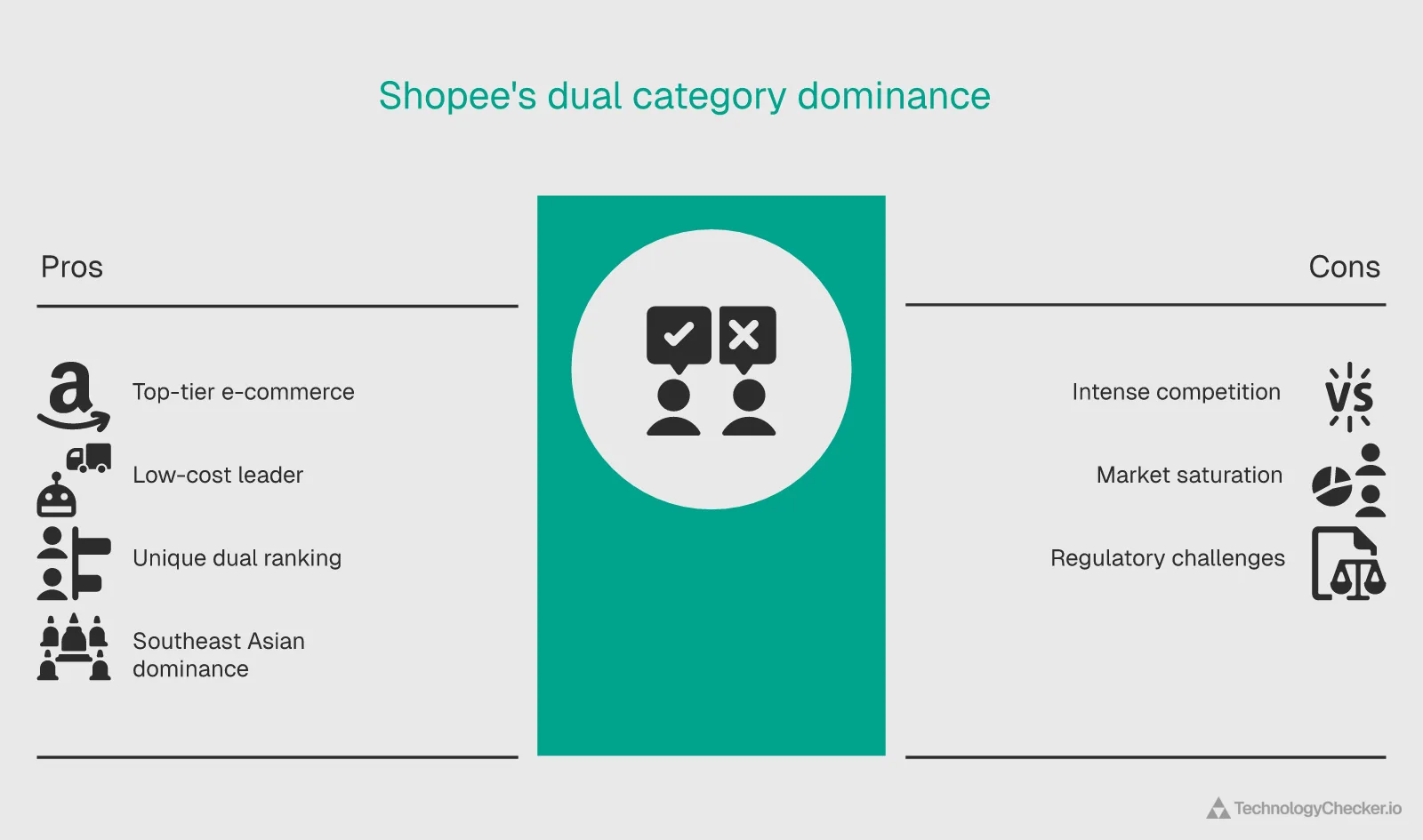
Shopee is the only platform in Cloudflare's entire dataset that ranks top 3 in two separate categories at the same time:
- E-commerce: #3 (behind Amazon and Shopify)
- Low-Cost E-commerce: #1
In Low-Cost E-commerce, Shopee and Temu have been at each other's throats. Temu held #1 for several weeks in mid-2025. Shopee took it back and has held it through most of Q1 2026. AliExpress sits at a distant #3.
| Low-Cost E-commerce | Platform | Trend |
|---|---|---|
| #1 | Shopee | Took back from Temu in late 2025 |
| #2 | Temu | Briefly held #1 mid-2025 |
| #3 | AliExpress | Stable but distant |
| #4 | Tokopedia | Indonesia-focused |
| #5 | Allegro | Poland-focused |
May 2026 update — DHgate's top-5 entry reversed; Allegro returned: The May top 5 reads Shopee / Temu / AliExpress / Allegro / Tokopedia, with DHgate falling back to #6. April's DHgate entry — which we flagged as the first time a Chinese B2B-leaning marketplace cracked this top 5 — lasted exactly one month. Allegro (Poland) retook #4 and Tokopedia (Indonesia) slid to #5. Shopee and Temu kept #1 and #2 cleanly. The honest read: DHgate's April appearance was a one-month blip, not the structural breakthrough it looked like at the time.
June 23, 2026 update — DHgate retook #4 again: June flips it back: Shopee / Temu / AliExpress / DHgate / Tokopedia, with Allegro down to #6. DHgate and Allegro have now traded #4 three times (DHgate in April, Allegro in May, DHgate again in June), which is the textbook definition of a contested slot rather than a trend. Shopee and Temu stayed locked at #1 and #2 the whole time.
What makes Shopee unusual is its role in Southeast Asia. In Indonesia and the Philippines, Shopee is both the Amazon (general e-commerce) and the Walmart (discount marketplace) of the region. That dual function is why it shows up in two Cloudflare categories. Western analysts tend to bucket Shopee as "just another Temu competitor," but its DNS footprint tells a bigger story. It's competing at two levels simultaneously, and winning at one of them.
Gaming: Roblox holds forever, Discord appears out of nowhere
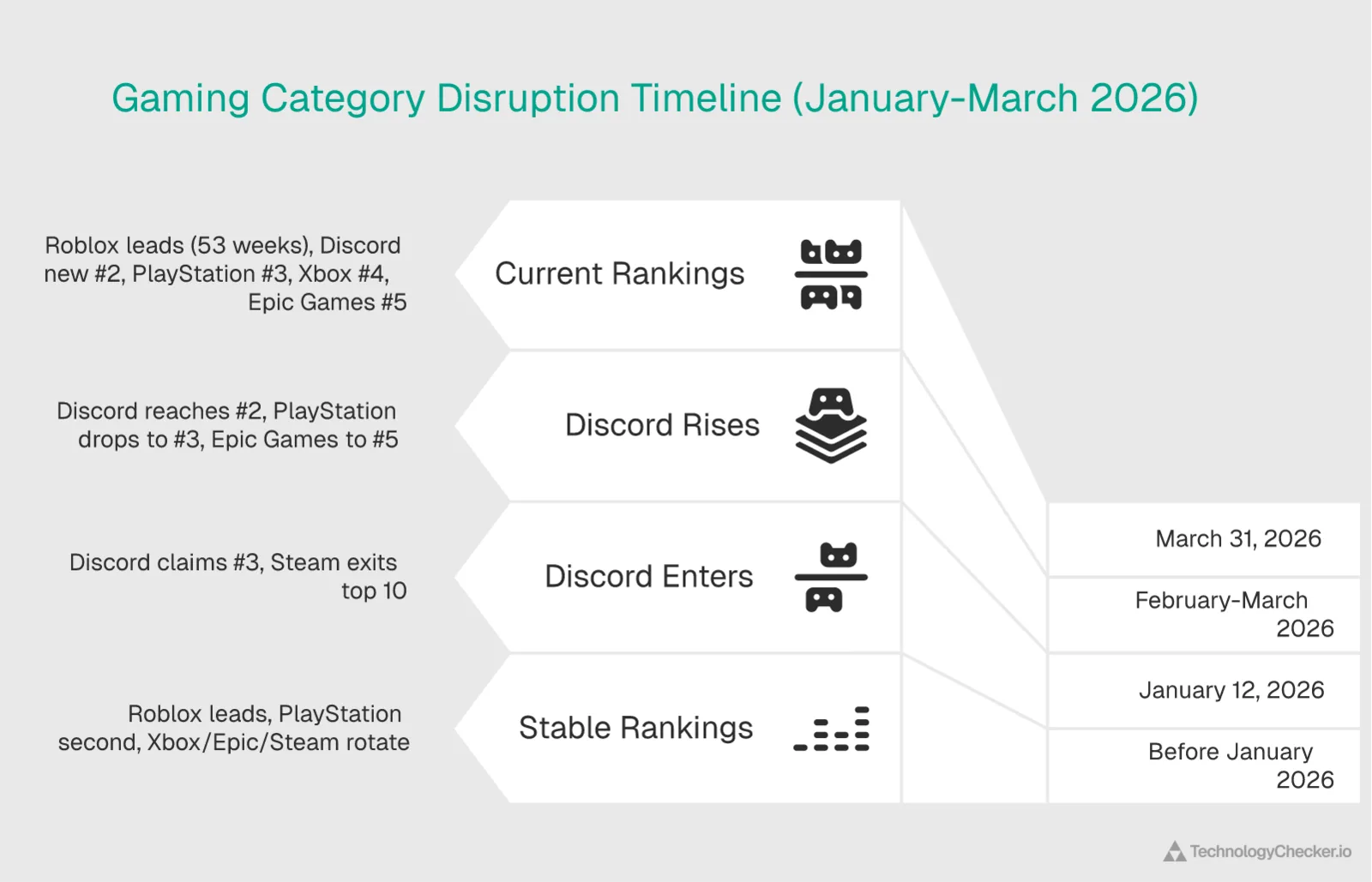
Roblox: 53 weeks at #1 with zero turbulence. Its DNS footprint comes from always-on persistent sessions. Tens of millions of users keep Roblox running in the background, and every one of those sessions maintains DNS connections. That's infrastructure-level traffic, not browse-and-leave behavior.
The disruption happened below Roblox. For most of 2025, the Gaming category was predictable: PlayStation at #2, Xbox and Epic Games rotating through #3–#5, Steam making occasional appearances. Then on January 12, 2026, Discord showed up in the Gaming rankings for the first time. It came in at #3. Within weeks it was #2.
In the same period, Steam dropped out of the top 10 entirely and hasn't returned.
| Rank | Platform | Trend |
|---|---|---|
| #1 | Roblox | 53 weeks. No challenger. |
| #2 | Discord | Appeared Jan 2026. |
| #3 | PlayStation | Was #2 for most of 2025. |
| #4 | Xbox | Stable. |
| #5 | Epic Games | Was #3–#4 in 2025. |
May 2026 update — Steam held #5 for a second month:
Rank Q1 2026 April 2026 May 2026 #1 Roblox Roblox Roblox #2 Discord Discord Discord #3 PlayStation PlayStation PlayStation #4 Xbox Xbox Xbox #5 Epic Games Steam Steam #6 — Epic Games Epic Games Steam held #5 in May, a second consecutive month back in the top 5 after a full quarter out of the top 10. Two months makes the return structural rather than a one-off bounce, and retires the Q1 "Discord replaced Steam" framing for good. Discord is genuinely a top-2 gaming platform on DNS volume, but Steam's distribution business sits comfortably in the top 5 alongside it. Epic Games held #6.
June 23, 2026 update — Steam slipped back out; Epic Games retook #5: June reverses the May call. The top 5 is now Roblox / Discord / PlayStation / Xbox / Epic Games, with Steam dropping out of the tracked top 5 (Electronic Arts, Blizzard, and Minecraft fill #7–#9). Across four monthly snapshots the #5 slot has gone Epic → Steam → Steam → Epic, so the honest read is that Steam and Epic Games are splitting one contested slot, not that either owns it. Steam's two-month run was a real signal, but it wasn't permanent. The top four (Roblox, Discord, PlayStation, Xbox) haven't moved a single position all year.
I'll be honest: the timing of Discord's entry and Steam's exit in the same week makes me suspect a classification change in Cloudflare's methodology. But whatever caused it, the end result reflects something real. The Gaming category now measures platform engagement (Roblox sessions, Discord voice/chat) more than game distribution (Steam downloads). And by that metric, Discord really is a top-2 gaming platform.
If you're targeting gaming companies, dev communities, or under-30 audiences, Discord's DNS ranking confirms what you probably already felt: it's where those audiences live, not just where they occasionally drop by.
News: why a Brazilian company outranks the BBC and CNN
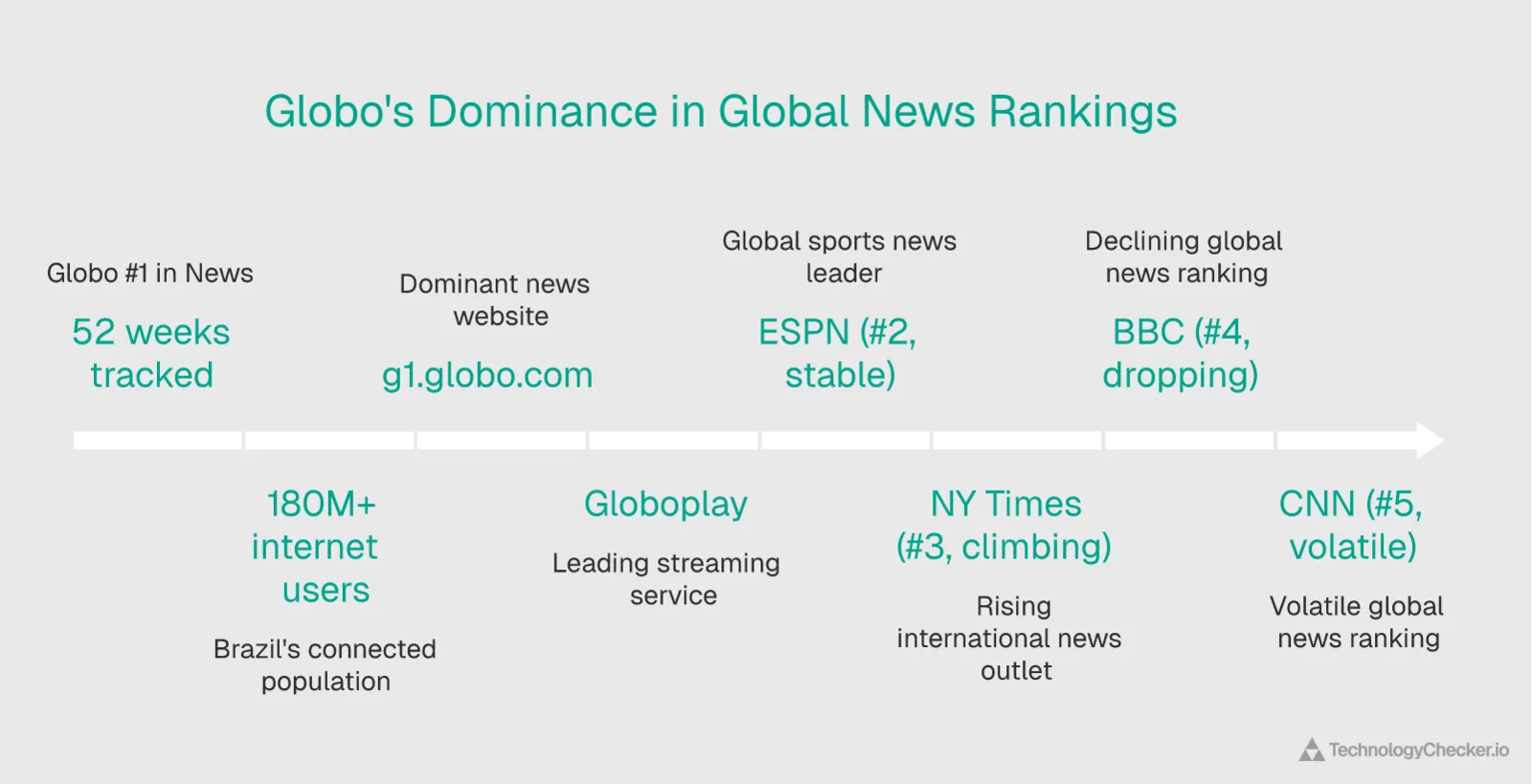
Globo: #1 in News for all 52 weeks. ESPN: #2 for all 52 weeks. Neither has shifted a single position.
This is probably the most counterintuitive finding in the whole dataset. Globo is a Brazilian media conglomerate. How does a Portuguese-language publisher outrank every English-language news brand on earth?
Two words: concentrated market.
Brazil has 180M+ internet users, the 4th largest connected population globally. In the US, news traffic fragments across dozens of competing outlets. Fox, CNN, NYT, WashPost, NBC, ABC, local stations, Substack newsletters. In Brazil, Globo owns the dominant news website (g1.globo.com), the leading streaming service (Globoplay), and several TV channels. All of that DNS traffic rolls up under one umbrella.
Below Globo and ESPN, things get volatile:
- NY Times climbed to #3 from occasional appearances
- BBC dropped from #3 to #4 in March
- CNN bounces between #4, #5, and off the list entirely
- Fox News shows the same in-and-out pattern
May 2026 update — BBC held #3, Fox News slid to #9: The May top 5 again reads Globo / ESPN / BBC / NY Times / CNN, with BBC holding #3 for a second month. The churn moved further down the table this time: Fox News dropped from #6 to #9, and NewsBreak took the #6 slot. Globo and ESPN remain the habitual top while everything below #2 reshuffles with the news cycle. The "stable at top, chaotic below" pattern now has three consecutive months of support.
June 23, 2026 update — NY Times retook #3: June's top 5 is Globo / ESPN / NY Times / BBC / CNN, with NY Times and BBC swapping #3 and #4 yet again. Globo and ESPN have now held #1 and #2 for every week of the tracking period. Below the top five the cycle-driven churn continued: Yahoo Finance rose to #7, Fox News recovered to #8, and Google News slid to #9. The "stable at top, chaotic below" pattern holds for a fourth straight month.
That volatility pattern (stable at the top, chaotic below) tells you something. Globo and ESPN have habitual audiences. Western general-news outlets have event-driven audiences. People tune in for big stories, then tune out. Sports and concentrated regional markets produce steady traffic. Fragmented general news markets don't.
For content marketing and PR: if you're targeting Latin American markets, Globo's DNS dominance makes it the single most important media property in the region. Bigger in traffic terms than any English-language outlet globally.
Financial services: Stripe is #1 and most people don't understand why
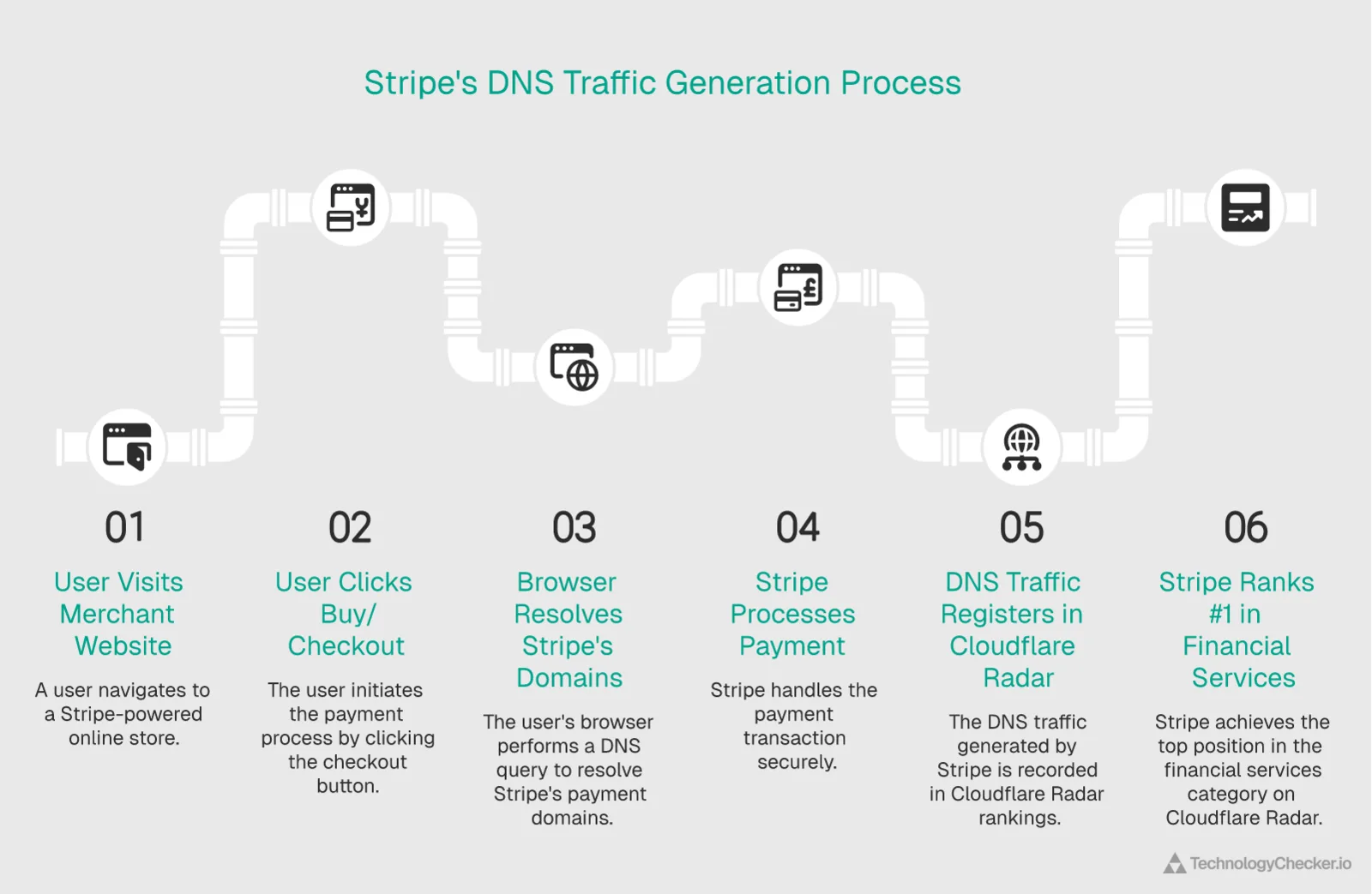
Stripe has held #1 in Financial Services for 53 weeks. It outranks PayPal, Alipay, and every bank on earth. A B2B payments infrastructure company sitting on top of a consumer-facing ranking.
The mechanics are simple. Every time someone buys something on a Stripe-powered store, the browser resolves Stripe's payment domains. Millions of merchants use Stripe. Each transaction generates DNS queries. Stripe's traffic doesn't come from people visiting stripe.com. It comes from Stripe being woven into the internet's payment layer.
| Rank | Platform | What it is | Region |
|---|---|---|---|
| #1 | Stripe | Payment infrastructure | US, global reach |
| #2 | TradingView | Retail trading | Global |
| #3 | Alipay | Mobile payments | China |
| #4 | PayPal | Consumer payments | Western markets |
| #5 | Nubank | Digital bank | Brazil, Mexico, Colombia |
May 2026 update — Binance held #5; Alipay and TradingView swapped: The May top 5 is Stripe / Alipay / TradingView / PayPal / Binance, with Nubank still at #6. Binance held the Financial Services top 5 for a second straight month, turning April's "first crypto-native platform in mainstream finance" entry from a one-month curiosity into a durable shift. It stays cross-category (Cryptocurrency Services #1 and Financial Services #5), the only such platform besides Shopee. The other move was Alipay edging past TradingView for #2. Nubank's #6 keeps the Brazil-effect narrative intact.
June 23, 2026 update — TradingView retook #2; Binance held #5 a third month: June reads Stripe / TradingView / Alipay / PayPal / Binance. TradingView and Alipay swapped #2 and #3 back to their Q1 order, and Binance held the Financial Services top 5 for a third straight month, which makes it a settled cross-category fixture rather than a swing. Stripe's #1 has not been challenged once all year. Nubank held #6, keeping the Brazil effect intact, and Intuit entered the wider top 10 at #7.
Our own crawl data backs this up. We detect Stripe on 243,000+ active domains, powering payments for companies like Tata, Accenture, Infosys, Wipro, Siemens, and Bank of America. It's the #1 ranked payment technology in our detection category. Software Development (6.5% of Stripe sites), Retail (4.8%), and Technology companies (4.7%) are the heaviest adopters.
PayPal, by contrast, shows up on 2M+ domains in our scans but has been declining. It went from 1.85M active domains a year ago to 1.64M today. Stripe's active count has also dipped from 253K to 200K, but its per-domain value is higher: Stripe sites tend to run newer, more technically mature stacks.
Nubank at #5 is another story worth noting. It's a Brazilian digital bank operating in just three countries (Brazil, Mexico, Colombia), and it generates enough DNS traffic to rank alongside global giants. That's the Brazil effect again: 180M concentrated internet users produce outsized DNS signals.
The Financial Services top 5 has a clean geographic split. No single region dominates. Stripe is US-built with global merchant reach. TradingView serves retail traders everywhere. Alipay owns China. PayPal covers the West. Nubank owns Latin America.
For prospecting: the payment processor a company uses is one of the strongest signals of tech stack maturity. Stripe sites are newer, more likely to run modern frameworks (Next.js, React), and more likely to adopt additional SaaS tools. PayPal sites skew older and more conservative. If you sell B2B SaaS, knowing which payment processor your prospect runs is one of the highest-value technographic signals you can have.
Four categories that never change
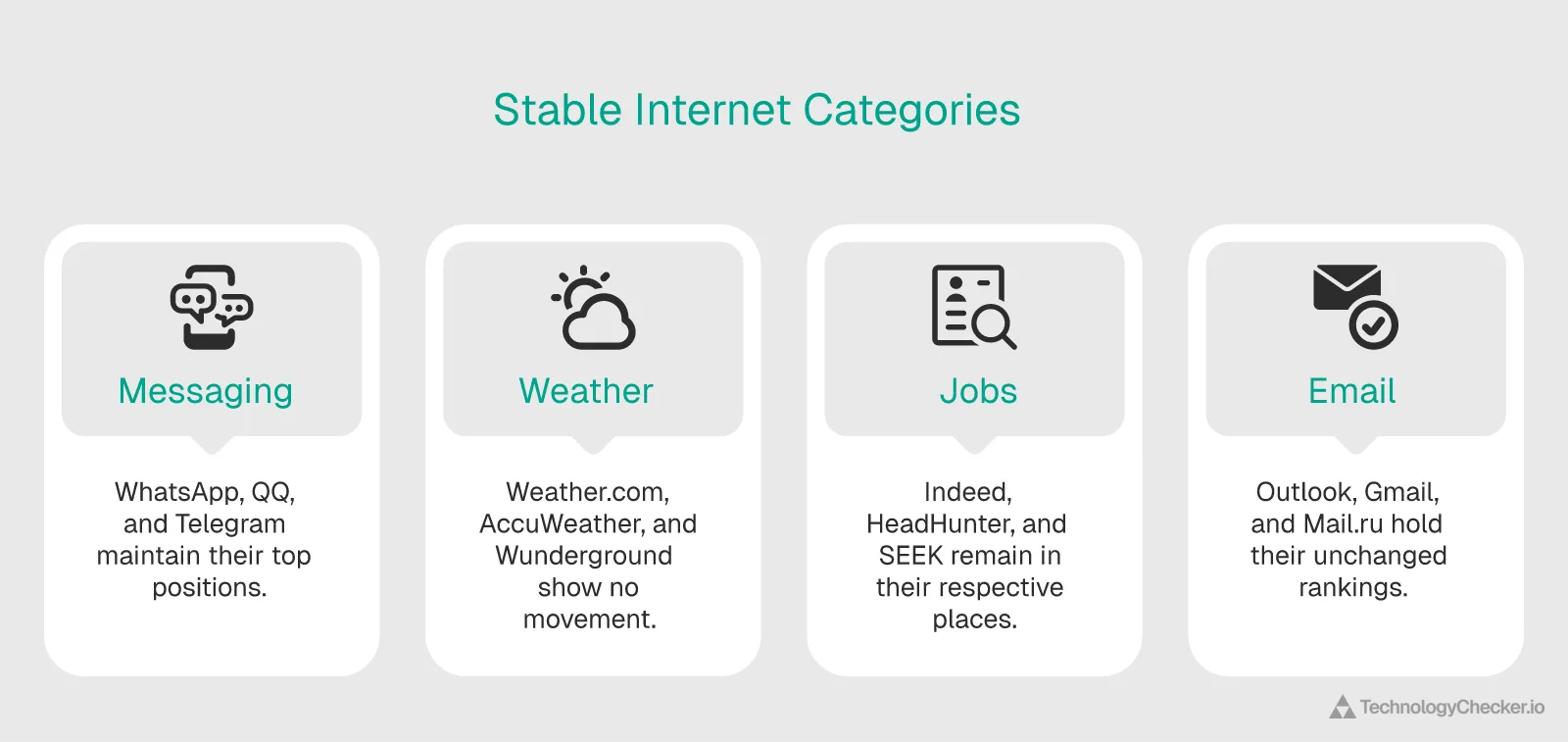
Not everything is in motion. Four categories haven't budged in 52 weeks.
Messaging: WhatsApp #1, QQ #2, Telegram #3. Same positions every week for a full year. Signal climbed from outside the top 5 to a stable #5 by September, and Viber rebranded to "Rakuten Viber" in the data. That's it. QQ's #2 comes from China's 550M+ MAU base, mostly domestic.
Weather: Weather.com, AccuWeather, Wunderground. Zero movement. People don't switch weather apps. The one that came on their phone is the one they use.
Jobs: Indeed #1, HeadHunter (Russia) #2, SEEK (Australia) #3. The geographic spread is notable. No US platform besides Indeed makes the top 5 globally.
Email: Outlook beats Gmail for #1. Mail.ru sits at #3, which is Russia's self-contained internet ecosystem at work. Proton (privacy email) is at #6. Niche, but holding. It's small on business domains too: 46,917 domains receive their email through Proton Mail in our September 2026 crawl, and 89.2% of the Proton Mail customers we can match have 10 or fewer staff.
May 2026 update — two of these four moved: The "never changes" label held for Weather and Email (Email is now frozen for a sixth straight month), but May broke the other two. WeChat displaced Signal for #5 in Messaging, the first top-5 change in that category in over a year. And Jobs reshuffled: SEEK rose to #2, HeadHunter slipped to #3, Talent.com entered at #4, and AnywhereWorks dropped to #6. The switching-cost logic still explains why the #1 in each category is immovable (WhatsApp, Outlook, Weather.com, and Indeed all held), but the lower top-5 slots were less locked than we claimed in Q1.
June 23, 2026 update — Email and Weather still frozen; Jobs reshuffled again: Email held its top 5 for a seventh straight month and Weather for the full tracking period, confirming both as genuinely locked. Messaging kept WeChat at #5 over Signal, so May's change stuck. Jobs, by contrast, reshuffled a second time: HeadHunter returned to #2, Glassdoor rose to #3, SEEK eased to #4, and Talent.com fell out of the top 10 entirely after a single month at #4. Jobs is now the most volatile category in the dataset, which undercuts the idea that job boards are sticky below #1 even though Indeed itself never moves.
What these four share is high switching cost. You don't switch messaging apps (all your contacts are there), email providers (years of archived mail), weather apps (it's a default), or job boards (you bookmarked it during your last search). Once these platforms capture a user, they keep them.
For B2B teams: stability in messaging and email adoption is a useful prospecting signal. When a company runs Outlook alongside Slack, or uses both WhatsApp and Teams, those are deliberate infrastructure decisions, not trends. They tell you something about how the company operates.
Cross-category patterns
Three patterns cut across all 13 categories.
The "forever #1" club
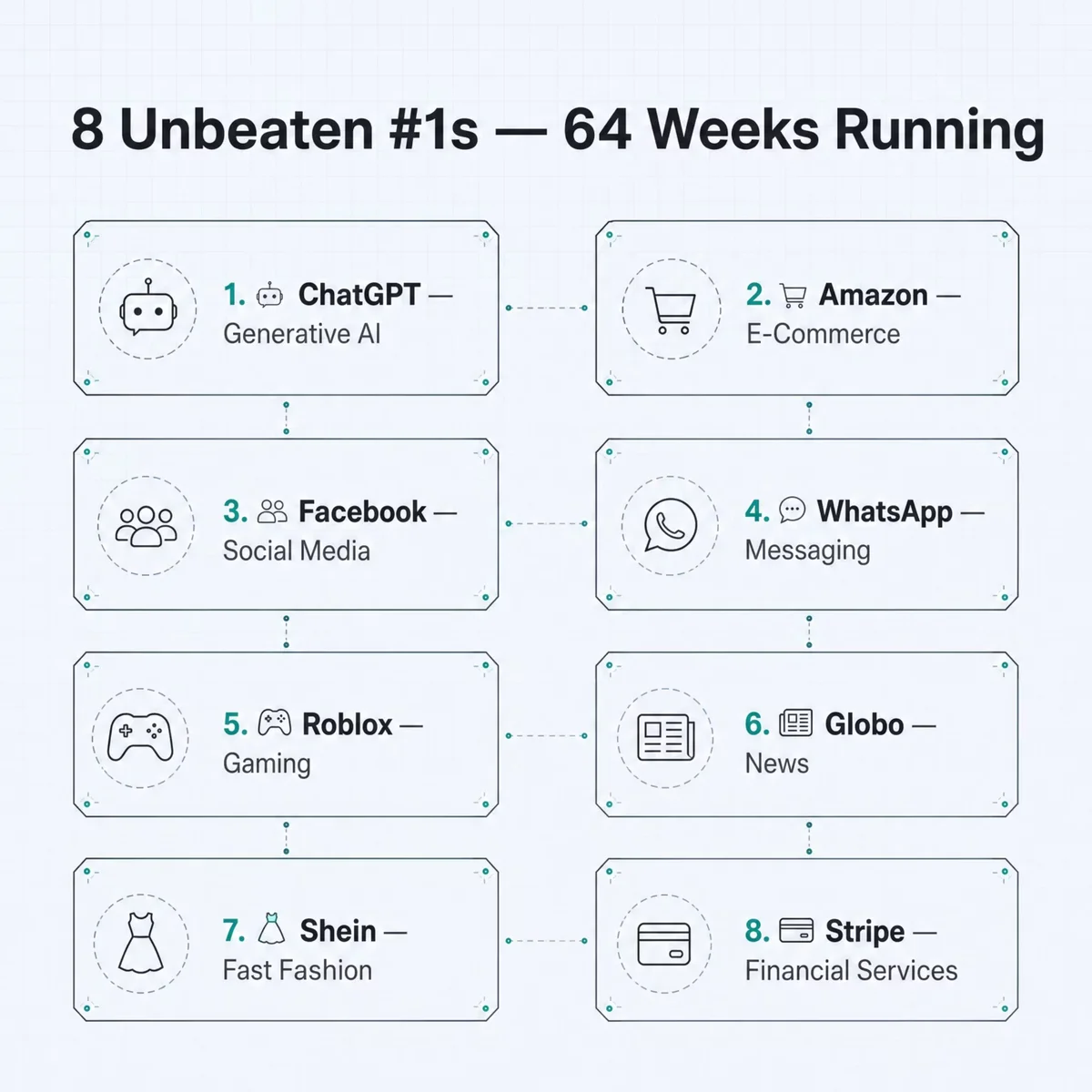
Eight of 13 categories have a leader that held #1 for all 53 weeks without a single week of challenge:
| Platform | Category | Weeks at #1 |
|---|---|---|
| ChatGPT | Generative AI | 53/53 |
| Amazon | E-commerce | 53/53 |
| Social Media | 53/53 | |
| Messaging | 53/53 | |
| Roblox | Gaming | 53/53 |
| Globo | News | 53/53 |
| Shein | Fast Fashion | 53/53 |
| Stripe | Financial Services | 53/53 |
May 2026 update — all eight forever-#1 platforms still hold: ChatGPT, Amazon, Facebook, WhatsApp, Roblox, Globo, Shein, and Stripe all retained #1 through May, extending each streak to roughly 60–61 consecutive weeks. The Q1 thesis that "once a platform reaches #1 in a category, network effects and infrastructure lock-in make it very hard to displace" now has two more months of supporting evidence. Eight categories, zero #1 changes in over a year — even as the slots below them churned harder in May than in April.
June 23, 2026 update — still eight for eight: ChatGPT, Amazon, Facebook, WhatsApp, Roblox, Globo, Shein, and Stripe all held #1 again in June, extending every streak to roughly 64 consecutive weeks. No category has changed its #1 in over a year, even as June reshuffled the slots beneath them harder than any month since Q1. The lock-in thesis now has three extra months of evidence on top of the original 53-week baseline.
The other five (Crypto, Low-Cost E-commerce, Weather, Email, Jobs) also have dominant leaders, but with occasional week-to-week fluctuations. The pattern is clear: once a platform reaches #1 in a category, the network effects and infrastructure lock-in make it very hard to displace.
Regional internet powers that don't get enough attention
Three countries punch well above their weight in these global rankings:
- Brazil: Globo (#1 News), Nubank (#5 Financial Services). 180M+ internet users in a concentrated media and fintech market. That's enough to put Portuguese-language platforms above English-language global brands.
- China: QQ (#2 Messaging), Alipay (#3 Financial Services), Doubao (top 10 AI). Even behind the Great Firewall, internal DNS volume is large enough to register globally.
- Turkey: Trendyol (#3 Fast Fashion). Turkey's fashion e-commerce market is big enough to push a domestic platform into the global top 3.
The infrastructure inversion
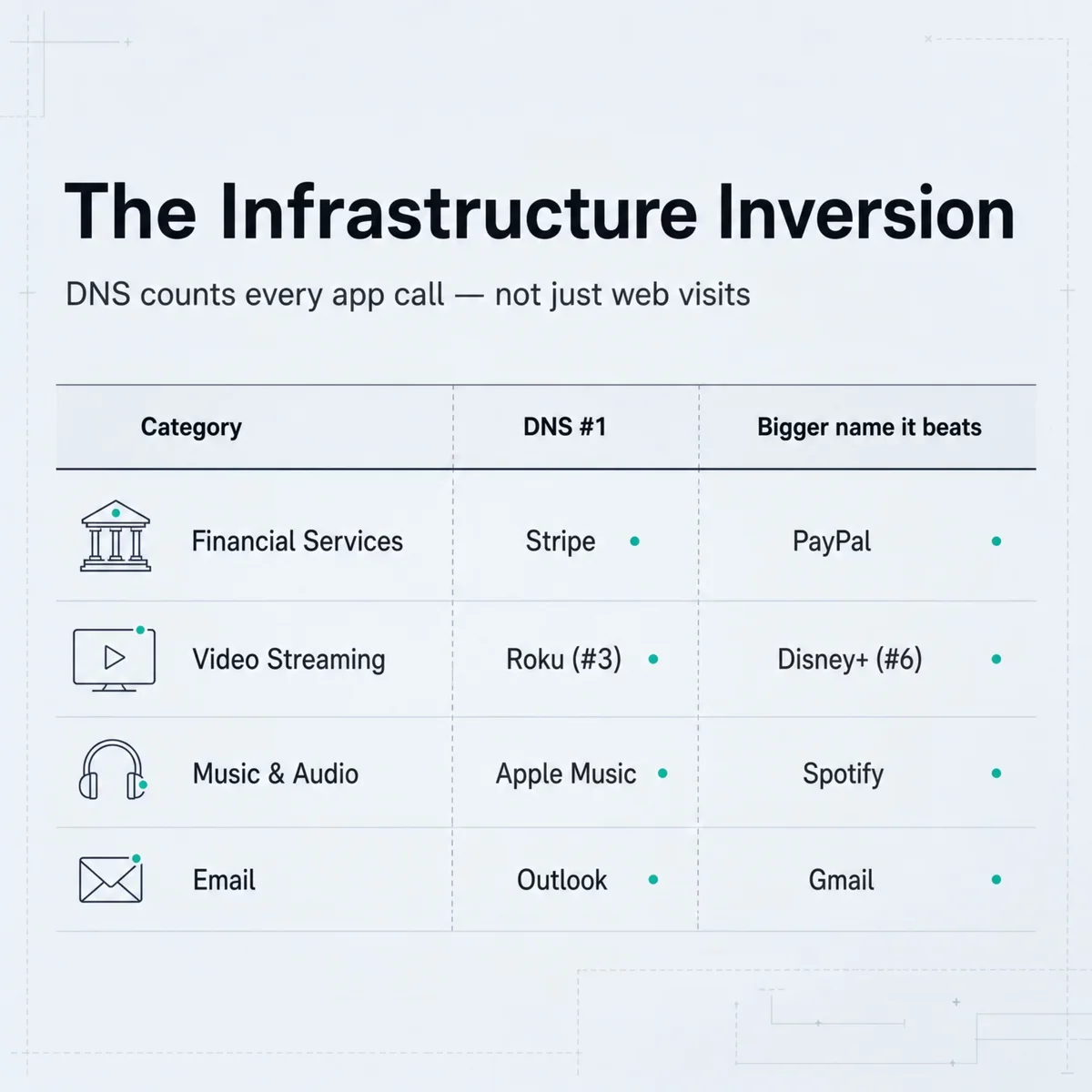
The most surprising #1 platforms don't feel like consumer brands:
- Stripe (#1 Financial Services): users don't visit Stripe. Stripe is embedded in their purchases.
- Roblox (#1 Gaming): not a game store. A persistent platform with always-on sessions.
- Shopee (#1 Low-Cost E-commerce): a marketplace, not a retailer.
These platforms generate massive DNS traffic through embedded usage, not brand searches. Every Stripe payment, every Roblox session, every Shopee product page triggers DNS resolution.
This connects directly to what we do at TechnologyChecker. When we detect Stripe or Shopify on a domain, we're picking up the same infrastructure signal that drives these DNS rankings. The technology is in the plumbing of the web, not on the surface. And that's often where the most valuable prospecting signals live.
How have the AI and gaming rankings moved over the quarter?
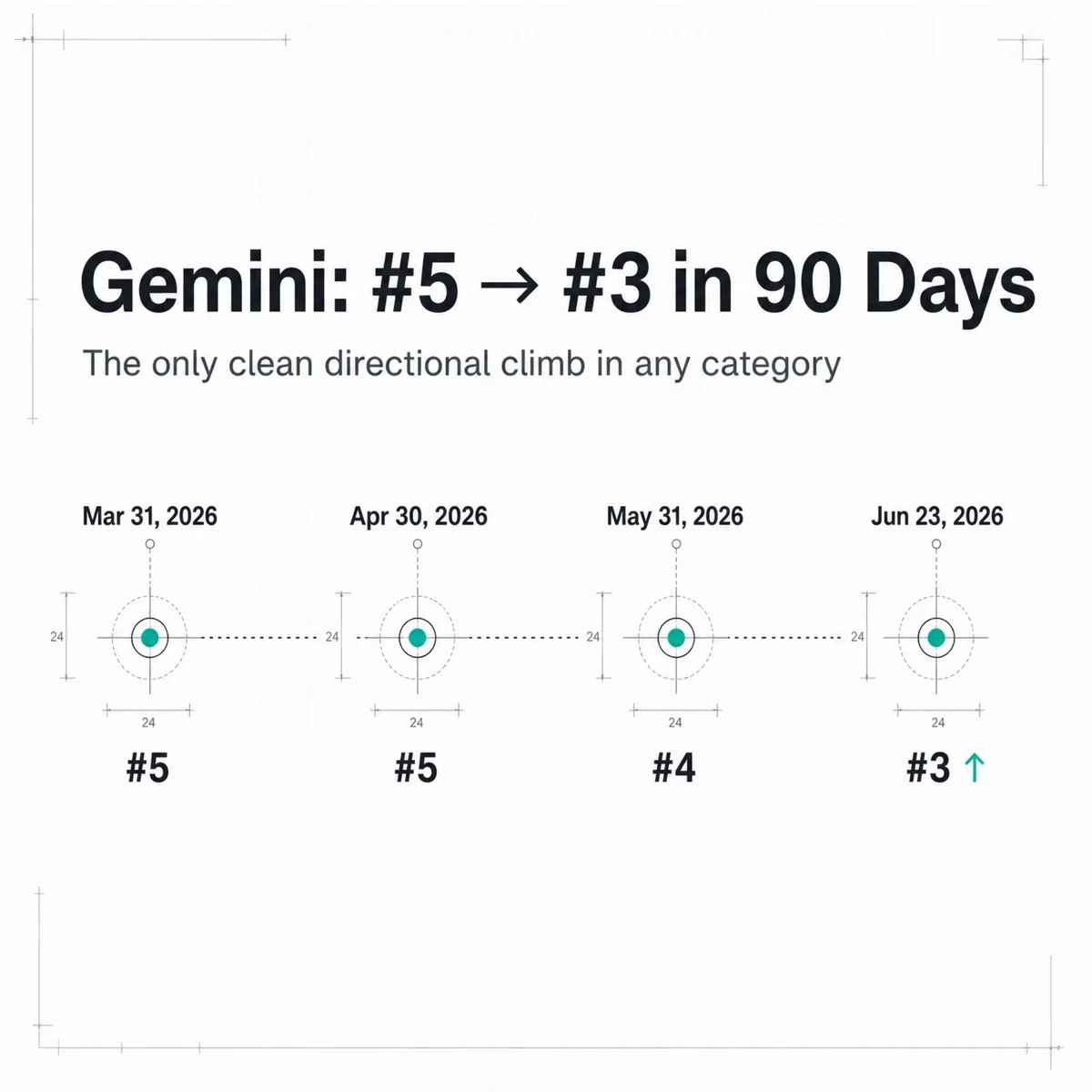
Snapshots show where platforms sit; trajectories show where they're heading. Pulling Cloudflare Radar's weekly ranks for the two most volatile categories from March 31 to June 23, 2026 makes the pattern clear: the top of each category is frozen, and almost all the movement happens in the #3 to #6 band. In Generative AI that movement has a direction (Gemini up). In Gaming it's a standoff (Steam and Epic Games trading one slot).
Generative AI rank trajectory (top 5)
| Service | Mar 31 | Apr 30 | May 31 | Jun 23 |
|---|---|---|---|---|
| ChatGPT | #1 | #1 | #1 | #1 |
| Claude | #2 | #2 | #2 | #2 |
| Google Gemini | #5 | #5 | #4 | #3 |
| Perplexity | #3 | #3 | #3 | #4 |
| DeepSeek | #4 | #4 | #5 | #5 |
Gemini is the only platform with a clean directional climb. It sat at #5 for two months, took #4 from DeepSeek in May, then #3 from Perplexity in June. Perplexity and DeepSeek each slipped one spot to make room, while ChatGPT and Claude never moved. If that one-spot-a-month pace held, Gemini would challenge Claude for #2 next, though Claude has defended #2 without a single down-week all year.
⚠️ Superseded by the August 2026 update above; preserved as originally published. The climb stopped in July. Perplexity retook #3 by July 5 and held it on July 9, 13, 17, 21 and 25, with only the July 31 snapshot flipping back to Gemini. The one-spot-a-month extrapolation in the paragraph above was wrong, and Claude was never pressured.
Gaming rank trajectory (the contested #5 slot)
| Service | Mar 31 | Apr 30 | May 31 | Jun 23 |
|---|---|---|---|---|
| Roblox | #1 | #1 | #1 | #1 |
| Discord | #2 | #2 | #2 | #2 |
| PlayStation | #3 | #3 | #3 | #3 |
| Xbox | #4 | #4 | #4 | #4 |
| Epic Games | #5 | out | out | #5 |
| Steam | out | #5 | #5 | out |
This is the cleanest blip-versus-signal illustration in the dataset. The top four positions never changed across the entire quarter. The #5 slot is a straight Epic-versus-Steam alternation: Epic in Q1, Steam for two months, Epic again in June. Steam's two-month run looked structural in May; June showed it wasn't. When a slot oscillates like this, the right call is to treat both platforms as roughly tied on DNS volume and stop reading each monthly flip as a trend.
Three categories we added: Video, Music, and the Overall ranking
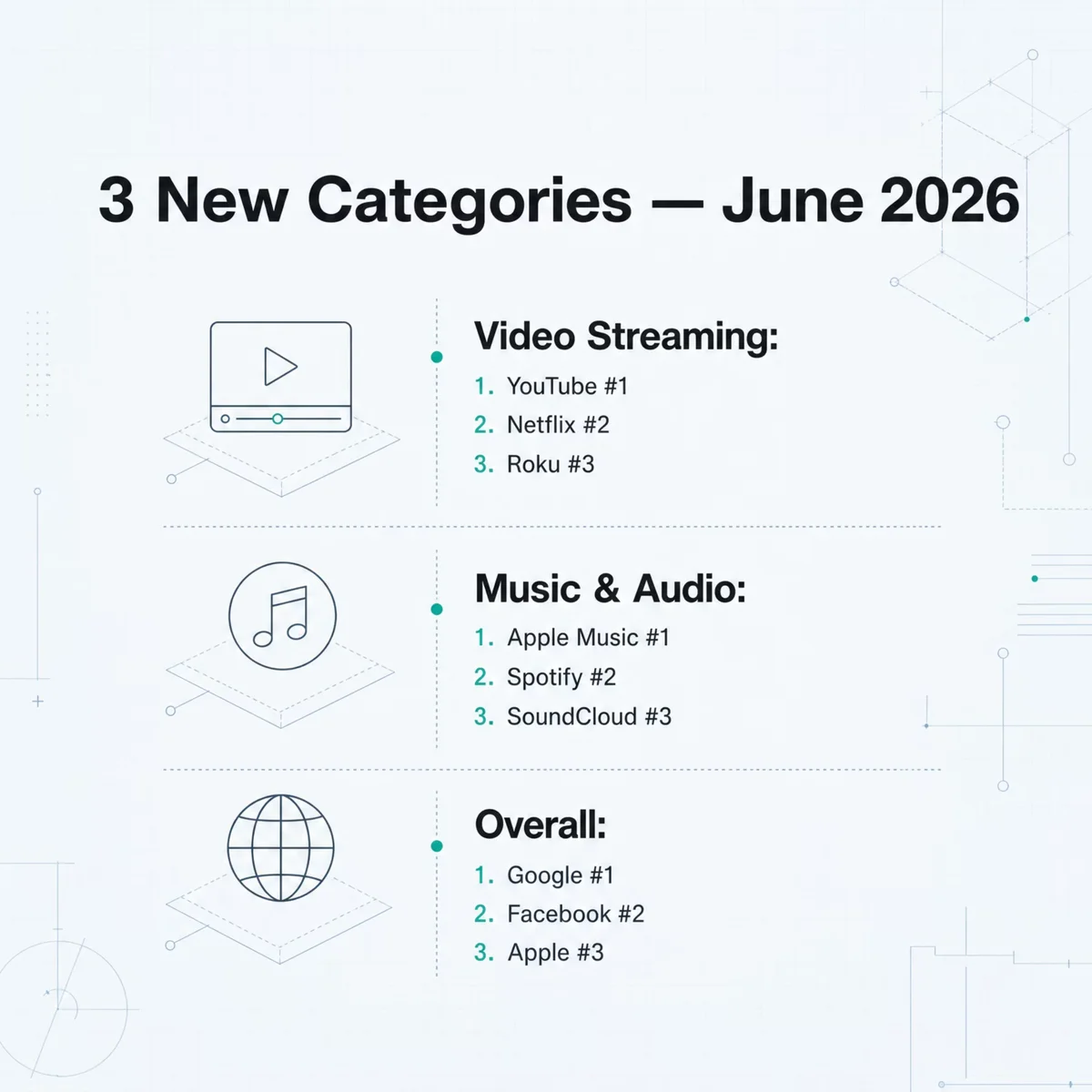
Cloudflare expanded its Internet Services Rankings to 16 categories, and three of them weren't in our original report: Video Streaming, Music & Audio Streaming, and an Overall ranking that spans every service. Here's the June 23, 2026 picture for each.
What are the most popular video streaming platforms in 2026?
By DNS traffic, the top five video platforms are YouTube, Netflix, Roku, Twitch, and Prime Video.
| Rank | Platform | Note |
|---|---|---|
| #1 | YouTube | Persistent sessions plus embeds across the web |
| #2 | Netflix | The only pure-subscription service near the top |
| #3 | Roku | A platform/OS, not a single app: every Roku device pings home |
| #4 | Twitch | Always-on live streams generate continuous DNS load |
| #5 | Prime Video | Edged past Disney+ (#6) in June |
YouTube at #1 is no surprise, but Roku at #3, ahead of Disney+ and HBO/Max, is the infrastructure-inversion pattern again. Roku ranks high not because people search for it but because Roku is an operating system on tens of millions of TVs, each maintaining background connections. The same logic that puts Stripe above PayPal puts Roku above Disney+.
Why is Apple Music ranked above Spotify?
In Music & Audio Streaming, the DNS ranking is Apple Music, Spotify, SoundCloud, Pandora, and YouTube Music, and Apple Music at #1 over Spotify is the most counterintuitive result in the entire dataset.
| Rank | Platform |
|---|---|
| #1 | Apple Music / iTunes |
| #2 | Spotify |
| #3 | SoundCloud |
| #4 | Pandora |
| #5 | YouTube Music |
Spotify has more global subscribers than Apple Music, so why does Apple rank first on DNS? Same reason Outlook beats Gmail in our Email category: the domain is wired into the operating system. Apple Music and iTunes services resolve across every iPhone, iPad, and Mac for music, podcasts, and account checks, whether or not the user is an active subscriber. Spotify's traffic comes only from people actually using Spotify. DNS volume rewards platforms baked into devices, not just the ones with the biggest paid audiences.
What are the most popular internet services overall?
The Overall ranking collapses all categories into one list. As of June 23, 2026: Google, Facebook, Apple, Microsoft, and Instagram.
| Rank | Service | Why it ranks here |
|---|---|---|
| #1 | Search, Android, ads, and APIs across the web | |
| #2 | 3.2B users plus embedded social plugins | |
| #3 | Apple | Device services on every iPhone and Mac |
| #4 | Microsoft | Windows, Office, Azure, and Outlook |
| #5 | Climbed past AWS (#6) in June |
The Overall top four are platform companies whose domains are embedded in operating systems, browsers, and developer infrastructure, not destination websites. It's the clearest single confirmation of this report's core thesis: on the DNS lens, the most-resolved services are the ones woven into the plumbing of the internet, not the ones with the flashiest front doors.
What this means if you sell B2B
Five takeaways:
AI adoption has diversified. It's not "ChatGPT or nothing" anymore. Claude, Perplexity, DeepSeek, and Gemini all have growing DNS footprints. Companies running 2+ AI platforms tend to be more technical and more willing to buy new tools. Track which specific AI tools your prospects use, not just whether they "use AI."
E-commerce infrastructure is a better signal than e-commerce brand. A prospect on Shopify with Stripe payments is a very different buyer than one on WooCommerce with PayPal. We see this in our own data: Shopify's 2.4M detected domains skew toward Retail (17%), Fashion (12%), and F&B (4%). Stripe's 243K domains skew toward Software Development (7%), Retail (5%), and Tech (5%). Those industry distributions tell you who's buying what.
Regional platforms are bigger than you think. Globo, Nubank, Trendyol, QQ. They don't show up in Western tech media, but they dominate their categories globally. Our own crawl shows the same pattern among website builders: Jimdo ranks 11th worldwide, yet 32,388 of the companies that use Jimdo are German, level with Wix there, and Webnode, 31st worldwide, is the third hosted builder among Czech companies (September 2026 crawl). The same crawl puts more Hostinger Website Builder customers in Brazil and India combined (7,662 matched companies) than in the United States (5,148). Local builders bring other vendors' tools with them: Finland is the fifth country among Osano customers, with 237 matched companies, because Kotisivukone, a Finnish small-business website builder, puts Osano's consent banner on its customers' sites (September 2026 crawl). If you're expanding into Latin America, Southeast Asia, or Turkey, these platforms define the local internet experience, and your prospects there are using them daily.
Platform stability is a prospecting signal. The four static categories (Messaging, Weather, Jobs, Email) show deep lock-in. If a prospect has standardized on Outlook and WhatsApp, they're not switching communication tools. Sell integrations, not replacements.
DNS traffic reveals hidden infrastructure. Stripe's #1 ranking despite being a B2B company shows that infrastructure platforms generate more internet activity than most consumer brands. For technology intelligence, detecting these embedded technologies across prospect websites gives you a more accurate picture of tech maturity than surface-level website analysis.
What May 2026 resolved, and what we're watching next
The May 2026 data answered all four of the questions we flagged in the April update, and answered them cleanly.
Steam held #5 in Gaming. This was the big one. Steam re-entered in April after a full quarter out; May confirms it at #5 a second time. Two consecutive months retire the "Discord replaced Steam" framing for good and treat the Q1 exit as a confirmed methodology blip.
Doubao returned to the AI top 10. After dropping to #11 in April, Doubao climbed back to #10 in May. The "China's biggest push into global AI rankings" framing survives, but as an on-the-bubble presence: Doubao has now bounced between #10 and #11 three times.
Binance held its Financial Services top 5 spot. Two consecutive months in mainstream Financial Services turns April's crypto-native breakthrough into a real category shift, not a one-month artifact. Binance is now a durable cross-category top-5 platform alongside Shopee.
X (Twitter) stayed out at #6. X held #6 for a third straight snapshot. The on-off flickering of 2025 has, for now, settled into stable exclusion just below the top 5 rather than a return. That is the clearest evidence yet that X's social-media DNS volume has structurally dropped below LinkedIn's.
Three new questions opened up in May, and we'll track them into the next update:
Will Gemini hold #4 in AI, or does DeepSeek take it back? Gemini's overtake of DeepSeek was the first top-5 order change in Generative AI since Q1. One month tells us it happened; a second would tell us whether Gemini's distribution push or DeepSeek's model release cycle is the stronger DNS driver.
Were the Messaging and Jobs shifts real, or April-style blips? WeChat displacing Signal, and Talent.com plus SEEK reshuffling the Jobs top 5, broke two categories we had called static. Given how many April newcomers reversed in May, the honest stance is to treat both as provisional until a second month confirms them.
Which May newcomers reverse? Uniqlo (Fast Fashion #4) and Talent.com (Jobs #4) are May's fresh top-5 entrants. Based on the CoinMarketCap, DHgate, and Zara pattern, roughly half of one-month entries reverse. The next snapshot will show which of these two stuck.
Update — June 23 answered all three. Gemini didn't just hold #4, it took #3 from Perplexity, so the climb was real and accelerating. The Messaging shift held (WeChat kept #5), but the Jobs shift did not: Talent.com fell out of the top 10 entirely. And both of May's fresh entrants reversed, with Uniqlo crashing to #9 and Talent.com vanishing. That's the "roughly half of one-month entries reverse" rule landing on the high side this round.
The new questions for the next update: is Steam done in Gaming, or does it trade #5 with Epic Games indefinitely? Four snapshots now read Epic / Steam / Steam / Epic for that slot. We're also watching whether Gemini's monthly climb stalls at #3 or finally pressures Claude at #2, and which of June's fresh entrants (Kraken in Cryptocurrency, Fashion Nova in Fast Fashion) survive a second month.
Q2 close update (June 30): the one-year view added at the top of this post answers the bigger question these monthly notes kept circling. Steam didn't settle its Gaming slot (it sits at #6 a year on, with Discord now the durable #2), Gemini's climb held all the way to #3, and the deeper finding is that 15 of 16 category leaders are unchanged since June 2025 even as the seats beneath them churned hard. The next edition lands with the Q3 2026 close in October, when a second year-over-year point will show whether Generative AI's top five keeps reshuffling or finally stabilizes the way Music, Weather, and Email already have.
⚠️ Partly superseded by the August 2026 update above; preserved as originally published. Two of the three claims in that paragraph didn't survive July. "Gemini's climb held all the way to #3" is wrong for the month: Perplexity held #3 from July 5 to July 25. And "15 of 16" becomes 16 of 16 on a July-to-July baseline. The Steam reading holds: Epic kept #5 for a second straight month and Steam sat at #6 every day of July. The three open questions listed above this note are now answered in the August layer at the top of the post, so treat those as closed rather than pending.
Frequently asked questions
What are the most popular platforms by category in 2026?
Based on Cloudflare Radar DNS rankings for Q3 2026, the #1 platforms are Google (Overall), Facebook (Social Media), WhatsApp (Messaging), Amazon (E-commerce), Shopee (Low-Cost E-commerce), Shein (Fast Fashion), Stripe (Financial Services), Binance (Cryptocurrency), ChatGPT (Generative AI), Outlook (Email), Indeed (Jobs), Roblox (Gaming), Globo (News) and Weather.com (Weather). Video Streaming and Music are contested: YouTube and Apple Music led until September 23, 2026, Netflix and Spotify from September 24 (provisional).
What changed in Q3 2026?
At #1, only Video Streaming and Music, both on September 24, 2026, inside a reshuffle that touched 13 of the 16 top fives that week. Below #1, Shopify held #2 in E-commerce and Claude #2 in Generative AI all quarter, and AWS entered the Overall top five. Source: Cloudflare Radar, radar/ranking/internet_services/top.
Did Google Gemini hold #3 in generative AI in July 2026?
No. Perplexity retook #3 by July 5, 2026 and held it on July 9, 13, 17, 21 and 25. Only the July 31 snapshot shows Gemini back at #3, so the slot is a contested pair rather than a Gemini position. ChatGPT and Claude held #1 and #2 on every date. Source: Cloudflare Radar, radar/ranking/internet_services/top?serviceCategory=Generative AI.
What changed between the Q2 2026 close and the end of July 2026?
Very little at the top. Every category's #1 and #2 held from June 30 to July 31, 2026, and only three changed a #3 (Fast Fashion, Financial Services, News). The clearest real moves were Kraken falling from #4 to #8 in Cryptocurrency and SEEK from #5 to #10 in Jobs. Source: Cloudflare Radar, radar/ranking/internet_services/top.
Can you trust a single-day platform ranking?
Below #3, often not. Checking July 28 to 31, 2026, three apparent changes reversed within a day: Trendyol's #2 in Fast Fashion, Lesoir's #5 in News, and Gemini's #3 in generative AI. The #1 and #2 slots were stable across all 16 categories. Source: Cloudflare Radar, radar/ranking/internet_services/top.
Which categories saw the biggest shifts in 2026?
Generative AI had the most movement. Claude went from #9 to #2, Perplexity from #8 to #3, and Google Gemini entered the top 5, then kept climbing: it took #4 from DeepSeek in May and #3 from Perplexity by June 23. That climb then reversed, with Perplexity holding #3 for most of July 2026. Gaming also shifted when Discord appeared in January 2026 and claimed #2, while Steam dropped out entirely. Steam returned to #5 in April and held it through May, but slipped back out in June as Epic Games retook #5, and Epic kept #5 through July with Steam at #6. Jobs proved the most volatile category of all: Talent.com fell out of the top 10 in June, briefly reappeared at #7 on July 19, and was gone again by July 31, while SEEK dropped from #4 to #10 across July.
What are the most popular social media platforms in 2026?
By DNS traffic: Facebook (#1, 53 straight weeks), Instagram (#2, 39 weeks after overtaking TikTok), TikTok (#3), Snapchat (#4), LinkedIn (#5). X (Twitter) dropped out of the top 5 in 18 of 52 weeks in Q1 and has stayed at #6 ever since, including on every July 2026 date sampled. All five positions are unchanged from July 2025, when X held #5 and LinkedIn #6. Late September 2026 shuffled the order: on September 28 and 30, TikTok sat at #2 and X back at #4, inside the 24 September reshuffle described above, so treat that order as provisional.
What are the most popular video and music streaming platforms in 2026?
By Cloudflare Radar DNS rankings, YouTube led Video Streaming on every date sampled from July 2025 to September 23, 2026. From September 24, Netflix ranks #1 and YouTube #2, followed by Prime Video, Twitch and Disney Plus (September 30, provisional). In music, Apple Music led from May 31 to September 23, 2026 and Spotify from September 24. That is the sixth change at the top of Music in sixteen months. Apple Music ranking near Spotify despite Spotify's larger subscriber base reflects the DNS lens: Apple's music domains resolve across every iPhone, iPad and Mac whether or not the user subscribes.
How can B2B teams use this data?
The technology platforms a company deploys are strong buying signals. Stripe vs. PayPal, Shopify vs. WooCommerce, Slack vs. Discord: each choice reflects tech maturity and market focus. TechnologyChecker detects these platforms across the 29.9M live business domains we crawl, turning the same infrastructure signals that drive DNS rankings into prospect lists you can act on.
What do Gen Z actually use?
DNS data showed Instagram at #2 in Social Media, ahead of TikTok at #3, on every date through September 21, 2026. TikTok moved ahead on September 28 (provisional). Gen Z hasn't abandoned Instagram. They use multiple platforms. Sprout Social's 2026 data shows TikTok, Instagram, and YouTube now account for 60%+ of product discovery, surpassing Google as a discovery channel.
How reliable are DNS-based rankings?
DNS rankings measure total platform engagement, including app connections, API calls, and background pings, not just website visits. This makes them broader than web traffic tools but also noisier. CDN configurations and app behavior can influence results. We find them most useful as a relative measure: if a platform is rising or falling in DNS rankings over 52 weeks, that trend is real even if the absolute number is imprecise.
Did the most popular platforms change over the past year (2025 to 2026)?
Fourteen of sixteen did not. Their #1s were identical on all 16 dates sampled from July 31, 2025 to September 30, 2026. Video Streaming changed on September 24, 2026 (YouTube to Netflix, provisional), and Music is contested, with six changes between Apple Music and Spotify in sixteen months. A comparison built on two single dates can hide that: September 30 shows Spotify leading Music in both years.
Which AI platforms grew the most over the past year?
By Cloudflare Radar DNS rank from July 31, 2025 to July 31, 2026: Google Gemini rose from #8 to #3, Grok/xAI from #10 to #6, DeepSeek from #9 to #5, and Perplexity from #6 to #4. ChatGPT and Claude held #1 and #2 for the full year. GitHub Copilot fell from #3 to #8 and Character.AI from #4 to #9.
What is the most stable platform category?
At #1, fourteen categories tie: their leaders never moved on any date sampled from July 2025 to September 2026. Below #1, Weather is the steadiest in Q3 2026, with Weather.com, AccuWeather and Wunderground in the same top three on every date. Music, once the most stable top nine, is now the least stable at #1. Source: Cloudflare Radar DNS rankings.
Update history
Re-pulled all 16 categories on 16 dates (July 31, 2025 to September 30, 2026). Added the Q3 2026 status table, a Q3 analysis, a 2026 month-by-month table and a live Generative AI chart. Graded the September edition's "15 of 16 leaders are immovable": 14 held on every date, and Video Streaming (YouTube to Netflix) and Music (Apple Music to Spotify) both flipped on September 24, 2026, provisionally. Replaced a bare "50M+ domains" figure with the 29.9M live business domains we crawl.
August 2026 verification: sixteen leaders, thirteen months, two moves
Verified 3 September 2026 against every category, and it produced a correction. This post has claimed since July that all sixteen category leaders were unchanged year over year. Checking all sixteen, on a run of dates rather than one, shows fifteen are genuinely immovable and the sixteenth is not a "leader" at all.
Music & Audio Streaming has changed hands five times in fifteen months. Apple Music and Spotify have swapped #1 repeatedly, and which one you call the leader depends entirely on the date you sample:
| Month end | #1 |
|---|---|
| June–July 2025 | Apple Music / iTunes |
| August–October 2025 | Spotify |
| November 2025 | Apple Music / iTunes |
| December 2025 – April 2026 | Spotify |
| May–August 2026 | Apple Music / iTunes |
Source: Cloudflare Radar — radar/ranking/internet_services/top with serviceCategory=Music & Audio Streaming, month-end snapshots, pulled 2026-09-03.
That is why this post's year-over-year count kept coming out at sixteen. Measured July-to-July, Apple Music leads on both ends and the category reads as "held". Measured August-to-August, Spotify leads the 2025 end and it reads as "changed". Both are true and neither is informative. The category's real property is that it is contested, and Apple Music's current four-month run (May to August 2026) is the longest either service has managed since Spotify's three-month run in late 2025.
The full leaderboard, all sixteen categories
| Category | #1, August 2026 | #1, August 2025 | Status |
|---|---|---|---|
| Overall | Immovable | ||
| Social Media | Immovable | ||
| Video Streaming | YouTube | YouTube | Immovable |
| Messaging | Immovable | ||
| E-commerce | Amazon | Amazon | Immovable |
| Low cost E-commerce | Shopee | Shopee | Immovable |
| Fast Fashion | Shein | Shein | Immovable |
| Financial Services | Stripe | Stripe | Immovable |
| Cryptocurrency Services | Binance | Binance | Immovable |
| Generative AI | ChatGPT / OpenAI | ChatGPT / OpenAI | Immovable |
| Outlook | Outlook | Immovable | |
| Jobs | Indeed | Indeed | Immovable |
| Metaverse & Gaming | Roblox | Roblox | Immovable |
| News | Globo | Globo | Immovable |
| Weather | Weather.com | Weather.com | Immovable |
| Music & Audio Streaming | Apple Music / iTunes | Spotify | Contested — 5 changes in 15 months |
Source: Cloudflare Radar — radar/ranking/internet_services/top with serviceCategory, one call per category per date, pulled 2026-09-03. This endpoint returns ordinal ranks derived from 1.1.1.1 DNS traffic with no underlying volume figure, so it supports statements about order and nothing about share or magnitude. Every position was checked on 3, 10, 17, 24 and 31 August.
Two other positions moved, both confirmed on four dates
- Messaging: WeChat moved from #5 to #4, swapping with Rakuten Viber. Confirmed on 17, 24 and 31 August; on 10 August the old order still held.
- Financial Services: Alipay moved from #3 to #2, swapping with TradingView. Confirmed on all four August dates.
- Generative AI: Perplexity held #3, so the call this post made in August stands.
Everything else was identical on every date sampled.
Because nothing else moved, the analysis in the sections below is unchanged rather than restated. The tables they were built on still describe August.
Updated August 1, 2026 with July data. I re-pulled all 16 categories at the July 31, 2026 snapshot, and again at June 30, 2026 (the Q2 close) and July 31, 2025 for a like-for-like month baseline. The headline changed shape. On a July-to-July lens, all 16 category #1s held, not 15. Low-Cost E-commerce, the one crown this report said changed hands over the year, only looks like a handover from a June 30 baseline: Shopee had already retaken #1 from Temu by July 7, 2025 and held it on every date I sampled since. Two things July settled outright. Perplexity took #3 in Generative AI back from Gemini and held it for almost the entire month, which answers this report's own open question the wrong way for Gemini. And Epic Games held Gaming's #5 for a second straight month, with Steam parked at #6 every day of July. The August layer leads; the Q2-close view, the June 23 refresh, the May layer, and the Q1 baseline are all preserved below it exactly as published.
A note on the stamp: "(August 2026 Update)" says when this was refreshed. The new data covers the July 31, 2026 snapshot.
Updated July 2, 2026 for the Q2 close. I re-pulled all 16 categories at the June 30, 2026 quarter close and, for the first time, against a June 30, 2025 snapshot to get a clean one-year view. The one-number headline: 15 of the 16 category #1s are exactly where they were a year ago. The only crown that changed hands was Low-Cost E-commerce, where Shopee finally overtook Temu. Underneath the frozen leaders, though, a full year churned harder than any single month: Generative AI's entire top five turned over below ChatGPT (Character.AI fell from #2 to #9 as Claude, Gemini, Perplexity, and DeepSeek all climbed), Discord went from unranked to #2 in gaming, and Shopify climbed from #6 to #2 in E-commerce. The new one-year section leads; the Q1 baseline and the April, May, and June-23 monthly layers are all preserved below it.

Data Analyst
5+ years of experience
Emma is a Data Analyst at TechnologyChecker, where she analyses technology adoption data to build better prospect lists and uncover actionable patterns for sales teams.
- BSc Data Science, Cardiff University
- Google Data Analytics Professional Certificate
- Tableau Desktop Certified Associate
Never miss our research