Web Traffic Statistics Q3 2026: The 15 Numbers That Matter
Q3 2026 Cloudflare Radar data: bots were 35.5% of web requests, all-traffic desktop 60.4% and HTTP/3 20.2%. 15 numbers vs Q2 2026 and Q3 2025.
Published •Updated •Data through September 2026•79 min read

Updated October 1, 2026 with Q3 2026 data (July to September 2026; September is provisional). Earlier editions of this report are preserved in the update history at the end, annotated where newer data supersedes them.
Bots made up 35.49% of all HTTP requests in Q3 2026, up from 33.21% in Q2 2026 and 30.13% in Q3 2025. All-traffic desktop share reached 60.41%, 6.15 points above a year earlier, HTTP/3 slid to 20.17% of requests, and WAF rules handled 56.41% of application-layer attack mitigations against 42.52% a year ago. Those are four of the fifteen numbers below. Cloudflare has revised several of the series we published in September, and each revision is named where it lands rather than swapped in silently. Source: Cloudflare Radar, calendar quarters, pulled 2026-10-01.
What are the current global internet traffic statistics?
In Q3 2026, bots made up 35.49% of HTTP requests, 95.10% of requests used HTTPS, 93.89% of traffic ran on TLS 1.3 or QUIC, and HTTP/3 carried 20.17%, according to Cloudflare Radar. These are shares of the traffic Cloudflare serves, which is a large sample of the web, not a count of every internet byte.
| Metric, Q3 2026 | Q3 2025 | Q3 2026 | Year over year |
|---|---|---|---|
| Bots, of all HTTP requests | 30.13% | 35.49% | +5.36 pt |
| HTTPS, of HTTP requests | 93.97% | 95.10% | +1.13 pt |
| TLS 1.3 + QUIC, of web traffic | 92.53% | 93.89% | +1.36 pt |
| HTTP/3, of requests | 22.98% | 20.17% | −2.81 pt |
| IPv6, of HTTP requests | 31.25% | 29.54% | −1.71 pt |
| Post-quantum encrypted, of requests | 32.04% | 57.30% | +25.26 pt |
Source: Cloudflare Radar, http/summary/{bot_class, http_protocol, tls_version, http_version, ip_version, post_quantum}, Q3 2025 (July 1 to September 30, 2025) and Q3 2026, pulled 2026-10-01. All traffic, bots included.
Is 50% of internet traffic AI? No. Internet traffic is NOT half AI on Cloudflare's measurement: every kind of automated request combined was 35.49% of HTTP requests in Q3 2026, and AI crawlers, AI search fetchers and AI assistants are only part of that automated share. Our bot traffic report breaks down who runs those bots and where the "half of traffic" figures come from.
Q3 2026 analysis: the 15 numbers, quarter over quarter and year over year
These are the same fifteen metrics this report has tracked since Q1, now on calendar quarters: Q3 2026 against Q2 2026 and against Q3 2025. A quarter damps the one-month bursts that put asterisks on four of August's numbers, so this is the table to cite.
| # | Metric (share of…) | Q3 2025 | Q2 2026 | Q3 2026 | QoQ Δ | YoY Δ |
|---|---|---|---|---|---|---|
| 1 | Bots, of all HTTP requests | 30.13% | 33.21% | 35.49% | +2.28 pt | +5.36 pt |
| 2 | AI crawlers, of bot traffic ⚠️ | 18.03% | 19.07% | 22.12% | +3.05 pt | +4.09 pt |
| 3 | Search-engine crawlers, of bot traffic | 32.99% | 29.63% | 26.14% | −3.49 pt | −6.85 pt |
| 4 | Googlebot, of AI-bot traffic | 41.94% | 27.49% | 23.80% | −3.69 pt | −18.14 pt |
| 5 | ClaudeBot, of AI-bot traffic | 10.26% | 13.87% | 13.23% | −0.64 pt | +2.97 pt |
| 6 | Compromised logins, of inspected attempts ⚠️ | 63.10% | 57.36% | 23.45% | −33.91 pt | −39.65 pt |
| 7 | Link signal, of malicious email | 49.15% | 70.12% | 74.55% | +4.43 pt | +25.40 pt |
| 8 | WAF, of L7 attack mitigations | 42.52% | 50.85% | 56.41% | +5.56 pt | +13.89 pt |
| 9 | UDP, of L3 attacks | 70.92% | 82.63% | 89.59% | +6.96 pt | +18.67 pt |
| 10 | Modern TLS (1.3 + QUIC), of web traffic | 92.53% | 94.34% | 93.89% | −0.45 pt | +1.36 pt |
| 11 | HTTP/3, of requests | 22.98% | 21.91% | 20.17% | −1.74 pt | −2.81 pt |
| 12 | IPv6 (AAAA), of DNS queries | 18.43% | 21.20% | 21.34% | +0.14 pt | +2.91 pt |
| 13 | ECDSA, of certificate records ⚠️ | 27.73% | 50.17% | 50.11% | −0.06 pt | +22.38 pt |
| 14 | Let's Encrypt, of records logged in CT ⚠️ | 69.60% | 58.63% | 50.90% | −7.73 pt | −18.70 pt |
| 15 | TLS 1.2 (legacy), of web traffic | 7.44% | 5.65% | 6.10% | +0.45 pt | −1.34 pt |
Source: Cloudflare Radar, http/summary/{bot_class, tls_version, http_version}, bots/summary/bot_category, ai/bots/summary/user_agent, leaked_credential_checks/summary/compromised, email/security/summary/threat_category, attacks/layer7/summary/mitigation_product, attacks/layer3/summary/protocol, dns/summary/query_type, ct/summary/{public_key_algorithm, ca_owner}. Calendar quarters (Q3 2025: July 1 to September 30, 2025; Q2 2026: April 1 to June 30, 2026; Q3 2026: July 1 to September 30, 2026), pulled 2026-10-01. Row 7 comes from an OVERLAPPED_PERCENTAGE endpoint where one message can carry several signals, so those shares never sum to 100. Row 9 is a share of attack bytes, not of attacks. Rows 13 and 14 are computed from raw record counts.
The rows I would put in front of an engineering team are 1, 8 and 9. Bots rose 5.36 points in a year, WAF rules now handle 56.41% of application-layer mitigations where DDoS rules led a year ago, and UDP carried 89.59% of network-layer attack bytes. Read together, the volume problem moved from the network edge into the application layer while a third of the traffic you serve became automated. I read rows 2, 6, 13 and 14 differently. Each moved for a reason that is about the measurement, not the web, and the next section says which.
One more thing about September. Cloudflare's daily bot share sat near 33% in the first days of the month and closed near 40% in its last week. A step that size inside one month is more likely a change in how Cloudflare classifies traffic than a sudden wave of new bots, so September stays provisional until October confirms or reverses it.
Four rows that moved for reasons that are not about the web
Row 6: compromised logins, the third month. In August we flagged that this rate had halved twice running (54.72% in June, 44.62% in July, 21.46% in August) and said we would not build a claim on it until it held. It held: September read 20.19%. The reason sits in a second Radar series, the share of inspected login attempts that came from automated clients.
| Month (2026) | Compromised, of inspected logins | Automated, of inspected logins |
|---|---|---|
| June | 54.72% | 86.68% |
| July | 44.62% | 69.41% |
| August | 21.46% | 50.50% |
| September (provisional) | 20.19% | 51.53% |
Source: Cloudflare Radar, leaked_credential_checks/summary/compromised and leaked_credential_checks/summary/bot_class, calendar months, pulled 2026-10-01. Q3 2025 for reference: 63.10% compromised, 94.86% automated.
Credential stuffing did NOT fall by two thirds in a quarter: the pool of logins Cloudflare inspects changed, from almost nine in ten automated in June to about half by August, and a check that sees far fewer bot attempts finds far fewer stolen passwords. The compromised rate is now a reading on a different population, so we are keeping it in the table with its asterisk and no longer comparing it with the first half of the year.
Row 2: AI crawlers. Cloudflare retired its AI_ASSISTANT category in August, so the AI buckets have to be summed to compare across the year. AI crawler, AI search and AI assistant traffic together were 29.56% of bot traffic in Q2 2026 and 32.49% in Q3. Q3 2025 had no AI search or AI assistant buckets at all, so the year-over-year figure on this row compares different taxonomies.
Rows 13 and 14: certificates. Let's Encrypt's share of certificate records fell from 69.60% to 50.90% in a year mostly because the measured total grew as Cloudflare indexed more precertificates and static logs, not because Let's Encrypt issued less. ECDSA's year-over-year move from 27.73% to 50.11% is real on every basis we have checked. Our certificate transparency report has the issuer-by-issuer detail.
2026 month by month: six headline rows
| Month (2026) | Bots | Desktop, all traffic | HTTP/3 | HTTPS | IPv6 | Post-quantum |
|---|---|---|---|---|---|---|
| January | 29.55% | 56.82% | 22.36% | 94.02% | 30.64% | 48.93% |
| February | 31.65% | 58.41% | 22.41% | 93.95% | 30.56% | 52.01% |
| March | 30.66% | 58.17% | 22.05% | 94.48% | 31.00% | 53.10% |
| April | 31.96% | 57.82% | 21.96% | 94.53% | 31.04% | 54.25% |
| May | 32.63% | 58.07% | 22.17% | 95.11% | 31.30% | 55.34% |
| June | 34.79% | 59.08% | 21.61% | 94.98% | 30.39% | 56.31% |
| July | 34.75% | 59.83% | 20.47% | 94.92% | 29.90% | 56.47% |
| August (provisional) | 35.42% | 60.76% | 20.25% | 95.02% | 29.17% | 56.83% |
| September (provisional) | 36.15% | 60.75% | 19.83% | 95.35% | 29.51% | 58.46% |
| January → September | +6.60 pt | +3.93 pt | −2.53 pt | +1.33 pt | −1.13 pt | +9.53 pt |
Source: Cloudflare Radar, http/summary/{bot_class, device_type, http_version, http_protocol, ip_version, post_quantum}, calendar months, all traffic (bots included), pulled 2026-10-01. September 2025 for comparison: bots 29.35%, HTTP/3 22.90%, post-quantum 34.24%.
Post-quantum is the row I would watch. It gained 9.53 points between January and September, more than any other row in this table, and it is the one that moves because browsers and servers changed their defaults, not because a classifier did. HTTP/3 is the mirror image: it lost share in six of the eight month-to-month steps this year and finished September below 20% for the first time in 2026 on Cloudflare's revised series.
By vertical: where attacks and crawlers land
Two Radar datasets break traffic down by the vertical of the site being hit: mitigated application-layer attacks and verified crawler requests. They answer different questions, so they sit side by side here and are never divided by each other.
| Site vertical | L7 attack share, Q1 2026 | L7 attack share, Q3 2026 | Crawler share, Q1 2026 | Crawler share, Q3 2026 |
|---|---|---|---|---|
| Internet and Telecom | 22.38% | 25.02% | 22.30% | 20.65% |
| Computer and Electronics | 24.03% | 20.20% | 18.92% | 19.27% |
| Shopping & General Merchandise | 11.91% | 14.64% | 23.13% | 25.71% |
| Finance | 10.69% | 7.94% | 2.84% | 2.72% |
| Gambling | 6.24% | 7.62% | 7.38% | 6.63% |
| News, Media, and Publications | 7.22% | 6.09% | 8.98% | 8.63% |
| Professional Services | 3.14% | 4.85% | 2.68% | 2.88% |
| Business and Industry | 3.89% | 3.41% | 3.65% | 3.56% |
| Other | 8.05% | 7.92% | 7.81% | 7.67% |
Source: Cloudflare Radar, attacks/layer7/summary/vertical (share of mitigated application-layer attack requests by target-site vertical) and bots/crawlers/summary/vertical (share of verified crawler requests by site vertical), Q1 2026 (January 1 to March 31) and Q3 2026, pulled 2026-10-01. Travel and Tourism (2.31% of Q3 attack share) and Games (2.28% of Q3 crawler share) fall outside the other column's top nine. The attack dataset ignores an industry= filter, so the vertical is read from the dimension itself.
Web traffic statistics in July 2026: the 15 numbers, month over month and year over year
Updated August 1, 2026. The "(August 2026 Update)" stamp in the title says when we refreshed. The data in this section covers July 2026. July is a single 31-day sample, so every comparison here is either month-to-month (July against June) or same-month-to-same-month (July 2026 against July 2025). The Q2 2026 quarter numbers in the section that follows are a bridge for the reader, labelled as a quarter, and we never read a one-month figure against a 91-day one as if it were movement.
⚠️ Since this section was written, Cloudflare revised the history of four series it uses, so several July 2026 figures below no longer match Radar and are preserved as originally published. On data re-pulled on 1 October 2026, July 2026 reads: HTTP/3 20.47% (not 19.84%), all-traffic desktop 59.83% (not 60.84%), and AI crawl purpose Training 50.78% with Search 5.54% (not 44.54% and 11.57%; Cloudflare moved volume from Search to Training across its whole history). Bot share and the compromised-login figures still reproduce. The Q3 2026 analysis at the top of this report uses the revised series.
From where I sit running our crawling infrastructure in Edinburgh, July's story is the device column. All-traffic desktop share has climbed 6.11 points in twelve months, and that is not people putting their phones down. It's automated traffic showing up in a device split, and at this size it distorts any dashboard that doesn't filter bots.
The 15 numbers, month over month and year over year
Every figure below is a single Cloudflare Radar pull for three windows: July 2025, June 2026 and July 2026. The MoM column is June to July; the YoY column is July 2025 to July 2026. Bold marks the six metrics that moved more than 10 points on the year.
| # | Metric (share of…) | Jul 2025 | Jun 2026 | Jul 2026 | MoM Δ | YoY Δ |
|---|---|---|---|---|---|---|
| 1 | Bots, of all HTTP requests | 30.76% | 34.79% | 34.75% | -0.04 pt | +3.98 pt |
| 2 | AI crawlers, of bot traffic | 19.00% | 17.23% | 18.82% | +1.60 pt | -0.17 pt |
| 3 | Search-engine crawlers, of bot traffic | 32.99% | 26.27% | 26.07% | -0.20 pt | -6.92 pt |
| 4 | Googlebot, of AI-bot traffic | 42.69% | 25.18% | 24.52% | -0.66 pt | -18.17 pt |
| 5 | ClaudeBot, of AI-bot traffic | 11.23% | 19.77% | 16.28% | -3.48 pt | +5.05 pt |
| 6 | Compromised logins, of inspected attempts | 63.70% | 54.72% | 44.62% | -10.11 pt | -19.09 pt |
| 7 | Link phishing, of malicious email | 48.84% | 81.05% | 76.02% | -5.02 pt | +27.19 pt |
| 8 | WAF, of L7 attack mitigations | 32.07% | 56.20% | 54.31% | -1.90 pt | +22.23 pt |
| 9 | UDP, of L3 attacks | 75.23% | 82.84% | 93.03% | +10.19 pt | +17.80 pt |
| 10 | Modern TLS (1.3 + QUIC), of web traffic | 91.26% | 93.97% | 93.77% | -0.20 pt | +2.51 pt |
| 11 | HTTP/3, of requests | 21.64% | 20.85% | 19.84% | -1.01 pt | -1.80 pt |
| 12 | IPv6 (AAAA), of DNS queries | 18.56% | 21.82% | 22.14% | +0.32 pt | +3.58 pt |
| 13 | ECDSA, of new certificates | 26.20% | 52.19% | 49.70% | -2.48 pt | +23.51 pt |
| 14 | Let's Encrypt, of certs logged in CT | 70.90% | 59.52% | 69.11% | +9.59 pt | -1.80 pt |
| 15 | TLS 1.2 (legacy), of web traffic | 8.71% | 6.01% | 6.22% | +0.20 pt | -2.50 pt |
Source: Cloudflare Radar — http/summary/bot_class, bots/summary/bot_category, ai/bots/summary/user_agent, leaked_credential_checks/summary/compromised, email/security/summary/threat_category, attacks/layer7/summary/mitigation_product, attacks/layer3/summary/protocol, http/summary/tls_version, http/summary/http_version, dns/summary/query_type, ct/summary/public_key_algorithm and ct/summary/ca_owner, each queried for July 1–31 2025, June 1–30 2026 and July 1–31 2026 on August 1, 2026. Normalization matters here: rows 13 and 14 come back as raw issuance counts, so those shares are computed, and row 7 is an overlapping percentage that can never be summed with anything. The other twelve rows are returned as percentages and used directly.
Desktop's all-traffic lead is now a 6-point year-over-year swing
This is the largest single move in the July pull, and it is the one most likely to be misread. All-traffic desktop share hit 60.84% in July 2026 against 54.73% in July 2025, a 6.11-point year-over-year swing, with mobile falling from 45.25% to 39.11%. The rise is also still accelerating: the five weekly buckets inside July run 59.85%, 60.12%, 60.77%, 61.41% and 62.10%, climbing every week.
Filter the same month to human traffic and the order flips, exactly as it did in Q2:
| Device split, July 2026 | Desktop | Mobile |
|---|---|---|
| All traffic (bot-inclusive) | 60.84% | 39.11% |
| Human traffic only | 45.34% | 54.64% |
| Automated traffic only | 87.04% | 12.87% |
That third row is the mechanism, and it's the first time we've published it. Automated traffic classifies as desktop 87.04% of the time, so a rising bot share mathematically drags the all-traffic desktop number up whether or not a single human changes device. Humans are still mobile-majority at 54.64%, though that has eased from 57.01% in July 2025, a 2.37-point decline over the year. So both readings are true and they mean different things. Name the population every time you cite a device split.
Source: Cloudflare Radar — http/summary/device_type, with botClass=LIKELY_HUMAN and botClass=LIKELY_AUTOMATED variants, July 1–31 2025 and July 1–31 2026. Cross-checked against http/timeseries_groups/device_type at weekly aggregation for July 2026, which averages to the same 60.85%.
Bots held at 34.75%, and a third of crawler requests now come back 4xx
Bot share was 34.75% of all HTTP requests in July, statistically unchanged from June's 34.79% and up 3.98 points from 30.76% a year ago. The weekly series inside July runs 34.07% to 35.69%, so the monthly summary and the weekly view agree. One month of flatness is not a plateau, and we're not calling it one.
What did change is how the web answers crawlers:
| Crawler response class | Jul 2025 | Jun 2026 | Jul 2026 |
|---|---|---|---|
| 2xx | 73.50% | 47.23% | 47.66% |
| 4xx | 14.04% | 36.47% | 35.79% |
| 3xx | 11.32% | 13.89% | 14.46% |
| 5xx | 1.14% | 2.41% | 2.09% |
A year ago crawlers got a successful response nearly three times out of four. Now it's under half, and more than a third of crawler requests are refused outright. That is the blocking and rate-limiting layer of the web showing up in aggregate telemetry, and it's a far bigger signal than the robots.txt counts we've been tracking.
Source: Cloudflare Radar — http/summary/bot_class and bots/crawlers/summary/response_status_category, July 2025, June 2026 and July 2026, queried August 1, 2026.
Anthropic is the #3 bot operator, at 1.7 times OpenAI's volume
Operator-level shares tell a cleaner story than user-agent strings, because one company can run several agents:
| Bot operator | Jul 2025 | Jun 2026 | Jul 2026 |
|---|---|---|---|
| 38.71% | 28.24% | 27.05% | |
| Meta | 17.94% | 12.77% | 14.60% |
| Anthropic | below 1.80% | 12.69% | 10.97% |
| OpenAI | 8.27% | 6.90% | 6.54% |
| Microsoft | 6.22% | 5.10% | 5.45% |
| Amazon | 3.68% | 4.29% | 4.73% |
Anthropic doesn't appear in July 2025's top nine operators at all, and the smallest entry in that list is Huawei at 1.80%, so its share a year ago was under 1.8%. That's a bound, not a measurement, and we're reporting it as one. Twelve months later Anthropic is third at 10.97%, running roughly 1.7 times OpenAI's crawl volume. Google has given up 11.66 points over the same year without any drop in absolute crawling; everyone else simply got bigger.
Source: Cloudflare Radar — bots/summary/bot_operator, July 2025, June 2026 and July 2026, queried August 1, 2026.
Training took over the declared crawl purpose, then stopped climbing
| Declared crawl purpose | Jul 2025 | Jun 2026 | Jul 2026 |
|---|---|---|---|
| Training | 35.74% | 47.25% | 44.54% |
| Mixed Purpose | 54.61% | 39.03% | 39.99% |
| Search | 7.79% | 10.39% | 11.57% |
| User Action | 1.38% | 2.56% | 2.66% |
| Undeclared | 0.48% | 0.77% | 1.24% |
Training rose 8.8 points on the year and Mixed Purpose lost 14.6, so the year-over-year direction is real. The month-over-month direction is not: Training fell 2.70 points from June, and July's 44.54% sits essentially on the Q2 quarter figure of 44.86%. Anyone writing "AI training crawling keeps climbing" needs a newer reason than this data.
Source: Cloudflare Radar — ai/bots/summary/crawl_purpose, July 2025, June 2026 and July 2026, queried August 1, 2026.
HTTP/3 didn't plateau. It declined.
We've called HTTP/3 a plateau in four consecutive updates. July ends that framing, and not in the direction we expected. HTTP/3 landed at 19.84% of requests, down from 20.85% in June and 21.64% in July 2025. Every one of July's five weekly buckets came in under 20% (19.68% to 19.96%); across the twelve months of weekly data Radar returns in a single call, the only other sub-20% week was mid-December 2025.
| HTTP version | Jul 2025 | Jun 2026 | Jul 2026 |
|---|---|---|---|
| HTTP/2 | 47.57% | 51.15% | 52.27% |
| HTTP/1.x | 30.79% | 28.00% | 27.89% |
| HTTP/3 | 21.64% | 20.85% | 19.84% |
HTTP/2 took all of it, gaining 4.70 points on the year while HTTP/1.x gave up 2.90. Grading our own call honestly: "plateau" was right for four months and wrong as a forecast. A protocol that loses share for a full year isn't waiting for a catalyst, it's losing ground to the one that already works everywhere. Our HTTP protocol adoption trends analysis carries the longer series.
Source: Cloudflare Radar — http/summary/http_version, July 2025, June 2026 and July 2026, plus http/timeseries_groups/http_version at weekly aggregation for August 2025 through July 2026, queried August 1, 2026.
RSA retook the certificate lead, and the May crossover we published is gone
In July, RSA was 50.30% of newly issued certificates logged in Certificate Transparency and ECDSA 49.70%. That reverses June, when ECDSA held 52.19%.
Two things have to be said plainly here. First, this reverses the trajectory this report has been tracking all year. Second, the May crossover we published in the June update no longer exists in Cloudflare's data: the same calendar-month query that returned 50.21% ECDSA in May now returns 48.53%, because Cloudflare revised the Certificate Transparency series after we published. Our sibling certificate transparency report owns that correction in full and has published it; we're citing it rather than re-arguing it here. The short version is that June is the only month on current data where ECDSA held a clear majority, and it held it for exactly one month.
Because a revision like that can quietly falsify a headline, we cross-checked July two ways. The calendar-month summary gives 49.70% ECDSA; a daily-summed timeseries over the identical window gives 49.77%. They agree to within 0.07 points. Radar's weekly aggregation gives 50.33%, which would have handed us the opposite headline, but its four buckets run June 29 to July 26: they include two June days and drop the last five days of July entirely. That is the same "don't mix window types" trap this report flagged at the April/May seam, so calendar-month summary cross-checked against daily-sum is what we publish, and it's what we'd suggest anyone reproducing this use.
The CA mix moved with it. Let's Encrypt (ISRG) issued 69.11% of everything logged in CT in July, up from 59.52% in June, while Google Trust Services fell to 7.46%. Weekly buckets confirm the shift rather than pinning it on one bad day: 70.68%, 68.67%, 68.51% and 65.90%. Since Let's Encrypt's volume is still RSA-weighted, its July surge and RSA's return to the lead are the same event counted twice.
Source: Cloudflare Radar — ct/summary/public_key_algorithm and ct/summary/ca_owner (both return raw issuance counts; shares computed), July 2025, June 2026 and July 2026, cross-checked against ct/timeseries_groups/public_key_algorithm at daily aggregation and ct/timeseries_groups/ca_owner at weekly aggregation, queried August 1, 2026.
Credential stuffing fell hard, and the two views of July disagree
Compromised logins dropped to 44.62% of inspected attempts in July, from 54.72% in June and 63.70% in July 2025. That's the lowest reading this report has ever carried, and it deserves a caveat rather than a victory lap.
The monthly summary says 44.62%. An unweighted mean of the same month's daily values says 47.61%. The gap comes from the shape of the month: July 1 through 27 ran between 40% and 58%, then the last four days collapsed to 22.04%, 20.56%, 21.09% and 25.65%. A step change that abrupt in four days is more consistent with a coverage or classification change on Cloudflare's side than with credential-stuffing operators standing down, so treat the 44.62% as the number Radar reports and the direction as the finding. The July 2025 and June 2026 windows show no such split, with summary and daily mean agreeing to within 0.3 points in both.
On attacks, the network layer went further toward raw volume: UDP was 93.03% of L3 attacks in July, up from 82.84% in June and 75.23% a year ago, with TCP down to 6.91%. Weekly buckets run 87.60% to 95.79%, so the monthly figure holds. At the application layer WAF handled 54.31% of mitigations against DDoS rules' 40.12%, a 22.23-point year-over-year reversal from July 2025, when DDoS rules led 65.28% to 32.07%.
Source: Cloudflare Radar — leaked_credential_checks/summary/compromised and leaked_credential_checks/timeseries_groups/compromised (daily), attacks/layer3/summary/protocol, attacks/layer7/summary/mitigation_product, July 2025, June 2026 and July 2026, queried August 1, 2026.
What July answered from the Q2 watchlist
At the Q2 close we said we'd watch three things into Q3. One month in, July has answers for all three, and two of them went against us.
Does ECDSA extend its new majority? No. RSA retook the lead at 50.30% in July, and the May crossover we reported has been revised away. Marked wrong.
Does ClaudeBot hold #2, or does Googlebot stabilize? Both, partly. ClaudeBot held #2 at 16.28% of AI-bot traffic, ahead of Meta-ExternalAgent at 12.65%, though it gave back 3.48 points from June. Googlebot did not stabilize; it slipped again to 24.52%.
Does the human mobile share keep easing? It steadied. Human-only mobile was 54.64% in July against 54.92% in June, a 0.28-point move, after falling 2.37 points across the year. One flat month is not a floor.
Web Traffic Statistics in Q2 2026: The Full-Quarter Numbers
Q2 2026 is closed, so this refresh moves off the rolling monthly snapshots and re-pulls every metric for the full calendar quarter (April 1 – June 30, 2026), with a like-for-like comparison against the same quarter of 2025. That year-over-year frame is the part that pays off: a single month tells you where a metric sits, but a Q2-over-Q2 read tells you what actually moved on the internet in a year.
From where I sit running our crawling infrastructure in Edinburgh, three of these year-over-year shifts changed how we operate. The bot share crossed a third of all requests, which re-set our rate-limit budgets. The AI-bot leaderboard reordered around us: Googlebot's share of that traffic more than halved while ClaudeBot climbed to second, so our per-crawler handling had to follow. And ECDSA finally became the majority certificate algorithm, exactly the kind of quiet infrastructure milestone this report exists to catch.
The 15 numbers, with quarter-over-quarter and year-over-year deltas
Every figure below is a single Cloudflare Radar pull for three windows (Q2 2025, Q1 2026, and Q2 2026), so each row carries both a quarter-over-quarter and a year-over-year delta. Bold marks the metrics that moved most decisively over the year.
| # | Metric (share of…) | Q2 2025 | Q1 2026 | Q2 2026 | YoY Δ |
|---|---|---|---|---|---|
| 1 | Bots, of all HTTP requests | 30.4% | 30.5% | 33.2% | +2.8 pt |
| 2 | AI crawlers, of bot traffic | 19.2% | 21.7% | 19.1% | -0.2 pt |
| 3 | Search-engine crawlers, of bot traffic | 40.3% | 32.3% | 29.6% | -10.7 pt |
| 4 | Googlebot, of AI-bot traffic | 57.2% | 35.2% | 27.5% | -29.7 pt |
| 5 | ClaudeBot, of AI-bot traffic | 8.3% | 11.3% | 13.9% | +5.6 pt |
| 6 | Compromised logins, of inspected attempts | 60.1% | 63.5% | 57.4% | -2.8 pt |
| 7 | Link phishing, of malicious email | 55.0% | 69.7% | 75.8% | +20.8 pt |
| 8 | WAF, of L7 attack mitigations | 47.6% | 51.5% | 50.8% | +3.2 pt |
| 9 | UDP, of L3 attacks | 49.8% | 70.3% | 82.6% | +32.8 pt |
| 10 | Modern TLS (1.3 + QUIC), of web traffic | 90.7% | 93.5% | 93.9% | +3.2 pt |
| 11 | HTTP/3, of requests | 20.5% | 21.6% | 21.0% | +0.5 pt |
| 12 | IPv6 (AAAA), of DNS queries | 17.7% | 20.5% | 21.2% | +3.5 pt |
| 13 | ECDSA, of new certificates | 26.5% | 43.1% | 50.3% | +23.8 pt |
| 14 | Let's Encrypt, of certs logged in CT | 68.4% | 54.4% | 56.7% | -11.7 pt |
| 15 | TLS 1.2 (legacy), of web traffic | 8.9% | 6.5% | 6.1% | -2.8 pt |
Source: Cloudflare Radar API — http/summary, bots/summary, ai/bots/summary, leaked_credential_checks/summary, email/security/summary, attacks/layer3 and layer7/summary, dns/summary, and ct/summary, each queried for Q2 2025 (Apr 1 – Jun 30, 2025), Q1 2026, and Q2 2026 (Apr 1 – Jun 30, 2026) on July 2, 2026. Certificate shares are computed from raw issuance counts. The Q1 figures here are calendar-quarter, so they differ slightly from the rolling 30-day "Q1" baseline used in the original sections below.
Bots crossed a third of all requests, and they explain the "desktop" mirage
Bot traffic reached 33.2% of all HTTP requests in Q2 2026, up from 30.5% in Q1 and off a 30.4% floor a year ago. That is the cleanest "nearly one in three requests is a bot" the data has shown, and the quarter-over-quarter jump (+2.7 points) is the sharpest single-quarter move in the series.
That rising bot share also resolves a number that would otherwise mislead you. Cloudflare's all-traffic device split shows desktop leading at 59.6% and rising +3.5 points year over year, which reads like a reversal of the mobile-first decade. It isn't. Filter the same quarter to human traffic only and the order flips: mobile leads at 54.9%, desktop at 45.1%. The all-traffic "desktop" majority is largely automated traffic, which Cloudflare classifies as desktop, so the desktop rise and the bot rise are the same story told twice. When you cite a device split, name the population. The honest human-only number is still mobile-majority, even though it eased about two points from Q2 2025's 57.3%.
| Device split, Q2 2026 | Desktop | Mobile |
|---|---|---|
| All traffic (bot-inclusive) | 59.6% | 40.3% |
| Human traffic only | 45.1% | 54.9% |
The AI-bot leaderboard reordered: Googlebot's share halved, ClaudeBot took #2
The single biggest year-over-year move in this report is who is doing the AI-era crawling. In Q2 2025, Googlebot accounted for 57.2% of all AI-bot traffic, an outright majority. A year later that share has more than halved to 27.5%. It didn't fall because Google crawls less; it fell because everyone else crawls far more.
| AI-bot user agent | Q2 2025 | Q1 2026 | Q2 2026 | YoY Δ |
|---|---|---|---|---|
| Googlebot | 57.2% | 35.2% | 27.5% | -29.7 pt |
| ClaudeBot | 8.3% | 11.3% | 13.9% | +5.6 pt |
| Meta-ExternalAgent | 6.3% | 13.9% | 12.7% | +6.4 pt |
| GPTBot | 11.4% | 12.5% | 10.2% | -1.2 pt |
| Bingbot | 7.0% | 9.2% | 8.1% | +1.1 pt |
| Bytespider | 2.4% | 3.5% | 7.9% | +5.5 pt |
| Applebot | 0.9% | 3.6% | 7.4% | +6.4 pt |
| Amazonbot | 3.8% | 4.9% | 5.1% | +1.3 pt |
Anthropic's ClaudeBot is now the #2 AI-bot user agent at 13.9%, up from eighth place a year ago, and with Claude-SearchBot (2.1%) the two Anthropic agents together clear 16%. Bytespider (ByteDance) and Applebot each roughly quadrupled their year-ago share. The durable read: the crawler field that was Google-dominant in 2025 is now genuinely multipolar, and "the fastest riser" changes almost every quarter, which is why we stopped making single-month projections after Applebot's spike-and-reversal earlier this year.
On the defensive side, the robots.txt picture held its shape but the counts drifted up. As of the Q2-close snapshot, GPTBot remains the most-disallowed AI crawler (690 domains), followed by ClaudeBot (594), Google-Extended (558), CCBot (554), and Bytespider (467), with PerplexityBot (415) now firmly inside the most-blocked group. Blocking is rising in absolute terms, but there is still no step-change toward wholesale exclusion.
ECDSA crossed RSA for the full quarter, and the CA mix diversified
For the first full calendar quarter, ECDSA became the majority public-key algorithm among newly issued certificates logged in Certificate Transparency: 50.3%, up from 43.1% in Q1 and just 26.5% a year ago. ECDSA nearly doubled its share in twelve months. The driver is automated, ECDSA-default issuance across the managed CA layer, and the CA mix itself shifted underneath it:
| Certificate authority (owner) | Share of certs logged in CT, Q2 2026 |
|---|---|
| Let's Encrypt (ISRG) | 56.7% |
| Google Trust Services | 13.4% |
| Sectigo | 11.8% |
| Amazon | 6.5% |
| GoDaddy | 5.0% |
| DigiCert | 4.2% |
Let's Encrypt still issues a clear majority of everything logged in CT, but its share has slipped from 68.4% a year ago to 56.7% as Google Trust Services and other automated CAs expanded. So the "free-and-automated CA won" story from 2025 is now two stories: automation won decisively, but it is no longer Let's Encrypt alone. The ECDSA-first default is spreading across several issuers at once.
Attacks went volumetric: UDP now drives 82.6% of L3, WAF holds the L7 line
The network-layer attack mix swung hard toward volumetric floods over the year. UDP now accounts for 82.6% of L3 attacks, up from 49.8% in Q2 2025, a 32.8-point year-over-year swing, with TCP-based attacks falling from near-parity (49.1%) to 17.0%. At the application layer, WAF holds the mitigation lead it took from DDoS-specific rules over the past year (50.8% versus 44.1%, reversing a DDoS-rules lead of 49.1% in Q2 2025). The operational reading is unchanged from our monthly updates: keep both layers tuned. The L7 lead has changed hands more than once, and the L3 story is that raw volume is back in fashion.
Email threats all rose year over year: direction solid, magnitudes approximate
Every major malicious-email category is materially higher than a year ago. Link-based phishing reached 75.8% of malicious email (up from 55.0% in Q2 2025), scam flags rose from 1.8% to 58.0%, and identity-deception and brand-impersonation each cleared 57%.
| Malicious-email category | Q2 2025 | Q1 2026 | Q2 2026 |
|---|---|---|---|
| Link-based phishing | 55.0% | 69.7% | 75.8% |
| Identity deception | 34.6% | 55.5% | 58.8% |
| Scam | 1.8% | 35.1% | 58.0% |
| Brand impersonation | 28.8% | 53.4% | 57.4% |
| Domain-age abuse | 20.4% | 33.1% | 45.6% |
Two honest caveats travel with this table. These categories overlap (one message can be flagged Link, Scam, and Brand-impersonation at once), so the column never sums to a meaningful total and should not be pie-charted. And a uniform, across-the-board rise of this magnitude can reflect classifier recalibration as much as a genuine surge in attack volume. Treat the direction as solid and the exact magnitudes as approximate. Either way, the year-over-year floor rose everywhere, so budgets sized off 2025's email numbers are now low.
What Q2 confirmed, and what we're watching for Q3
Q2 confirmed three trajectories and complicated one. Confirmed: the bot share keeps climbing toward the 2027 human/bot crossover; ECDSA is now the default certificate algorithm; and volumetric UDP attacks are resurgent. Complicated: "mobile lost to desktop" is false once you remove bots, since the honest human split is still mobile-majority. Into Q3 we are watching whether ClaudeBot holds #2 or Googlebot's share stabilizes, whether ECDSA extends its new majority, and whether the human mobile share keeps easing or steadies.
The sections below preserve the original Q1 2026 baseline and the April and May monthly-update layers, the longitudinal record behind the quarter-close numbers above. The methodology, scope, and reading frame are unchanged; only the full-quarter data and the year-over-year comparison are new.
What Changed in Q1 2026 Web Traffic Statistics Through May 2026?
According to Cloudflare Radar, bot traffic rose to 32.58% of all HTTP requests in May 2026 (up from 31.19% in Q1), ECDSA certificate issuance crossed RSA for the first time (50.21% vs 49.79%), and WAF reclaimed the application-layer mitigation lead after April's brief reversal. We re-pulled every metric in this report for the full month of May 2026 to see which Q1 trajectories held, which reversed, and which accelerated. Updated June 1, 2026.
⚠️ The ECDSA claim in the paragraph above is superseded by the August 2026 update near the top of this report and is preserved as originally published. Cloudflare has since revised its May 2026 certificate data, and the same calendar-month query now returns 48.53% ECDSA rather than the 50.21% we reported, so the May crossover no longer appears in its data. The rest of this May layer still reads true for the month it covers.
From where I sit running our crawling infrastructure in Edinburgh, the May numbers map directly to operational reality. When a crawler like Bytespider scales this fast — it nearly doubled its share of AI crawler traffic in a single month — we re-tune our classification thresholds within 48 hours of seeing the pattern shift. Our rate-limit budgets felt the bot share climb the same week Cloudflare's data registered it — these aren't abstract telemetry shifts to us, they're tickets in our queue. For the operator-by-operator and country-by-country view of that climb, see our bot traffic statistics.
The headline: bot traffic kept climbing, but April's two reversals reversed back. WAF retook the #1 L7 mitigation slot from DDoS rules, ECDSA finally overtook RSA among newly issued certificates, and the AI-crawler leaderboard reshuffled — Bytespider surged into the top four while Applebot, April's fastest riser, gave back almost all of its gains.
Which Cloudflare Radar Metrics Changed Most Between Q1 2026 and May 2026?
| Metric | Q1 2026 | May 2026 | Δ | Direction |
|---|---|---|---|---|
| Bot share of HTTP traffic | 31.19% | 32.58% | +1.39 pt | Confirmed climb |
| AI Crawler share of bots | 22.0% | 20.3% | -1.7 pt | Eased and held |
| AI Search share of bots | 5.5% | 6.5% | +1.0 pt | Higher |
| Combined AI traffic share of bots | 27.5% | 26.7% | -0.8 pt | Mix shift, not retreat |
| Applebot (% of AI crawlers) | 7.15% | 7.01% | -0.14 pt | Surge reversed |
| Bytespider (% of AI crawlers) | 3.83% | 10.25% | +6.42 pt | Surged to #4 |
| GPTBot (% of AI crawlers) | 11.05% | 11.48% | +0.43 pt | Reclaimed lead vs ClaudeBot |
| Compromised login rate | 60.25% | 56.96% | -3.29 pt | Third straight decline |
| Link-based phishing | 70.5% | 79.58% | +9.1 pt | Sharp escalation |
| Scam email category | 39.6% | 67.21% | +27.6 pt | Sharp escalation |
| UDP share of L3 attacks | 78.0% | 85.24% | +7.2 pt | More dominant |
| WAF mitigation share (L7) | 51.9% | 50.95% | -0.95 pt | Retook #1 |
| DDoS rules mitigation share (L7) | 43.2% | 44.22% | +1.0 pt | Back to #2 |
| ECDSA share of new certs | 44.9% | 50.21% | +5.3 pt | Crossed RSA |
| Let's Encrypt total CA share | 43.3% | 41.1% | -2.2 pt | Slight pullback |
| HTTP/3 share of requests | 21.1% | 21.20% | +0.1 pt | Plateau persists |
| Modern TLS (1.3 + QUIC) | 93.7% | 93.9% | +0.2 pt | Steady |
Which Q1 2026 Narratives Did May Reverse, Confirm, or Extend?
1. The WAF-vs-DDoS-rules story flipped back. In Q1 we wrote that WAF had quietly overtaken DDoS-specific rules as the primary L7 mitigation layer (51.9% vs 43.2%). April reversed that — DDoS rules handled 49.3% versus WAF's 45.9%. In May the gap flipped a third time: WAF reclaimed the lead at 50.95% versus DDoS rules at 44.22%. The honest read across three months is that neither layer "won" — application-layer attack mix swings month to month between volumetric floods (DDoS rules) and signature-detectable exploits (WAF). The April advice still holds: keep both layers tuned rather than deprecating either based on a single month.
2. AI crawler share eased and then held. The AI Crawler bot category fell from 22.0% (Q1) to 19.9% (April) and settled at 20.3% in May, while AI Search bots held around 6.5%. Combined AI-related traffic landed at 26.7% of all bot traffic — within a point of Q1. The category isn't retreating; the bigger May story is inside it. Bytespider nearly doubled to 10.25% of AI crawler traffic and is now the #4 crawler, while GPTBot (11.48%) reclaimed a clear lead over ClaudeBot (9.73%).
3. Email phishing escalated again — and the whole threat profile rose with it. Link-based phishing climbed from 75.9% (April) to 79.58% of malicious email, and the scam category jumped from 45.5% to 67.21%. Identity-deception and brand-impersonation flags rose by roughly 12 points each in the same window. A caveat worth stating plainly: these categories overlap (one message can trip several), and a uniform across-the-board rise of this size can reflect classifier recalibration as much as a genuine attack wave. Either way, if you're sizing email-security budgets off the Q1 numbers in this report, your Q2 inbox is materially noisier.
Which Q1 2026 Findings Held Through May? The Bytespider Story
Here's where we'll tell on ourselves. In the April update we projected that Applebot — then the fastest-rising crawler — would become a top-three AI crawler in May. It didn't. Applebot eased back to 7.01% of AI crawler traffic, round-tripping almost exactly to its Q1 level (7.15%). The crawler that actually surged was ByteDance's Bytespider, which jumped from 5.73% (April) to 10.25% in May to claim the #4 spot. GPTBot (11.48%) reclaimed a clear lead over ClaudeBot (9.73%) after the two ran neck-and-neck earlier in the year. The durable Q1 finding still holds: the crawler ecosystem that looked OpenAI-dominant in 2024 now has Google, Meta, ByteDance, OpenAI, and Anthropic as serious volume players — but which one is "the riser" changes almost monthly, and single-month projections are a bad bet.
How Does the May 2026 Update Affect Q1 2026 Findings?
The 15 numbers in the Q1 sections below are still the right baseline for understanding the trajectory into Q2. Where the May figures move the picture meaningfully, we've added inline notes alongside the original Q1 tables. The methodology, scope, and reading frame haven't changed — only the latest data point has.
I run TechnologyChecker's crawling infrastructure from Edinburgh. We scan 50 million domains a month and feel the downstream effects of every trend in this briefing firsthand. When AI crawlers spike, our rate-limit budgets get eaten. When bot traffic shifts, our detection accuracy gets tested in real time. When credential stuffing climbs, the websites we monitor become targets. These aren't abstract numbers to us. They're operational reality.
How We Conducted This Research
Data source: Cloudflare Radar API — HTTP analytics, bot intelligence, AI insights, robots.txt analysis, credential leak detection, email security analytics, attack analytics (L3/L7), DNS query distribution from 1.1.1.1 resolver, and Certificate Transparency logs.
Scale: Cloudflare processes over 81 million HTTP requests per second across 330 cities in 125+ countries. This telemetry represents a significant cross-section of global internet traffic — not a sample or estimate.
Timeframe: The Q1 2026 baseline covers March 11 through April 10, 2026 (30 days), with month-over-month comparisons against the preceding 30-day control period (February 9 through March 11, 2026). The June 2026 update re-pulled every metric for the full calendar month of May 2026 (May 1–31), and the robots.txt blocking counts reflect the June 1, 2026 snapshot. The July 2026 update covered the full Q2 2026 quarter against Q2 2025. The August 2026 update covers the full calendar month of July 2026 (July 1–31) against June 2026 and July 2025, with robots.txt counts from the July 27, 2026 snapshot.
Limits of a one-month window: a 31-day sample carries more noise than a 91-day quarter. Where the July figures disagree with the Q2 quarter figures, we name the window each number came from instead of declaring a reversal, and we never place a July value and a Q2 value at opposite ends of a trend line.
Method: We queried nine Cloudflare Radar API endpoints, cross-referenced the results with our own crawling data from 50M+ domain scans per month, and supplemented with third-party research for external validation where noted.
Limitations: Cloudflare's data reflects traffic routed through its network. Sites not using Cloudflare aren't represented. Bot classification depends on Cloudflare's detection models, which may differ from other providers' methodologies. DNS data comes from 1.1.1.1 resolver users, skewing toward privacy-conscious populations.
Q1 2026 Web Traffic Statistics at a Glance
The 15 web traffic statistics that matter in 2026:
- 31.2% of all HTTP requests are bots (up from 30.9% last month)
- 22% of bot traffic is now AI crawlers — the fastest-growing category
- Applebot surged 140% in Q1 (2.97% to 7.15% of AI traffic) — though that spike reversed by May, easing back to 7.01% (see the June update notes above)
- GPTBot is the most-blocked AI crawler — disallowed by 476 of 4,055 domains analyzed
- Meta-ExternalAgent is the #2 AI crawler at 16.3%, overtaking both GPTBot and ClaudeBot
- 60.3% of login attempts use compromised credentials (down from 63.5% last month)
- 70.5% of malicious email contains link-based phishing
- 51.9% of L7 attacks are mitigated by WAF, now surpassing DDoS rules (43.2%)
- UDP dominates L3 attacks at 78%, with TCP at 21.3%
- 93.7% of web traffic uses modern TLS (TLS 1.3 + QUIC)
- HTTP/3 holds at 21.1% — steady but not growing this month
- 20.4% of DNS queries are IPv6 (AAAA records)
- ECDSA certificates hit 44.9%, closing the gap on RSA (55.1%)
- Let's Encrypt (R13 + R12 + E8) issues 43.3% of all certificates — more than any other CA family
- TLS 1.2 is down to 6.3% of web traffic, effectively a legacy protocol
For context: 5.65 billion people now connect to the internet — 68.7% of the global population — according to DemandSage. The infrastructure serving those users is what this report measures.
The Bot Traffic Reality: 31.2% of All Requests
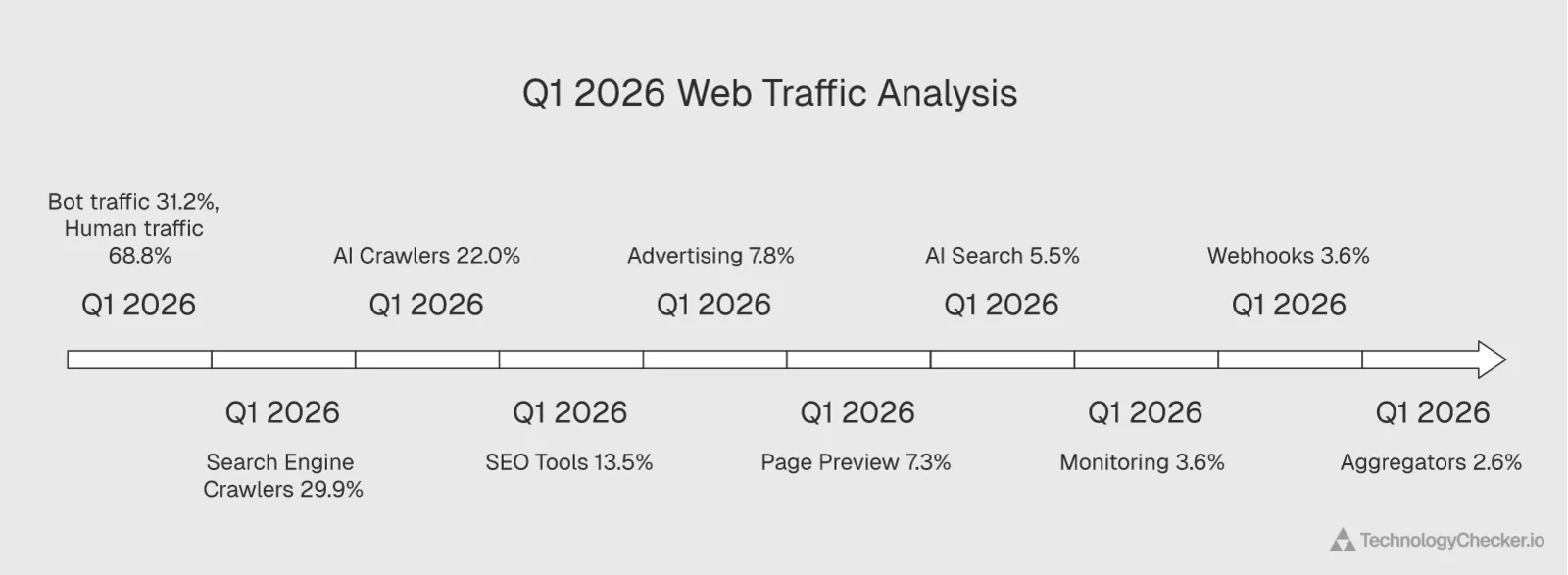
Nearly one in three HTTP requests hitting websites right now is non-human. According to Cloudflare Radar's HTTP analytics, 31.2% of all requests in the past 30 days were classified as bot traffic — up from 30.9% in the prior period.
| Traffic class | Current period | Previous period | Change |
|---|---|---|---|
| Bot | 31.19% | 30.93% | +0.26 pts |
| Human | 68.81% | 69.07% | -0.26 pts |
That 0.26-point shift looks small in isolation. It's not. Extrapolated across Cloudflare's 81 million requests per second, it means roughly 210,000 additional bot requests per second compared to last month.
May 2026 update: Bot share climbed again in May to 32.58%, with humans at 67.42% — up 1.39 points from Q1 across two months. The human/bot crossover Cloudflare's CEO flagged for 2027 stays on schedule; the Q1-to-May pace adds on the order of 1.1 million more bot requests per second to Cloudflare's network.
Bot category breakdown
Within that 31.2%, the composition tells the real story:
| Bot category | Share of bot traffic |
|---|---|
| Search Engine Crawlers | 29.9% |
| AI Crawlers | 22.0% |
| SEO Tools | 13.5% |
| Advertising & Marketing | 7.8% |
| Page Preview | 7.3% |
| AI Search | 5.5% |
| Monitoring & Analytics | 3.6% |
| Webhooks | 3.6% |
| Aggregators | 2.6% |
AI crawlers are now the second-largest bot category, behind only traditional search engine crawlers. Combined with AI Search bots (5.5%), AI-related traffic accounts for 27.5% of all bot traffic. That share grows every month.
May 2026 update: The AI Crawler category settled at 20.3% in May — down from Q1's 22.0% but up from April's 19.9% — with AI Search bots at 6.5%. Combined AI traffic share of bots was 26.7%, within a point of Q1. Search Engine Crawlers held at 30.5%. The category isn't retreating; the real movement is inside it, where Bytespider surged into the top four (see the user-agent table below).
Why this matters: If you're running a web application and not accounting for bot traffic in your analytics, capacity planning, and security posture, you're making decisions based on data that's at least 30% noise. Your "users" metric is inflated. Your server costs include bots you may not want to serve. And your conversion funnel math is wrong.
What to do with this insight: Audit your analytics platform for bot filtering. Most tools don't separate bot traffic by default, which means your traffic dashboards overcount real users by roughly a third. For SaaS teams, this directly affects unit economics: if your cost-per-visit is rising (Contentsquare reports it's up 9% year over year and 30% over three years), part of that increase is bots consuming resources meant for humans.
External context: According to TechCrunch, Cloudflare's CEO has stated that online bot traffic will exceed human traffic by 2027. Our month-over-month data confirms this trajectory is on track.
The bot traffic trajectory: 2019 to 2026
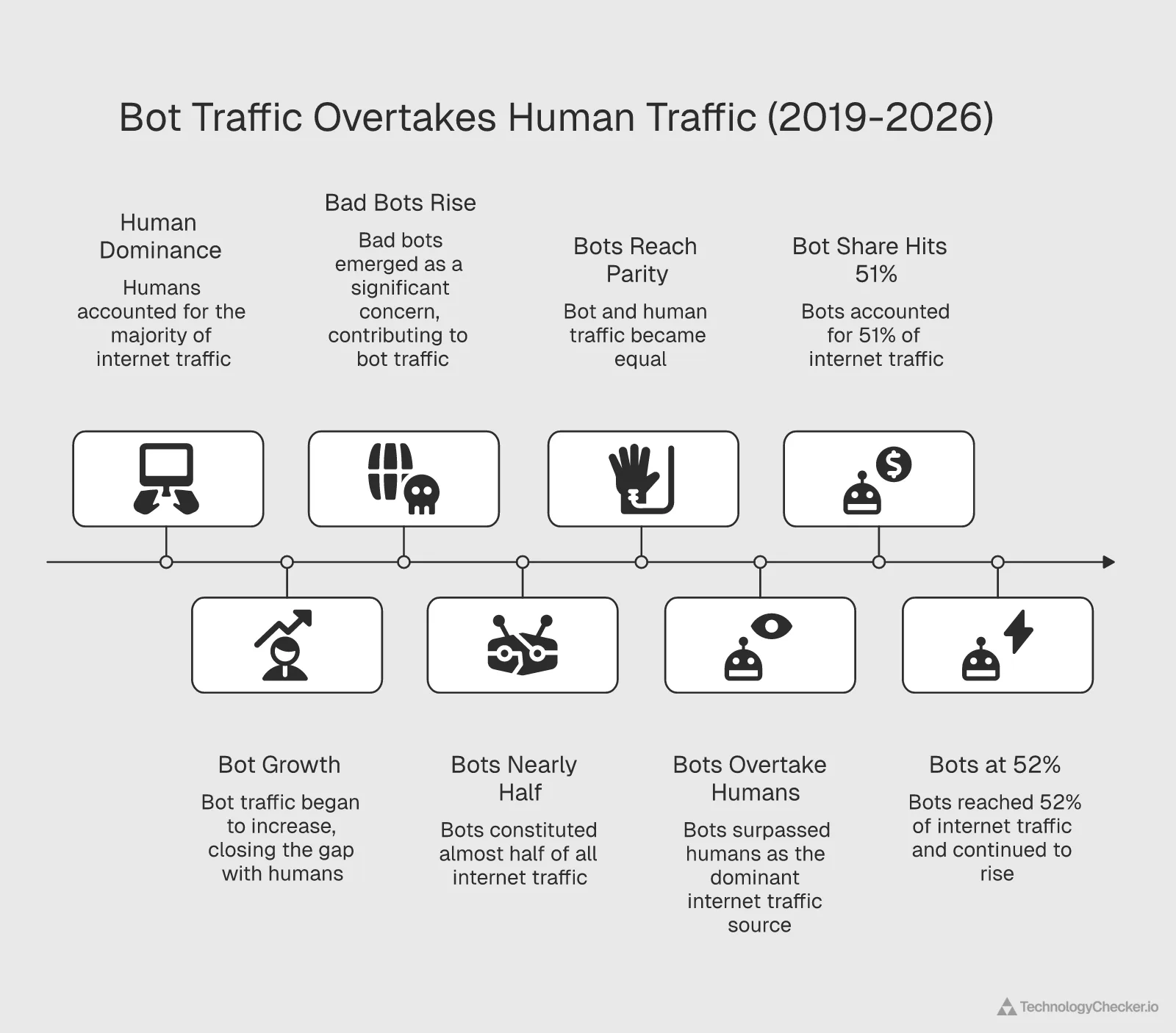
This isn't a sudden shift. Bot traffic has been climbing steadily for seven years. According to HUMAN Security's 2026 State of AI Traffic report, bots now account for 51-52% of all global web traffic, having crossed the 50% threshold for the first time in 2024. AI bot traffic specifically grew 187% from January to December 2025, while human traffic grew just 3.1%.
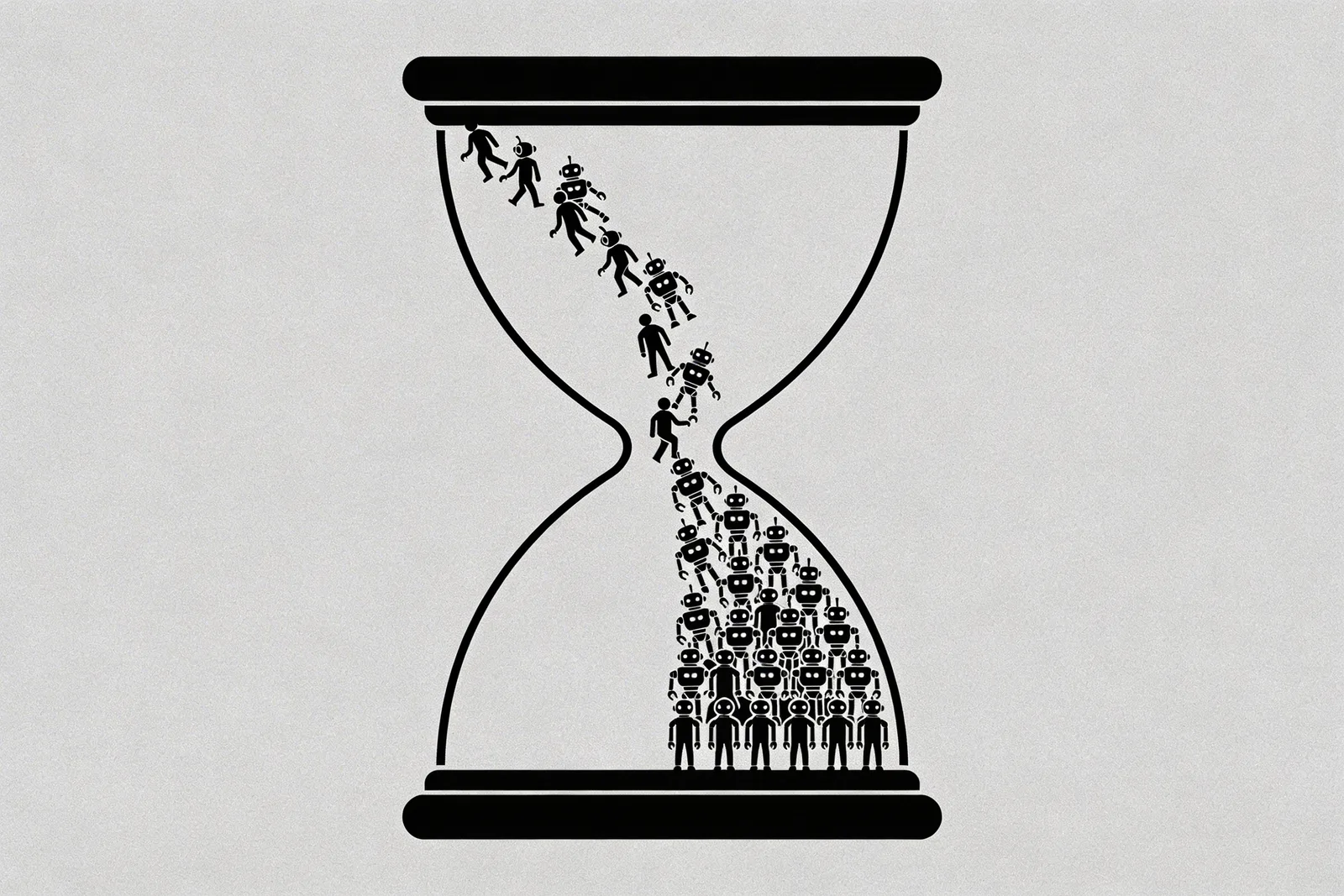
The composition of that bot traffic is also changing. Training crawlers declined from 90% to 74% of all AI-driven traffic during 2025, while scraper bots rose from 10% to 24%, and a new category — agentic bots performing autonomous tasks — emerged at 1.7%. HUMAN Security reports that OpenAI's bots alone account for approximately 69% of all AI-driven traffic by volume.
AI Crawlers Now 22% of Bot Traffic and Growing Fast
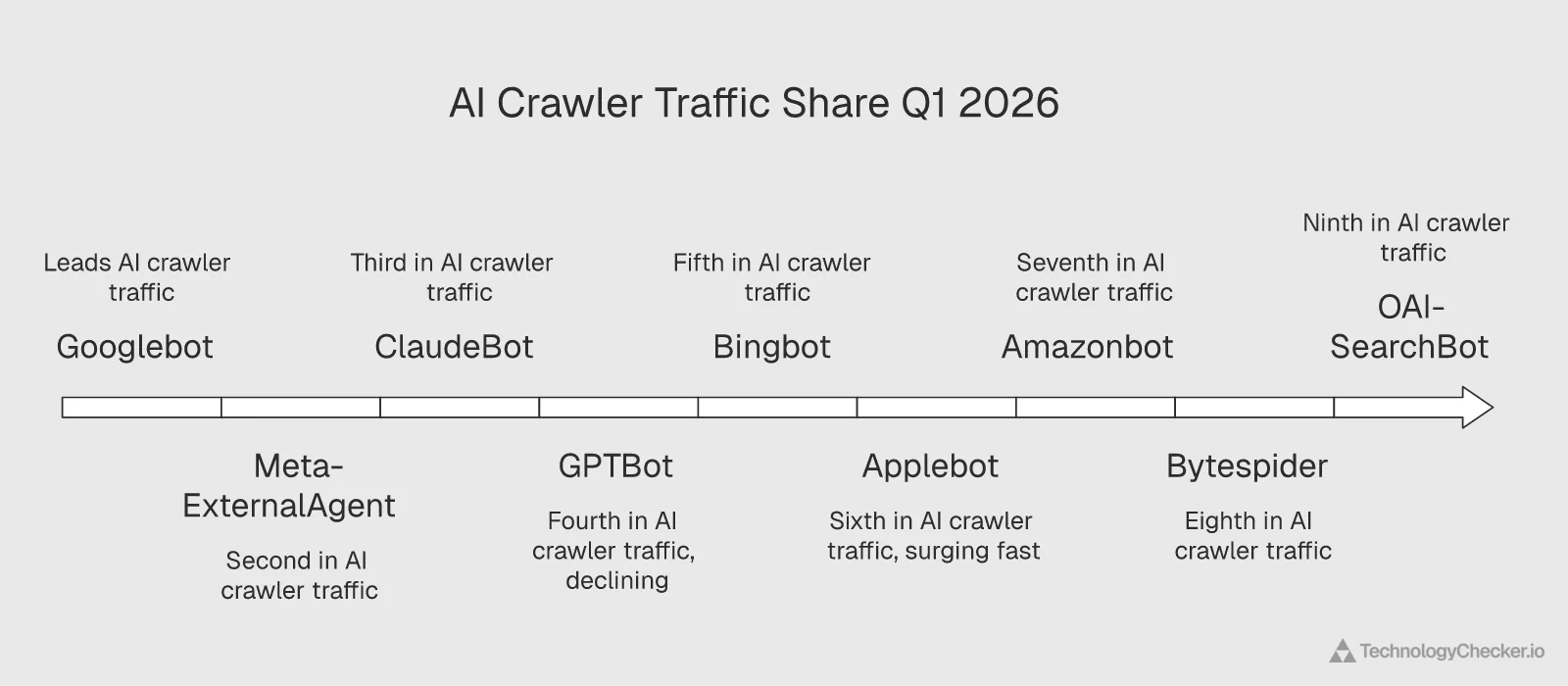
AI crawlers are the fastest-growing bot category on the internet. They've risen from a negligible share two years ago to 22% of all bot traffic in Q1 2026, overtaking SEO tools, advertising bots, and every other category except traditional search engines.
Here's the full AI crawler user agent breakdown with month-over-month trends:
| AI crawler | Current share | Previous month | Change |
|---|---|---|---|
| Googlebot | 31.73% | 34.76% | -3.04 pts |
| Meta-ExternalAgent | 16.29% | 15.21% | +1.08 pts |
| ClaudeBot | 11.78% | 10.95% | +0.83 pts |
| GPTBot | 11.05% | 12.13% | -1.08 pts |
| Bingbot | 7.99% | 9.31% | -1.32 pts |
| Applebot | 7.15% | 2.97% | +4.17 pts |
| Amazonbot | 4.21% | 5.30% | -1.09 pts |
| Bytespider | 3.83% | 3.29% | +0.54 pts |
| OAI-SearchBot | 2.13% | 2.58% | -0.45 pts |
May 2026 update — the leaderboard reshuffled: Bytespider surged to 10.25% (+4.5 pts from April) to become the #4 crawler, GPTBot recovered to 11.48% and reclaimed a clear lead over ClaudeBot (9.73%), and Applebot gave back its April spike, easing to 7.01%. Googlebot (27.26%) and Meta-ExternalAgent (13.23%) hold #1 and #2. The April projection that Applebot would crack the top three did not pan out — Bytespider took the riser crown instead, and the two Anthropic agents (ClaudeBot 9.73% + Claude-SearchBot 2.22%) now sit just behind GPTBot.
Meta-ExternalAgent quietly became the #2 AI crawler. It's been climbing steadily and now sits at 16.29%, ahead of both ClaudeBot (11.78%) and GPTBot (11.05%). Meta's AI ambitions — Llama model training, AI-powered features across Instagram, WhatsApp, and Facebook — require enormous volumes of web data. This crawler is doing the heavy lifting.
GPTBot is declining in share even as it remains the most-blocked. GPTBot dropped from 12.13% to 11.05% while still being disallowed by more domains than any other AI crawler. That's a meaningful tension: OpenAI's crawler faces the most resistance but is also losing relative share to faster-growing competitors.
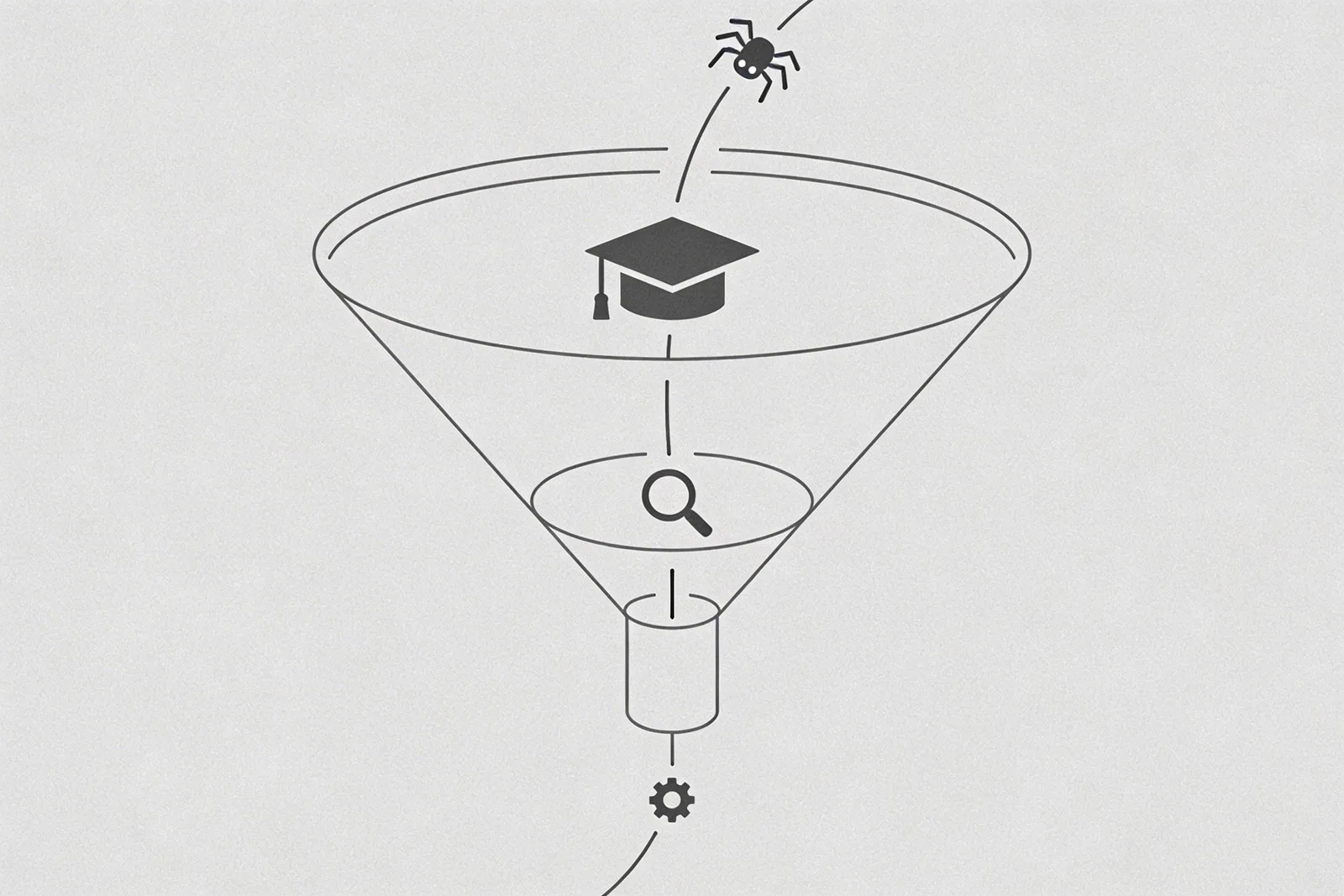
What to do with this insight: Review your robots.txt and rate-limiting rules for AI crawlers quarterly, not annually. The crawler environment changes too fast for a set-and-forget approach. We published a detailed breakdown in our AI crawlers blocking report covering which crawlers to watch and how to configure access.
External context: According to SEOmator, AI search traffic went up 527% in a year, and roughly 60% of searches now yield no clicks. The crawling we're seeing at the infrastructure level is the supply side of that equation: AI systems consuming web content at scale to power zero-click answers.
Applebot Surge and the Most-Blocked AI Crawlers

Applebot surged 140% in a single month, jumping from 2.97% to 7.15% of AI crawler traffic. That kind of crawling acceleration typically signals a product launch or a major feature expansion.
The Applebot spike
This wasn't a gradual climb. Applebot vaulted past Amazonbot, Bytespider, and OAI-SearchBot in a single 30-day period. Given Apple's ongoing investment in Apple Intelligence and on-device AI features that need web-sourced training data, this surge makes sense. Safari's AI-powered summaries, Siri's expanding web answers, and Apple's partnership with OpenAI all require fresh, high-quality web content.
If you're a content publisher and haven't reviewed your robots.txt rules for Applebot recently, now's the time. Unlike GPTBot (which many sites have already evaluated), Applebot flew under the radar for most of 2025. That window is closing.
May 2026 update — the surge reversed. Applebot's climb did not hold. In May it eased to 7.01% of AI crawler traffic, round-tripping almost exactly to its Q1 level (7.15%) and slipping back behind Bingbot (8.45%). Our April projection that Applebot would become a top-three crawler in May was wrong. The crawler that actually surged was ByteDance's Bytespider, which jumped to 10.25% and took the #4 spot. The lesson stands: single-month crawler spikes are a poor basis for projection.
Who's blocking whom: the robots.txt arms race
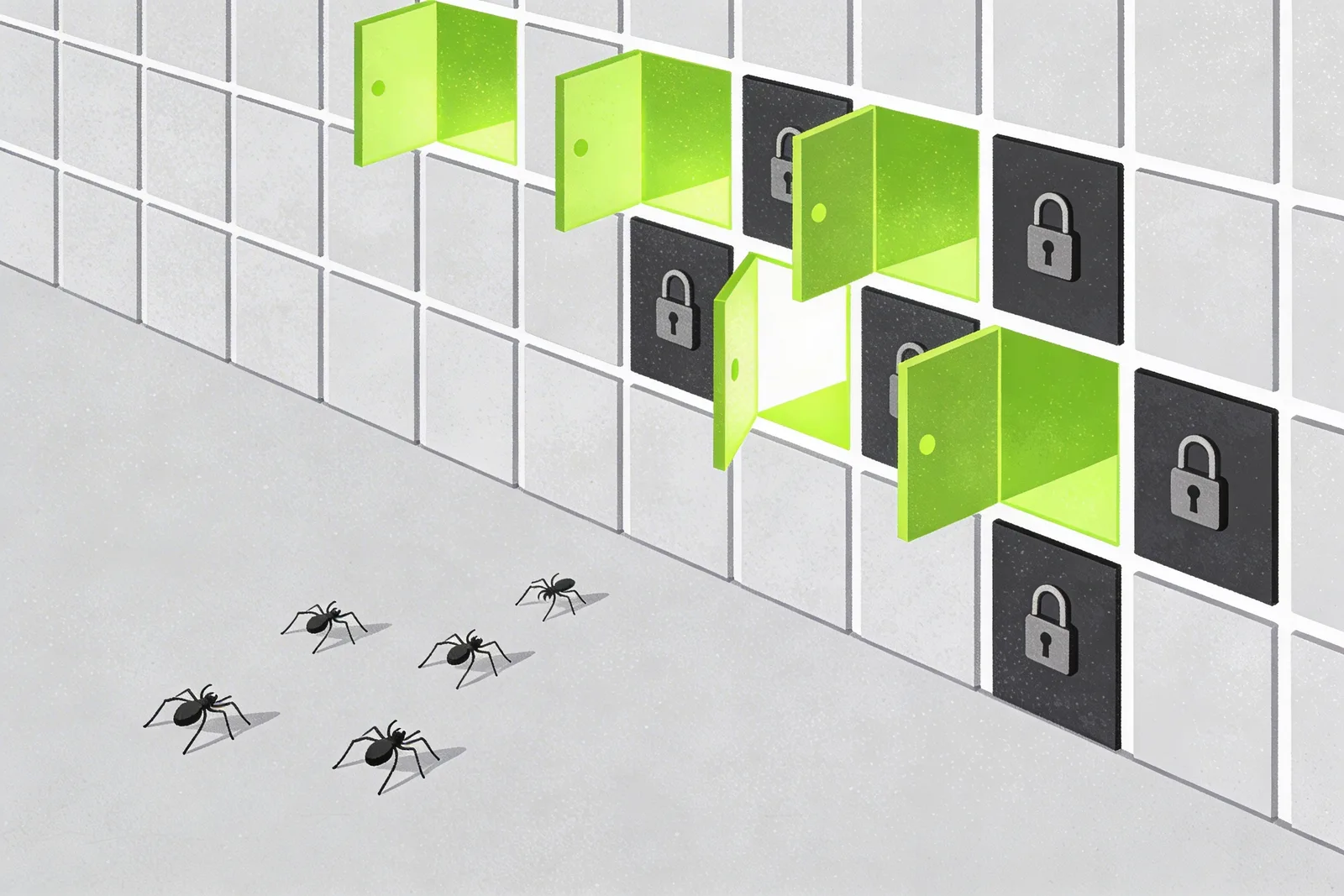
According to Cloudflare Radar's robots.txt analysis of 4,055 domains, the most-disallowed AI crawlers are:
| AI crawler | Domains blocking | Fully blocked | Partially blocked |
|---|---|---|---|
| GPTBot | 476 (11.7%) | 365 | 111 |
| CCBot | 426 (10.5%) | 361 | 65 |
| ClaudeBot | 407 (10.0%) | 324 | 83 |
| Google-Extended | 378 (9.3%) | 299 | 79 |
| Bytespider | 350 (8.6%) | 306 | 44 |
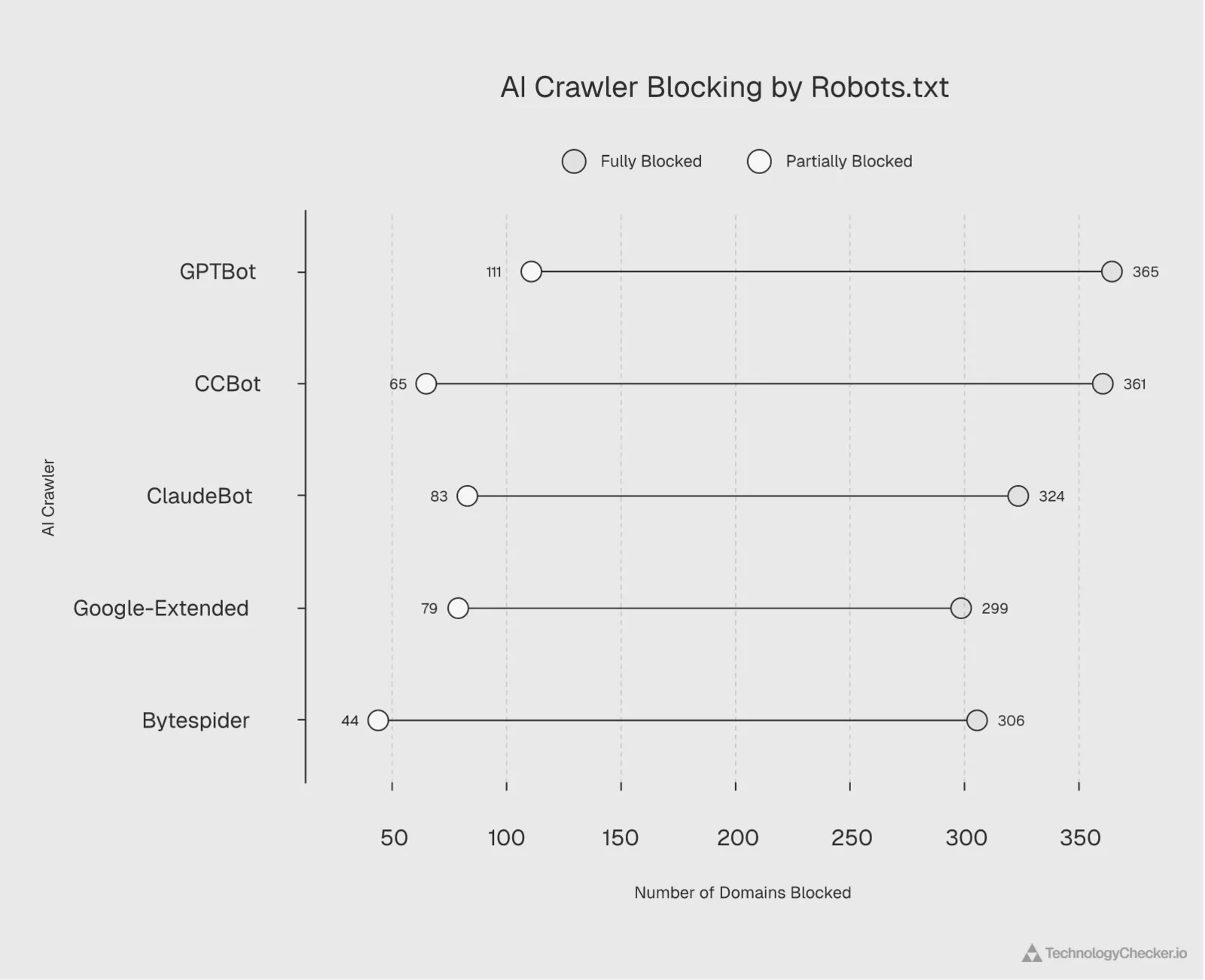
GPTBot is blocked by 11.7% of analyzed domains — the highest of any AI crawler. But the gap is narrowing. All five major AI crawlers are now blocked by roughly 9-12% of websites.
The ratio of full to partial blocking tells a deeper story. Bytespider has the highest full-block rate (87.4% of its blocks are full disallows), suggesting that site operators who block ByteDance's crawler tend to block it entirely. GPTBot sees more partial blocking (23.3%), meaning some publishers allow OpenAI to crawl specific paths while restricting others.
What to do with this insight: Check whether your robots.txt distinguishes between AI training crawlers and AI search crawlers. Blocking GPTBot also blocks OAI-SearchBot from indexing your content for ChatGPT Search, which could mean losing a growing traffic source. Consider partial rules that allow search access while restricting training data collection.
External context: According to Digital Bloom's 2026 organic traffic report, 60% of searches ended without a click, and mobile zero-click behavior reached 77%. For publishers already losing organic clicks, blocking AI crawlers entirely may accelerate traffic decline by removing visibility from AI-powered search results.
Security Metrics: Credential Stuffing and Phishing Trends
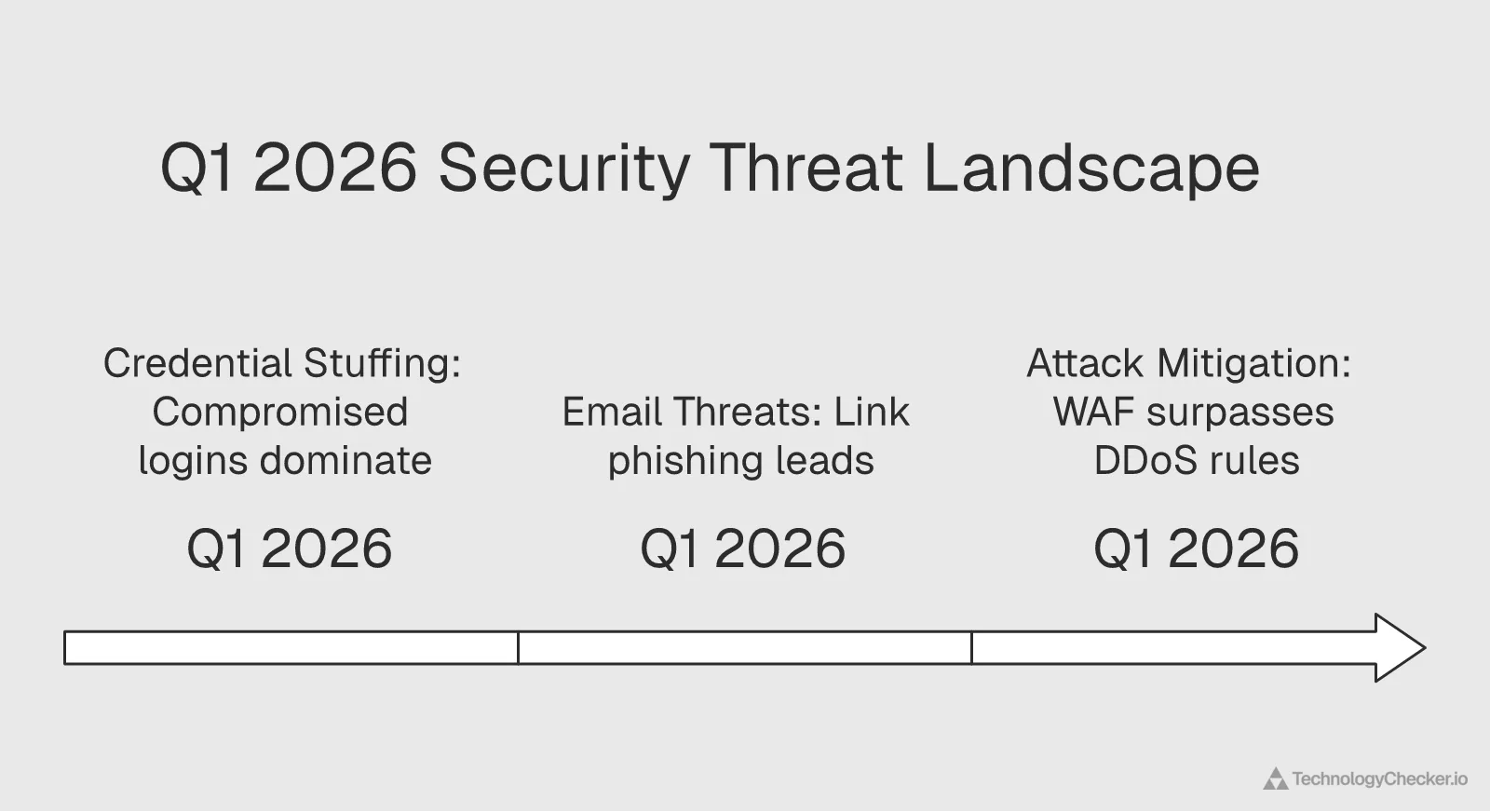
Six out of every ten login attempts on the internet use passwords that have already been exposed in data breaches. According to Cloudflare Radar's credential leak detection, 60.3% of all HTTP authentication requests in the past 30 days used credentials from known breach databases.
| Status | Current period | Previous period | Change |
|---|---|---|---|
| Compromised | 60.25% | 63.51% | -3.26 pts |
| Clean | 39.75% | 36.49% | +3.26 pts |
The good news: the compromised rate dropped 3.26 percentage points month-over-month, the first meaningful improvement we've seen. The bad news: malicious login attempts using leaked credentials remain the norm, not the exception. This is credential stuffing at industrial scale.
May 2026 update: Compromised credentials fell more sharply in May to 56.96% — a 2.55-point drop and the third consecutive month of improvement, the steepest of the three. Three months of decline is a trend, not noise. The most plausible explanation is the rolling effect of passkey defaults shipping across major identity providers. Even so, with more than half of all login attempts still using leaked credentials, credential stuffing remains the operational baseline, not a fringe attack pattern.
Why this matters: If you're running a login form without rate limiting, bot detection, or compromised credential checking, these numbers are your wake-up call. The majority of authentication traffic hitting your application isn't humans trying to log in. It's automated tools cycling through leaked databases.
Email threat breakdown
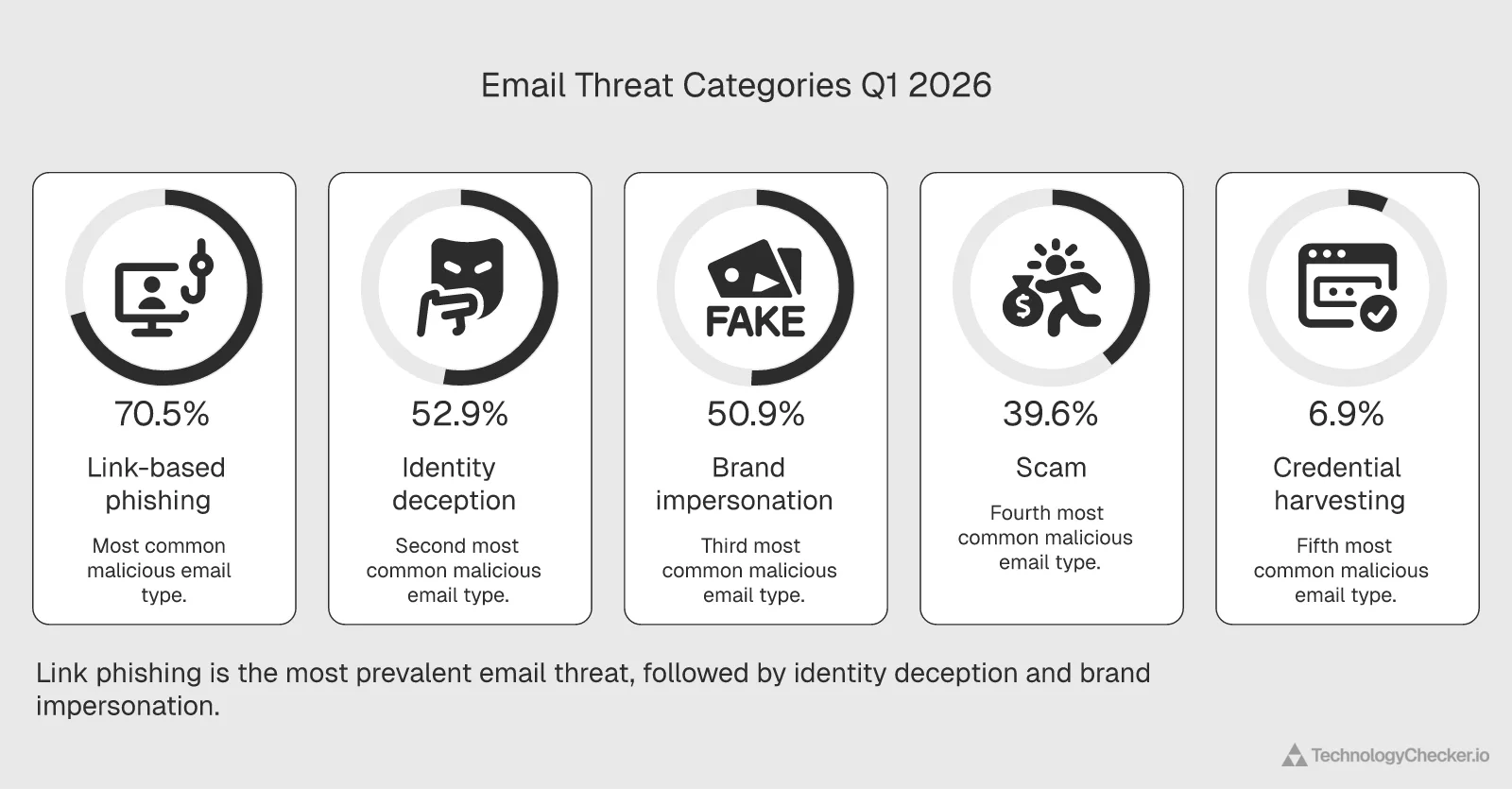
Cloudflare Radar Email Security Analytics show the top threat categories in malicious email for Q1 2026:
| Threat type | % of malicious email |
|---|---|
| Link-based phishing | 70.5% |
| Domain age abuse | 53.2% |
| Identity deception | 52.9% |
| Brand impersonation | 50.9% |
| Scam | 39.6% |
| Credential harvesting | 6.9% |
Percentages overlap because a single malicious message can trigger multiple threat categories. Seven out of ten malicious emails contain a deceptive link. More than half exploit newly registered domains or impersonate a known identity or brand.
May 2026 update — the email threat profile escalated further:
Threat type Q1 2026 May 2026 Δ Link-based phishing 70.5% 79.58% +9.1 pts Scam 39.6% 67.21% +27.6 pts Identity deception 52.9% 64.67% +11.8 pts Brand impersonation 50.9% 63.72% +12.8 pts Domain age abuse 53.2% 51.04% -2.2 pts Nearly every threat category rose together between Q1 and May, with link phishing crossing 79% and scam flags up more than 27 points. One honest caveat: these categories overlap (a single message can trip several), so a uniform across-the-board jump of this magnitude can reflect classifier recalibration as much as a real surge in attack volume. Treat the direction as solid and the exact magnitudes as approximate. Either way, your Q2 inbox is materially noisier than Q1's, and the link-phishing assumption in particular is worth re-checking before you size security-awareness budgets off the Q1 numbers.
These numbers validate what our email authentication analysis revealed: email infrastructure has a systemic security gap. We found that 50.12% of encrypted email traffic still uses deprecated TLS 1.0 or 1.1. Combined with the phishing rates above, email remains the weakest link in most organizations' security posture.
DDoS and application attack shifts
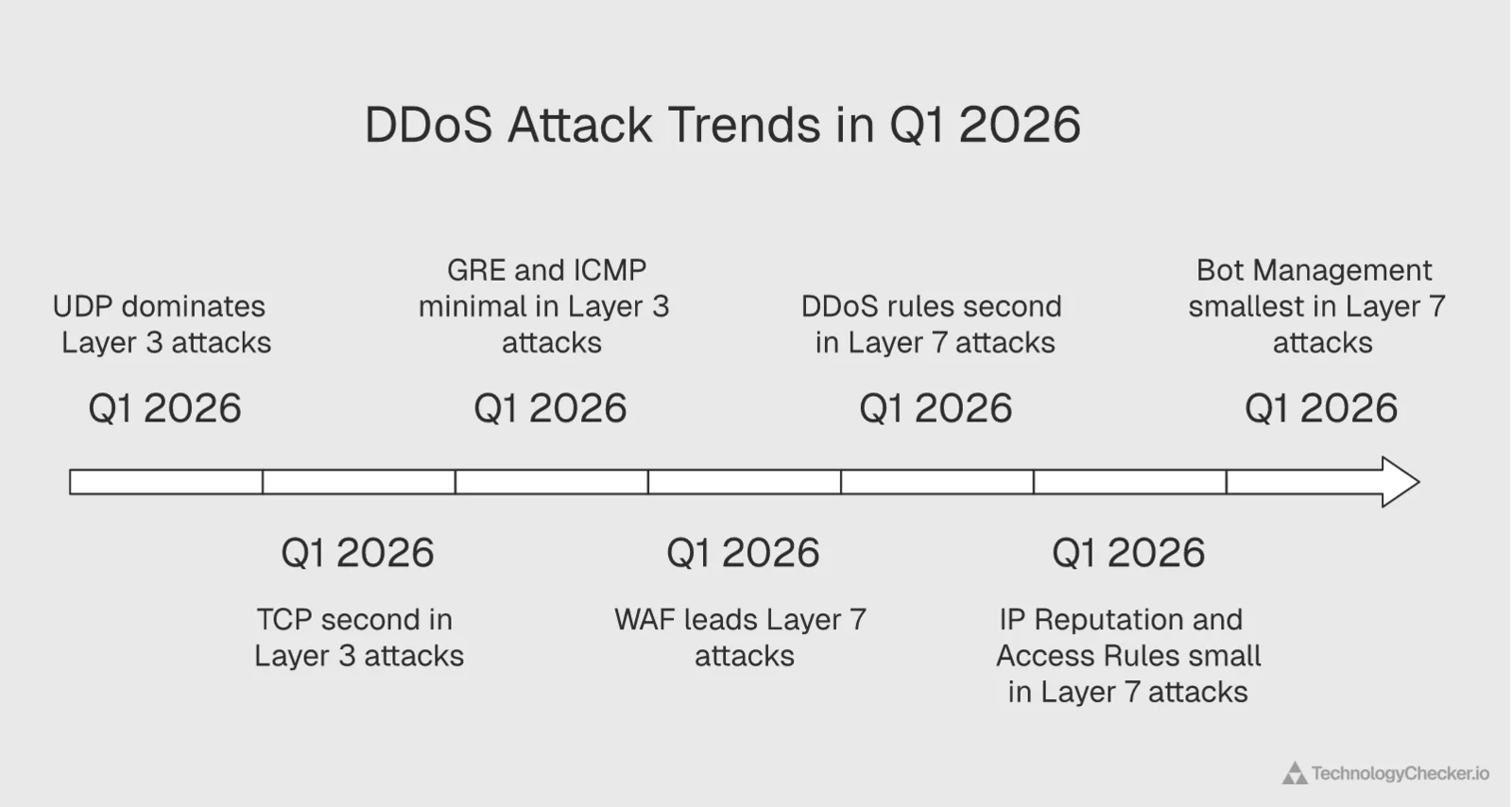
At the network layer, UDP flood attacks dominate L3 DDoS at 78%, with TCP at 21.3%. UDP's connectionless nature makes it the path of least resistance for volumetric attacks — spoofed source IPs and amplification through open resolvers without completing a handshake.
At the application layer, a quiet but significant shift: WAF now mitigates more L7 attacks than DDoS-specific rules. WAF handles 51.9% of application-layer mitigations versus 43.2% for DDoS rules. This reflects the evolution of attacks from pure volumetric floods to more sophisticated exploits — SQL injection, XSS, and API abuse that require signature-based detection.
What to do with this insight: Prioritize WAF configuration over pure rate limiting for application-layer defense. If your security stack relies primarily on DDoS mitigation, you're defending against last year's attack profile. The attack surface has shifted to application logic exploits.
May 2026 update — WAF retook the L7 lead; UDP got more dominant at L3: L3 UDP attacks climbed again to 85.24% of L3 volume (up ~5 points from April). At L7 the mitigation mix flipped back to Q1's order — WAF reclaimed #1 at 50.95% while DDoS rules eased to 44.22%.
L7 mitigation Q1 2026 April 2026 May 2026 WAF 51.9% 45.9% 50.95% DDoS rules 43.2% 49.3% 44.22% Access rules — 2.0% 2.52% IP reputation — 2.1% 1.78% Translation: the volumetric application-layer wave that favored DDoS rules in April receded in May, and signature-detectable exploits — WAF's domain — were back on top. The lead has now changed hands three times across Q1 → April → May, which is itself the takeaway: keep both layers tuned and don't deprecate either on a single month's read.
Protocol Adoption: TLS 1.3, HTTP/3, and IPv6 in 2026

Modern TLS now carries 93.7% of all web traffic — effectively the standard for the browseable internet.
TLS version distribution
| Protocol | Current share |
|---|---|
| TLS 1.3 | 71.6% |
| TLS QUIC | 22.2% |
| TLS 1.2 | 6.3% |
| TLS 1.0 | 0.015% |
| TLS 1.1 | 0.002% |
TLS 1.2 is down to 6.3% and dropping. TLS 1.0 and 1.1 are essentially extinct for web traffic at 0.017% combined. This is the web. Email is a different story entirely — our DMARC adoption statistics analysis found that 50.12% of encrypted email traffic still uses deprecated TLS 1.0 or 1.1. If you want a single metric that captures the gap between "the internet we browse" and "the internet that delivers our mail," TLS version distribution is it.
HTTP version adoption
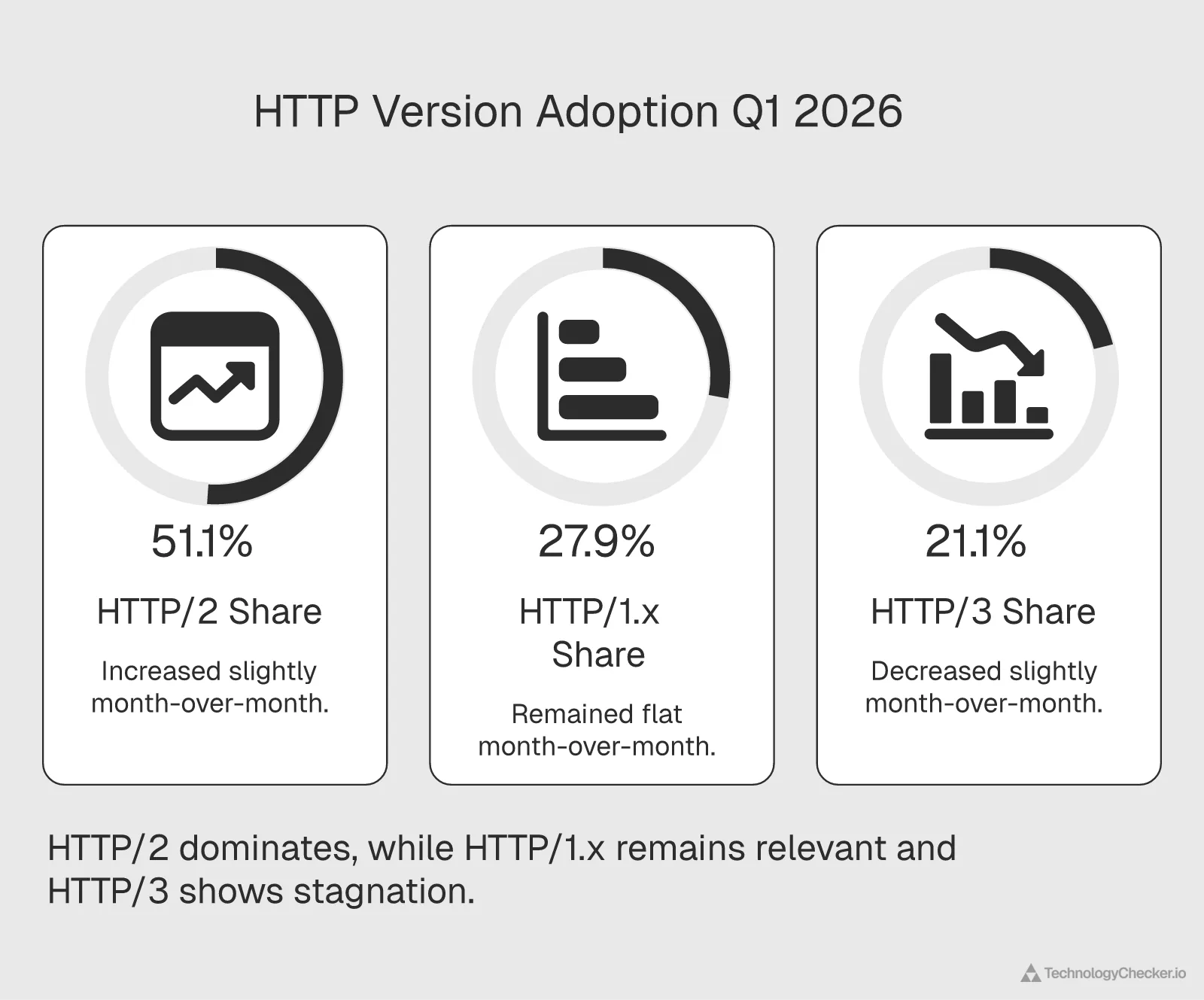
| HTTP version | Current | Previous month | Change |
|---|---|---|---|
| HTTP/2 | 51.1% | 50.5% | +0.52 pts |
| HTTP/1.x | 27.9% | 27.9% | flat |
| HTTP/3 | 21.1% | 21.6% | -0.50 pts |
HTTP/3 dipped slightly this month, from 21.6% to 21.1%. HTTP/2 picked up the share. This isn't cause for alarm — HTTP/3 adoption fluctuates based on CDN rollouts and client updates — but it does suggest the protocol has hit a temporary plateau around the 21% mark. For a deeper dive into these trends, see our HTTP protocol adoption trends analysis.
May 2026 update: The plateau extended into a fourth consecutive month — HTTP/2 51.1%, HTTP/1.x 27.7%, HTTP/3 21.2%. HTTP/3 has now held within a 0.6-point band for four straight months. Whatever breaks the protocol toward 30% still has not arrived.
⚠️ Superseded by the August 2026 update near the top of this report, preserved as originally published: the plateau broke, and it broke downward. HTTP/3 fell to 19.84% in July 2026 against 21.64% in July 2025, with every week of July under 20%. HTTP/2 took the share at 52.27%. Source: Cloudflare Radar — http/summary/http_version, July 1–31 2026 and July 1–31 2025.
The jump to 30% will likely require broader server-side adoption beyond Cloudflare, Google, and the major CDNs. AWS CloudFront and major hosting providers are the next catalysts.
DNS query distribution
From Cloudflare's 1.1.1.1 resolver data:
| Query type | Share |
|---|---|
| A (IPv4) | 60.4% |
| AAAA (IPv6) | 20.4% |
| HTTPS | 7.4% |
| ANY | 4.3% |
| PTR | 4.1% |
IPv6 DNS queries represent 1 in 5 lookups. That's meaningful adoption but still well behind IPv4's 3:1 dominance. The HTTPS record type at 7.4% is worth watching — it lets clients discover HTTPS support and HTTP/3 availability directly from DNS, cutting connection setup time.
What to do with this insight: If you haven't migrated to TLS 1.3 yet, you're in a 6.3% minority. Most CDNs and modern hosting platforms handle TLS 1.3 by default. The bigger question is HTTP/3: enabling it requires QUIC support on your origin or CDN. For Cloudflare technology profile users, it's a toggle. For self-hosted infrastructure, it's a more involved upgrade.
External context: According to Network World, global internet traffic surged 17% year over year, with post-quantum cryptography adoption accelerating alongside the TLS 1.3 migration we're tracking here.
Certificate Trends and Let's Encrypt Dominance

ECDSA certificates now account for 44.9% of all SSL/TLS certificates issued globally, closing the gap with RSA to just 10.2 percentage points.
Public key algorithm distribution
| Algorithm | Share of certificates issued |
|---|---|
| RSA | 55.1% |
| ECDSA | 44.9% |
ECDSA offers smaller key sizes, faster handshakes, and equivalent security. The technical case has been settled for years. The remaining RSA majority is largely inertia: legacy systems and certificate management platforms that default to RSA key generation.
May 2026 update — ECDSA crossed RSA: It happened. In May, ECDSA became the majority public-key algorithm among newly issued certificates for the first time.
Algorithm Q1 2026 April 2026 May 2026 ECDSA 44.9% 49.0% 50.21% RSA 55.1% 51.0% 49.79% The crossover the April update projected for Q2 landed in May. The swing continues to come from ECDSA-default issuance across managed platforms — Let's Encrypt's ECDSA intermediates plus a fast-growing ZeroSSL ECC line are now issuing at parity with the legacy RSA intermediates. A 0.4-point lead is a crossover, not a rout: RSA isn't disappearing, but ECDSA-first is now the default behavior of the automated CA layer.
⚠️ Superseded by the August 2026 update near the top of this report, preserved as originally published, and wrong on both counts. Cloudflare revised the May figure to 48.53% ECDSA after we published, so no May crossover appears in current data, and RSA retook the lead outright in July 2026 at 50.30% against ECDSA's 49.70%. June (52.19% ECDSA) is the only month on current data with a clear ECDSA majority. Our sibling certificate transparency report carries the full correction. Source: Cloudflare Radar — ct/summary/public_key_algorithm, May, June and July 2026, queried August 1, 2026.
Top certificate authorities
| CA | Share |
|---|---|
| R13 (Let's Encrypt) | 16.7% |
| R12 (Let's Encrypt) | 16.6% |
| WE1 (WE Encrypt) | 13.1% |
| E8 (Let's Encrypt ECDSA) | 10.0% |
Let's Encrypt intermediates (R13 + R12 + E8) collectively issue 43.3% of all certificates logged in Certificate Transparency. That's a remarkable market position for a free, automated CA. The E8 intermediate, which issues ECDSA-only certificates, accounts for 10% on its own — evidence that ECDSA adoption is being driven partly by Let's Encrypt's default configurations.
For more on how certificate issuance patterns affect technology detection and security posture, see our certificate transparency report.
What to do with this insight: If you're still generating RSA certificates manually, switch to ECDSA through your CA or certificate manager. ECDSA's smaller key sizes reduce TLS handshake latency measurably — a benefit for both user experience and search rankings. Let's Encrypt's ACME protocol automates renewal entirely, eliminating certificate expiration as a failure mode.
What These 2026 Web Traffic Statistics Mean for SaaS Teams

The web traffic statistics in this report point to three operational shifts that B2B SaaS teams should account for in 2026.
Your traffic numbers are inflated
With 31.2% of all traffic being bots, your analytics dashboards almost certainly overcount real users. Contentsquare reports that 59% of sites saw traffic decline in 2025, while cost per visit rose 9% year over year. Part of that rising cost is bots consuming resources meant for humans. If you haven't implemented bot filtering in your analytics and capacity planning, your unit economics are off by roughly a third.
AI is reshaping traffic sources
Contentsquare tracked a 632% increase in AI-referred traffic year over year, though it still represents just 0.2% of total traffic. That share is tiny now, but the crawling activity we're measuring at the infrastructure level — AI crawlers at 22% of bot traffic and rising — is the leading indicator. These crawlers are building the knowledge bases that will power the next generation of AI-driven referral traffic.
For more on how AI is reshaping technology adoption patterns, see our AI adoption trends analysis.
Security posture needs to catch up with traffic reality
60% of login attempts using leaked credentials. 70% of malicious email containing phishing links. WAF overtaking DDoS rules as the primary application defense layer. These aren't future risks. They're current operational conditions. If your security stack was configured more than six months ago, the attack profile has already changed.
Our cloud provider traffic analysis shows how infrastructure choices affect exposure to these threats, and our internet outage report covers the connectivity disruptions that compound security risks.
2026 Web Traffic Benchmarks at a Glance
| Benchmark | Value | Source | Notes |
|---|---|---|---|
| Bot traffic share | 33.2% | Our Cloudflare Radar data | Q2 2026; up from 30.5% in Q1 and 30.4% a year ago |
| AI crawler share of bots | 19.1% | Our Cloudflare Radar data | Q2 2026; second-largest bot category behind search crawlers |
| Credential stuffing rate | 57.4% | Our Cloudflare Radar data | Q2 2026; down from 63.5% in Q1, of logins Cloudflare inspects |
| Modern TLS adoption | 93.9% | Our Cloudflare Radar data | Q2 2026; TLS 1.3 + QUIC combined, up 3.2 pt YoY |
| HTTP/3 adoption | 21.0% | Our Cloudflare Radar data | Q2 2026; fell to 19.84% in July 2026, below 20% and down 1.80 pt YoY |
| ECDSA share of new certs | 50.3% | Our Cloudflare Radar data | Q2 2026 as published; RSA retook the lead in July 2026 at 50.30% vs ECDSA 49.70%, and Cloudflare has since revised Q2 to 50.17% |
| Let's Encrypt certificate share | 56.7% | Our Cloudflare Radar data | Q2 2026; owner-level, all ISRG intermediates (down from 68.4% YoY) |
| Mobile traffic share | 63.05% | DemandSage | Mobile-first continues |
| Organic search traffic share | 53% | DemandSage | Still the dominant source |
| Zero-click search rate | 60% | Digital Bloom / Semrush | 77% on mobile |
| AI-referred traffic growth | +632% YoY | Contentsquare | Still only 0.2% of total |
| Global internet users | 5.65B (68.7%) | DemandSage | Up 1.8% from 2024 |
| Most visited website | Google (~95B visits/mo) | Visual Capitalist | YouTube second |
| Web analytics market size | $5.2B (2026) | Piwik Pro | CAGR 17.6% through 2032 |
| AI-referred bounce rate | 53.6% | Contentsquare | Just behind social/paid |
| Mobile bounce rate increase | +54% in 2025 | Figma | Half of mobile users exit after one page |
The Radar rows above are the Q2 2026 calendar quarter, kept as a dated snapshot. For Q3 2026 values on the same fifteen metrics, against Q2 2026 and Q3 2025, see the Q3 2026 analysis at the top of this report. The third-party rows are unchanged and carry their original publication dates.
Frequently Asked Questions
How much of web traffic is bots in 2026?
In Q3 2026, 35.49% of all HTTP requests were classified as bot traffic, up from 33.21% in Q2 2026 and 30.13% in Q3 2025, according to Cloudflare Radar. September alone read 36.15% (provisional), after a step late in the month that we treat as provisional until October confirms it. Within verified bots, AI crawlers were 22.12% and search-engine crawlers 26.14% of bot traffic in Q3. Cloudflare's CEO has said bot traffic will pass human traffic by 2027; at the pace of the last twelve months (+5.36 points) the series is not on course to reach 50% by then. Our bot traffic report carries the full breakdown.
Is 50% of internet traffic AI?
No. Internet traffic is NOT half AI on Cloudflare's measurement: every kind of automated request combined was 35.49% of HTTP requests in Q3 2026, and AI crawlers, AI search fetchers and AI assistants are only part of that automated share. The bot traffic report covers where the "half of traffic" figures in circulation come from.
Which AI crawler is growing fastest in 2026?
It changes every quarter, which is the real answer, but the bigger 2026 story is the crawler whose share is falling. Googlebot's share of AI-bot traffic fell from 41.94% in Q3 2025 to 23.80% in Q3 2026 as the field diversified. Anthropic's ClaudeBot held 13.23% in Q3 2026, up from 10.26% a year earlier. Earlier in the year Applebot and then Bytespider each spiked and reversed, which is the standing lesson here: single-quarter crawler spikes are a poor basis for projection. Source: Cloudflare Radar, ai/bots/summary/user_agent, Q3 2025 and Q3 2026.
Is desktop or mobile winning web traffic in 2026?
It depends entirely on whether you count bots. Cloudflare's all-traffic device split shows desktop leading at 60.41% in Q3 2026, up from 54.26% in Q3 2025, but that number is bot-inflated because automated traffic mostly identifies as desktop. Filter to human traffic only and mobile leads at 54.36%, with desktop at 45.62%, though mobile's human share is down from 56.53% a year earlier. So mobile still wins among real people, and the "desktop is winning" headline is mostly the bot-traffic story in disguise. Always name the population when you cite a device split. Source: Cloudflare Radar, http/summary/device_type, all traffic and botClass=LIKELY_HUMAN, Q3 2025 and Q3 2026.
Did ECDSA overtake RSA for SSL certificates in 2026?
They are now level. ECDSA was 50.11% of certificate records logged in Certificate Transparency in Q3 2026, against 27.73% in Q3 2025, so the year-over-year shift is large and real. Month to month the lead has changed hands several times, and Cloudflare has revised several of the months we published, including the May 2026 "crossover" we later withdrew. Our certificate transparency report tracks the issuer-by-issuer detail and the corrections.
Which company's bot crawls the web the most in 2026?
Google, by a shrinking margin. Google's bots were 26.91% of verified-bot traffic in Q3 2026, down from 38.29% in Q3 2025. Meta was second at 17.06%, Anthropic third at 8.84% (it was outside the top nine a year earlier) and OpenAI fourth at 5.64%. On the blocking side, GPTBot remains the most-disallowed crawler in robots.txt files. Source: Cloudflare Radar, bots/summary/bot_operator, Q3 2025 and Q3 2026.
Did HTTP/3 adoption go backwards in 2026?
Yes. HTTP/3 carried 20.17% of requests in Q3 2026, down from 22.98% in Q3 2025, and September 2026 (19.83%, provisional) was the first month of the year below 20% on Cloudflare's revised series. Cloudflare revised its HTTP version history in October 2026, so figures we published earlier (including 19.84% for July) no longer match; the decline holds on the revised data. Source: Cloudflare Radar, http/summary/http_version.
What is AI crawling actually for in 2026?
Training accounted for 47.62% of declared AI crawl purpose in Q3 2026, against 40.82% in Q3 2025, while Mixed Purpose fell from 55.59% to 38.86% and Search rose from 1.32% to 8.26%. Cloudflare reclassified this series in October 2026, moving volume from Search to Training across its whole history, so the figures earlier editions of this report published for June to August read differently now. Source: Cloudflare Radar, ai/bots/summary/crawl_purpose, Q3 2025 and Q3 2026.
How often do crawlers get refused in 2026?
More than a third of the time. In Q3 2026, 37.26% of crawler requests returned 4xx and only 46.68% returned 2xx, against 14.39% and 73.06% in Q3 2025. That aggregate refusal rate is a much larger signal than robots.txt blocking counts. Source: Cloudflare Radar, bots/crawlers/summary/response_status_category, Q3 2025 and Q3 2026.
What are the top 10 most visited websites in the world in 2026?
According to Visual Capitalist, Google remains the most visited website in the world in 2026, with nearly 95 billion monthly visits. YouTube ranks second, reinforcing Alphabet's dominance over global internet traffic. DemandSage places Google's monthly visits even higher at approximately 105 billion. The concentration of traffic at the top means these platforms are also the primary targets for the bot traffic and credential stuffing attacks we track — our Q3 2026 finding that 35.49% of requests are bots applies disproportionately to high-traffic properties.
What are the top 20 most visited websites in the world?
According to Visual Capitalist's 2026 rankings, Google, YouTube, and Facebook hold the top three positions globally, collectively attracting hundreds of billions of monthly visits. ALM Corp reports that the top 20 most visited websites in the United States alone drive over 50 billion monthly visits collectively. From our infrastructure perspective, this extreme concentration of attention makes these platforms prime targets for the security threats we measure: credential stuffing (57.4% of inspected login attempts in Q2 2026), link-based phishing (75.8% of malicious email), and growing AI crawler activity.
What We're Watching Next Month

Applebot trajectory. A 140% month-over-month surge demands follow-up. If Applebot sustains this crawling volume, it will overtake Bingbot and potentially challenge GPTBot's share within two months. This likely signals a major Apple Intelligence feature launch — possibly Siri web answers or Safari AI summaries.
April 2026 outcome — confirmed. Applebot rose to 9.23%, passing Bingbot and closing on GPTBot.
May 2026 outcome — reversed. The surge didn't hold. Applebot fell back to 7.01% (roughly its Q1 level) and slipped behind Bingbot (8.45%) again. May's real riser was Bytespider, jumping to 10.25% to take the #4 crawler spot. Our two-month projection was right; the third month wasn't — a reminder that crawler share is volatile.
July 2026 outcome — both risers gave it back. Applebot sat at 6.54% of AI-bot traffic in July, still behind Bingbot (8.92%). Bytespider, May's riser, fell to 5.14% from 7.65% in June. ClaudeBot leads the non-Google field at 16.28%. Two consecutive risers have now round-tripped, so we've stopped projecting individual crawlers entirely. Source: Cloudflare Radar —
ai/bots/summary/user_agent, July 1–31 2026.
AI crawler blocking rates. With GPTBot, CCBot, and ClaudeBot all blocked by roughly 10% of domains, we're approaching a tipping point. Will the blocking rate plateau, or will high-profile publisher lawsuits push it toward 20%? The next 90 days will tell.
April 2026 outcome — partially confirmed. GPTBot remained the most-disallowed AI user-agent, with CCBot, ClaudeBot, Google-Extended and Bytespider clustered behind it in the same order as Q1.
May 2026 outcome — ranking holds, rate keeps drifting up. As of June 1, GPTBot is disallowed by 529 of 4,072 analyzed domains (13.0%), with CCBot (463), ClaudeBot (457), Google-Extended (417), and Bytespider (395) behind it in the unchanged order. The blocking rate is creeping up — GPTBot is now blocked by ~13% of domains versus ~11.7% in Q1 — but there's still no step-change toward 20%.
July 2026 outcome — counts up, order shuffled below the top. As of the July 27, 2026 snapshot, GPTBot is disallowed by 768 domains, ClaudeBot by 680, Google-Extended by 639, CCBot by 622 and Bytespider by 550, with meta-externalagent (482), Applebot-Extended (465) and Amazonbot (462) now clustered just behind. Every count is up, ClaudeBot has moved ahead of CCBot, and GPTBot's lead is intact. Still no step-change. The sharper blocking signal this month isn't robots.txt at all: 35.79% of crawler requests were answered with a 4xx. Source: Cloudflare Radar —
robots_txt/top/user_agents/directive(snapshot endpoint, no date range; snapshot dated 2026-07-27) andbots/crawlers/summary/response_status_category, July 2026.
Credential stuffing direction. The 3.26-point drop in compromised credentials is the first meaningful improvement we've seen. Is this a trend or noise? If passkey adoption continues to accelerate across major identity providers, this number should decline further.
April 2026 outcome — trend, not noise. Compromised credential rate fell again to 59.51% (-0.74 pts). Two consecutive months of decline.
May 2026 outcome — trend confirmed. The rate fell again to 56.96% (-2.55 pts), a third consecutive monthly decline and the steepest of the three. The direction is now firmly established, though compromised credentials remain the majority of login attempts.
July 2026 outcome — below half, with a caveat. The rate fell to 44.62% in July from 54.72% in June, the first sub-50% reading this report has carried. But the month splits in two: July 1–27 ran 40% to 58% and the final four days dropped to 20.56%–25.65%, which pulls the volume-weighted monthly figure well below the unweighted daily mean of 47.61%. A four-day step change that sharp looks more like a measurement change than a behaviour change, so we're publishing the number and flagging the shape. Source: Cloudflare Radar —
leaked_credential_checks/summary/compromisedandleaked_credential_checks/timeseries_groups/compromised(daily), July 1–31 2026.
HTTP/3 at 21%. The protocol has stalled at this level for two consecutive months. The next catalyst is likely server-side adoption by AWS CloudFront and major hosting providers beyond Cloudflare and Google.
April 2026 outcome — plateau extended to three months. HTTP/3 at 21.0% in April. No catalyst arrived.
May 2026 outcome — plateau now four months. HTTP/3 at 21.2% in May, still range-bound within 0.6 points. Still no catalyst. Watching CloudFront and Akamai posture into the second half of 2026.
July 2026 outcome — the plateau call was wrong. HTTP/3 fell to 19.84% in July, below 20% in every week of the month, against 21.64% in July 2025. It didn't stall waiting for a catalyst; it lost share for a full year while HTTP/2 climbed from 47.57% to 52.27%. We're retiring the "waiting for CloudFront" framing. Source: Cloudflare Radar —
http/summary/http_version, July 2025 and July 2026, cross-checked weekly.
AI-referred traffic quality. Contentsquare reports 53.6% of AI-referred traffic is bouncing. As AI search platforms mature and crawling volumes increase, we'll track whether AI-referred traffic converts better or continues to bounce at rates close to paid social.
What May 2026 resolved
WAF retook the L7 lead. The tiebreaker went to WAF: 50.95% versus DDoS rules' 44.22%. Across Q1 → April → May the lead changed hands three times, so the durable takeaway is "keep both layers tuned," not "one won."
ECDSA crossed RSA. May was the first month ECDSA majority-issued new certificates (50.21% vs 49.79%). The milestone the April update projected for Q2 landed.
⚠️ Superseded by the August 2026 update, preserved as originally published. Cloudflare's revised data now puts May at 48.53% ECDSA, so this call is withdrawn. See the certificate transparency report for the full correction.
Email phishing escalated again. Link phishing reached 79.58% and scam flags jumped to 67.21%. But the across-the-board, overlapping rise across nearly every threat category warrants the classifier-recalibration caveat noted earlier — so we're treating the magnitudes as approximate while the direction is clear.
What we're watching for the next update
Does ECDSA hold its new majority? A 0.4-point lead is a crossover, not a rout. We'll watch whether ECDSA extends the gap or RSA claws back.
July 2026 answer — no, and the question itself was built on a revised number. RSA claws back. It retook the lead at 50.30% in July against ECDSA's 49.70%, and the May crossover this question refers to has since been revised out of Cloudflare's data. June (52.19% ECDSA) is the only clear ECDSA month on record.
Bytespider vs Applebot. May's riser was Bytespider, not April's Applebot — which round-tripped to its starting point. We'll track whether Bytespider sustains its #4 position or follows Applebot's reversal.
July 2026 answer — Bytespider followed Applebot down. It fell to 5.14% of AI-bot traffic from 7.65% in June, behind Applebot (6.54%), Amazonbot (6.02%) and Bingbot (8.92%). Two risers, two reversals.
Bot share toward the 2027 crossover. At 32.6% and climbing roughly a point a quarter, the human/bot crossover Cloudflare's CEO flagged for 2027 stays on schedule. We'll keep marking the pace.
July 2026 answer — on schedule, but July was flat. Bot share was 34.75% in July against 34.79% in June, so the month added nothing. The year did: 30.76% in July 2025 to 34.75% in July 2026 is +3.98 points, which is faster than "a point a quarter." One flat month doesn't change the trajectory, and we won't call it a ceiling on a single reading.
What we're watching after July 2026
Does the desktop swing keep steepening? All-traffic desktop rose every week of July and finished at 62.10% in the final weekly bucket. If the bot share stays near 34.75% while desktop keeps climbing, the two stop being the same story and something else is moving.
Q3 2026 answer: it rose through August, then held. On Cloudflare's revised device series, all-traffic desktop went from 59.83% in July to 60.76% in August and 60.75% in September, while bot share kept rising to 36.15%. The two stopped moving together in September, which fits a change in how traffic is classified better than a change in devices. Source: Cloudflare Radar,
http/summary/device_typeandhttp/summary/bot_class, calendar months, pulled 2026-10-01.
Is the credential-stuffing collapse real? July's last four days broke from the rest of the month by more than 25 points. August will show whether 20%-ish is the new level or whether the series snaps back, which would confirm a measurement change rather than a behavioural one.
Q3 2026 answer: the level held, and the population changed. September read 20.19%, so the drop was not a one-month blip. Over the same months the share of inspected logins that came from automated clients fell from 86.68% in June to 50.50% in August, which explains the drop without any change in credential stuffing. The row now carries a permanent asterisk. Source: Cloudflare Radar,
leaked_credential_checks/summary/{compromised, bot_class}, calendar months, pulled 2026-10-01.
Does Let's Encrypt hold 69% of CT? Its share jumped 9.59 points in a month and dragged the RSA/ECDSA balance with it. If that reverses, so does the certificate headline.
Q3 2026 answer: no, and the market did not move. Let's Encrypt was 50.90% of certificate records in Q3 2026 against 69.60% in Q3 2025, because the measured total grew as Cloudflare indexed more precertificates and static logs. Issuer-level counts, not shares, are the honest read. Source: Cloudflare Radar,
ct/summary/ca_owner, Q3 2025 and Q3 2026, pulled 2026-10-01.
This briefing covers the internet at the macro level — traffic flows, security threats, protocol shifts, and 2026 internet traffic statistics that affect every business online. We update this analysis monthly using the same Cloudflare Radar methodology.
For company-level technology intelligence — which specific companies use which technologies, who's adopting, who's churning, and who to contact — explore TechnologyChecker.io.
Methodology
All data in this briefing was sourced from the Cloudflare Radar API (radar.cloudflare.com). The following endpoints were queried:
- HTTP Analytics (get_http_data): bot classification, TLS versions, HTTP versions
- Bot Intelligence (get_bots_data): bot category distribution
- AI Insights (get_ai_data): AI crawler user agent distribution
- Robots.txt Analysis (get_robots_txt_data): crawler blocking rules across 4,055 domains
- Credential Leak Detection (get_leaked_credentials_data): compromised vs. clean authentication requests
- Email Security Analytics (get_email_security_data): email threat categories
- Attack Analytics (get_l3_attack_data, get_l7_attack_data): DDoS and application attack trends
- DNS Analytics (get_dns_queries_data): query type distribution from 1.1.1.1 resolver
- Certificate Transparency (get_certificate_transparency_data): public key algorithms and CA distribution
Time periods: The Q1 2026 baseline covers March 11 through April 10, 2026 (30 days), with month-over-month comparisons against the preceding 30-day control period (February 9 through March 11, 2026). The June 2026 update re-queried every endpoint for the full calendar month of May 2026 (May 1–31, 2026); robots.txt blocking counts reflect the June 1, 2026 snapshot of 4,072 parsed files. The July 2026 update re-pulled every metric for the full Q2 2026 calendar quarter (April 1 – June 30, 2026) alongside the same quarter of 2025 (April 1 – June 30, 2025) for year-over-year comparison, with robots.txt counts from the Q2-close snapshot; certificate-algorithm and CA-owner shares are computed from raw Certificate Transparency issuance counts. The August 2026 update re-pulled every metric for the full calendar month of July 2026 (July 1–31) against two baselines: June 2026 (June 1–30) for month-over-month and July 2025 (July 1–31) for a like-for-like year-over-year read; robots.txt counts come from the July 27, 2026 snapshot. All percentages are normalized by Cloudflare Radar's standard methodology, and we check meta.normalization on every endpoint before computing: certificate endpoints return raw issuance counts, the email threat-category endpoint returns overlapping percentages that never sum to 100, and the rest return percentages used directly.
Verification for the August 2026 update: any figure that carried a headline or reversed a prior claim was confirmed a second way against a timeseries view of the same window before publication. Device share, bot share, L3 protocol mix and Let's Encrypt's CA share were cross-checked weekly; certificate public-key share and the compromised-credential rate were cross-checked daily. Where the two views disagreed, we say so in the text rather than publishing the more convenient figure. The compromised-credential rate is the one July metric where they disagree materially (44.62% summary against a 47.61% unweighted daily mean).
The Q3 2026 update (October 1, 2026) re-pulled all fifteen metrics for three calendar quarters (Q3 2025, Q2 2026 and Q3 2026), six headline rows for every calendar month of 2026, and two vertical breakdowns (Q1 and Q3 2026). Every window this report had already published for August was re-pulled first and compared with what is printed; the revisions found are named in the Q3 sections and annotated in the older ones. The September bot share was cross-checked against a daily series (30 days, mean 36.20% against a 36.15% monthly summary). Raw responses are kept with each pull.
Geographic scope: Global (no location filters applied).
Data source: Cloudflare Radar API (radar.cloudflare.com) Analysis and insights by TechnologyChecker.io
Update history
Moved the fifteen numbers to calendar quarters: Q3 2026 against Q2 2026 and Q3 2025. Bots were 35.49% of requests in Q3 and 36.15% in September (provisional). Added a short answer to "What are the current global internet traffic statistics?", a 2026 month-by-month table for six headline rows with a live device-split chart, and a by-vertical table for attacks and crawlers. Gave the compromised-login row its third month: it held near 20%, and the inspected login pool went from 86.68% automated in June to about half, so that row now measures a different population. Marked Cloudflare's revisions to the HTTP version, TLS, device and crawl-purpose histories where they touch figures this report published. The August and July editions below are preserved as published.
Web traffic statistics in August 2026: the 15 numbers, and the four that need an asterisk
Updated September 3, 2026. The "(September 2026 Update)" stamp says when we refreshed; the data covers August 2026, one closed calendar month read against July 2026 and against August 2025.
This month four of the fifteen numbers moved for reasons that are not about the web. Cloudflare retired a bot category, changed how much certificate transparency data it indexes, and produced a compromised-login figure that has now halved twice running. We have marked each one rather than letting it travel as a trend, and the marks are the most useful thing in this section.
The number that did move for real is the device split. All-traffic desktop share is up 6.59 points year over year, and only about a third of that is human behaviour.
The 15 numbers, month over month and year over year
| # | Metric (share of…) | Aug 2025 | Jul 2026 | Aug 2026 | MoM Δ | YoY Δ |
|---|---|---|---|---|---|---|
| 1 | Bots, of all HTTP requests | 30.30% | 34.75% | 35.42% | +0.67 pt | +5.12 pt |
| 2 | AI crawlers, of bot traffic ⚠️ | 17.72% | 18.82% | 24.98% | +6.16 pt | +7.26 pt |
| 3 | Search-engine crawlers, of bot traffic | — | 26.07% | 25.06% | −1.01 pt | — |
| 4 | Googlebot, of AI-bot traffic | 38.67% | 24.44% | 22.90% | −1.54 pt | −15.77 pt |
| 5 | ClaudeBot, of AI-bot traffic | 11.92% | 16.54% | 11.88% | −4.66 pt | −0.04 pt |
| 6 | Compromised logins, of inspected attempts ⚠️ | 62.49% | 44.62% | 21.46% | −23.16 pt | −41.03 pt |
| 7 | Link signal, of malicious email | 51.46% | 64.97% | 71.06% | +6.08 pt | +19.60 pt |
| 8 | WAF, of L7 attack mitigations | 49.83% | 54.31% | 56.42% | +2.11 pt | +6.59 pt |
| 9 | UDP, of L3 attacks | 78.36% | 93.03% | 91.30% | −1.73 pt | +12.93 pt |
| 10 | Modern TLS (1.3 + QUIC), of web traffic | 92.04% | 93.77% | 93.62% | −0.15 pt | +1.58 pt |
| 11 | HTTP/3, of requests | 22.18% | 19.84% | 19.48% | −0.36 pt | −2.70 pt |
| 12 | IPv6 (AAAA), of DNS queries | 18.42% | 22.14% | 20.62% | −1.52 pt | +2.21 pt |
| 13 | ECDSA, of new certificates ⚠️ | 27.20% | 49.71% | 50.53% | +0.82 pt | +23.33 pt |
| 14 | Let's Encrypt, of records logged in CT ⚠️ | — | 69.15% | 45.47% | −23.68 pt | — |
| 15 | TLS 1.2 (legacy), of web traffic | 7.93% | 6.22% | 6.36% | +0.14 pt | −1.57 pt |
Source: Cloudflare Radar — http/summary/{bot_class,tls_version,http_version,http_protocol}, bots/summary/bot_category, ai/bots/summary/user_agent, leaked_credential_checks/summary/compromised, email/security/summary/threat_category, attacks/layer7/summary/mitigation_product, attacks/layer3/summary/protocol, dns/summary/query_type, ct/summary/{public_key_algorithm,ca_owner}. Calendar-month windows, pulled 2026-09-03. Row 7 comes from an OVERLAPPED_PERCENTAGE endpoint where one message can carry several signals, so those shares sum above 100 and must never be charted as parts of a whole. Row 9 is byte-weighted, not request-weighted.
The four asterisks, in order of how badly they would mislead you
Row 2 — AI crawlers, of bot traffic. Cloudflare retired the AI_ASSISTANT category in August. It was 9.01% of bot traffic in July and is absent from the August response; AI_CRAWLER rose 6.16 points and PAGE_PREVIEW rose 2.67 points, which together account for it. Adding the AI buckets gives roughly 34% in both months. AI crawling did not grow 33% in August. The detail is in our AI adoption trends report.
Row 14 — Let's Encrypt's share of certificate transparency records. Its issuance rose 1.8% in August. Its share fell 23.68 points because the measured total grew 55%, and the total grew because Cloudflare's precertificate and static-log coverage roughly doubled. The two authorities with historically complete logging, Let's Encrypt and IdenTrust, both grew ×1.02; every other authority grew between ×1.68 and ×4.19. That is a coverage change, not a market shift. The detail is in our certificate authority market share report.
Row 13 — ECDSA's share of new certificates. The year-over-year move is real and large on every basis. The month-over-month move is not usable: the same coverage change means precertificates went from 36% to 50.5% of all records, and precertificates and final certificates disagree by four points about which algorithm leads. The detail is in our certificate transparency report.
Row 6 — compromised logins. This has now fallen by roughly half in each of two consecutive months, 62.49% to 44.62% to 21.46%. A metric that halves twice in a row is more likely to be a change in what is being inspected than a collapse in credential stuffing. We are publishing it because it is one of the fifteen, and flagging it because we would not build a claim on it until it holds for a month.
Desktop's all-traffic lead is now a 6.6-point year-over-year swing
| Device metric | Aug 2025 | Jul 2026 | Aug 2026 | MoM | YoY |
|---|---|---|---|---|---|
| Desktop, all traffic (blended) | 55.31% | 60.84% | 61.90% | +1.06 pt | +6.59 pt |
| Desktop, human traffic only | 43.56% | 45.34% | 45.83% | +0.49 pt | +2.27 pt |
| Desktop, bot traffic only | 83.33% | 87.04% | 88.00% | +0.96 pt | +4.67 pt |
| Mobile, human traffic only | 56.42% | 54.64% | 54.15% | −0.49 pt | −2.27 pt |
Source: Cloudflare Radar — radar/http/summary/device_type, calendar-month windows, three populations (blended, botClass=LIKELY_HUMAN, botClass=LIKELY_AUTOMATED), pulled 2026-09-03.
The blended desktop figure is the one that gets quoted, and on its own it says the web went back to desktop. It did not. Human traffic is still majority mobile at 54.15%. The blended number rose because bots are 35.42% of requests and 88% of bot traffic identifies as desktop. Decompose the 6.59-point annual shift and 2.27 points are human behaviour and 4.32 points are bot composition — roughly one third to two thirds. Our bot traffic report carries that decomposition in full.
We re-pulled every metric in this report for the full month of July 2026 (July 1–31) and set it against the same calendar month of 2025, so each number carries a like-for-like year-over-year read rather than a month-against-quarter one. Bots are now 34.75% of all HTTP requests. All-traffic desktop share reached 60.84%, up 6.11 points in a year, while human-only traffic stayed mobile-majority at 54.64%. HTTP/3 fell to 19.84%, RSA retook the lead over ECDSA among newly issued certificates, and Anthropic is now the #3 bot operator on the internet. The Q2 2026 close, the May 2026 layer and the original Q1 2026 baseline all stay below as published, with the claims July overturns marked inline rather than deleted.
Key findings — July 2026 (July 1–31, 2026; year-over-year vs July 2025, month-over-month vs June 2026):
- 34.75% of all HTTP requests are bots, up from 30.76% in July 2025 and flat against June's 34.79%
- All-traffic desktop reached 60.84%, a 6.11-point year-over-year swing (54.73% in July 2025). Filter to humans and mobile still leads at 54.64%, though that human mobile share is down 2.37 points on the year
- HTTP/3 fell to 19.84%, down from 21.64% a year ago, with every week of July under 20%. HTTP/2 absorbed the difference, climbing from 47.57% to 52.27%
- RSA retook the public-key lead at 50.30% of new certificates against ECDSA's 49.70%. On current Radar data June is the only month ECDSA has held a clear majority, which corrects a call we published in May
- Anthropic is the #3 bot operator at 10.97% of all bot traffic, behind Google (27.05%) and Meta (14.60%), running roughly 1.7 times OpenAI's crawl volume (6.54%)
- Training is 44.54% of declared AI crawl purpose, up from 35.74% a year ago, while Mixed Purpose fell from 54.61% to 39.99%
- UDP drives 93.03% of network-layer attacks, up from 75.23% a year ago, and WAF handles 54.31% of application-layer mitigations
- Crawlers get a 2xx only 47.66% of the time. 35.79% of crawler requests come back 4xx, against 14.04% in July 2025
Key findings — Q2 2026 close (April 1 – June 30, 2026; year-over-year vs Q2 2025):
- 33.2% of all HTTP requests are bots — up from 30.5% in Q1 and 30.4% a year ago, still on track to pass human traffic by 2027
- Googlebot's grip on AI-bot traffic more than halved YoY, from 57.2% (Q2 2025) to 27.5%, as ClaudeBot (13.9%) rose to the #2 crawler and Bytespider tripled its share
- ECDSA crossed RSA at 50.3% of new certificates logged in Certificate Transparency, nearly double its 26.5% share a year ago
- UDP now drives 82.6% of network-layer (L3) attacks, up from 49.8% a year ago, as volumetric floods displace TCP-based attacks
- 57.4% of inspected login attempts use compromised credentials, down from 63.5% in Q1 and 60.1% a year ago (these are the logins Cloudflare checks, ~88% automated)
- All-traffic shows desktop leading at 59.6%, but human-only traffic is mobile-majority at 54.9% — the gap is the bot signal, since automated traffic classifies as desktop
- 93.9% of web traffic uses modern TLS (1.3 + QUIC), up 3.2 points YoY, while TLS 1.2 has slipped to 6.1%
- WAF holds the L7 mitigation lead at 50.8%, having overtaken DDoS-specific rules (49.1% a year ago) over the past year
⚠️ One claim in the Q2 block above is superseded and preserved as originally published: the ECDSA-crossed-RSA bullet. RSA retook the lead in July 2026, and Cloudflare has since revised its own May and Q2 certificate figures, so that milestone is withdrawn. The rest of the Q2 block still reads true for the quarter it measures, though the device split and the HTTP/3 figure have both moved materially since. The July numbers are directly below.

CTO
15+ years of experience
David is the CTO of TechnologyChecker, responsible for the engineering and architecture behind the platform's crawling infrastructure.
- MEng Computer Science, University of Edinburgh
- AWS Solutions Architect Professional
- Contributor, Open Source Crawling Frameworks
Never miss our research