

•Updated
DNS Statistics 2026: Benchmarks, Trends and 22 Countries
What's a normal NXDOMAIN rate or cache hit ratio? Q3 2026 DNS statistics from 1.1.1.1 by month and country, plus who hosts DNS: Cloudflare 15.4%.
 David Thomson
CTO
David is the CTO of TechnologyChecker, responsible for the engineering and architecture behind the platform's crawling infrastructure. Before joining TechnologyChecker, he spent five years at Google on the Search team, where he worked on large-scale crawling and indexing systems that shaped his approach to building high-performance data infrastructure.
He oversees the detection systems that successfully crawl 29.9M live business domains per sweep, ensuring accurate and timely identification of technology stacks across the web. His work focuses on scalable data pipelines, real-time processing, and maintaining detection accuracy across HTTP headers, JavaScript libraries, DNS records, and HTML patterns.
Based in Edinburgh, David is a devoted single malt whisky enthusiast when he's not architecting distributed systems.
Written from real expertise — every post adds first-hand know-how and original insights.
Content effort estimates the hours David spent researching and creating each post. Every article is written in David’s field of expertise, so it carries first-hand know-how and unique insights — not commodity information rehashed from elsewhere.
What's a normal NXDOMAIN rate or cache hit ratio? Q3 2026 DNS statistics from 1.1.1.1 by month and country, plus who hosts DNS: Cloudflare 15.4%.
David Thomson
An AI crawler list of all 67 user-agent strings in Cloudflare's directory as of October 2026: what each bot wants and the robots.txt line that controls it.
David Thomson
How to migrate from Webflow to Next.js in 2026: why teams switch, a step-by-step process, real cost ranges, and how to choose a migration partner.
David Thomson
Q3 2026 Cloudflare Radar data: training was 47.6% of AI crawling, search crawling more than doubled to 8.3%, and Cloudflare relabelled the series again.
David Thomson
Bots made up 35.5% of web requests in Q3 2026 and 36.2% in September (provisional), 6.8 points more than a year earlier. Who runs them, who blocks them.
David Thomson
Technology detection explained: we match 6,675 technologies across 14 signal types on a 50M-domain database, re-crawled monthly and scored 0–100.
David Thomson
Stanford counts 5.6M open-source AI projects. We scanned 50M+ domains for what's deployed: Botpress leads at 1,558 vs 52,682 for the closed OpenAI API.
David Thomson
Q3 2026 Cloudflare Radar data: bots were 35.5% of web requests, all-traffic desktop 60.4% and HTTP/3 20.2%. 15 numbers vs Q2 2026 and Q3 2025.
David Thomson
Cloudflare Radar, Q3 2026: DMARC pass held at 89.1%, SPF failed on 16.0% of messages, and routed email fell to 76.8% encrypted as IPv6 mail grew.
David Thomson
HTTP/3 carried 20.2% of web requests in Q3 2026, down 2.8 points in a year, while HTTP/1.x rose to 27.4%. Cloudflare Radar data through September.
David Thomson
Q3 2026 robots.txt data from Cloudflare Radar: training bots are still blocked more than answer bots, but Allow rules naming GPTBot tripled in a year.
David Thomson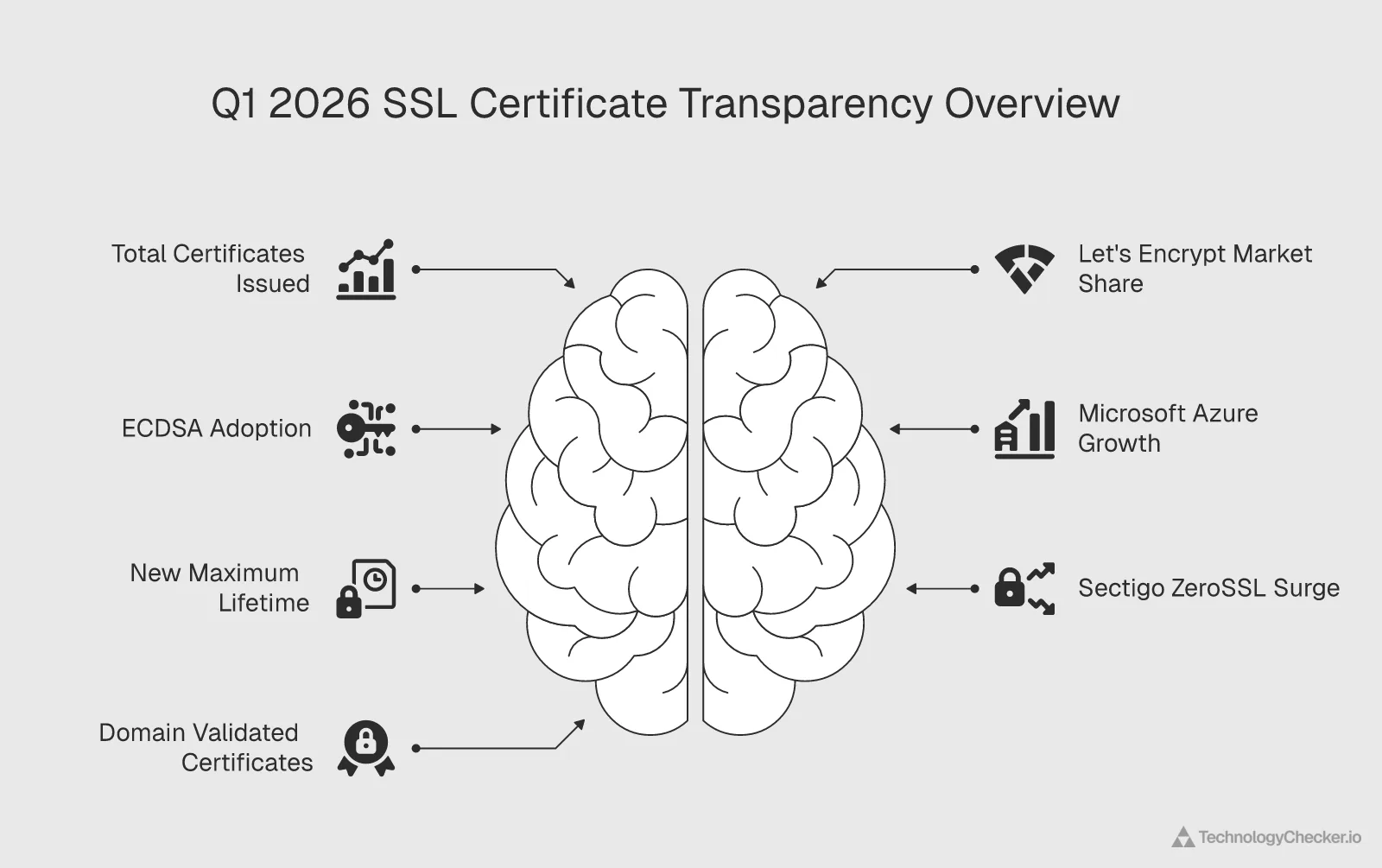
ECDSA rose from 27.7% to 50.4% of SSL certificate records between Q3 2025 and Q3 2026 (Cloudflare Radar). Inside Let's Encrypt it hit 52.3% in September.
David Thomson