Mobile vs Desktop in the UK: We Filtered Out the Bots — Here's the Real Human Split in 2026 (September 2026 Update)
UK web traffic ran 59% desktop in August 2026 per Cloudflare Radar, but filter the bots out and real humans are still mobile-first at 54%. The gap between the two measures has now held for a full year.
Published •Updated •Data through August 2026•33 min read
Updated September 3, 2026 with August data. August changed almost nothing, and after a year of this series that is itself the finding.
UK web requests ran 59.10% desktop on Cloudflare Radar's all-traffic measure in August 2026, against 58.98% in July. Filter the bots out and UK humans are still mobile-majority at 53.93%, against 54.18% in July. Both measures moved by roughly a tenth of a point, and the 17-point gap between them is unchanged.
The year is where the movement is. Human mobile share in the UK was 58.50% in August 2025 and is 53.93% now, down 4.57 points. That is a real behavioural shift and it is roughly twenty times larger than anything that happened this month.
| UK metric | Aug 2025 | Jul 2026 | Aug 2026 | MoM | YoY |
|---|---|---|---|---|---|
| Desktop, all traffic (blended) | — | 58.98% | 59.10% | +0.12 pt | — |
| Mobile, all traffic (blended) | — | 40.97% | 40.89% | −0.08 pt | — |
| Mobile, human traffic only | 58.50% | 54.18% | 53.93% | −0.25 pt | −4.57 pt |
| Desktop, human traffic only | 41.50% | 45.80% | 46.05% | +0.25 pt | +4.55 pt |
| Gap between blended and human desktop | — | 13.18 pt | 13.05 pt | −0.13 pt | — |
Source: Cloudflare Radar — radar/http/summary/device_type with location=GB, calendar-month windows, blended and botClass=LIKELY_HUMAN populations, pulled 2026-09-03.
Updated August 1, 2026. July 2026 is closed. UK web requests ran 58.98% desktop and 40.97% mobile on Cloudflare Radar's all-traffic measure, 8.55 points more desktop than in July 2025. Filter the bots out and UK humans are still mobile-majority, at 54.18%. The July section below adds a like-for-like July 2025 comparison, grades the call we published in July, and corrects the UK-versus-world comparison, which has flipped direction. Everything we published earlier stays below, dated.
In 2026, desktop generates about 56% of UK web traffic and mobile about 43%, according to Cloudflare Radar (28 days to 22 June 2026). But that all-traffic figure is inflated by bots. Filter to real human visitors and the UK flips mobile-first, with 56% of human requests coming from phones.
Key findings, newest first: the August 2026 update (July 2026 data), then the original analysis (28 days to 22 June 2026).
August 2026 update, on July 2026 data:
- UK all-traffic now splits 58.98% desktop / 40.97% mobile.
- Humans are still mobile-majority: 54.18% mobile vs 45.80% desktop.
- All-traffic desktop rose 8.55 points in a year, from 50.43% in July 2025. Of that, 44% is real human drift and 56% is bot composition, so the roughly even split we published in July holds.
- Bots are 24.73% of UK requests, up from 20.01%, and in July they ran 89.95% desktop.
- Correction: the UK is now less bot-driven than the world (24.73% vs 34.75%), not more. On human traffic the UK, at 54.18% mobile, sits a fraction behind the global average of 54.64%.
- Filter the bots and iOS is the UK's most-used operating system, at 29.63% against Windows on 29.08%.
Original analysis, 28 days to 22 June 2026:
- UK all-traffic splits 56.3% desktop / 43.1% mobile — a desktop majority on the raw numbers.
- Filter to likely-human traffic and the UK is mobile-first: 56.4% mobile vs 43.6% desktop.
- UK bot traffic is 85.0% desktop, which is what drags the all-traffic figure toward desktop.
- Britain runs more mobile than the world average: UK mobile 43.1% vs 39.8% globally.
- Apple leads UK mobile: iOS 25.8% of requests vs Android 23.4% — the reverse of the global pattern.
- The Chrome family takes ~54% of UK browser traffic, the Safari family ~27%.
- Measured like-for-like one year apart (Q2 2025 to Q2 2026), the UK's roughly 4-point rise in all-traffic desktop share splits about evenly between a real human drift toward desktop (human mobile eased from 57.8% to 55.8%) and a growing, desktop-heavy bot layer (21% to 24% of UK requests). Humans stayed clearly mobile-first.
The honest answer to "is the UK mobile or desktop?" depends on what you count. Most pages that try to answer it pick one dataset and stop there. We pulled live Cloudflare Radar data for the United Kingdom, then triangulated it against StatCounter, and the gap between the two tells you more than either number alone. This post walks through the device split, why two trusted sources disagree, how bots distort the picture, and what it all means for the device market share you should design around.
Mobile vs desktop in the UK: the 2026 numbers
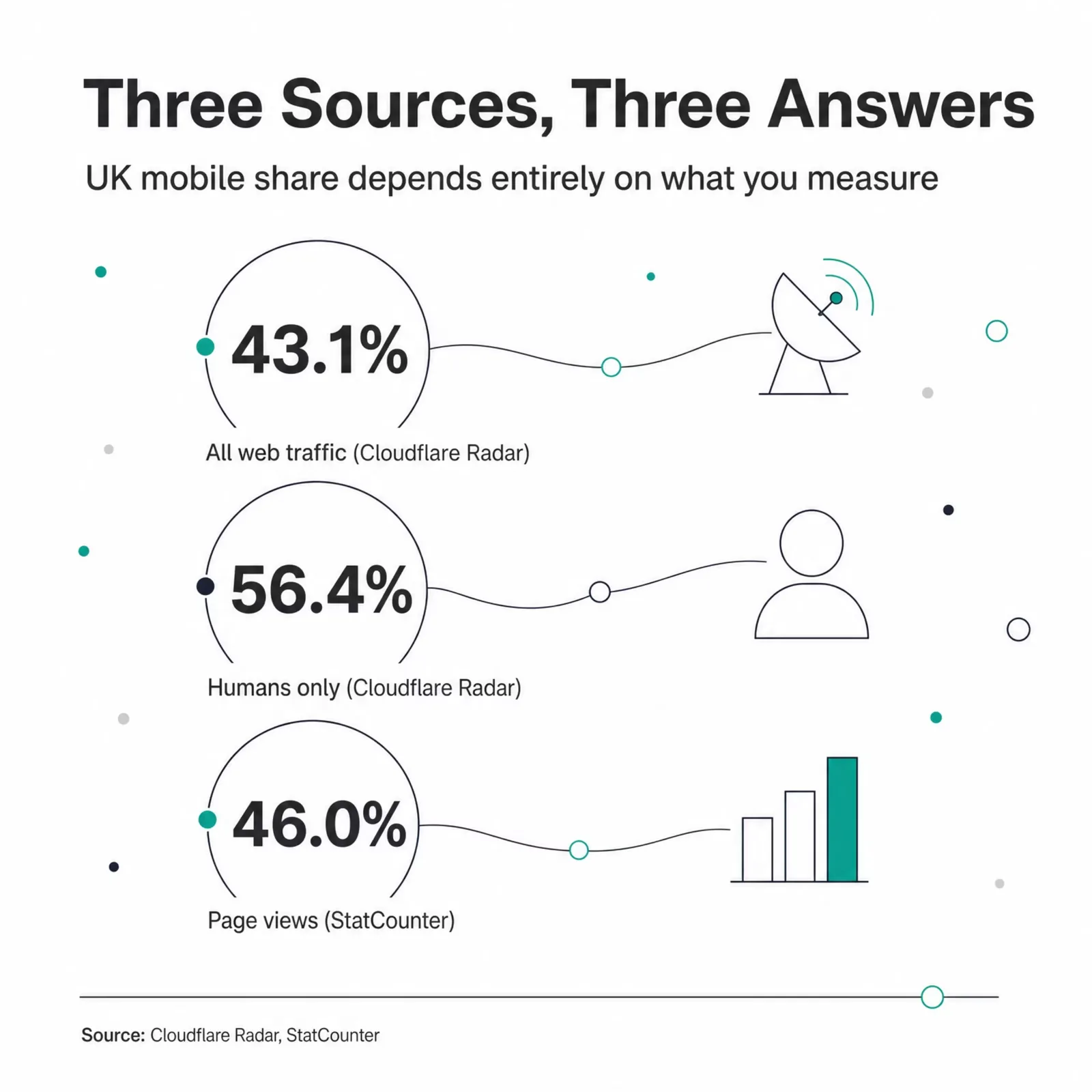
In Cloudflare Radar's data for the 28 days to 22 June 2026, desktop devices generated 56.3% of UK web requests and mobile devices 43.1%, with the remaining 0.6% on other device types. That is the all-traffic view: every HTTP request hitting Cloudflare's network and resolver, bots included. StatCounter, which measures a different population, puts the split much closer to even.
Here are the three measurements side by side. They disagree by design, and the next section explains why.
| Source / Method | Desktop | Mobile | Notes |
|---|---|---|---|
| Cloudflare Radar — all HTTP traffic (incl. bots) | 56.3% | 43.1% | 28 days to 22 June 2026; 0.6% other; no separate tablet |
| Cloudflare Radar — likely-human traffic only | 43.6% | 56.4% | Bot-filtered; the UK flips mobile-first |
| StatCounter — page views, member sites | 49.75% | 46.04% | May 2025–May 2026; tablet counted separately at 4.2% |
Three credible sources, three different splits. None is wrong. They measure different things: all traffic versus humans versus tracked page views. StatCounter's two-way "Desktop vs Mobile" view for the UK actually shows the two near level, which lines up with the bot-filtered Radar number more than the raw one.
The figure you quote should match the question you're answering. Counting machines and crawlers? Desktop wins. Counting people on the UK web right now? Mobile wins, and it isn't close.
Why two trusted sources disagree on the UK device split

Cloudflare Radar and StatCounter report different UK device shares because they sample different populations with different methods. Cloudflare Radar measures all HTTP requests across Cloudflare's CDN and its 1.1.1.1 resolver, an estimated 20 to 25% of all web traffic. It buckets requests into desktop, mobile, and other (no separate tablet), and it includes automated traffic. StatCounter measures page views via a tracking code embedded on roughly 1.5 million member sites, separates tablet into its own category, and skews toward content publishers who run that code.
Those design choices pull the numbers apart in predictable ways:
- Bots count on Radar, not on StatCounter. Radar logs every request, including the crawlers and scrapers that mostly present as desktop. StatCounter's JavaScript tag fires on real page renders, so most non-human traffic never registers.
- Different surfaces. Radar sees raw network and DNS traffic across millions of sites. StatCounter sees rendered page views on the specific sites running its code.
- Tablet placement. Radar folds tablets into other categories; StatCounter breaks tablet out (4.2%), which shaves a few points off both desktop and mobile in its three-way view.
radar/http for location GB, 28 days to 22 June 2026, normalised as share of HTTP requests. We cite shares, not absolute counts, because Radar reports percentages of the traffic it sees.Neither method is the "true" number, because there isn't one. A bank optimising a logged-in dashboard cares about the human, tracked-pageview view. A security team sizing crawler load cares about the all-traffic view. Knowing which lens produced a stat is what stops you from designing for the wrong audience. For the bigger picture on automated traffic, see our bot traffic statistics.
Humans vs bots: why the UK is more mobile-first than it looks
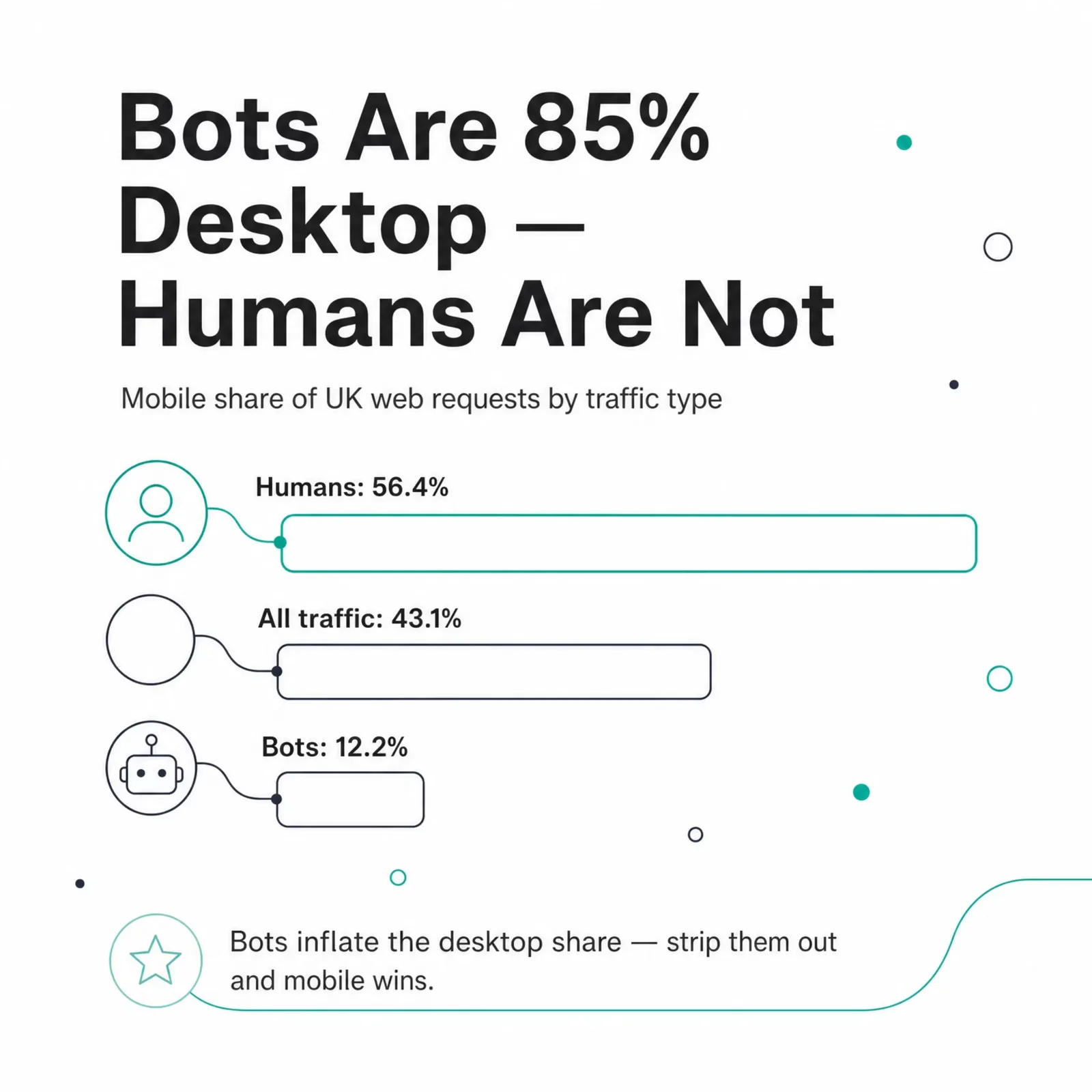
Filtered to likely-human traffic, the UK is mobile-majority: 56.4% of human web requests came from mobile versus 43.6% from desktop (Cloudflare Radar, June 2026). That is the opposite of the all-traffic headline, and the reason is the third bar in the chart above. UK bot traffic is overwhelmingly desktop: 85.0% desktop versus 12.2% mobile. Crawlers, scrapers, monitors, and headless browsers almost all identify as desktop user agents, so they pile weight onto the desktop side of the raw number.
When you blend a mobile-heavy human population with a desktop-heavy bot population, the average lands at desktop-majority even though most actual people are on phones. That's the trap in any single all-traffic stat.
| Traffic type (UK) | Mobile share | Desktop share |
|---|---|---|
| Likely-human | 56.4% | 43.6% |
| All traffic | 43.1% | 56.3% |
| Likely-automated (bots) | 12.2% | 85.0% |
In our analysis of Cloudflare Radar data, this human-versus-bot gap is the single most useful thing the dataset reveals about the UK, and it's exactly what a one-source page misses. If you're deciding where to spend design and engineering time, the human split is the one that matters. Build for the phone first.
July 2026: the newest month, and where it lands
July 2026 closed with UK web requests at 58.98% desktop and 40.97% mobile on the all-traffic measure. Desktop gained 2.35 points on June alone, and it climbed through the whole month: weekly desktop share ran 57.95%, 58.17%, 58.85%, 59.57%, then 60.49% in the week of 27 July. The monthly summary and the weekly series agree, which is the check we run before publishing any Radar figure that moves this hard.
Human traffic moved the same way, at less than half the speed.
| UK device split | Jul 2025 | Jun 2026 | Jul 2026 | Year over year |
|---|---|---|---|---|
| Desktop, all traffic | 50.43% | 56.63% | 58.98% | Up 8.55pt |
| Mobile, all traffic | 49.56% | 42.66% | 40.97% | Down 8.59pt |
| Desktop, humans only | 42.03% | 44.17% | 45.80% | Up 3.77pt |
| Mobile, humans only | 57.95% | 55.82% | 54.18% | Down 3.77pt |
Behind that, the bot layer both grew and changed shape. Bots were 24.73% of UK requests in July 2026 against 20.01% a year earlier. They also got more desktop-heavy: 89.95% of UK bot requests came from desktop user agents in July 2026, against 82.08% in July 2025.
One caveat on that last pair, because it matters. Measured over full calendar quarters instead, UK bots were 84.97% desktop in Q2 2025 and 84.98% in Q2 2026. We re-pulled both on 1 August and they're unchanged from what this post published. So the quarter view says the bot mix is flat while the July month view says it's climbing. A 31-day sample is noisier than a 91-day one. Both readings stay in this post. Treat the monthly one as the newer signal rather than as proof the quarterly one was wrong.
Splitting the 8.55-point swing
Every term below is measured directly. Nothing is back-solved from the others.
The gap between the all-traffic desktop figure and the human-only one was 8.40 points in July 2025 (50.43% against 42.03%). In July 2026 it's 13.18 points (58.98% against 45.80%). So the gap widened by 4.78 points. Over the same year, human desktop share itself rose 3.77 points. Those two add to 8.55 points, which is exactly the all-traffic move.
Grading the call we published in July
The July edition of this post said the UK's year-over-year desktop rise splits "about evenly" between people and bots. On a clean July-to-July year it comes out 44/56. That's close enough to stand, so we're recording it as confirmed rather than quietly restating it. A call that holds up is worth as much as one you have to correct.
The global version of the same claim did not survive. Worldwide the decomposition ran about two-thirds human when we published. On July data it's 39% human and 61% composition, from blended desktop 54.73% to 60.84% against human desktop 42.97% to 45.34%.
The UK-versus-world comparison has flipped
This post argued that the UK was the more bot-driven market, and that Britain's steeper headline swing toward desktop owed more to a growing crawler layer here than to real behaviour. July reverses that direction, and we'd rather say so than leave it standing.
| July 2026 | United Kingdom | Worldwide |
|---|---|---|
| Desktop, all traffic | 58.98% | 60.84% |
| Mobile, all traffic | 40.97% | 39.11% |
| Mobile, humans only | 54.18% | 54.64% |
| Bots, share of requests | 24.73% | 34.75% |
UK bots are 24.73% of requests against 34.75% worldwide, which puts Britain about ten points less bot-driven than the global average. The world converged on the UK, not the other way round. The UK's human-mobile edge has gone too: UK humans ran 54.18% mobile in July against 54.64% globally, a fraction behind rather than ahead. Over the year UK human mobile fell 3.77 points while the world's fell 2.37, so UK people drifted toward desktop faster than the global average across this window, not slower.
What survives all of that is the thing this post is actually about. The blended figure still misleads about real people, and in the UK it now misleads by 13.18 points, the widest gap this post has recorded. British humans are still mobile-majority.
Source: Cloudflare Radar — radar/http/summary/device_type and radar/http/summary/bot_class, location GB and worldwide, 1–31 July 2026, 1–30 June 2026 and 1–31 July 2025, split by all-traffic, likely-human and likely-automated filters; weekly cross-check via radar/http/timeseries_groups/device_type. Pulled 2026-08-01. Radar flags a short HTTP pipeline issue on 16 July (10:15 to 12:00 UTC), under two hours of a 31-day window, which doesn't move the monthly shares.
How UK mobile and desktop usage shifts by season
UK mobile usage is seasonal. Over the past 52 weeks, mobile briefly drew level with desktop during the 2025 Christmas fortnight and again over the late-August summer break, then desktop reclaimed the lead on every working week. The pattern is intuitive: people swap the work laptop for a phone on the sofa during holidays, and pick it back up at a desk come Monday.
The 12-week trajectory below shows the device split moving week to week. Watch the working-week desktop lead of roughly 55 to 57% across Q1 and Q2 2026.
UK device share by traffic type over the last 12 weeks (Cloudflare Radar, GB). Holiday weeks compress the gap; working weeks widen it back toward desktop.
⚠️ That chart is live, so it has moved past the range described above. As of the August update its window includes July 2026, where weekly all-traffic desktop share ran 57.95%, 58.17%, 58.85%, 59.57% and 60.49% across the five weeks from 29 June. Read the "roughly 55 to 57%" band as the Q1 and Q2 2026 range it was written for. Source: Cloudflare Radar — radar/http/timeseries_groups/device_type, location GB, 1–31 July 2026, weekly.
UK mobile vs desktop: 2025, Q1 2026, Q2 2026
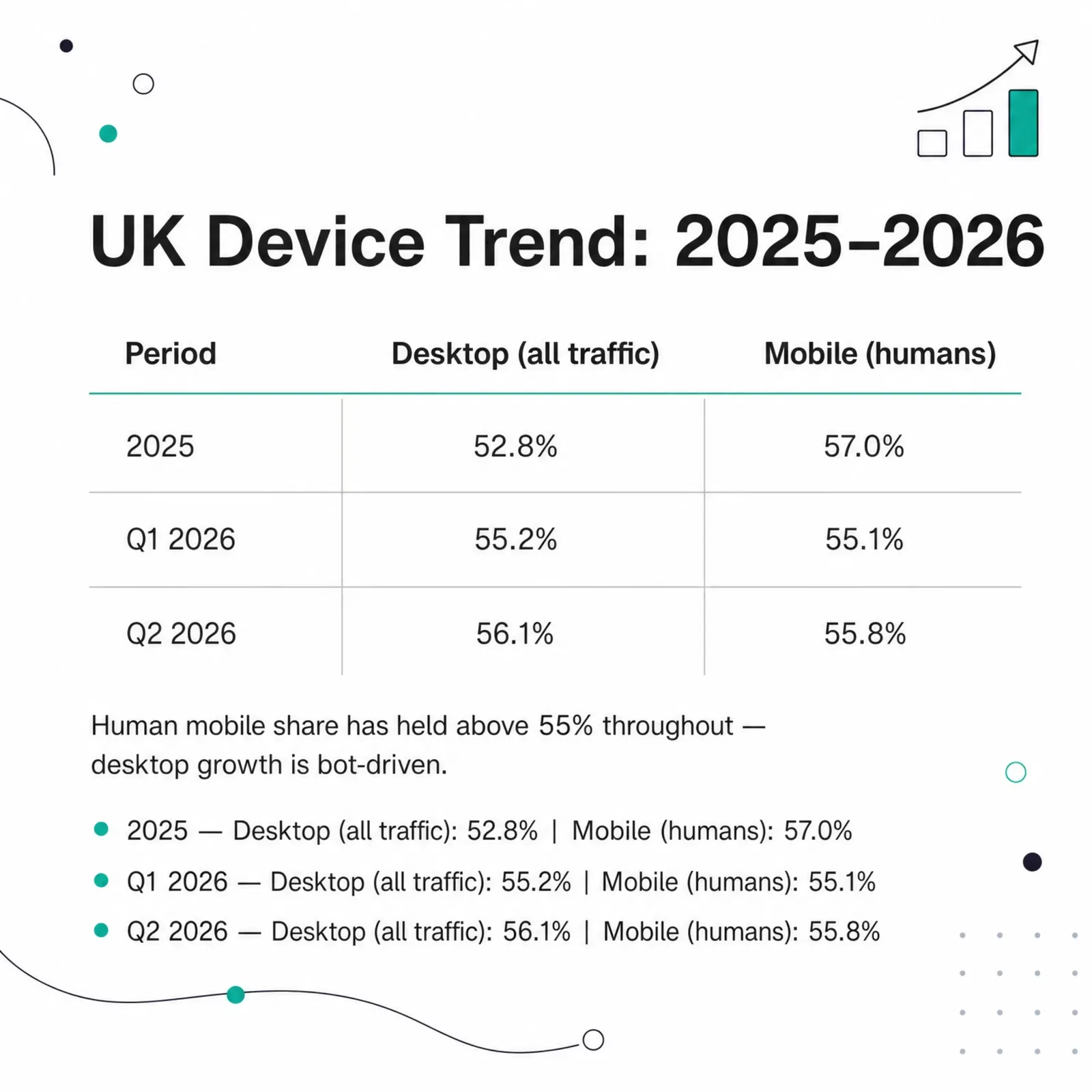
Zoom out from the weekly noise and the same lesson holds across the year. On Cloudflare Radar's all-traffic measure, UK desktop share climbed from 52.8% across 2025 to 56.1% in Q2 2026 (to 22 June). Filtered to real humans, though, mobile held the majority the whole way, from 57.0% in 2025 to 55.8% so far in Q2 2026.
| Period | Desktop (all traffic) | Mobile (all traffic) | Mobile (humans only) |
|---|---|---|---|
| 2025 (full year) | 52.8% | 47.2% | 57.0% |
| Q1 2026 (Jan–Mar) | 55.2% | 44.8% | 55.1% |
| Q2 2026 (to 22 Jun) | 56.1% | 43.7% | 55.8% |
Two trends hide in that table. All-traffic desktop share gained about three points in eighteen months, tracking the rise of desktop-presenting bots and crawlers more than any real return to laptops. Human mobile share eased slightly from its 2025 high but never surrendered the lead, holding in the mid-50s. The honest read is stability: UK people have been, and remain, mobile-first.
One caveat on reading any live device chart: the most recent partial week can look wildly desktop-heavy simply because it holds only a day or so of data. Anchor on the rolling 28-day summary, not the final point on the line.
Same season, one year apart: Q2 2025 vs Q2 2026
The table above uses 2025's full year as its baseline, and that full year folds in the Christmas and late-summer mobile peaks this section just described. To read the real year-over-year change without that seasonal tilt, compare the same quarter one year apart: Q2 2025 against Q2 2026, both full calendar quarters.
| UK device split (full calendar quarter) | Q2 2025 | Q2 2026 | Year over year |
|---|---|---|---|
| Desktop, all traffic | 52.2% | 56.2% | Up 4.0pt |
| Mobile, all traffic | 47.8% | 43.6% | Down 4.2pt |
| Mobile, humans only | 57.8% | 55.8% | Down 2.0pt |
| Desktop, bots only | 85.0% | 85.0% | Flat |
On a clean same-season basis the all-traffic desktop share rose about 4 points, from 52.2% to 56.2%. That single number hides two very different halves. About half of it is real: filtered to human traffic, desktop climbed 2 points as human mobile eased from 57.8% to 55.8%, so even people drifted a little toward the larger screen over the year. The other half is not a change in how bots behave, because UK bots were about 85% desktop in both years, but a change in how many of them there are. Bots grew from 21% to 24% of UK requests, and because that layer is so heavily desktop, its growth alone widened the gap between the all-traffic figure and the human reality by about 2 points.
This is where the UK parts company with the global picture, and in a revealing way. Worldwide, all-traffic desktop share rose from 56.2% to 59.6% over the same year, about 3.5 points, a touch slower than the UK's 4. Yet the UK's humans held on to mobile slightly better than the world's did: UK human mobile eased 2.0 points versus 2.4 points globally. So Britain's steeper headline swing toward desktop is not a sign that UK people are abandoning their phones faster than everyone else. It is close to the opposite. UK humans stayed a shade more mobile-first than the global average, and the extra desktop weight in the raw number owes more to the growing bot layer here than to real behaviour. For the same human-versus-bot decomposition across other markets, see our mobile internet usage by country breakdown.
⚠️ Superseded by the August update above; preserved as originally published. On a July-to-July basis the direction reverses. UK human mobile fell 3.77 points against the world's 2.37, and UK bots are 24.73% of requests against 34.75% worldwide, so the UK is now the less bot-driven market, not the more. The quarter figures in this section are unchanged on re-pull; the July months simply say something different.
Source: Cloudflare Radar — http/summary/device_type and http/summary/bot_class for location GB and worldwide, full calendar quarters Q2 2025 versus Q2 2026, split by all-traffic, likely-human, and likely-automated filters. Pulled 2026-07-03.
The same effect runs every week, not just at Christmas
The seasonal story above has a much shorter cousin, and once you see it you cannot quote a single UK device figure with a straight face again. The holiday mechanism of work laptop down, phone up does not wait for August or Christmas. It happens every weekend, and in the UK it is worth nearly seven points.
Aggregating Radar's UK human traffic by day rather than by week, across 1 June to 5 August 2026:
| UK human traffic | Weekday average | Weekend average | Swing |
|---|---|---|---|
| Mobile | 53.16% | 59.98% | +6.82 pt |
| Desktop | 46.82% | 40.00% | −6.82 pt |
Source: Cloudflare Radar — http/timeseries_groups/device_type, location GB, human (LIKELY_HUMAN) traffic, daily aggregation, 1 June–5 August 2026 (9 full weeks). Pulled 2026-08-05.
This is not a tendency, it is a metronome. The weekend mobile gain was positive in all nine weeks in the window, never dropping below +5 points. Britain is a 53% mobile country Monday to Friday and a 60% mobile country on Saturday and Sunday. The annual holiday peaks the section above describes are simply the same effect held down for a fortnight instead of two days.
The UK's swing is also unusually large. Worldwide the same measurement gives +5.32 points, so Britain oscillates about a quarter harder than the global average, second only to Brazil (+7.18) among the twelve markets we checked and more than double Nigeria's +3.02. The reason is the flip side of the bot story running through this report: the swing measures how much of a country's desktop traffic is workplace traffic, and the UK has a lot of it to switch off on Friday evening. Markets where desktops are scarce to begin with have less to lose. Our mobile internet usage by country breakdown carries the full country table.
The practical consequence is the same discipline this whole post argues for. A UK device figure is only meaningful if you know which days produced it: a Monday-to-Friday sample understates British mobile by roughly three points against a whole-week average, and a weekend-weighted one overstates it by about the same. If your UK traffic is consumer-facing and peaks at weekends, your real mobile exposure is the 60% number, not the 53% one. Sizing a responsive-design or mobile-checkout budget off the weekday average is how teams end up under-investing in the half of the week their customers actually shop in.
UK vs the world: how mobile-heavy is Britain?
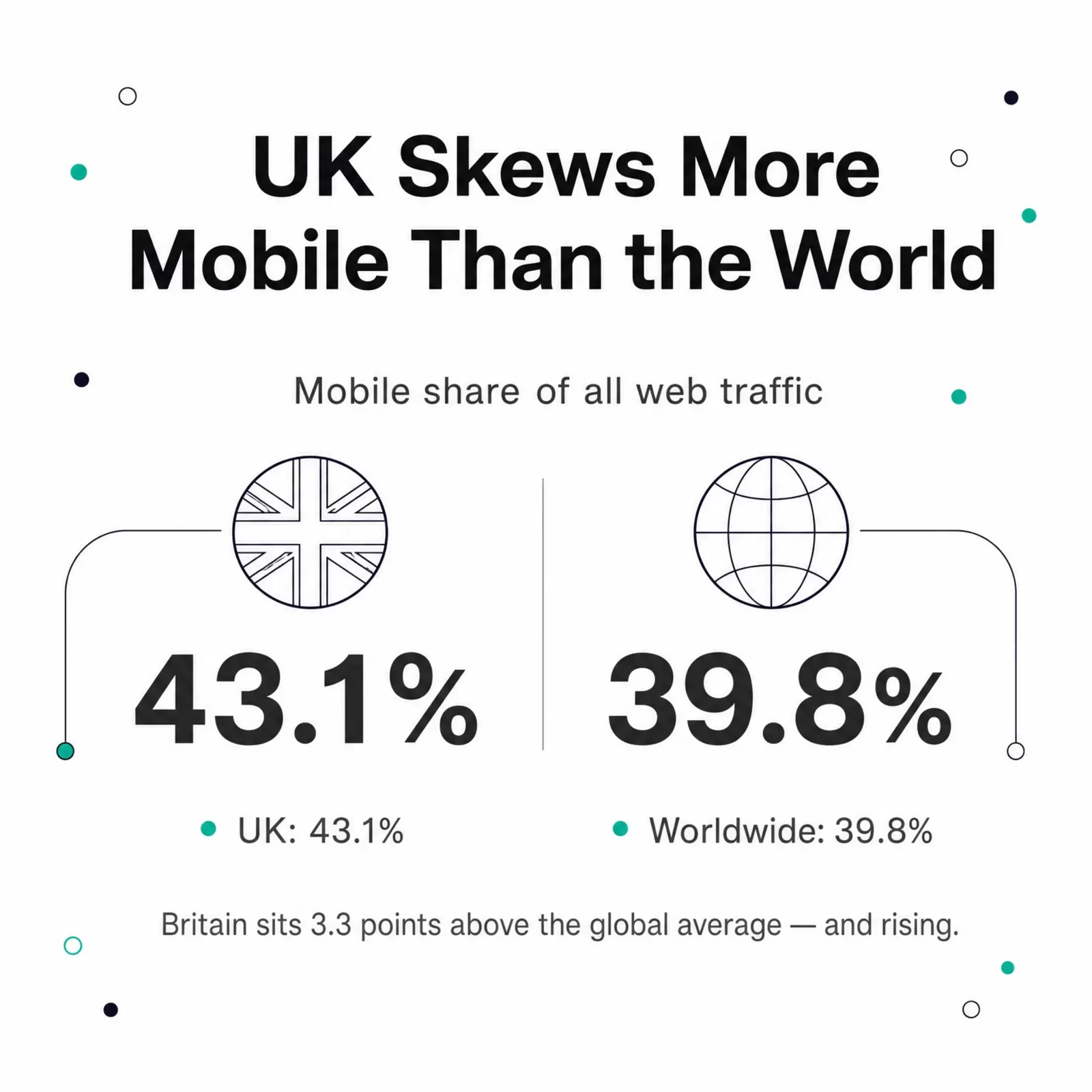
UK web traffic skews more mobile than the global average. UK mobile share was 43.1% versus 39.8% worldwide on Radar's all-traffic measure (Cloudflare Radar, 28 days to 22 June 2026). On the same basis, UK desktop sits at 56.3% against roughly 60% globally. Britain leans a few points more toward the phone than the planet as a whole.
| Measure (all traffic) | United Kingdom | Worldwide |
|---|---|---|
| Mobile share | 43.1% | 39.8% |
| Desktop share | 56.3% | ~60% |
That 3.3-point mobile gap is modest but consistent, and it widens once you bot-filter both populations. High smartphone penetration and fast mobile networks make the UK a mobile-forward market by Western European standards, even if it isn't as mobile-dominant as emerging markets where phones are the primary or only access device. For how that varies country by country, see our breakdown of mobile internet usage by country.
⚠️ The second clause is superseded by the August update above; preserved as originally published. In July 2026 the all-traffic gap narrowed to 1.86 points (UK mobile 40.97% vs 39.11% worldwide) and it does not widen under bot-filtering, it inverts: UK humans ran 54.18% mobile against 54.64% globally. The UK is still a mobile-forward market, but on human traffic it now sits level with the world rather than ahead of it. Source: Cloudflare Radar — radar/http/summary/device_type, location GB and worldwide, 1–31 July 2026.
Operating systems: iOS vs Android on the UK web
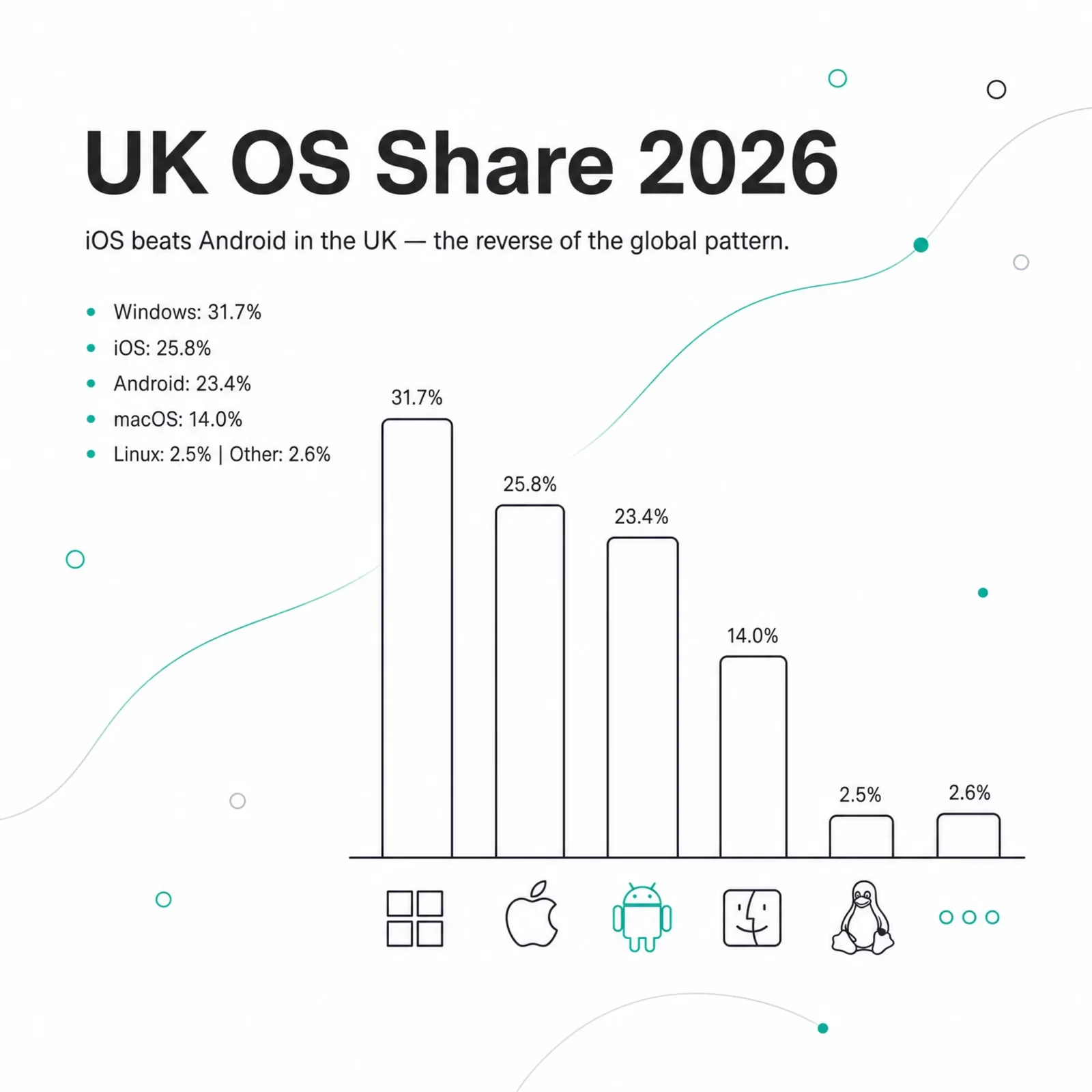
Windows is still the UK's single most common operating system for web requests at 31.7%, ahead of iOS (25.8%) and Android (23.4%), with macOS at 14.0% and Linux at 2.5% (Cloudflare Radar, June 2026). Group them by type and it's a near-perfect tie: desktop operating systems (Windows, macOS, Linux, ChromeOS) total about 49.3%, mobile operating systems (iOS, Android) about 49.2%. The device-type and OS views agree.
| Operating system (UK) | Share of web requests |
|---|---|
| Windows | 31.7% |
| iOS | 25.8% |
| Android | 23.4% |
| macOS | 14.0% |
| Linux | 2.5% |
The standout is the Apple gap on mobile: iOS outweighs Android on the UK web, 25.8% to 23.4%. Globally Android leads handset volume by a wide margin, so the UK reversal reflects both high iPhone ownership and the fact that iPhone users tend to browse the web more actively. Add macOS (14.0%) to iOS and Apple platforms account for roughly 40% of all UK web requests. That's a large, high-intent slice worth testing against, especially given Safari ships as the default on every one of those devices. We unpack the browser side of that in our Safari market share analysis.
July 2026 refresh: iOS overtakes Windows once you filter the bots
The figures above are all-traffic, the same population as the 56.3% desktop headline. Here they are again for July 2026, this time next to the human-only cut.
| Operating system (UK), July 2026 | All traffic | Humans only |
|---|---|---|
| Windows | 30.94% | 29.08% |
| iOS | 26.86% | 29.63% |
| Android | 24.02% | 24.96% |
| macOS | 13.25% | 12.90% |
| Linux | 3.89% | 2.39% |
| ChromeOS | 0.94% | 1.01% |
Two things worth taking from that. Filter the bots out and iOS is the UK's most-used operating system, at 29.63% against Windows on 29.08%. On the all-traffic view Windows still leads. Same country, same month, and the ranking changes with the filter, which is this post's whole argument in one table.
The other is Linux. It ran 3.89% of all UK requests in July against 2.75% in June, but only 2.39% of human requests. That's a crawler signature, and it tracks the desktop-presenting bot traffic that grew over the same month.
The Apple numbers hold up. iOS still beats Android on both cuts, and the gap is wider among humans (29.63% to 24.96%) than on raw traffic (26.86% to 24.02%). Apple platforms together are 40.11% of all UK requests and 42.53% of human ones, so the "roughly 40%" figure above stands.
⚠️ One claim above needs correcting: "the device-type and OS views agree" no longer holds on all-traffic data. In July 2026 the mobile operating systems total 50.88% while the device-type series reads 40.97% mobile, a ten-point disagreement. On human-only data the two still line up almost exactly, 54.59% mobile by OS against 54.18% by device type. The two series don't cover the same request population, so read the OS breakdown as its own measurement rather than as a cross-check on the device split.
Source: Cloudflare Radar — radar/http/summary/os, location GB, 1–31 July 2026 and 1–30 June 2026, all traffic and likely-human.
Browsers: Chrome and Safari's share of UK traffic
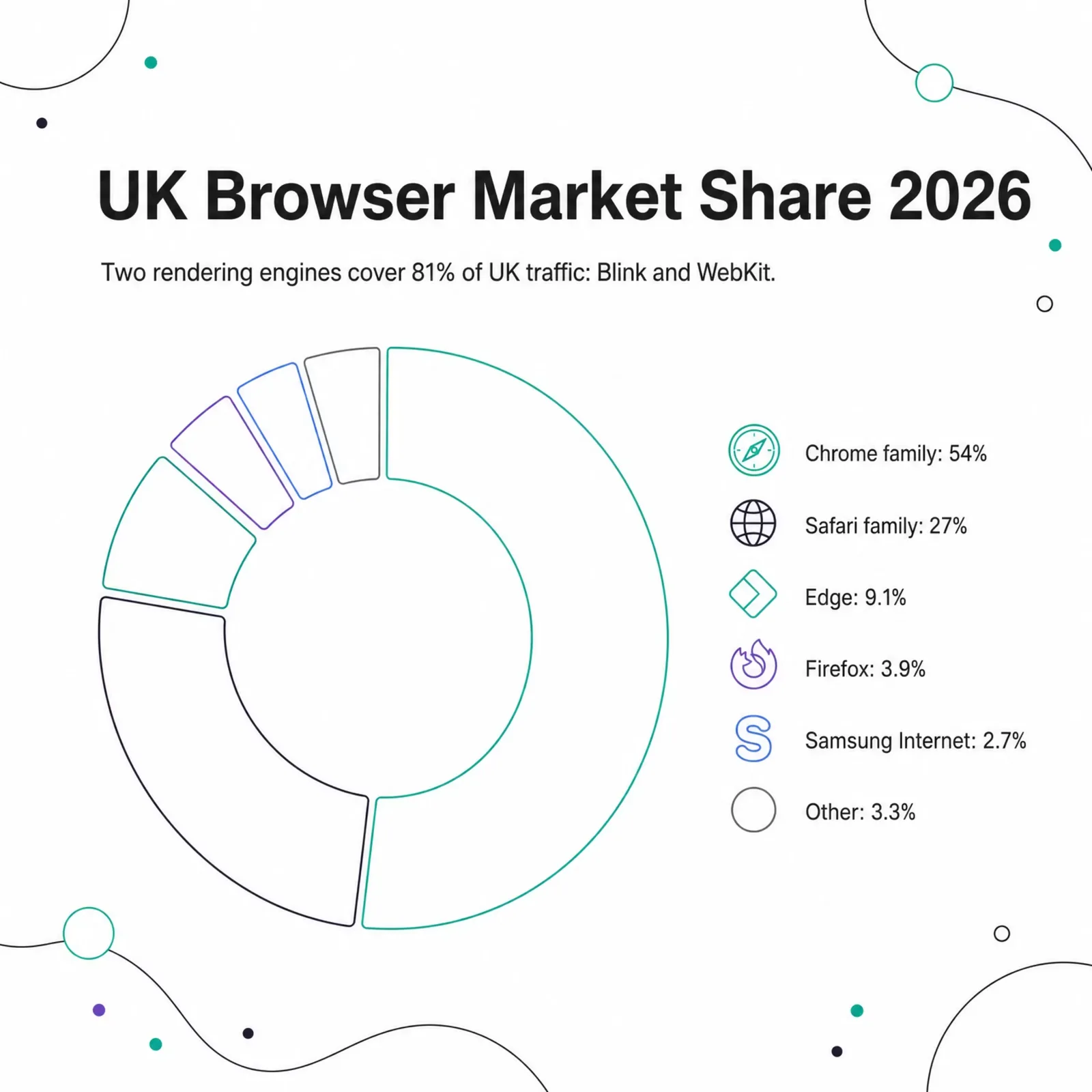
The Chrome family generated roughly 54% of UK web requests and the Safari family about 27% (Cloudflare Radar, June 2026). Those two engines cover more than 80% of the UK web between them. Microsoft Edge takes 9.1%, Firefox 3.9%, and Samsung Internet 2.7%, which rounds out the meaningful players.
| Browser family (UK) | Share of web requests |
|---|---|
| Chrome (desktop + mobile + WebView) | ~54% |
| Safari (desktop + mobile + WebView) | ~27% |
| Edge | 9.1% |
| Firefox | 3.9% |
| Samsung Internet | 2.7% |
Safari's ~27% is bigger than its desktop browser share alone would suggest, because Mobile Safari rides on every iPhone and iPad, and a lot of in-app browsing on iOS routes through the Safari WebView. So Safari's real reach across the UK web is wider than the desktop-only numbers imply. Practically, that means two rendering engines to take seriously: Blink (Chrome, Edge, Samsung) and WebKit (Safari). Test against both. Edge at 9.1% also deserves a glance given its share of Windows desktops. For deeper detail on the leader, see our Chrome market share report.
July 2026 refresh: Safari's real reach among UK humans is 30%
Browsers get the same treatment. The shares above are all-traffic. Here is July 2026 next to the human-only cut.
| Browser family (UK), July 2026 | All traffic | Humans only |
|---|---|---|
| Chrome | 55.59% | 52.71% |
| Safari | 27.42% | 30.17% |
| Edge | 9.38% | 9.86% |
| Firefox | 3.66% | 3.23% |
| Samsung Internet | 2.91% | 3.00% |
| Opera | 1.01% | 1.02% |
Safari's ~27% is the all-traffic number. Among real UK people it's 30.17%, close to a third of the human web here, with the two figures sitting 2.74 points apart in July. Which population a browser share came from is not a footnote, it changes the answer. Chrome and Safari together still cover 83.0% of UK traffic, so the advice to test both rendering engines is unchanged.
Source: Cloudflare Radar — radar/http/summary/browser_family, location GB, 1–31 July 2026, all traffic and likely-human.
How fast is the UK internet on mobile vs desktop?

UK fixed broadband, the connection behind most desktops and laptops, runs far faster than the mobile networks phones use on the move. On Cloudflare's speed data (the 90 days to 22 June 2026), the big fixed ISPs deliver 170 to 275 Mbps download at roughly 40 ms latency, while the main mobile carriers manage 47 to 64 Mbps at 70 to 77 ms. The headline UK figure of about 194 Mbps download is really a fixed-line average, because most speed tests run on broadband.
One caveat up front: Cloudflare Radar measures connection speed by network, not by device, so it can't tag a test as "phone" or "laptop." But network type is the real driver of the gap, since phones browse over cellular while desktops sit on fixed broadband. The operator comparison below is the honest stand-in for a true device split.
| Network (UK) | Type | Download | Upload | Idle latency |
|---|---|---|---|---|
| Virgin Media | Fixed broadband | 275 Mbps | 56 Mbps | 43 ms |
| Sky | Fixed broadband | 170 Mbps | 52 Mbps | 37 ms |
| BT | Fixed broadband | 169 Mbps | 53 Mbps | 40 ms |
| Vodafone | Mobile | 64 Mbps | 18 Mbps | 70 ms |
| Three | Mobile | 56 Mbps | 17 Mbps | 77 ms |
| O2 | Mobile | 47 Mbps | 13 Mbps | 72 ms |
This is the missing half of the mobile-first argument. Most UK humans browse on phones, and those phones sit on slower, higher-latency connections. A page that feels instant on a 275 Mbps office desktop can crawl on a 50 Mbps mobile link with 75 ms of lag. It's the clearest reason to weight mobile Core Web Vitals (especially INP and Largest Contentful Paint) above the desktop scores most teams habitually watch.
What the UK mobile vs desktop split means for your website

For UK audiences, design mobile-first and verify on desktop, because real human traffic is mobile-majority (56.4%) while a meaningful, work-hours desktop minority still converts on considered tasks. The data supports building the core experience for the phone, then making sure nothing breaks on the larger screen, rather than the other way round.
A few concrete moves that follow directly from the numbers:
- Treat mobile as the primary layout, not the adaptation. With most UK humans on phones, the mobile view is the main event. Responsive design that starts at the small screen beats a desktop site squeezed down.
- Obsess over mobile performance. Phones face slower networks and weaker CPUs, so Core Web Vitals matter most there. Watch INP (Interaction to Next Paint, the metric that replaced FID) and Largest Contentful Paint on real mobile hardware, not just a fast laptop.
- Test both rendering engines and Apple devices. Chrome/Blink and Safari/WebKit cover 80%-plus of UK traffic, and Apple platforms are ~40% of requests. A WebKit-only or iOS-only bug hits a large share of your audience.
- Keep desktop sharp for work-hours, high-intent sessions. The desktop minority skews toward considered tasks during working weeks. Complex forms, comparison tables, and long reads still deserve a polished large-screen experience.
- Read your own analytics with the methodology in mind. A tag-based tool counts human page views, so it will skew more mobile than Radar's all-traffic split. Don't try to reconcile the two numbers; each answers a different question about who's visiting.
The broader context backs the mobile-first call. According to Finder, 95% of UK residents aged 16 and over owned a smartphone in 2025, around 53 million people. And Uswitch reports that 89% of people used their mobiles to go online in 2023, up from 28% in 2009. Near-universal ownership plus near-universal mobile internet use is exactly the foundation under a mobile-majority human web. Official sources such as Ofcom and the ONS track the same upward trend in mobile internet adoption.
How device usage gets measured matters for your own analytics, too. Whether you run Google Analytics or a privacy-focused alternative, the device buckets you see reflect tracked page views, not raw traffic, so expect them to read closer to StatCounter than to Radar's all-traffic split.
Frequently asked questions
What percentage of UK web traffic is mobile vs desktop?
On Cloudflare Radar's all-traffic measure for July 2026, UK web traffic was 58.98% desktop and 40.97% mobile. Filtered to likely-human visitors, it flips to 54.18% mobile and 45.80% desktop. StatCounter, which counts page views, puts the UK at roughly 49.75% desktop and 46.04% mobile for May 2025 to May 2026.
Is the UK mobile-first or desktop-first?
The UK is mobile-first for real people. Once bot traffic is filtered out, 54.18% of human web requests come from mobile devices versus 45.80% from desktop (Cloudflare Radar, July 2026). Raw all-traffic figures look desktop-majority only because bots, which ran 89.95% desktop in July, inflate the desktop side.
Why do Cloudflare Radar and StatCounter report different device shares?
They measure different populations. Cloudflare Radar logs all HTTP requests across its CDN and 1.1.1.1 resolver, bots included, and has no separate tablet category. StatCounter counts page views via a tracking code on about 1.5 million publisher sites and breaks out tablet. Because most bots present as desktop, Radar's raw split skews more desktop than StatCounter's human-pageview panel.
Do more people in the UK access the internet via a smartphone or a laptop?
More via smartphone. Filtered to humans, mobile accounts for 54.18% of UK web requests versus 45.80% for desktop devices like laptops (Cloudflare Radar, July 2026). Survey data agrees: Uswitch reports 89% of UK people used a mobile to go online in 2023, and smartphone ownership reached 95% of those aged 16-plus in 2025 per Finder.
Does a PC use more data than a mobile?
Usually yes, but that's a different question from device share. Cloudflare Radar measures the share of web requests by device, not gigabytes consumed. A desktop session typically loads heavier pages, larger images, and more background requests than a phone on a mobile network, so one PC visit often pulls more data, even though most UK human sessions still happen on mobile (54.18%).
Do iPhones or Android phones dominate UK web traffic?
iPhones. iOS took 26.86% of all UK web requests against Android's 24.02% in July 2026, and among likely-human traffic iOS leads 29.63% to 24.96% (Cloudflare Radar). That reverses the global pattern, where Android leads. High iPhone ownership plus heavier web browsing among iPhone users tips the UK balance toward iOS.
Which operating system is most used in the UK?
It depends which population you count. On all web requests Windows leads with 30.94%, ahead of iOS on 26.86% (Cloudflare Radar, July 2026). Filter to likely-human traffic and iOS takes first place at 29.63% against Windows on 29.08%. Android is third on both cuts, at 24.02% and 24.96%.
What is the UK browser market share in 2026?
On all UK web requests in July 2026, Chrome led with 55.59%, then Safari on 27.42%, Edge 9.38%, Firefox 3.66% and Samsung Internet 2.91% (Cloudflare Radar). Among likely-human traffic Safari rises to 30.17% and Chrome eases to 52.71%. The two cover 83% of UK traffic, so test both Blink and WebKit.
Has UK mobile vs desktop usage changed over the past year?
Yes, and sharply. Measured July to July, UK all-traffic desktop rose 8.55 points, from 50.43% to 58.98% (Cloudflare Radar). Of that, 44% is real human drift and 56% is a growing, desktop-heavy bot layer that went from 20.01% to 24.73% of requests. Humans stayed mobile-majority throughout, easing from 57.95% to 54.18%.
Why did UK desktop share jump 8 points in a year?
Two things at once. Real people drifted toward desktop, with human desktop share rising from 42.03% to 45.80% July to July. And the bot layer grew from 20.01% to 24.73% of UK requests while running 89.95% desktop. The measured split is 44% human behaviour, 56% bot composition (Cloudflare Radar, July 2026).
Is the UK more or less mobile than the global average?
On raw traffic, slightly more mobile: 40.97% UK against 39.11% worldwide in July 2026 (Cloudflare Radar). On human traffic the UK now sits a fraction behind, 54.18% against 54.64% globally. The larger difference is bots, at 24.73% of UK requests against 34.75% worldwide.
Is the UK more bot-driven than the rest of the world?
Not any more. Bots were 24.73% of UK web requests in July 2026 against 34.75% worldwide (Cloudflare Radar). This post previously argued the opposite, on Q2 data. Global bot share climbed faster over the year, so the world converged on the UK rather than the UK on the world.
Is mobile or desktop internet faster in the UK?
Desktop, by a wide margin, because desktops run on fixed broadband. On Cloudflare's speed data, UK fixed ISPs (BT, Sky, Virgin Media) download at 170–275 Mbps with about 40 ms latency, while mobile carriers (Vodafone, Three, O2) manage 47–64 Mbps at 70–77 ms. Radar measures speed by network rather than device, but since phones browse on cellular and desktops on broadband, the gap is real for your mobile-first visitors.
What does the UK mobile vs desktop split mean for web design?
Build mobile-first, then verify on desktop. Because most UK human traffic is mobile, the small-screen layout should be the primary experience, with strong Core Web Vitals (especially INP and LCP) on real mobile hardware. Test both Chrome/Blink and Safari/WebKit, since Apple platforms make up roughly 40% of UK web requests, and keep desktop polished for high-intent, work-hours sessions.
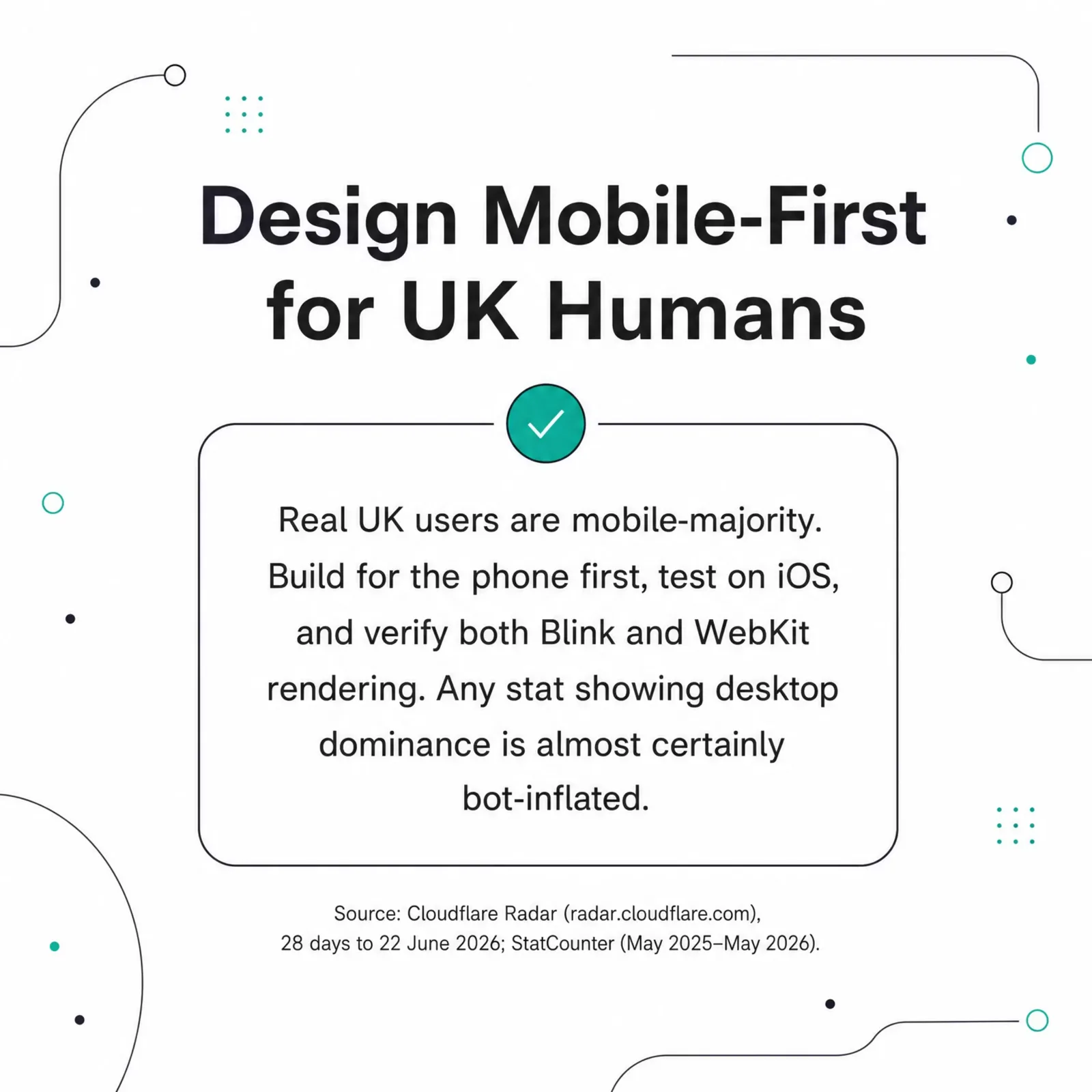
The UK device story isn't a single number, it's a question of who you count. Real people on the UK web are mobile-first at 56.4%, iOS edges Android at 25.8% to 23.4%, and the Chrome and Safari families own more than 80% of browser traffic. The all-traffic desktop majority is mostly bots. Design for the human split, test against Apple devices and both rendering engines, and treat the seasonal mobile peaks as planning signals.
⚠️ Figures superseded by the August update above; preserved as originally published. On July 2026 data the conclusion is unchanged but the numbers have moved: UK humans are 54.18% mobile, iOS leads Android 26.86% to 24.02% on raw traffic and 29.63% to 24.96% among humans, and Chrome plus Safari hold 83.0%.
Want to see the technologies, analytics, and platforms behind UK websites across millions of domains? Explore what our pricing and put device and stack data to work on your own market.
Source: Cloudflare Radar (radar.cloudflare.com). Original analysis: 28 days to 22 June 2026. August 2026 update: calendar months 1–31 July 2026, 1–30 June 2026 and 1–31 July 2025, pulled 2026-08-01.

Data Analyst
5+ years of experience
Emma is a Data Analyst at TechnologyChecker, where she analyses technology adoption data to build better prospect lists and uncover actionable patterns for sales teams.
- BSc Data Science, Cardiff University
- Google Data Analytics Professional Certificate
- Tableau Desktop Certified Associate
Never miss our research