Linux Market Share 2026: 4.5% of Human Desktops (6.7% If You Count Bots)
Linux market share is 4.5% of human desktop web traffic (Aug–Oct 2026) and 6.7% with bots counted. Why sources say 3% to 10%, by country, browser and distro.
Published •Data through October 2026•19 min read

Linux market share is 4.45% of human desktop web traffic worldwide (August to October 2026), up from 3.22% a year earlier, and 6.65% once bots are counted. More than half of desktop requests that claim Linux are automated, which is why published figures disagree. Source: Cloudflare Radar, radar/http/summary/os, deviceType=DESKTOP, human = botClass=LIKELY_HUMAN, pulled 2026-11-03.
Six published Linux desktop figures for autumn 2026, from four sources, run from 3.95% to 11.87%. None of them is wrong. Valve counts gamers who opt in, StatCounter counts page views, the US government counts visits to .gov sites, and Radar can count humans and bots separately. Sorted by who's being counted, as in the table below, the spread starts to make sense.
The second finding surprised me more. Windows did not lose desktop share to Linux in the year after Windows 10 support ended: 74.40% to 74.47% of human desktop requests. Linux's gain came out of macOS and ChromeOS instead, and it arrived eight to nine months after the support deadline, in the same months ChromeOS fell.

Why do Linux market share figures range from 3% to over 10%?
Linux market share figures range from just under 4% to almost 12% in 2026 because each source counts a different population. Sort the six figures I could verify by population and a pattern shows up: the more bot traffic and the more US weight a source carries, the higher its Linux number.
| Source | Linux share | Who is counted | Period |
|---|---|---|---|
| Steam Hardware & Software Survey | 3.95% | Gamers who opt in to Valve's survey | Oct 2026 |
| Cloudflare Radar, humans only | 4.45% | Desktop requests Cloudflare classes as human | Aug–Oct 2026 |
| StatCounter, worldwide | 5.63% | Desktop page views on sites running its tag | Oct 2026 |
| Cloudflare Radar, all traffic | 6.65% | Every desktop request, bots included | Aug–Oct 2026 |
| US .gov sites (DAP), desktop OS families | 6.96% | Visits to federal sites, mostly from the US (our calculation) | Oct 2026 |
| StatCounter, United States | 11.87% | US desktop page views | Jul 2026 |
StatCounter's desktop OS page showed Linux at 5.63% for October 2026, with ChromeOS on a separate row at 2.04%. The government row comes from analytics.usa.gov, where Linux was 4.08% of all October visits on every device type. The Digital Analytics Program has no OS-by-device split, so I kept the desktop OS families (Windows, Macintosh, Linux, Chrome OS) and recalculated to get 6.96%.
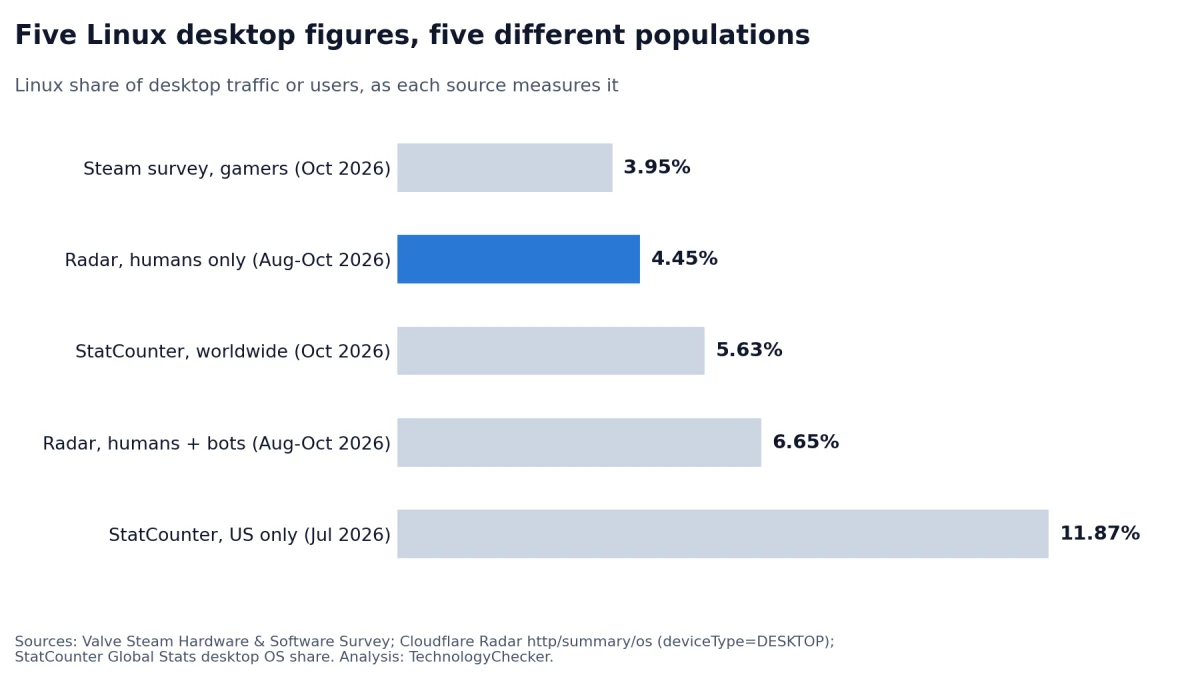
The gap between Radar's two rows is the bot layer, and it's thicker on Linux than on any other desktop OS. In our analysis of Radar's August–October data (the same cuts are in its HTTP data explorer), Linux is 12.11% of desktop bot requests but 4.45% of human ones. Bots claim Linux about 2.7 times as often as people use it.
| Desktop OS | Bots as a share of its requests, Aug–Oct 2025 | Aug–Oct 2026 |
|---|---|---|
| Linux | 47.06% | 52.31% |
| macOS | 16.19% | 33.98% |
| Windows | 17.06% | 25.20% |
| ChromeOS | 5.81% | 14.49% |
Bot share rose on every desktop OS in a year; Linux is the only one where bots are the majority.
StatCounter's history has moved, too. Its CSV exports show no "Unknown" row in any month from June 2024 to October 2026, yet reports in August 2026 quoted a 9.24% Unknown row for North America that June. StatCounter appears to have restated its history, and North America's July 2026 Linux share now reads 10.61%, slightly below the figure first reported. Older StatCounter quotes may not match the live data.
The US series on StatCounter's US desktop page is the starkest case:
| StatCounter US desktop, 2026 | Jun | Jul | Aug | Sep | Oct |
|---|---|---|---|---|---|
| Linux share of page views | 6.33% | 11.87% | 17.78% | 3.69% | 5.57% |
An installed base doesn't nearly triple in two months and then fall below where it started. We think the swing fits automated traffic being counted and then filtered out, though StatCounter hasn't said so. Our operating system market share report breaks the US July figure into bots, ChromeOS counted as Linux, existing users and genuine growth.
Is Linux market share increasing year over year?
Yes. Linux's share of human desktop requests rose from 2.89% in August–October 2024 to 3.22% in 2025 and 4.45% in 2026, a 1.23-point gain in the latest year. Add ChromeOS, the Linux-based system that parsers sometimes misfile as Linux, and the family grew far less: 5.28% to 5.88%, or 0.60 points.
| Desktop, human traffic, Aug–Oct | 2024 | 2025 | 2026 | Change, 2025 to 2026 |
|---|---|---|---|---|
| Linux | 2.89% | 3.22% | 4.45% | +1.23 |
| ChromeOS | 2.21% | 2.06% | 1.43% | −0.63 |
| Linux + ChromeOS | 5.11% | 5.28% | 5.88% | +0.60 |
| Windows | 76.41% | 74.40% | 74.47% | +0.07 |
| macOS | 18.49% | 20.32% | 19.63% | −0.69 |
| Linux, all traffic (humans + bots) | 4.87% | 4.98% | 6.65% | +1.67 |
Source: Cloudflare Radar, radar/http/summary/os, deviceType=DESKTOP, same three months each year. Pulled 2026-11-03.
On Linux vs Windows market share, the table is blunt. In net terms, Linux's gain matches what macOS and ChromeOS lost, while Windows edged up. The ChromeOS half matters: its user agent carries a CrOS token, and when a parser misses it, a Chromebook falls into "Linux". About half of Linux's one-year gain is matched by ChromeOS's loss, so I treat that half as unproven. Over two years, Linux alone gained 1.56 points and the Linux family 0.77.
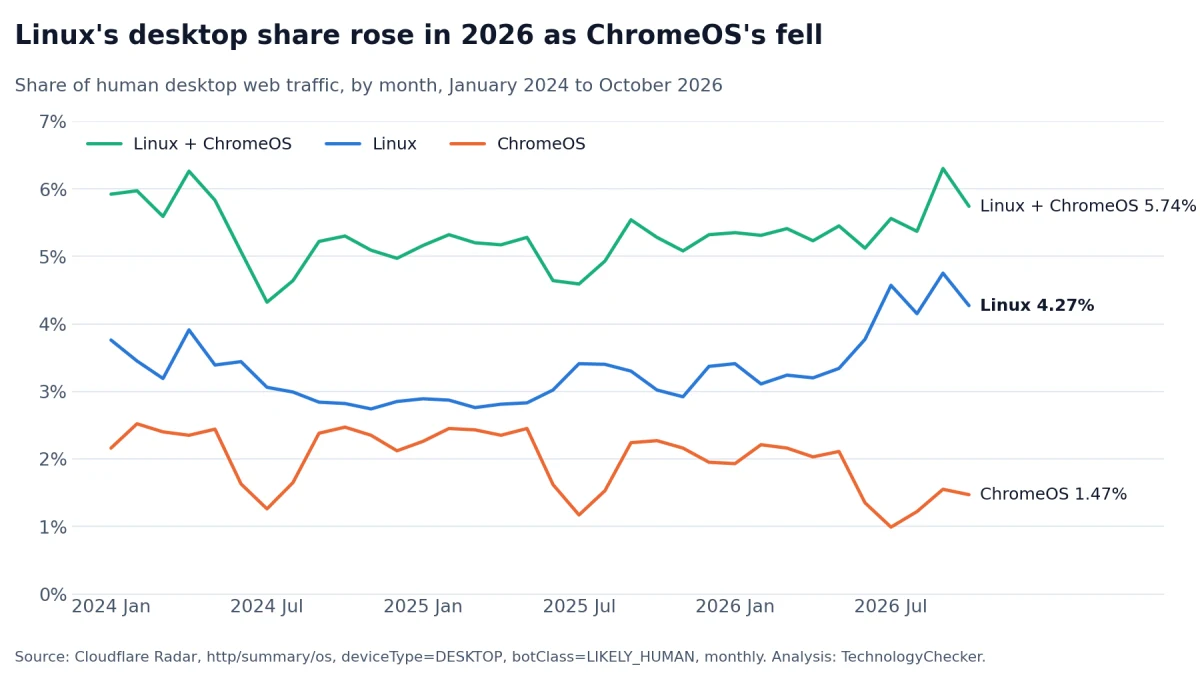
http/summary/os, deviceType=DESKTOP, botClass=LIKELY_HUMAN, January 2024 to October 2026Month by month, Linux alone is at a record. Every month from July 2026 on (4.57%, 4.15%, 4.75% and 4.27%) sits above the highest month between January 2024 and June 2026, which was 3.91% in April 2024. The Linux family tells a quieter story. Linux plus ChromeOS reached 6.26% that April, and since July 2026 the combined line has run between 5.37% and 6.30%. September 2026 edges April 2024 by 0.04 points, which I'd call level.
ChromeOS dips every summer while schools are closed: 1.26% in July 2024, 1.17% in July 2025, 0.99% in July 2026. It normally recovers by October (2.47% in 2024, 2.27% in 2025). In October 2026 it stayed at 1.47%. That missing recovery decides how much of Linux's 2026 gain is people rather than parsing, so I'll watch it next.
Other trackers agree on direction. StatCounter's worldwide desktop CSV climbs from 3.33% in October 2025 to 5.66% in October 2026, and on US government sites the desktop-families figure rose from 5.09% to 6.96% (our calculation), which fits the US carrying most of the growth.
Did Windows 10's end of support push people to Linux?
No. Windows 10's end of support did not move measurable desktop share to Linux in the following year. Microsoft ended Windows 10 support on 14 October 2025, and for the next eight months Linux plus ChromeOS stayed below its September 2025 level of 5.54%.
| Human desktop, 2025–2026 | Linux | ChromeOS | Linux + ChromeOS | Windows |
|---|---|---|---|---|
| Sep 2025 | 3.30% | 2.24% | 5.54% | 73.96% |
| Oct 2025 (support ends) | 3.02% | 2.27% | 5.28% | 74.61% |
| Nov 2025 | 2.92% | 2.16% | 5.08% | 74.88% |
| Dec 2025 | 3.37% | 1.95% | 5.32% | 75.27% |
| Jan 2026 | 3.41% | 1.93% | 5.35% | 74.59% |
| Mar 2026 | 3.24% | 2.16% | 5.41% | 74.15% |
| May 2026 | 3.34% | 2.11% | 5.45% | 74.53% |
| Jul 2026 | 4.57% | 0.99% | 5.56% | 74.18% |
| Oct 2026 | 4.27% | 1.47% | 5.74% | 74.68% |
Windows held roughly 74% to 75% of human desktop requests throughout, and the combined line didn't pass September's 5.54% until July 2026. Linux's rise started in June and July 2026, eight to nine months after the deadline. Those are exactly the months ChromeOS fell, from 2.11% in May to 0.99% in July. A Windows 10 exodus would have shown up in late 2025, with Windows giving ground. Neither happened.
There was no cliff because anyone who wanted another year of Windows 10 security patches could get one. Microsoft's consumer Extended Security Updates programme lets home users enrol free by syncing PC settings, by redeeming 1,000 Microsoft Rewards points, or for $30. That cover was due to end on 13 October 2026, inside this report's window, until Microsoft extended it to 12 October 2027 around 25 June 2026.
Linux market share by country: the 30 largest desktop markets
The United States has the highest Linux share of the 30 largest desktop markets: 7.11% of human desktop requests in August–October 2026, up from 3.87% a year earlier. Germany (5.76%), India (5.34%), the Netherlands (5.00%) and Singapore (4.85%) follow. Iran (0.80%) and Taiwan (1.56%) sit at the bottom, just below Russia and China (1.78% each) and Japan (1.80%).
| Country | Linux 2026 | Linux 2025 | Change (pts) | ChromeOS 2026 | Linux + ChromeOS change (pts) |
|---|---|---|---|---|---|
| United States | 7.11% | 3.87% | +3.24 | 3.04% | +1.59 |
| Germany | 5.76% | 5.33% | +0.43 | 0.40% | +0.25 |
| India | 5.34% | 4.97% | +0.37 | 0.74% | +0.35 |
| Netherlands | 5.00% | 3.67% | +1.32 | 1.70% | +1.06 |
| Singapore | 4.85% | 2.46% | +2.39 | 0.54% | +2.40 |
| United Kingdom | 4.51% | 3.48% | +1.03 | 1.93% | +0.60 |
| Spain | 4.19% | 3.46% | +0.73 | 1.31% | +0.03 |
| Indonesia | 4.03% | 3.23% | +0.80 | 0.59% | +0.44 |
| France | 3.97% | 3.33% | +0.65 | 0.78% | +0.51 |
| Poland | 3.84% | 3.23% | +0.61 | 0.30% | +0.57 |
| South Africa | 3.80% | 2.75% | +1.05 | 0.59% | +0.83 |
| Italy | 3.50% | 3.30% | +0.20 | 0.66% | +0.15 |
| Ukraine | 3.50% | 3.17% | +0.33 | 0.25% | +0.26 |
| Turkey | 3.46% | 2.37% | +1.09 | 0.08% | +1.09 |
| Brazil | 3.22% | 3.09% | +0.13 | 1.01% | −0.29 |
| Canada | 3.19% | 2.33% | +0.86 | 2.04% | +0.15 |
| Mexico | 3.09% | 2.13% | +0.96 | 0.68% | +0.62 |
| Thailand | 2.90% | 2.67% | +0.23 | 0.45% | +0.58 |
| Argentina | 2.86% | 2.66% | +0.20 | 0.15% | +0.17 |
| Philippines | 2.65% | 2.25% | +0.40 | 0.94% | +0.07 |
| Saudi Arabia | 2.49% | 2.54% | −0.05 | 0.13% | −0.18 |
| Australia | 2.27% | 1.92% | +0.35 | 1.95% | +0.71 |
| South Korea | 2.26% | 2.36% | −0.10 | 0.55% | −0.36 |
| Colombia | 2.08% | 1.66% | +0.42 | 0.35% | +0.09 |
| Vietnam | 2.02% | 1.41% | +0.61 | 0.06% | +0.61 |
| Japan | 1.80% | 1.48% | +0.32 | 1.06% | −0.26 |
| China | 1.78% | 0.84% | +0.94 | 0.05% | +0.99 |
| Russia | 1.78% | 3.53% | −1.75 | 0.01% | −1.76 |
| Taiwan | 1.56% | 1.54% | +0.02 | 0.09% | −0.05 |
| Iran | 0.80% | 6.39% | −5.59 | 0.00% | −5.60 |
Source: Cloudflare Radar, radar/http/summary/os by location, deviceType=DESKTOP, botClass=LIKELY_HUMAN, August–October 2026 vs August–October 2025. The 30 countries are the largest by human desktop request volume. Pulled 2026-11-03.
Linux rose in 26 of the 30 markets, and Linux plus ChromeOS rose in 23. The US is where those two measures split furthest apart: Linux gained 3.24 points while US ChromeOS fell from 4.69% to 3.04%, so the family grew by 1.59. Holding the US at its 2026 weight of 27.11% of global human desktop requests, our estimate is that the US alone adds about 0.88 points of the global 1.23-point Linux gain. That's roughly seven-tenths of the worldwide increase, from the country where ChromeOS fell hardest.
Russia (3.53% to 1.78%) and Iran (6.39% to 0.80%) fell sharply. Both have heavily filtered internets, where the traffic that reaches Cloudflare shifts with VPN use and blocking. The data can't tell whether anyone there stopped using Linux, so I wouldn't read either row as a trend.
Which browsers do Linux desktop users run?
Chrome carries 79.34% of human desktop requests from Linux, up from 70.24% a year earlier, and Firefox 17.03%, down from 24.19%. Chrome now has a bigger share on Linux than on Windows (69.31%) or macOS (58.62%).
| Browser, human desktop | On Linux 2025 | On Linux 2026 | On Windows 2026 | On macOS 2026 |
|---|---|---|---|---|
| Chrome | 70.24% | 79.34% | 69.31% | 58.62% |
| Firefox | 24.19% | 17.03% | 7.43% | 5.28% |
| Samsung Internet | 3.83% | 2.09% | ~0% | 0% |
| Edge | 0.90% | 0.97% | 20.62% | 0.92% |
| Safari | 0.09% | 0.07% | ~0% | 34.68% |
Source: Cloudflare Radar, browser share filtered to each operating system, deviceType=DESKTOP, botClass=LIKELY_HUMAN, August–October. Pulled 2026-11-03.
Multiplying each browser's share of Linux by Linux's share of all human desktop requests (our calculation) shows where the growth went. Chrome-on-Linux went from 2.26% of all human desktop requests in 2025 to 3.53% in 2026, a gain of 1.27 points. Firefox-on-Linux went from 0.78% to 0.76%. Linux as a whole grew 1.23 points, so all of Linux's one-year gain is Chrome-on-Linux.
Linux desktop users are still 2.3 times as likely as Windows users to run Firefox (17.03% against 7.43%). Firefox's wider position is in our Firefox market share report, and the browser that picked up the new Linux traffic is in our Chrome market share analysis.
One browser in the table shouldn't be there at all. Samsung Internet has no Linux desktop version, yet it carries 2.09% of "Linux desktop" human requests. Samsung's user-agent documentation explains why: its desktop mode sends X11; Linux x86_64. Since December 2023, Chrome on "premium" Android tablets (8 GB of RAM or more, 10-inch screens and up) has requested desktop sites by default with the same string, as 9to5Google reported. We can't size the Chrome-tablet share. The Samsung 2.09% is the visible floor, and no web-traffic source can fully separate those tablets from real Linux desktops.
So three explanations fit Chrome-on-Linux growth: Chromebooks counted as Linux when a parser misses CrOS, Android tablets in desktop mode, and real Linux users moving to Chrome-based browsers. The data can't choose between them, and they aren't mutually exclusive.
What is Linux market share on Steam?
Linux was 3.95% of Steam Hardware & Software Survey respondents in October 2026, up 0.90 points on September. A year earlier, in an archived copy of Valve's October 2025 page, it was 3.05%. Steam counts gamers who opt in, a different population from web traffic, so the two shouldn't be expected to match.
Steam's monthly Linux share moves with the survey's language mix. Simplified Chinese respondents fell from 31.39% of the sample in September to 21.98% in October, and because Chinese-language respondents are overwhelmingly on Windows, Linux's share rose as they dropped out.
The Linux-only view of the survey lists distributions as a share of Linux Steam users:
| Linux distro on Steam, Oct 2026 | Share of Linux Steam users |
|---|---|
| CachyOS | 16.39% |
| SteamOS Holo | 13.89% |
| Arch Linux | 8.92% |
| Linux Mint 22.3 | 8.41% |
| SteamOS | 8.09% |
| Bazzite | 6.74% |
| Ubuntu 26.04.1 LTS (highest Ubuntu row) | 3.63% |
| Other | 14.76% |
Gaming-first distributions lead. CachyOS, Bazzite and Valve's own SteamOS builds take most of the top spots, and Ubuntu isn't in the top six. Valve added a separate "SteamOS" label this month alongside "SteamOS Holo", so read those two rows as one family.
Linux market share by distro: which distributions run the web?
Ubuntu runs 69.09% of the Linux web servers TechnologyChecker can identify by distribution, Debian 21.94% and CentOS 5.40%. Web traffic can't measure desktop distro share, because browsers rarely name a distribution in their user agent, so this section measures the server side from our own crawl.
| Distro | Live domains | Share of the seven Linux distros |
|---|---|---|
| Ubuntu | 409,810 | 69.09% |
| Debian | 130,134 | 21.94% |
| CentOS | 32,041 | 5.40% |
| AlmaLinux | 13,392 | 2.26% |
| Red Hat | 5,720 | 0.96% |
| Fedora | 1,461 | 0.25% |
| Gentoo | 619 | 0.10% |
| Total | 593,177 | 100% |
Source: TechnologyChecker detection data. Analysed 29 August 2026 (Ubuntu), 7 September 2026 (Debian, CentOS, AlmaLinux) and 11 October 2026 (Red Hat, Fedora, Gentoo).
TechnologyChecker detects Ubuntu on 409,810 live domains, more than three times Debian's count. Treat the whole table as a floor. Detection relies on the web server naming the distro in a Server or X-Powered-By response header, and only about 2.7% of live domains disclose an operating system at all. Nginx leaves the OS out by default, and CDNs strip the header.
CentOS still outnumbers its replacement, AlmaLinux, 2.4 to 1 (32,041 domains against 13,392), even though both of CentOS's last releases are out of support. Churn ratios and the country split for Ubuntu, Debian and CentOS are in the server OS section of our OS market share report, and every server OS we detect is listed in the operating systems category.
Which Linux market share number should you quote?
Quote the number whose population matches your question: for people on Linux desktops worldwide, that's Radar's human figure of 4.45%, or your country's row.
| If your question is… | Quote | Why |
|---|---|---|
| How many people browse on Linux desktops? | 4.45% (Radar, humans, Aug–Oct 2026) | Bots removed; still requests, not people |
| Should we build or test for Linux in the US? | 7.11% (Radar, US humans) | Well above the global figure |
| How many gamers run Linux? | 3.95% (Steam, Oct 2026) | Opt-in gamer survey |
| What does StatCounter say? | 5.63% (Oct 2026), with its date | Its history gets restated |
| Which distros run web servers? | Ubuntu, 69.09% (TechnologyChecker) | A floor: header-disclosed servers only |
If your own analytics show Linux well above these levels, check them for bots and for Android tablets in desktop mode before you plan a native client.
Methodology
Windows and pull dates. The headline window is 1 August to 31 October 2026 (Radar dateStart=2026-08-01, dateEnd=2026-11-01), compared with the same three months of 2025 and 2024. The monthly series uses calendar months from January 2024 to October 2026. Radar data was pulled on 3 and 4 November 2026; third-party figures were read on 3 November 2026.
Endpoints and filters. Every OS share comes from Cloudflare Radar http/summary/os with deviceType=DESKTOP. Human means botClass=LIKELY_HUMAN, bots means botClass=LIKELY_AUTOMATED, and "all traffic" has no bot-class filter. Bot share inside each OS and the browser mix (humans only) use Radar's bot-class and browser summaries filtered to that OS. Country rows add a location filter, and the 30 countries are the largest by human desktop request volume.
Units and limits. Radar reports shares of HTTP requests, not people, devices or sessions, and it sees Cloudflare-proxied traffic, a large but not random slice of the web. Bot classification is a model. A scraper that passes as human lands in the human column, and some real users get flagged as automated.
What counts as Linux. Radar's Linux row excludes Android and ChromeOS, which have their own rows even though both run a Linux kernel. SteamOS appears only in Steam's figures, which count it as Linux. Android tablets in desktop mode report as Linux and can't be fully removed.
Other sources. StatCounter figures come from its HTML pages and CSV exports, Steam's October 2025 figure from a Wayback Machine copy of Valve's page, and the DAP desktop-families figure is our calculation from analytics.usa.gov's API. Server distro counts come from TechnologyChecker's crawl, on the analysis dates given under the distro table.
Linux market share FAQ
What is the current market share of Linux?
Linux holds 4.45% of human desktop web traffic worldwide for August to October 2026, according to Cloudflare Radar, and 6.65% with bot traffic included. StatCounter put it at 5.63% of desktop page views in October 2026. Across all devices, phones included, Linux is 2.07% of human web requests.
Is Windows losing market share to Linux?
Windows is not losing desktop share to Linux: it held 74.40% of human desktop requests in August to October 2025 and 74.47% in the same months of 2026, while Linux gained 1.23 points. Windows 10's end of support didn't change that, partly because consumer Extended Security Updates now run to October 2027.
Is Linux market share increasing in 2026?
Yes, on its own. Linux rose from 3.22% to 4.45% of human desktop requests year over year, and every month since July 2026 beat its earlier peak. Counted together with ChromeOS, the growth shrinks to 0.60 points, and by our estimate roughly seven-tenths of the Linux gain comes from the United States.
What is the current desktop OS market share?
On human desktop web traffic for August to October 2026, Windows has 74.47%, macOS 19.63%, Linux 4.45% and ChromeOS 1.43%, according to Cloudflare Radar. Count bots as well and Windows drops to 70.95% while Linux rises to 6.65%, because automated traffic over-represents Linux.
What is Linux market share on Steam?
Linux was 3.95% of Steam Hardware & Software Survey respondents in October 2026, up from 3.05% in October 2025. Steam measures gamers who opt in, and its monthly figure swings with the survey's language mix, so compare several months.
How has Linux market share changed by year?
For August to October on human desktop traffic, Linux was 2.89% in 2024, 3.22% in 2025 and 4.45% in 2026. With bots included it was 4.87%, 4.98% and 6.65%. Most of the growth came in mid-2026 as ChromeOS fell, so Linux plus ChromeOS rose less: 5.11%, 5.28%, 5.88%.
What is Linux market share by distro in 2026?
Web traffic can't measure desktop distro share, so only partial views exist. Among Linux Steam users in October 2026, CachyOS leads at 16.39%, then SteamOS Holo at 13.89% and Arch Linux at 8.92%. Among web servers that name their distro, TechnologyChecker counts Ubuntu at 69.09%, Debian at 21.94% and CentOS at 5.40%.
Which Linux distro has the highest desktop share?
Nobody can say for certain, because browsers rarely name a distribution. The best proxy is Steam, where CachyOS leads Linux gaming desktops, but a gamer sample won't reflect office or developer machines.
Why does Linux desktop market share include bots?
A tracker counts whatever reaches it, and bots claim Linux far more often than people use it. In Radar's data, Linux is 12.11% of desktop bot requests against 4.45% of human ones, and 52.31% of desktop requests that claim Linux are automated, so any unfiltered figure runs high.
Should B2B SaaS products support Linux desktops?
Base the call on your buyers' countries, not the global average. Linux is 7.11% of US human desktop requests and 5.76% in Germany, against 4.45% worldwide. Filter bots out of your own analytics first; if Linux still shows up near those levels, test your web app on Linux before you cost a native client.
Related research

Data Analyst
5+ years of experience
Emma is a Data Analyst at TechnologyChecker, where she analyses technology adoption data to build better prospect lists and uncover actionable patterns for sales teams.
- BSc Data Science, Cardiff University
- Google Data Analytics Professional Certificate
- Tableau Desktop Certified Associate
Never miss our research