Firefox Market Share Q3 2026: 3.7% vs Chrome's 68.6%, 7.4% Desktop
Firefox fell to 3.65% of human web traffic in Q3 2026, down 0.20 points in a year, as its desktop share slid to 7.4%. How it compares with Chrome.
Published •Updated •Data through September 2026•38 min read

Updated 1 October 2026 with Q3 2026 data (July to September 2026; September is provisional). Earlier update notes are kept in the update history.
Firefox carried 3.65% of human web traffic in Q3 2026, down from 3.85% in Q3 2025. That 0.20-point drop is the first clear year-over-year decline this report has measured, and it happened even though desktop, where nine in ten Firefox sessions live, kept growing as a share of the web. Chrome carried 68.60% over the same quarter. Source: Cloudflare Radar, radar/http/summary/browser_family with botClass=LIKELY_HUMAN, calendar quarters and months, pulled 2026-10-01.
Firefox holds 3.63% of human web traffic as of August 2026. Measured on matched 28-day windows a year apart it reads 3.68% against 3.69% the year before — essentially unchanged. In a year when Safari lost 1.4 points and Chrome gained 1.3, Firefox moved one-hundredth of a point. It is the flattest line in the browser market.
That flatness is the most interesting thing about it, and it isn't what it looks like. Firefox's desktop share actually fell over the year, from 8.15% to 7.59%. It only appears flat because desktop itself grew as a share of the web while mobile receded, and the two moves cancelled almost exactly. Firefox didn't hold its ground. It got carried.
⚠️ superseded by the Q3 2026 update above; preserved as originally published. Measured quarter against quarter, Firefox fell from 3.85% in Q3 2025 to 3.65% in Q3 2026, so the flat year has ended.
I pulled all of this from Cloudflare Radar, comparing the same 28-day window one year apart, 16 June to 14 July in both 2025 and 2026, so the year-over-year numbers are like-for-like rather than two different slices of the calendar. Here's what the data actually says, country by country, operating system by operating system.
How many people use Firefox vs Chrome?
Firefox carried 3.65% of human web traffic in Q3 2026 and Chrome 68.60%, according to Cloudflare Radar, so Chrome handles about 19 requests for every one from Firefox. On desktop, where Firefox lives, the gap narrows to about 9 to 1 (67.88% against 7.40%). On phones it's about 105 to 1 (69.23% against 0.66%). These are shares of human requests, not head counts.
| Q3 2026, human traffic | Firefox | Chrome | Chrome requests per Firefox request |
|---|---|---|---|
| All devices | 3.65% | 68.60% | 18.8 |
| Desktop | 7.40% | 67.88% | 9.2 |
| Mobile | 0.66% | 69.23% | 104.5 |
Source: Cloudflare Radar, radar/http/summary/browser_family, botClass=LIKELY_HUMAN, filtered by deviceType for the device rows, 1 July to 30 September 2026. Pulled 2026-10-01.
Other trackers put Firefox lower, and the reason is what they count. StatCounter's worldwide page for September 2026, as displayed on 1 October 2026, shows Firefox at 2.8% and Chrome at 66.36%; its desktop page shows Firefox at 6.11% and Chrome at 65.09%. Radar's September figures on human traffic are 3.64% and 68.58% overall, and 7.26% and 68.24% on desktop. StatCounter counts page views on the sites that run its tracking tag. Radar counts requests from browsers Cloudflare classes as human across its whole network. Both agree Chrome leads by an order of magnitude; they disagree about Firefox's size by roughly a point, and neither one counts people. Any "X million Firefox users" figure comes from a different method entirely, and I haven't used one here.
Chrome's own numbers, and why its gain this year came on phones, are in the Chrome market share report.
Q3 2026 analysis: the flat line finally tilted
Q2 2026 reads 3.84%, but that quarter contains the two anomalous May weeks flagged further down, so the like-for-like comparison is Q3 against Q3.
| Firefox | Q3 2025 | Q2 2026 | Q3 2026 | vs Q3 2025 |
|---|---|---|---|---|
| All human traffic | 3.85% | 3.84% | 3.65% | −0.20 pt |
| Desktop | 8.04% | 7.82% | 7.40% | −0.65 pt |
| Mobile | 0.58% | 0.64% | 0.66% | +0.08 pt |
| Desktop's share of human traffic | 43.45% | 45.09% | 45.62% | +2.17 pt |
Source: Cloudflare Radar, radar/http/summary/browser_family (by deviceType) and radar/http/summary/device_type, botClass=LIKELY_HUMAN, full calendar quarters, pulled 2026-10-01. Q3 2026 includes a provisional September.
This is the July call coming due. I wrote then that Firefox's flat year was borrowed: it was losing desktop share and being carried by desktop growing as a slice of the web, and that the decline would show in the headline once the tailwind weakened. The tailwind didn't even stop. Desktop grew another 2.17 points of human traffic, worth roughly 0.15 points to Firefox, and the headline fell anyway, because Firefox lost 0.65 points of its own desktop share in a year. Over the same quarters Edge rose from 14.22% to 15.63% of desktop traffic.
My July prediction was that Firefox drifts into the low 3s over the next couple of years. At 3.65% it isn't there, and one quarter doesn't make a trend. But the mechanism I described is now visible in the headline number rather than hidden under it, and that's the thing I'd watch in Q4.
One September caveat applies to every browser in this edition. Cloudflare's bot share of all requests climbed from 33.44% on 1 September to 39.75% on the 30th, and the traffic it still classes as human changed shape with it. Firefox, which barely moved (3.64% for the month), is the browser least affected; Safari is the most, as the Safari report explains.
Firefox is the world's #4 browser, and the only one that shrinks when you remove bots
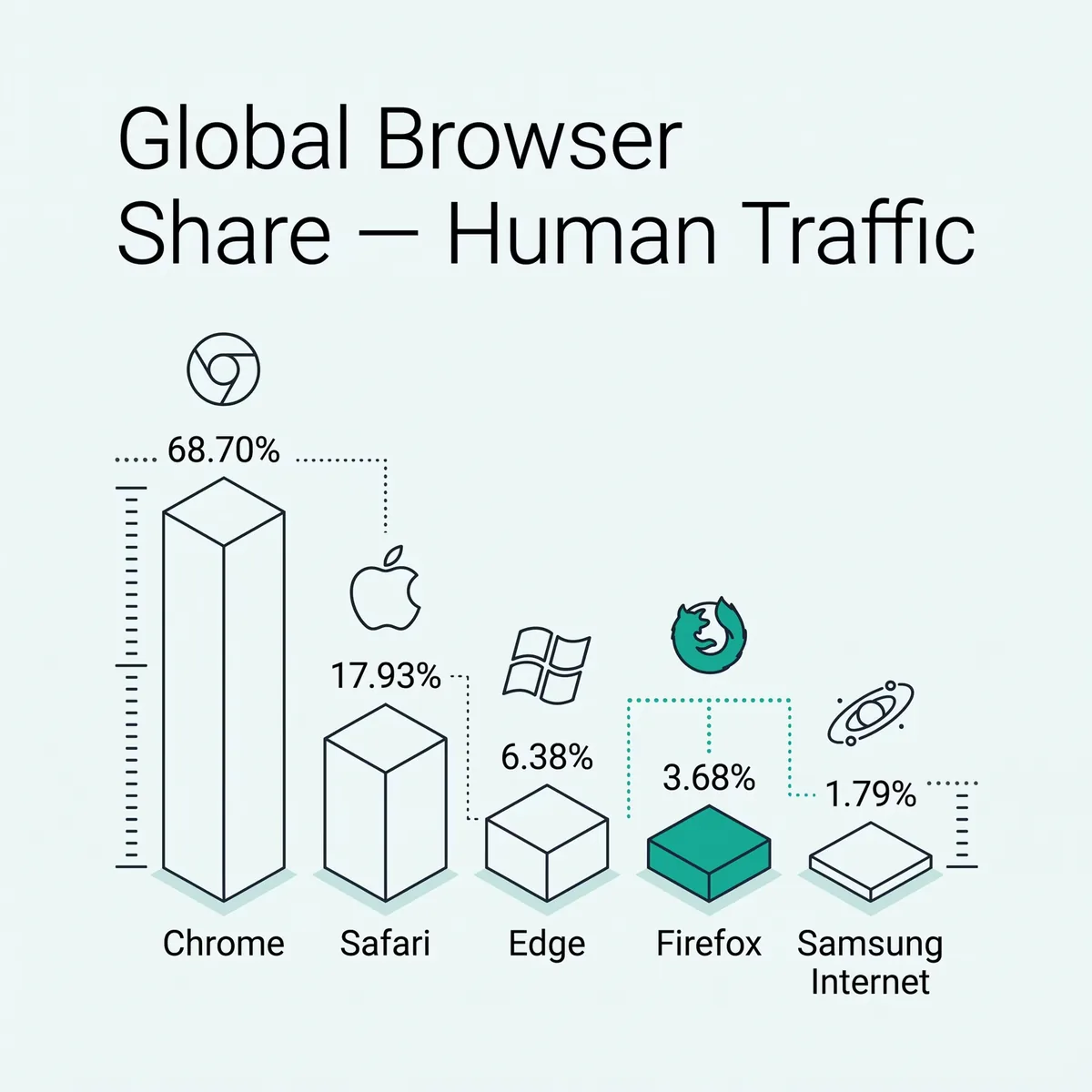
Firefox's market share in August 2026 is 4.17% across all global web traffic and 3.63% when you count only human requests, per Cloudflare Radar. It sits fourth, behind Chrome, Safari, and Edge.
Look closely at those two numbers, because they run backwards. For almost every other browser, filtering out bots makes the browser look bigger, since automated traffic overwhelmingly identifies as Chrome. Safari climbs from 15.7% to 17.6% when you drop the bots. Firefox goes the other way: it falls from 4.17% to 3.63%.
Here's Firefox's share three ways, depending on what traffic you decide to count:
| Traffic measured | Firefox | Chrome | Safari |
|---|---|---|---|
| All requests | 4.17% | 70.7% | 15.7% |
| Human only | 3.63% | 68.7% | 17.6% |
| Bots only | 4.93% | 79.6% | 8.5% |
Source: Cloudflare Radar — http/summary/browser_family, 28 days ending 5 August 2026.
Firefox's share of bot traffic (4.93%) is higher than its share of human traffic (3.63%). Scrapers, crawlers, and automated agents pick a Firefox user-agent string more often than actual people run the browser. It's a cheap, common choice for automation precisely because it's a real browser that isn't Chrome, which makes it useful camouflage.
The practical consequence: any browser-share figure that doesn't filter bots overstates Firefox by about half a point. That's a big relative error on a number this small — roughly 15% of the total.
I'll use the human-only figure throughout, because that's the number that maps to people loading your site — 3.63% for the current August window, and 3.68% in the matched year-over-year windows used for the trend sections below.
The flat year: Firefox moved 0.01 points while everything around it moved
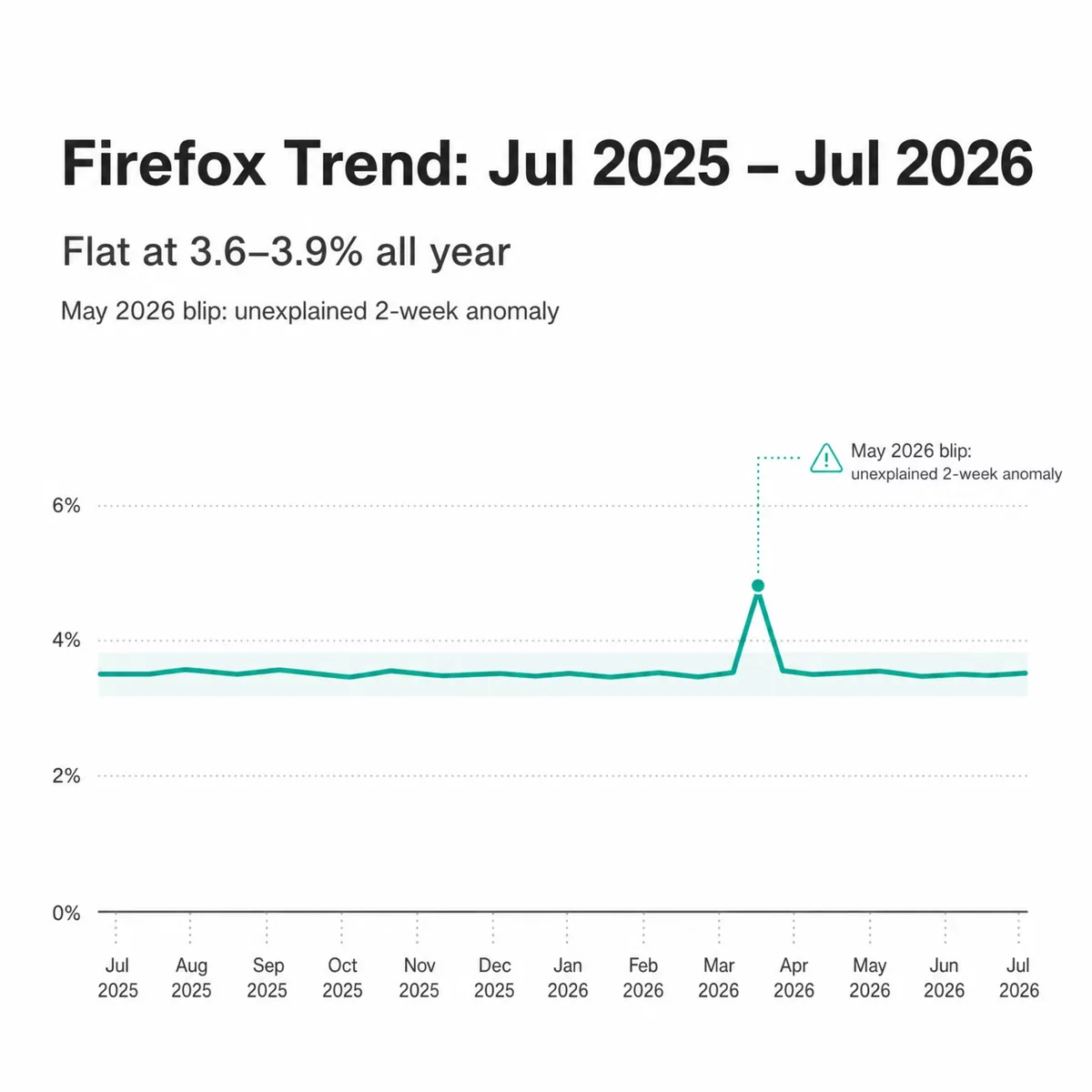
Comparing the same 28-day window in 2025 and 2026, on human traffic only, this is the whole browser market's year:
| Browser | 2025 | 2026 | Year-over-year |
|---|---|---|---|
| Chrome | 67.41% | 68.70% | +1.29 pt |
| Safari | 19.36% | 17.93% | −1.43 pt |
| Edge | 6.12% | 6.38% | +0.26 pt |
| Firefox | 3.69% | 3.68% | −0.01 pt |
| Samsung Internet | 1.83% | 1.79% | −0.04 pt |
| Opera | 1.40% | 1.31% | −0.09 pt |
Source: Cloudflare Radar — http/summary/browser_family, human (LIKELY_HUMAN) traffic, 28-day windows 16 Jun–14 Jul 2025 vs 16 Jun–14 Jul 2026. Pulled 2026-07-14.
Safari shed 1.43 points and Chrome absorbed almost all of it. Firefox sat out the entire transfer. It neither gained from Safari's loss nor gave anything to Chrome's gain.
This deserves saying plainly, because it contradicts the story most people carry around: in 2026, Firefox is not dying. The dramatic collapse everyone remembers happened years ago. What Radar shows over the last twelve months is a browser that has stopped falling and found a floor. The weekly series backs it up — Firefox spent the year oscillating in a narrow band between 3.5% and 3.9%, with no trend to speak of.
An honesty note on the trend, because it changes what you should trust. If you compare full calendar quarters instead of matched 28-day windows, Firefox appears to rise, from 3.63% in Q2 2025 to 3.84% in Q2 2026. That's an artifact. Two weeks in May 2026 show an unexplained spike to 4.44% and 4.65%, well outside Firefox's normal band, and they sit inside Q2 2026 and drag the quarterly average up. Strip those two weeks and Q2 2026 comes out at 3.71%. I've used matched 28-day windows for every year-over-year figure in this report specifically because they exclude that anomaly. If you see a source claiming Firefox grew in 2026, this is probably why.
The stat that stopped me: Firefox's flat year was an accident
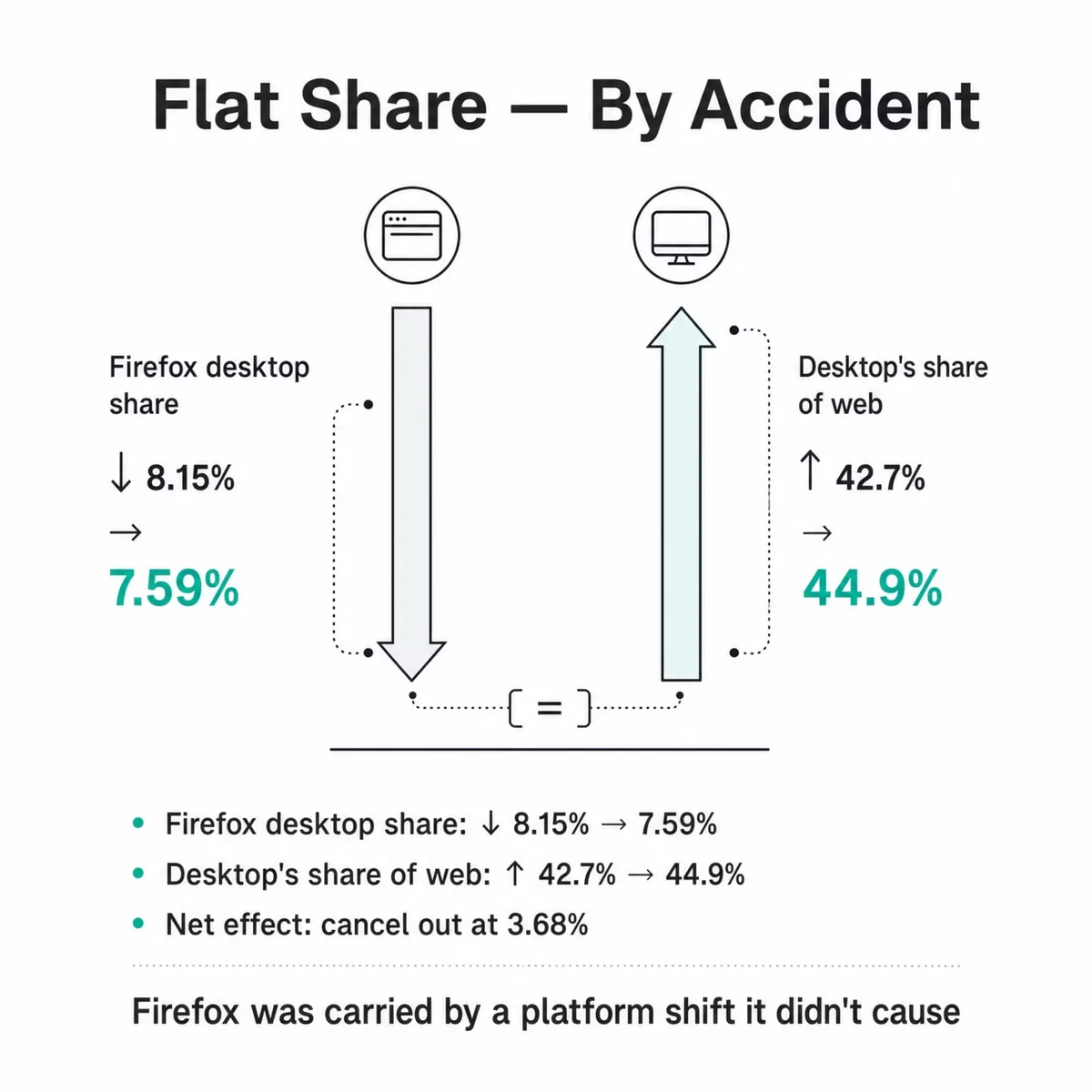
Here is the number that made me re-run the query. Firefox's overall share held steady, but its share of desktop fell:
| Firefox on… | 2025 | 2026 | Year-over-year |
|---|---|---|---|
| Desktop | 8.15% | 7.59% | −0.56 pt |
| Mobile | 0.44% | 0.65% | +0.21 pt |
Firefox lost more than half a point on the desktop, which is where essentially all of its users are. So how did the overall number not move?
Because the web itself moved underneath it. Desktop's share of human traffic grew over the year, from 42.7% to 44.9%, as mobile slipped from 57.3% to 55.1%. Firefox got a bigger slice of the pie handed to it at exactly the moment it was losing grip on its own slice.
| Device mix (human traffic) | 2025 | 2026 |
|---|---|---|
| Mobile | 57.3% | 55.1% |
| Desktop | 42.7% | 44.9% |
Run the arithmetic and the two effects cancel almost perfectly. Weighting Firefox's device shares by the device mix gives 3.73% in 2025 and 3.77% in 2026 — reconciling with the headline figures, and confirming the flat line is real rather than a query artifact.
Now hold the device mix constant. If desktop had stayed at its 2025 weight of 42.7% of the web, Firefox's 2026 share would land at roughly 3.61%, not 3.68%. The desktop rebound was worth about 0.16 points to Firefox — and it's the only reason the line looks flat.
This is the difference between a browser holding its users and a browser being carried by a platform shift it had nothing to do with. Firefox is the second. And the tailwind isn't guaranteed to keep blowing — if the mobile-versus-desktop mix stops shifting, Firefox's underlying desktop decline shows up in the headline number immediately.
Firefox's 2026, month by month, against every other browser
Firefox's flat year is the point of this post, and the monthly table is the cleanest evidence for it. It also shows that flat was an unusual outcome in 2026, not a normal one.
| Month | Chrome | Safari | Edge | Firefox | Samsung | Opera |
|---|---|---|---|---|---|---|
| January 2026 | 68.55% | 18.28% | 5.98% | 3.70% | 1.94% | 1.37% |
| February 2026 | 68.33% | 18.03% | 6.44% | 3.74% | 1.88% | 1.36% |
| March 2026 | 68.50% | 17.73% | 6.56% | 3.79% | 1.84% | 1.36% |
| April 2026 | 68.51% | 17.72% | 6.67% | 3.72% | 1.79% | 1.35% |
| May 2026 | 68.03% | 17.75% | 6.74% | 4.07% | 1.80% | 1.37% |
| June 2026 | 68.49% | 17.95% | 6.58% | 3.68% | 1.76% | 1.34% |
| July 2026 | 68.85% | 17.58% | 6.69% | 3.64% | 1.76% | 1.27% |
| August 2026 | 68.35% | 17.52% | 7.37% | 3.67% | 1.66% | 1.22% |
| September 2026 (provisional) | 68.58% | 18.02% | 6.92% | 3.64% | 1.46% | 1.20% |
| Change, January–August | −0.20 pt | −0.76 pt | +1.39 pt | −0.03 pt | −0.28 pt | −0.15 pt |
| Change, January–September | +0.03 pt | −0.26 pt | +0.93 pt | −0.06 pt | −0.48 pt | −0.17 pt |
Source: Cloudflare Radar — radar/http/summary/browser_family with botClass=LIKELY_HUMAN, one call per calendar month, pulled 2026-09-03; January to August re-pulled 2026-10-01 and reproduced to the second decimal, September added the same day (provisional). Normalization: PERCENTAGE. Human traffic only — bots are excluded, which is why these figures differ from blended browser rankings published elsewhere. Rows do not sum to 100% because the long tail (UC Browser, Yandex, Brave, Coc Coc) is omitted; it totals about 0.2%.
Firefox moved 0.03 points across eight months. January 3.70%, August 3.67%, with a single excursion to 4.07% in May that reverted the following month. No other browser in the table was that still: Edge moved 1.39 points, Safari 0.76, Samsung 0.28, Opera 0.15.
That stillness is the argument this post makes throughout. Firefox is nobody's default. It does not gain when a vendor ships it preinstalled and it does not lose when a competitor does, because its users chose it deliberately and keep choosing it. Every other browser in this table moved because something changed about how devices ship or how workplaces are configured. Firefox has no such lever attached to it.
The May reading is worth one caution. 4.07% is the highest Firefox figure in the series and it appears for one month only, with 3.68% either side of it. We are reporting it because it is what the endpoint returns, not because we think Firefox gained and lost 0.4 points in eight weeks.
September kept Firefox still and moved the browsers around it. Firefox read 3.64%, so January to September it's down 0.06 points, still the stillest line in the table. Safari jumped 0.50 points and Edge gave back 0.45, which is why the January-to-September row reads differently from the January-to-August one above; the Safari move is mostly a change in what Cloudflare classed as human traffic during September. The quarter view at the top is where Firefox's real 2026 story shows: stillness month to month, and a decline once you compare with the same quarter last year.
Firefox is nobody's default, and that explains almost everything
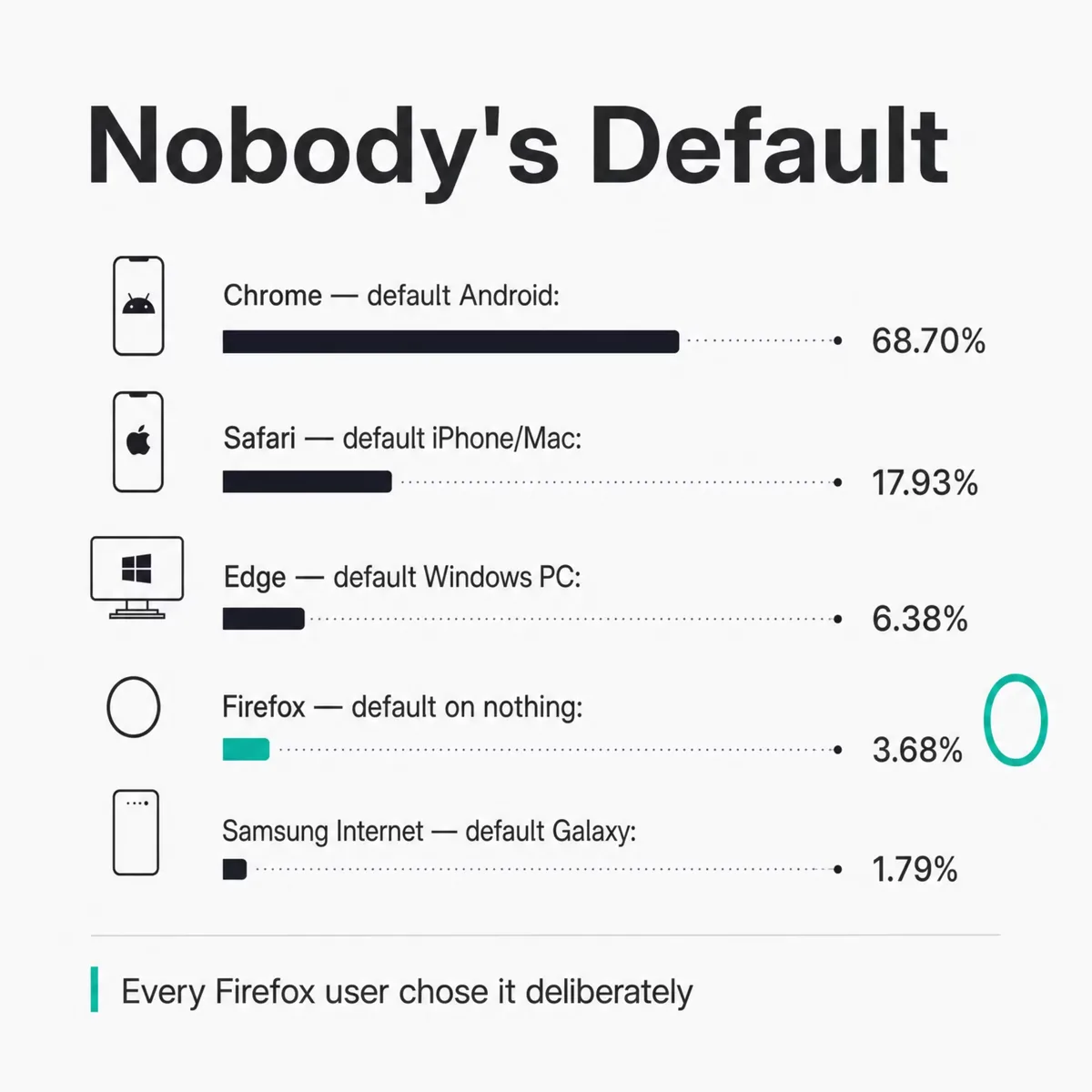
Every other browser in the top six is somebody's default, preinstalled on hardware someone already bought:
| Browser | Ships as default on | Aug 2026 human share |
|---|---|---|
| Chrome | Most Android phones | 68.66% |
| Safari | Every iPhone, iPad, and Mac | 17.57% |
| Edge | Every Windows PC | 6.93% |
| Samsung Internet | Galaxy phones | 1.74% |
| Opera | Preinstalled on some devices | 1.25% |
| Firefox | Nothing | 3.63% |
Source: Cloudflare Radar — http/summary/browser_family, human traffic, 28 days ending 5 August 2026.
Firefox is the only one that arrives on zero devices. No operating system ships it, no manufacturer bundles it, no carrier preloads it. Every single Firefox session on the web in 2026 traces back to a person who went and got it on purpose.
That reframes the 3.63%. It isn't the share of people who tolerate Firefox, the way most of Chrome's Android share is people who never changed a setting. It's the share of the web that actively chose its browser and chose this one. It's the closest thing the internet has to a measurement of deliberate browser choice.
It also explains the shape of everything below. Safari's share is predicted almost perfectly by how many iPhones a country has — it's a hardware story. Firefox has no hardware to ride, so its share isn't predicted by any device at all. It's predicted by intent, and intent varies by culture in ways hardware doesn't.
New for August: Firefox is the only browser that doesn't know it's the weekend
The "nobody's default" argument above is the kind of claim that's easy to assert and hard to prove. Last month's data proves it, from an angle I didn't expect.
Browser share moves on a seven-day cycle. When I broke the last twelve weeks down day by day rather than week by week, two browsers turned out to swing hard in opposite directions, and Firefox turned out to be the flattest line in the dataset again.
| Browser | Weekday avg | Weekend avg | Swing | Consistent week to week? |
|---|---|---|---|---|
| Safari | 17.21% | 19.44% | +2.23 pt | Yes, positive in all 9 weeks |
| Edge | 7.33% | 4.81% | −2.51 pt | Yes, negative in all 9 weeks |
| Chrome | 68.67% | 68.51% | −0.15 pt | No, sign flips week to week |
| Firefox | 3.66% | 3.61% | −0.06 pt | No, never leaves ±0.11 pt |
Source: Cloudflare Radar — http/timeseries_groups/browser_family, human (LIKELY_HUMAN) traffic, daily aggregation, 1 June–5 August 2026 (66 days, 9 full weeks). Pulled 2026-08-05. This window deliberately excludes the two anomalous May 2026 weeks flagged in the trend section above; including them moves Firefox's swing only from −0.06 to −0.05, so the finding doesn't depend on that choice.
Read the swing column as a measure of why people are using a browser. Edge loses a third of its share every Saturday because Edge is what corporate Windows fleets are issued. Its share is really a count of how many managed desktops are switched on. Safari gains two points every Saturday because Safari is what people own: personal iPhones and Macs get used more at the weekend, not less. Both browsers are defaults, and their shares swing with whichever context their default applies to.
Firefox does neither. Its weekday and weekend averages differ by six hundredths of a point, and across the nine full weeks in the window that gap never once exceeded a tenth of a point in either direction (−0.11 to +0.03). Compare that with Edge, whose weekend loss was between −2.28 and −2.58 points every single week, and Safari, whose gain was between +1.83 and +2.65 every single week. Firefox's cycle isn't small. It's absent.
That's the "nobody's default" thesis showing up in the timestamps. Firefox has no work context and no home context because it was never issued and never preinstalled. The people using it went and got it, and they use it wherever they are. A browser that swings with the working week is measuring hardware deployment; a browser that doesn't is measuring people.
There's a practical edge to this for anyone quoting the number. Because Firefox has no weekly cycle, its share is unusually robust to how you sample it: a Tuesday-only measurement and a whole-week measurement will agree. That's not true of Edge or Safari, where the day mix moves the answer by two points in either direction. If you're comparing Firefox figures across sources and they disagree, the sampling window isn't the culprit; bot filtering almost certainly is, as the opening section showed.
Firefox is a desktop browser, and barely exists on phones

Firefox's whole position is a desktop story, and the split is more lopsided than any other major browser's:
| Browser | Desktop share | Mobile share |
|---|---|---|
| Chrome | 68.34% | 69.03% |
| Edge | 14.59% | 0.00% |
| Firefox | 7.59% | 0.65% |
| Safari | 7.02% | 26.43% |
| Opera | 2.32% | 0.52% |
| Samsung Internet | 0.13% | 3.01% |
On desktop, Firefox is the #3 browser at 7.59% — ahead of Safari's 7.02%. That surprises people. Safari is four and a half times bigger than Firefox overall, but on the desktop specifically, Firefox is the larger browser.
On phones it effectively doesn't exist. 0.65% means about one mobile session in 154. Firefox on desktop is nearly twelve times its mobile share.
Weight those by the device mix and you get the clearest single fact about Firefox: about 9 out of every 10 Firefox sessions happen on a desktop (90.5% in 2026, down slightly from 93.2% in 2025). It is the exact mirror image of Safari, where four out of five sessions are on a phone.
Filter the live browser trend to desktop only and Firefox's real position appears — a solid #3, not the rounding error the global number suggests:
The reason is structural, and it follows directly from the no-default point. Switching browsers on a phone is a deliberate settings chore, and the payoff is small because mobile browsing is casual and single-app. Switching on a desktop takes ten seconds and the payoff is real: extensions, tab management, a profile you live in for eight hours a day. Firefox's entire pitch — control, customisation, privacy defaults — is a pitch that only pays off on a machine where you do serious work. So that's where its users are, and almost nowhere else.
Country by country: Firefox is a European browser
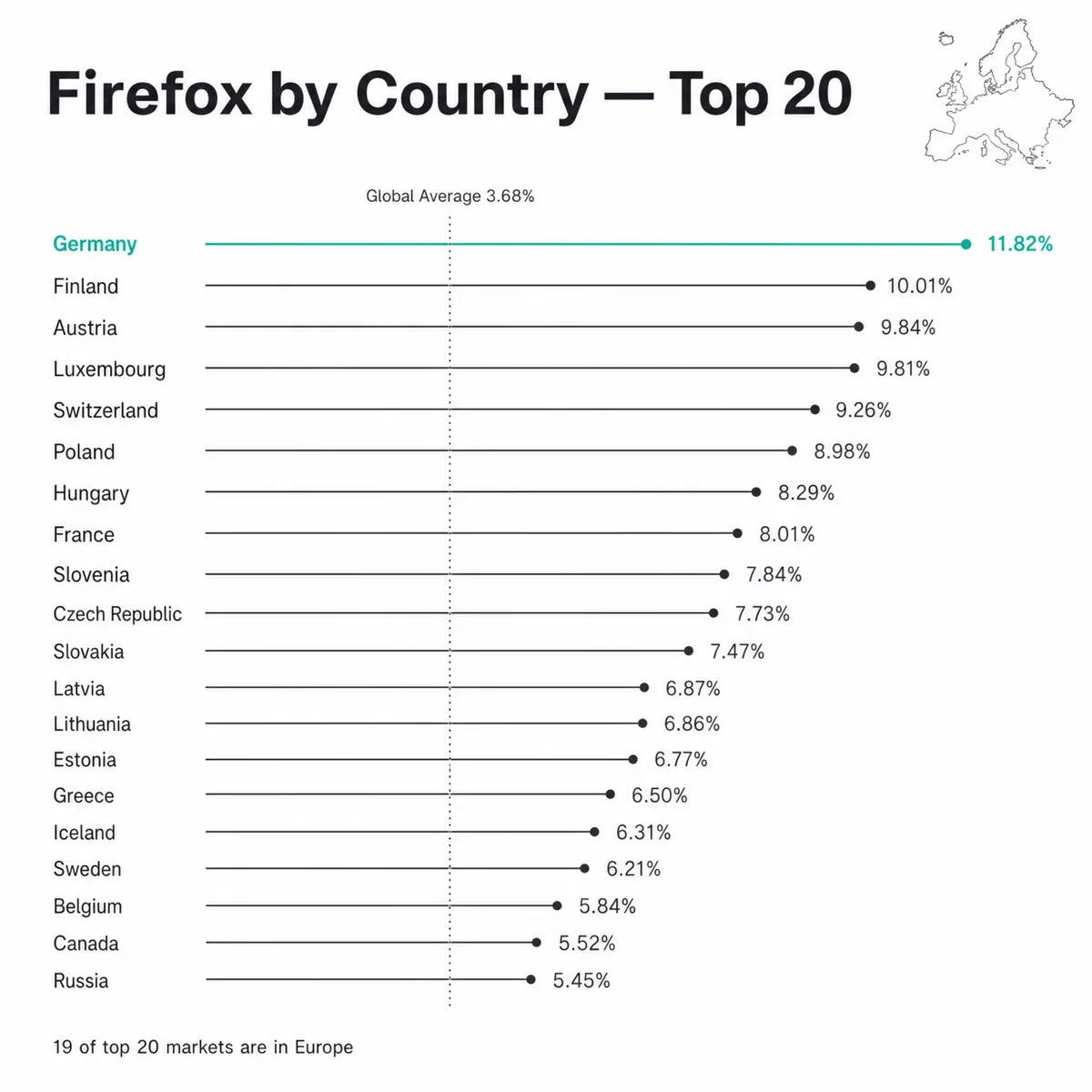
Firefox varies enormously by country, and the pattern is unmistakable. Here are the top 20 markets by Firefox's share of human web traffic, with the year-over-year change:
| Country | 2025 | 2026 | Year-over-year |
|---|---|---|---|
| Germany | 12.24% | 11.82% | −0.42 pt |
| Finland | 10.66% | 10.01% | −0.65 pt |
| Austria | 10.13% | 9.84% | −0.29 pt |
| Luxembourg | 10.20% | 9.81% | −0.39 pt |
| Switzerland | 9.65% | 9.26% | −0.39 pt |
| Poland | 9.24% | 8.98% | −0.26 pt |
| Hungary | 8.25% | 8.29% | +0.04 pt |
| France | 8.25% | 8.01% | −0.24 pt |
| Slovenia | 7.89% | 7.84% | −0.05 pt |
| Czech Republic | 7.33% | 7.73% | +0.40 pt |
| Slovakia | 7.44% | 7.47% | +0.03 pt |
| Latvia | 6.89% | 6.87% | −0.02 pt |
| Lithuania | 6.60% | 6.86% | +0.26 pt |
| Estonia | 7.17% | 6.77% | −0.40 pt |
| Greece | 6.82% | 6.50% | −0.32 pt |
| Iceland | 6.32% | 6.31% | −0.01 pt |
| Sweden | 6.36% | 6.21% | −0.15 pt |
| Belgium | 6.28% | 5.84% | −0.44 pt |
| Canada | 5.34% | 5.52% | +0.18 pt |
| Russia | 4.17% | 5.45% | +1.28 pt |
Nineteen of the top twenty are European. Germany leads the world at 11.82%, more than three times the global average, and the whole top tier is a tight cluster of German-speaking, Nordic, and Central European markets.
Now the same list for the big markets where most readers actually sell:
| Country | 2025 | 2026 | Year-over-year |
|---|---|---|---|
| Netherlands | 5.03% | 5.23% | +0.20 pt |
| United States | 4.38% | 4.51% | +0.13 pt |
| Spain | 4.83% | 4.54% | −0.29 pt |
| Italy | 4.61% | 4.42% | −0.19 pt |
| Australia | 4.17% | 4.08% | −0.09 pt |
| United Kingdom | 3.71% | 3.27% | −0.44 pt |
| Japan | 3.25% | 2.98% | −0.27 pt |
| Turkey | 1.79% | 1.76% | −0.03 pt |
| Brazil | 1.33% | 1.50% | +0.17 pt |
| India | 1.17% | 1.22% | +0.05 pt |
| South Korea | 0.94% | 1.12% | +0.18 pt |
The spread is roughly 10x from Germany (11.82%) to South Korea (1.12%) and India (1.22%).
The country pattern is privacy culture, not Linux
The obvious hypothesis is that Firefox is strong where Linux is strong — the open-source crowd sticking together. The data kills that idea.
| Country | Firefox 2026 | Linux share of traffic |
|---|---|---|
| Germany | 11.82% | 3.39% |
| Finland | 10.01% | 5.31% |
| Austria | 9.84% | 2.51% |
| Poland | 8.98% | 2.01% |
| United States | 4.51% | 4.01% |
| United Kingdom | 3.27% | 2.27% |
| Japan | 2.98% | 0.78% |
The United States has more Linux traffic than Germany (4.01% vs 3.39%) and less than half the Firefox share (4.51% vs 11.82%). Austria and Poland run Firefox at nearly 10% on a Linux base smaller than America's. Linux adoption simply does not predict Firefox adoption.
What does line up is something softer and harder to quantify: privacy culture. Firefox's strongholds are the markets with the most assertive data-protection norms in the world — Germany above all, then Austria, Switzerland, France, and the Nordics. These are places where people are, on average, more willing to spend effort to avoid Google. Since Firefox is nobody's default, willingness to spend that effort is the only thing that produces market share. Hardware can't do it for them.
That's the mechanism, and it's genuinely different from every other browser in this list. Safari's map is a map of iPhone sales. Firefox's map is a map of how much a country cares.
The desktop view, where Firefox is actually big
Because ~90% of Firefox usage is desktop, ranking countries by overall share badly understates the browser. Here's Firefox's share of desktop human traffic by country, which is the number that should drive your browser-testing matrix:
| Country | Desktop 2025 | Desktop 2026 | YoY | Mobile 2026 |
|---|---|---|---|---|
| Germany | 22.53% | 20.86% | −1.67 pt | 2.49% |
| Austria | 19.29% | 17.63% | −1.66 pt | 1.90% |
| Finland | 19.18% | 16.85% | −2.33 pt | 2.33% |
| Poland | 17.71% | 16.54% | −1.17 pt | 1.20% |
| Slovenia | 16.79% | 15.76% | −1.03 pt | 1.03% |
| Luxembourg | 16.96% | 15.69% | −1.27 pt | 1.89% |
| Hungary | 15.98% | 15.64% | −0.34 pt | 1.00% |
| Switzerland | 16.71% | 15.52% | −1.19 pt | 1.91% |
| Slovakia | 15.98% | 14.98% | −1.00 pt | 0.87% |
| France | 15.79% | 14.94% | −0.85 pt | 1.56% |
| Greece | 16.69% | 14.69% | −2.00 pt | 0.74% |
| Czech Republic | 14.13% | 13.59% | −0.54 pt | 1.03% |
| Sweden | 12.28% | 11.90% | −0.38 pt | 1.19% |
| Italy | 10.57% | 9.43% | −1.14 pt | 0.77% |
| Netherlands | 8.86% | 9.24% | +0.38 pt | 1.24% |
| United States | 8.02% | 7.38% | −0.64 pt | 0.92% |
| Australia | 7.15% | 6.79% | −0.36 pt | 0.85% |
| United Kingdom | 7.62% | 6.48% | −1.14 pt | 0.59% |
| Japan | 7.29% | 6.35% | −0.94 pt | 0.47% |
| Brazil | 4.83% | 4.87% | +0.04 pt | 0.18% |
| Turkey | 3.79% | 3.61% | −0.18 pt | 0.25% |
| India | 3.83% | 3.41% | −0.42 pt | 0.33% |
| South Korea | 1.83% | 1.91% | +0.08 pt | 0.31% |
One in five German desktops runs Firefox. That is a completely different browser from the 3.68% global figure, and if you sell into Germany, Austria, or the Nordics, it's the number that should be in your test plan.
Look at the year-over-year column, though. Firefox is losing desktop share in almost every one of its strongholds — Germany −1.67, Finland −2.33, Greece −2.00, Austria −1.66. The places where Firefox is strongest are the places it is weakening fastest, in absolute terms. Its small gains are coming from the margins: Russia (+1.28 overall), Ireland (+0.94), Indonesia (+0.77), Czechia (+0.40).
That's what "flat" actually consists of. The core is eroding and the periphery is topping it back up. It's a browser trading a loyal, high-density base for a thin, scattered one.
Firefox is losing Linux — its own home turf — to Chrome
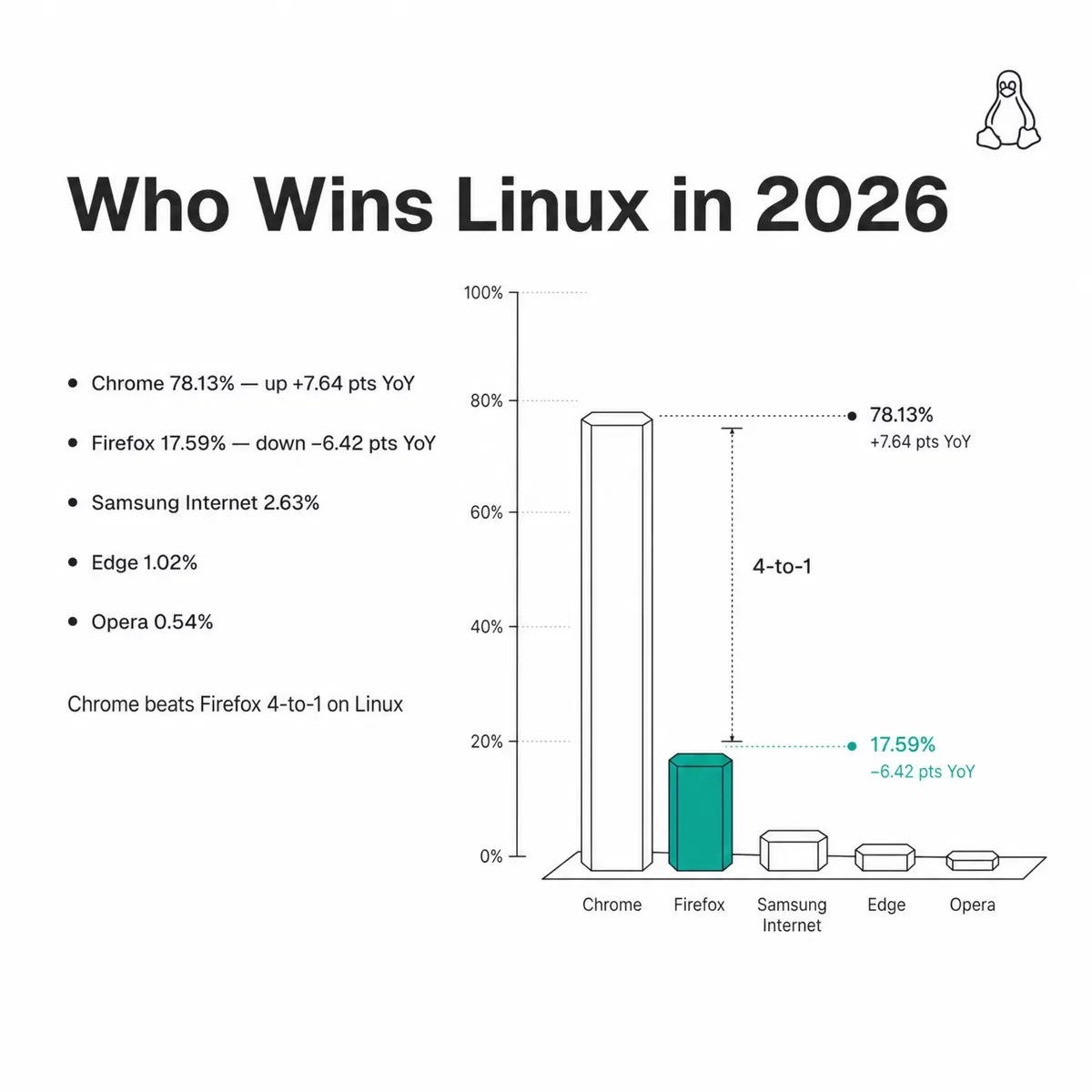
The stat I found hardest to believe. Here's how each browser does inside each operating system, 2025 versus 2026, human traffic:
| Operating system | Firefox 2025 | Firefox 2026 | YoY | Chrome 2026 |
|---|---|---|---|---|
| Linux | 24.01% | 17.59% | −6.42 pt | 78.13% |
| Windows | 8.43% | 7.62% | −0.81 pt | 69.95% |
| macOS | 5.09% | 5.59% | +0.50 pt | 58.53% |
| Android | 0.67% | 0.74% | +0.07 pt | 93.22% |
| iOS | 0.04% | 0.47% | +0.43 pt | 25.20% |
Source: Cloudflare Radar — http/summary/browser_family filtered by os, human traffic, matched 28-day windows. Pulled 2026-07-14.
On Linux — the operating system built by the free-software community — Chrome beats Firefox 78.13% to 17.59%. Google's browser wins Linux by more than four to one. And Firefox's Linux share collapsed 6.42 points in a single year while Chrome's rose 7.64.
If the thesis is "Firefox is the browser for people who care about an open, non-Google web," Linux is the one place that thesis should be unbeatable. It isn't even close. The population most equipped to reject Chrome on principle overwhelmingly runs Chrome.
Two caveats I want to state rather than bury, because this is the most dramatic number in the report and it's also the least stable. First, Linux is a small base — just 2.03% of human web traffic — so its percentages swing more than the others. Pull a 12-week window instead of 28 days and Firefox on Linux reads 22.2% rather than 17.6%. The exact figure is window-sensitive; the direction and the ranking are not, and Chrome leads Firefox on Linux by a wide margin in every window I tried. Second, "Linux" in a request-share dataset catches more than enthusiast desktops. Some of it is workstations, some is kiosks, some is developer tooling. Read it as "Chrome decisively leads Firefox on Linux," which is robust, rather than as an exact 78-to-18 that is not.
The one genuine bright spot in that table is macOS, where Firefox actually gained half a point, to 5.59%. It's the only major platform where Firefox grew meaningfully. It's also a platform where the fight is between Chrome (58.53%) and Safari, and Firefox is a distant third.
The engine question: 3.63% is the entire independent web
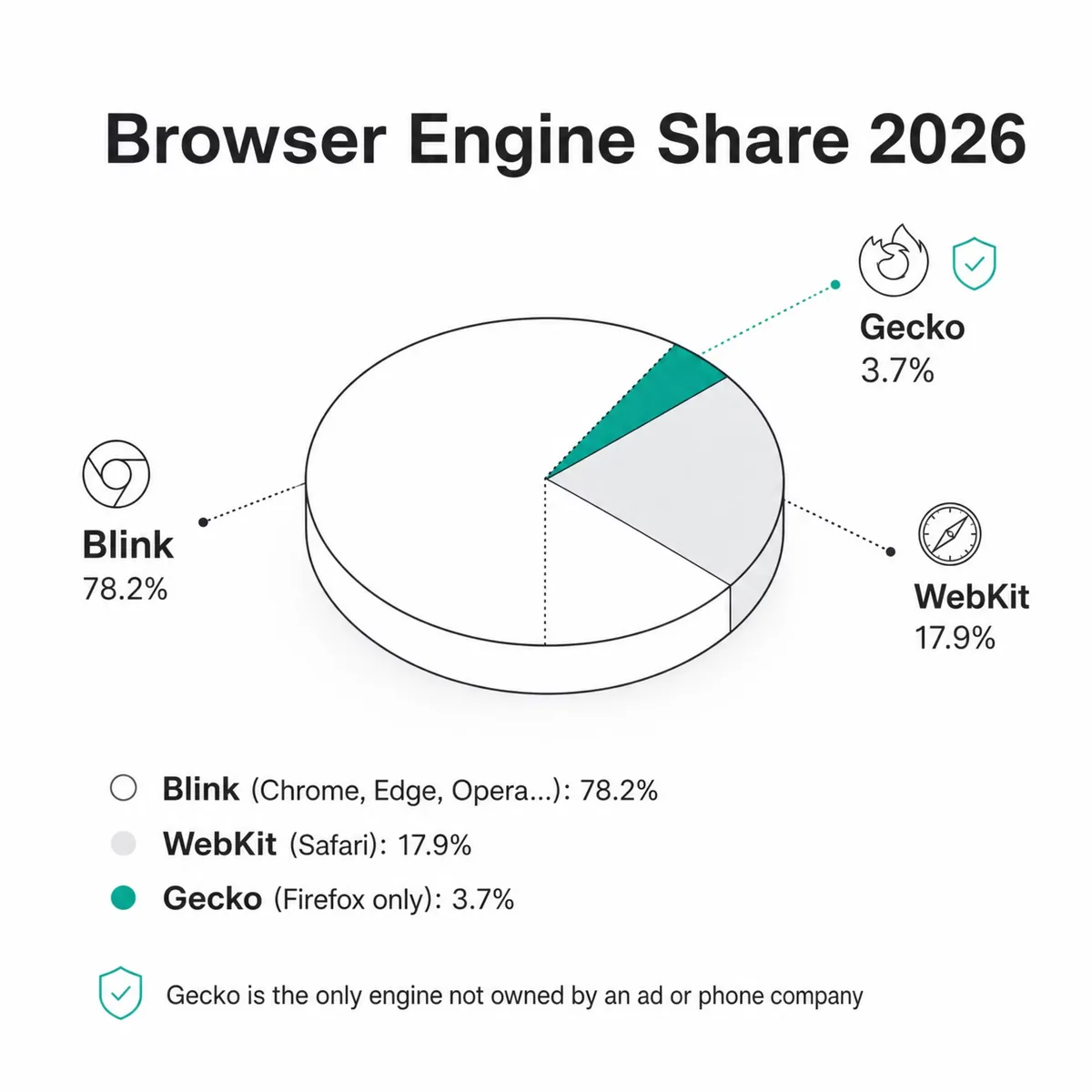
There are three browser engines left. Blink powers Chrome, Edge, Opera, Brave, and Samsung Internet. WebKit powers Safari. Gecko powers Firefox, and nothing else that matters.
Add up the Blink browsers on human traffic and you get roughly 78% of the web. Safari's WebKit takes 17.93%. Gecko gets 3.68%.
That 3.68% is not just Firefox's market share. It's the share of the web running on the only mainstream engine that is not owned by a company that also sells ads or phones. Blink is Google's. WebKit is Apple's. Gecko is the last engine whose roadmap isn't set by a trillion-dollar platform business with its own reasons to want the web shaped a particular way.
For web teams this has a very concrete consequence, and it's the practical reason Firefox matters more than 3.68% suggests. When you test in Chrome, you are effectively testing five browsers, because they share an engine. Firefox and Safari are the only two tests that tell you something Chrome can't. Skip Firefox and you have no coverage of Gecko at all — and Gecko is stricter than Blink about several things Chrome quietly forgives, which is exactly why bugs hide there.
What I'd do with this if I ran a web or GTM team

Test Firefox on desktop, and don't bother with mobile. At 0.65% of mobile traffic, Firefox for Android is not a rational use of QA time for most teams. At 7.59% of desktop — third place, ahead of Safari — desktop Firefox absolutely is. This is the rare case where the global number actively misleads you: 3.68% sounds skippable, and the desktop reality isn't.
If you sell into the DACH region or the Nordics, treat Firefox as a top-three browser. One in five German desktops. Nearly one in six in Austria, Finland, Poland, Switzerland. A B2B SaaS product selling to German enterprises that renders badly in Firefox is breaking a fifth of its prospects' desktops. That is not an edge case, and it is the single most actionable line in this report.
Read Firefox share as an intent signal, not just a compatibility one. Because no platform pushes Firefox on anyone, a visitor arriving in it has told you something: they configured their machine deliberately, and they are more likely than average to care about tracking, cookies, and data collection. If a meaningful slice of your traffic is Firefox, aggressive tracking and consent dark patterns will land worse with that audience than with your Chrome majority. That's a soft signal, not a rule — but it's the kind of technographic read that changes how you approach a segment. Knowing exactly which browsers and technologies your prospects run is the foundation of good technographic targeting, which is what our prospect intelligence platform is built around.
Don't budget for a Firefox comeback, and don't budget for its disappearance either. The 12-month data says flat. The underlying desktop trend says slow decline, currently masked by a device-mix tailwind. My honest prediction: Firefox drifts into the low 3s over the next couple of years as its European core keeps thinning, and it stays there for a long time, because the people left are the hardest people in the world to move. A browser with no defaults has no casual users to lose.
Methodology and source data
This report runs on first-party measurement from Cloudflare Radar. Cloudflare sits in front of roughly a fifth of all websites and operates 1.1.1.1, one of the world's largest public DNS resolvers, so Radar's view of browser share is built from a slice of real global internet traffic measured in the trillions of requests, spanning effectively every country and network. It isn't a panel anyone opted into.
That matters more than usual for Firefox. Tools like StatCounter measure usage through a JavaScript tag on a network of member websites, then count visitors landing on those specific sites. It's a legitimate method, but the sample is that fixed set of sites, and it can skew toward whatever kinds of sites install the script. Different sampling frames are why two reputable sources can report Firefox a point apart while agreeing on the ranking.
From the Q3 2026 edition (1 October 2026), the headline figures, the Firefox-vs-Chrome answer, the Q3 2026 analysis and the month-by-month table run on calendar quarters and months of human traffic, pulled 2026-10-01; the windows below apply to the sections that still carry them. The StatCounter comparison uses StatCounter's September 2026 pages as displayed on 1 October 2026.
Source: Cloudflare Radar — radar/http (radar.cloudflare.com). Current-state figures (the headline share, the traffic-type table, the defaults table, and the device and engine numbers in the FAQ) use the 28-day window ending 5 August 2026. The weekly-cycle section uses daily aggregation over 1 June–5 August 2026. All year-over-year comparisons use matched 28-day windows: 16 June–14 July 2025 versus 16 June–14 July 2026, and are unchanged from the July pull. All figures are share of HTTP request traffic across Cloudflare's network, traffic-weighted, not installed base or unique users. Every headline figure filters to human (LIKELY_HUMAN) traffic except where the all-traffic or bot figure is stated explicitly.
Endpoints used: http/summary/browser_family (unfiltered, and filtered by botClass, deviceType, os, and location), http/summary/device_type, http/summary/os, http/top/locations/browser_family/firefox, and http/timeseries_groups/browser_family for the 52-week series.
Why matched 28-day windows rather than calendar quarters. Two weeks in May 2026 show Firefox spiking to 4.44% and 4.65% of human traffic, far outside its stable 3.5–3.9% band for the rest of the year. I could not explain the spike, and it inflates any window containing it: comparing full Q2 quarters makes Firefox look like it grew (3.63% → 3.84%), while excluding those two weeks puts Q2 2026 at 3.71%. Matched 28-day windows ending 14 July exclude the anomaly entirely, which is why every YoY figure here uses them. I'm flagging it rather than smoothing it, because it's the single thing most likely to make this report disagree with another one.
A few honest limitations. Radar is traffic-weighted, so a handful of very active users carry more weight than many light ones; it's a request-share metric, not a head count. The Linux figures sit on a 2% base and are window-sensitive (see the caveat in that section). Chromium-based browsers like Brave largely report as Chrome and aren't cleanly broken out. And Firefox's bot share means any unfiltered browser statistic — including most published roundups — overstates it by roughly half a point.
One aggregation trap worth passing on, since it nearly caught me. Radar's weekly series leaves the most recent bucket partial: pull it mid-week and the final point covers only the days elapsed so far. Because browser share swings hard between weekdays and weekends, that partial bucket can invent a dramatic move — a weekday-only final week made Edge look like it had jumped to 9% when its four-week average was 6.9%. Firefox is the browser least exposed to this, having no weekly cycle at all, but if you are comparing it against Edge or Safari in a weekly chart, discard the last bucket or aggregate daily.
Because every figure comes from one source, I used internal consistency as the cross-check rather than a second vendor: the global number, the device split, the per-country cuts, and the per-OS breakdown all reconcile. Weighting the device-level shares (7.59% desktop, 0.65% mobile) by the device mix (44.9% / 55.1%) reproduces the 3.68% headline. When independent slices of the same dataset agree, the headline is carrying real weight rather than riding on one query.
Frequently asked questions
What is Firefox's market share in 2026?
Firefox's market share in Q3 2026 was 3.65% of human web traffic globally, and 3.81% of all web traffic including bots, per Cloudflare Radar for July to September 2026. That makes it the world's fourth browser, behind Chrome (68.60%), Safari (17.77%), and Edge (6.93%). It's down 0.20 points from 3.85% in Q3 2025.
How many people use Firefox vs Chrome?
Radar measures requests, not people, so the answer is a ratio. In Q3 2026 Chrome carried 68.60% of human web traffic and Firefox 3.65%, about 19 to 1. On desktop the gap is about 9 to 1 (67.88% against 7.40%); on phones about 105 to 1.
Is Firefox market share growing or declining in 2026?
Declining, slowly. Month to month it barely moves (3.70% in January, 3.64% in September 2026), but Q3 2026 read 3.65% against 3.85% in Q3 2025, a 0.20-point drop. The decline sits on desktop, down 0.65 points to 7.40% in a year, and it now shows through even though desktop kept growing as a share of the web.
Why do some sources say Firefox is around 4% and others say 3.7%?
Bot filtering, and what gets counted. Firefox accounted for 4.52% of automated traffic but 3.65% of human traffic in Q3 2026, so a statistic that doesn't exclude bots overstates it. StatCounter, which counts page views on its tagged sites, reads lower still: 2.8% for September 2026 as displayed on 1 October. The human-only Radar figure is the one built on requests from actual people.
What percentage of desktop users use Firefox?
Firefox took 7.40% of desktop human web traffic in Q3 2026, which makes it the third desktop browser, ahead of Safari (6.84%) and behind Chrome (67.88%) and Edge (15.63%). That's double its 3.65% overall share, because roughly 9 out of 10 Firefox sessions happen on a desktop.
Does anyone use Firefox on mobile?
Barely. Firefox held 0.66% of mobile human web traffic in Q3 2026, about one request in 150 (in August it was 0.76% on Android and 0.46% on iOS). For most teams, mobile Firefox is not a rational QA target, while desktop Firefox at 7.40% clearly is.
Which country has the highest Firefox market share?
Germany, at 11.82% of human web traffic in 2026 — more than three times the global average. It's followed by Finland (10.01%), Austria (9.84%), Luxembourg (9.81%), and Switzerland (9.26%). Nineteen of Firefox's top twenty markets are in Europe. On desktop specifically, Germany reaches 20.86%: one in five German desktops runs Firefox.
Why is Firefox so popular in Germany?
Germany combines a strong data-protection culture with a large desktop base, and Firefox is the browser you end up with when you deliberately avoid Google's. It is not about Linux: the United States actually has a higher Linux share of traffic than Germany (4.01% vs 3.39%) but less than half the Firefox share (4.51% vs 11.82%). Since no operating system ships Firefox by default, its share only grows where people are willing to make an active effort — and Germany, Austria, Switzerland, France, and the Nordics are exactly those markets.
Do Linux users use Firefox?
Mostly not. On Linux, Chrome leads Firefox by 78.13% to 17.59% in 2026, and Firefox's Linux share fell 6.42 points over the year while Chrome's rose 7.64. Even on the operating system built by the free-software community, Chrome wins by more than four to one. (Linux is a small base — 2.03% of traffic — so the exact figures shift with the measurement window, but Chrome's lead holds in every window.)
Is Firefox a dying browser?
The 2026 data says no, though it is shrinking. Firefox's collapse happened years ago. In Q3 2026 it held 3.65% of human web traffic, down 0.20 points on a year earlier: a slow slide, not a collapse. Because Firefox is no platform's default, it has no casual users left to lose — everyone still running it chose it deliberately, which makes them extremely hard to move. The honest read is a browser on a slow desktop decline that a device-mix tailwind no longer fully hides, with a hard floor of committed users beneath it.
How does Firefox compare to Safari and Chrome in 2026?
In Q3 2026 Chrome led with 68.60% of human web traffic, Safari was second at 17.77%, Edge third at 6.93%, and Firefox fourth at 3.65%. But the ranking flips by device: on desktop, Firefox (7.40%) beats Safari (6.84%), while on mobile Safari (26.49%) dwarfs Firefox (0.66%). Firefox is ~90% desktop; Safari is ~80% mobile. They're near-perfect opposites.
Why should teams still test in Firefox at only 3.7%?
Because Firefox is the only browser running the Gecko engine, and Gecko is one of just three engines left. Chrome, Edge, Opera, Brave, and Samsung Internet all share Blink, so testing Chrome effectively covers all of them. Only Firefox and Safari tell you anything new. Skip Firefox and you have zero coverage of Gecko — which is stricter than Blink about several things Chrome quietly forgives. And in DACH and Nordic markets, Firefox is a top-three desktop browser at 15–21% of desktop traffic, not a rounding error.
What is Firefox's share of the browser engine market?
Firefox's Gecko engine accounted for 3.65% of human web traffic in Q3 2026. Blink (Chrome, Edge, Opera, Brave, Samsung Internet) accounted for roughly 79%, and Apple's WebKit for 17.77%. Gecko is the only mainstream engine not owned by a company that also sells ads or hardware, so that 3.65% represents the entire independent web.
Update history
Moved the headline to the full Q3 2026 quarter on human traffic: Firefox 3.65%, down 0.20 points on Q3 2025, the first clear year-over-year decline this report has measured. Added a Firefox-vs-Chrome answer with a StatCounter comparison, a Q3 2026 analysis that grades the July "borrowed flat line" call, a September row in the month-by-month table (provisional), and refreshed the FAQ. January to August re-pulled and reproduced exactly.
Verified 3 September 2026 against the 28 days ending 2 September. Firefox reads 3.69% of human web traffic, against 3.63% in the 28 days ending 5 August, a move of 0.06 points, which rounds the headline from 3.6% to 3.7%. That is below this report's threshold for a new analysis layer, so the sections below are unchanged rather than restated — the figures they were built on still hold. The month-by-month 2026 table below carries the browser-versus-browser detail, including the one browser that did move this year.
Updated 5 August 2026. Headline figures and the new weekly-cycle section below run on the 28 days ending 5 August 2026, where Firefox reads 3.63% of human traffic. The year-over-year comparison, country tables, and operating-system tables use the matched 16 June–14 July windows described above and are unchanged — Firefox moved five hundredths of a point between the two pulls, which is rather the point of this post.

Data Analyst
5+ years of experience
Emma is a Data Analyst at TechnologyChecker, where she analyses technology adoption data to build better prospect lists and uncover actionable patterns for sales teams.
- BSc Data Science, Cardiff University
- Google Data Analytics Professional Certificate
- Tableau Desktop Certified Associate
Never miss our research