Top 23 Technologies Used in the Law Practice Industry (2026): Data from 29.9M Domains
What technologies do law practice companies actually use? We analyzed 66,536 law practice domains and broke down adoption by company size: small businesses, mid-market, and enterprise.
Published •15 min read

Among the 66,536 law practice domains we analyzed, Microsoft Exchange Online hits 39.07% adoption. The legal profession runs on Microsoft. Facebook (40.74%) and LinkedIn (38.06%) show that social platforms are central to client acquisition for firms of every size. But technology preferences shift by firm size: a solo practitioner's web stack looks nothing like what a global firm runs. Google Analytics adoption jumps from 28.57% at small firms to 64.56% at enterprise level. This ranking draws from TechnologyChecker.io's scan of 29.9M domains cross-referenced with 25.4M LinkedIn company records.
Key Findings
- Microsoft Exchange Online (39.07%) and Office 365 Mail (38.2%) dominate law firm email infrastructure, a concentration you won't find in most other industries
- Small law firms prefer Facebook (40.55%) for social media presence, while mid-market and enterprise firms lean toward LinkedIn (72.25% and 62.94%, respectively)
- Cloud infrastructure diverges sharply by firm size. Small firms favor Amazon at 14.37%, while enterprise firms use Amazon at 48.82% and add Microsoft Azure at 33.53%
- Microsoft Exchange Online dominates email services across all sizes, but its adoption jumps from 39.24% among small firms to 58.78% at mid-market
- 75.1% of law practice companies in our data have 1-10 employees, making this an industry dominated by solo practitioners
How We Conducted This Research
This analysis is based on TechnologyChecker.io's technology detection database, which continuously scans 29.9M domains and tracks over 40,000 web technologies. We matched detected technologies against LinkedIn's industry classifications to isolate 66,536 domains classified under Law Practice.
We segmented companies into three tiers using LinkedIn's self-reported employee count: small businesses (1-50 employees), mid-market (51-1,000 employees), and enterprise (1,000+ employees). Technologies are grouped by function (analytics, CMS, email services, security, and so on) so you can compare tools within the same category across company sizes.
Data was collected in March 2026. LinkedIn's industry classifications are self-reported by companies, and employee counts may lag behind actual headcount. Some firms operate under umbrella entities that affect how they're counted. That said, with 66,536 domains in the sample, this is one of the largest data-driven snapshots of law practice technology adoption available. TechnologyChecker.io's detection covers both front-end libraries visible in page source and back-end signals like email authentication records, DNS configurations, and server headers.
Top 23 Technologies Used in the Law Practice Industry
Here's what 66,536 law practice companies are running on their domains, ranked by adoption rate.
| Rank | Technology | Category | Adoption Rate | Domains Detected |
|---|---|---|---|---|
| 1 | jQuery | JavaScript Libraries | 57.68% | 38,379 |
| 2 | Apple Mobile Web Clips Icon | Accessibility Tools | 45.13% | 30,028 |
| 3 | RSS | Feed Readers & RSS | 43.33% | 28,832 |
| 4 | Google Font API | Font Services | 41.25% | 27,443 |
| 5 | Social Media Marketing | 40.74% | 27,107 | |
| 6 | Microsoft Exchange Online | Email Services | 39.07% | 25,994 |
| 7 | Office 365 Mail | Email Services | 38.2% | 25,417 |
| 8 | Social Media Marketing | 38.06% | 25,325 | |
| 9 | Google Tag Manager | Tag Management | 37.25% | 24,782 |
| 10 | Google Webmaster | SEO Tools | 35.49% | 23,616 |
| 11 | Google Analytics | Web Analytics | 34.62% | 23,033 |
| 12 | Intersection Observer | JavaScript Libraries | 33.39% | 22,215 |
| 13 | US Privacy User Signal Mechanism | Cookie Consent & Compliance | 32.67% | 21,737 |
| 14 | Global Site Tag | Web Analytics | 30.41% | 20,233 |
| 15 | Google Maps | Maps & Geolocation | 30.38% | 20,213 |
| 16 | jQuery 3.7.1 | JavaScript Libraries | 29.84% | 19,854 |
| 17 | Sitelinks Search Box | SEO Tools | 28.37% | 18,877 |
| 18 | HSTS | Security Tools | 27.89% | 18,555 |
| 19 | Apache | Web Servers | 26.48% | 17,620 |
| 20 | Font Awesome | Font Services | 25.93% | 17,256 |
| 21 | CrUX Dataset | Real User Monitoring (RUM) | 25.09% | 16,695 |
| 22 | Organization Schema | Schema & Structured Data | 23.77% | 15,814 |
| 23 | reCAPTCHA | Security Tools | 19.81% | 13,182 |
The law-specific insights jump out immediately from this list.
Microsoft Exchange Online (39.07%) and Office 365 Mail (38.2%) both sit in the top 12, a concentration you won't find in most other industries. The ABA's 2024 Cloud Computing TechReport confirms this pattern: Microsoft 365 leads cloud software adoption among law firms at roughly 72%, with Microsoft Teams at 63%. Our detection data captures the email infrastructure layer of that same Microsoft dependency. Facebook (40.74%) and LinkedIn (38.06%) rank even higher than email infrastructure, showing how central social platforms are for client acquisition. Google Tag Manager at 37.25% shows that a significant share of law firms actively manage marketing and analytics tags. Google Maps at 30.38% makes sense for an industry where physical office locations matter to clients seeking local representation — our data on companies using Google Maps shows it's especially common in location-dependent industries like legal services.
DMARC adoption at 31.21% is notable. For a sector that handles privileged communications, you'd expect it higher. The dominance of small firms (75.1% have 1-10 employees) pulls the average down.
Top Web Analytics Tools in Law Practice
Analytics helps law firms understand which practice areas attract visitors, which attorney profiles get the most clicks, and where potential clients drop off.
| Technology | Small Biz Adoption | Mid-Market Adoption | Enterprise Adoption |
|---|---|---|---|
| Google Analytics | 34.19% | 67% | 64.12% |
| Cloudflare Radar | — | 14.06% | 57.06% |
| Global Site Tag | 30.2% | 56.7% | 54.71% |
| Google Analytics 4 | 20.65% | 44.19% | 44.12% |
| Google Universal Analytics | 14.26% | 29.84% | 38.24% |
| Facebook Pixel | 6.11% | 11.32% | — |
| Siteimprove | — | — | 12.35% |
| Hotjar | — | 6.02% | — |
| Cloudflare Web Analytics | 3.7% | 5.9% | — |
Google Analytics dominates at every firm size, but small firms sit at 34.19% while mid-market jumps to 67%. Mid-market and enterprise firms don't just track more; they track differently. Cloudflare Radar appears on 57.06% of enterprise law firm domains but doesn't register among small firms at all. Siteimprove, an accessibility-focused analytics platform, shows up only at the enterprise level (12.35%). Larger firms face compliance requirements that smaller ones don't. Facebook Pixel skews toward smaller firms (6.11% small, 11.32% mid-market), where paid social advertising drives individual client acquisition.
Top Social Media Marketing Tools in Law Practice
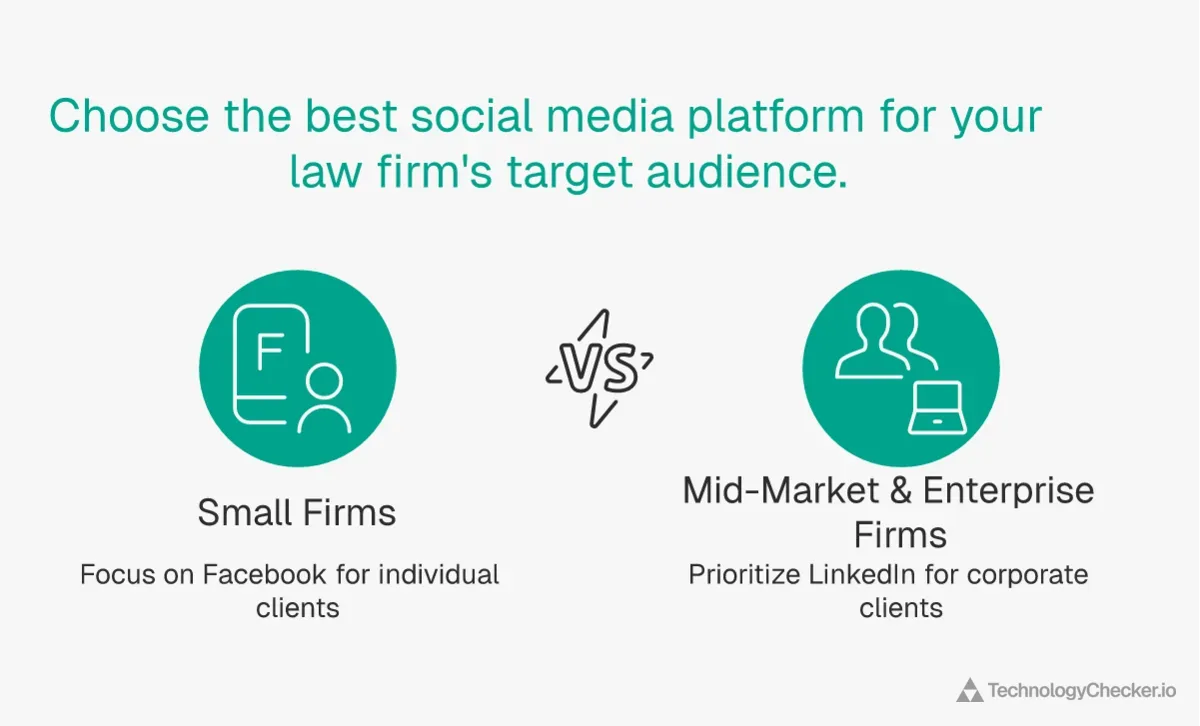
Potential clients check Facebook pages for reviews, and LinkedIn profiles signal a firm's credibility to corporate clients. The platform a firm prioritizes tells you a lot about its target market.
| Technology | Small Biz Adoption | Mid-Market Adoption | Enterprise Adoption |
|---|---|---|---|
| 38% | 72.25% | 62.94% | |
| 40.55% | 60.63% | 60.59% | |
| 20.27% | 45.98% | 60% | |
| Facebook Sharer | 4.37% | 15.54% | 25.29% |
The platform preference flip between small and mid-market firms is one of the clearest signals in our data. The ABA's 2024 Websites & Marketing TechReport found that 80% of law firms maintain a social media presence, with LinkedIn leading at 78% and Facebook at 53%. Our technology detection data shows a similar split: small law firms put Facebook first (40.55% vs. 38% for LinkedIn). Mid-market firms reverse that order, with LinkedIn at 72.25% vs. Facebook at 60.63%. This reflects a shift in client base: small firms serve individuals who find them on Facebook, while mid-market and enterprise firms pursue corporate clients who live on LinkedIn. Twitter adoption nearly triples from small (20.27%) to enterprise (60%). Larger firms use it for thought leadership and media visibility.
Top SEO Tools in Law Practice
Search engine optimization is a primary client acquisition channel for law firms. First Page Sage reports that law firms spent an average of $120,000 on SEO in 2024, with organic search driving 53% of all law firm website traffic. People search for "divorce lawyer near me" or "patent attorney" and click on whoever ranks first.
| Technology | Small Biz Adoption | Mid-Market Adoption | Enterprise Adoption |
|---|---|---|---|
| Google Webmaster | 35.57% | 52% | 56.47% |
| Sitelinks Search Box | 28.33% | 45.5% | 27.06% |
| Yoast Plugins | 19.64% | 36.87% | 20.59% |
| Yoast SEO Premium | 19.4% | 36.39% | 21.18% |
Google Webmaster (Search Console) leads across all sizes, climbing from 35.57% in small firms to 56.47% at enterprise. Yoast Plugins and Yoast SEO Premium peak at mid-market (36.87% and 36.39%) then drop at enterprise (20.59% and 21.18%). Enterprise firms likely use custom SEO solutions or agency-managed strategies rather than WordPress plugins. Sitelinks Search Box shows a similar curve, peaking at mid-market (45.5%) and falling to 27.06% at enterprise. Larger firm sites probably implement proprietary search features that replace the standard Google integration.
Top Email Services in Law Practice
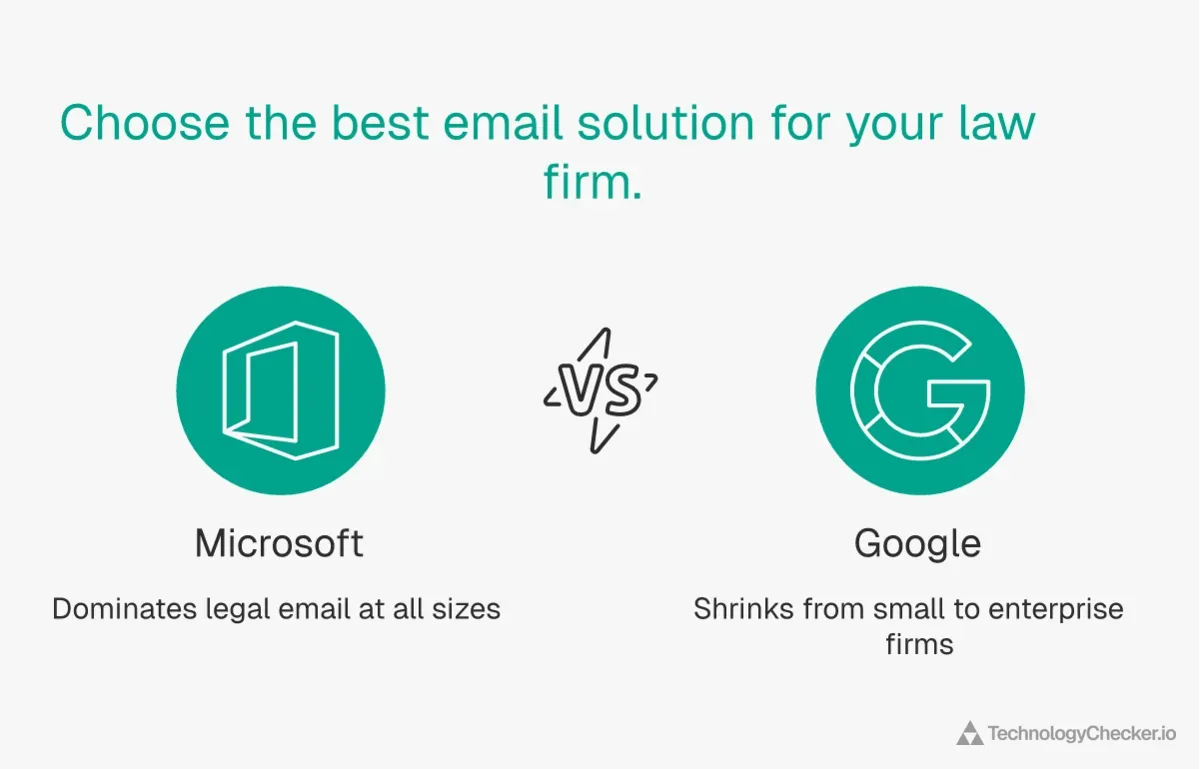
Email runs legal practice. Client correspondence, court filings, opposing counsel negotiations: it all flows through email.
| Technology | Small Biz Adoption | Mid-Market Adoption | Enterprise Adoption |
|---|---|---|---|
| Microsoft Exchange Online | 39.24% | 58.78% | 30% |
| Office 365 Mail | 38.41% | 56.88% | 27.65% |
| Google Apps for Business | 17.43% | 7.21% | — |
| Exclaimer | — | 7.21% | — |
| GoDaddy Email | 6.64% | — | — |
| MailChimp SPF | — | 6.25% | — |
| CodeTwo | — | 5.72% | — |
Microsoft's email stack (Exchange Online + Office 365 Mail) leads at every size. Small firms split between Microsoft (39.24%) and Google Apps for Business (17.43%), with budget-conscious solo practitioners also turning to GoDaddy Email (6.64%). Google's share plummets at mid-market (7.21%) and disappears at enterprise entirely. Mid-market firms add email signature tools like Exclaimer (7.21%) and CodeTwo (5.72%). Professional branding matters once you have 50+ attorneys sending client-facing emails. The drop in Microsoft detection from mid-market to enterprise is notable and may reflect larger firms running on-premise Exchange servers or hybrid configurations that our detection doesn't pick up the same way.
Top Security Tools in Law Practice
Law firms handle confidential client data protected by attorney-client privilege. Security isn't optional here; it's an ethical obligation.
| Technology | Small Biz Adoption | Mid-Market Adoption | Enterprise Adoption |
|---|---|---|---|
| HSTS | 27.66% | 47.71% | 59.41% |
| reCAPTCHA | 19.69% | 34.37% | 36.47% |
| Imunify360 | 3.59% | — | — |
HSTS adoption climbs steadily with firm size: 27.66% for small firms, 47.71% for mid-market, and 59.41% for enterprise. The stakes are high: the ABA's 2023 Cybersecurity TechReport found that 29% of law firms experienced a security breach, and Embroker puts the average cost of a law firm data breach at $5.08 million in 2024. Larger firms face greater regulatory pressure and have dedicated IT teams to enforce strict transport security. reCAPTCHA follows a similar trend (19.69% to 36.47%), probably because bigger firms receive more form submissions and need bot protection on their client intake forms. Imunify360 shows up only among small firms (3.59%). It's a server-level security suite that comes bundled with shared hosting environments, which is exactly where most small law firm websites live.
Top Cloud / IaaS Providers in Law Practice
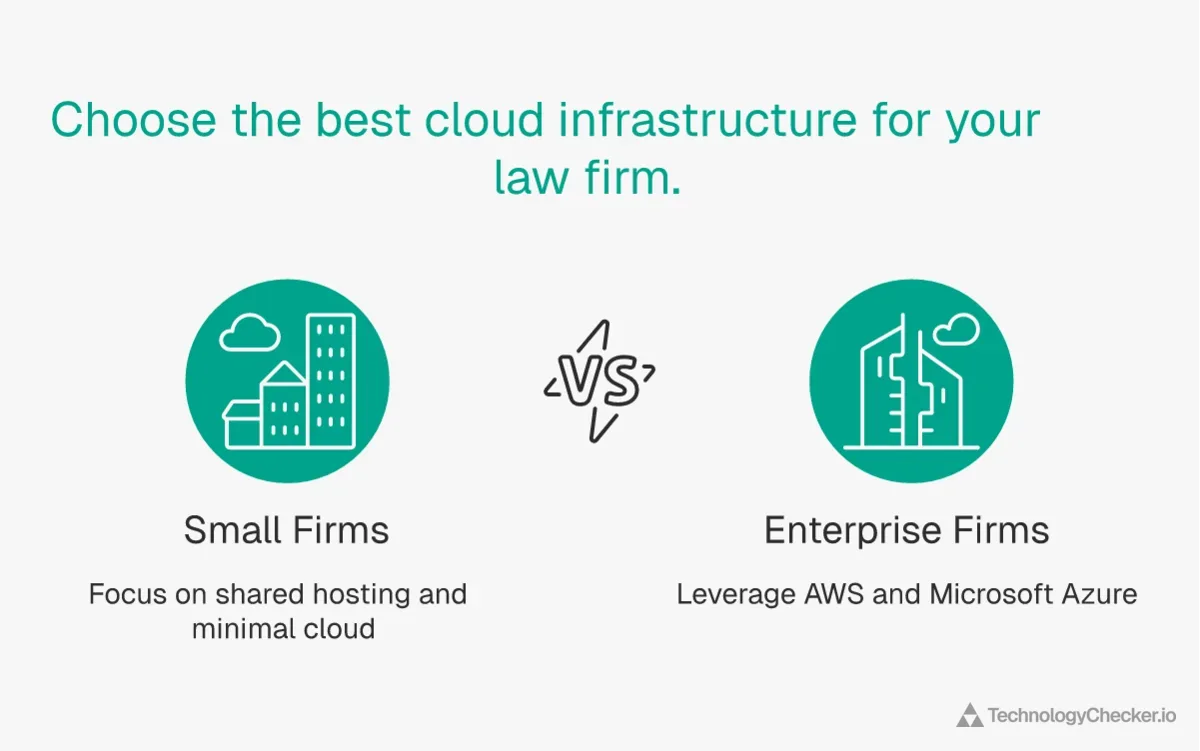
Cloud infrastructure determines where a firm's website, document management systems, and client portals actually live.
| Technology | Small Biz Adoption | Mid-Market Adoption | Enterprise Adoption |
|---|---|---|---|
| Amazon | 14.37% | 19.65% | 48.82% |
| Microsoft | — | 13.88% | 38.24% |
| Microsoft Azure | — | 7.5% | 33.53% |
| 12.43% | 12.51% | 18.82% | |
| Google Cloud | 12.2% | 12.69% | 17.65% |
| Amazon Virginia Region | 4.95% | 7.44% | 23.53% |
| Google Cloud Global Multi-Region | 6.78% | — | — |
| Microsoft Azure US East Region | — | — | 14.12% |
| Amazon Ireland Region | — | — | 13.53% |
Amazon Web Services leads at every size tier, but the gap widens at enterprise: 48.82% of large law firms use Amazon infrastructure, compared to just 14.37% of small firms. The ABA's 2024 Cloud Computing TechReport reports that 75% of attorneys now use cloud computing for work-related tasks, up from 60% in 2021, with solo practitioners at roughly 65% and firms with 50-99 lawyers at 94%. Microsoft's cloud presence is exclusively mid-market and enterprise. Microsoft Azure appears on 33.53% of enterprise law firm domains but doesn't register among small firms at all. This aligns with the Microsoft-heavy email stack we saw earlier. Enterprise firms also show specific region preferences (Virginia at 23.53%, US East at 14.12%, Ireland at 13.53%), likely driven by data residency requirements for international firms handling cross-border litigation.
Top Tag Management Tools in Law Practice
Tag management controls how marketing and analytics scripts load on a website. It's the gateway to measurement and optimization.
| Technology | Small Biz Adoption | Mid-Market Adoption | Enterprise Adoption |
|---|---|---|---|
| Google Tag Manager | 36.87% | 69.15% | 62.94% |
| Google Conversion Linker | 6.01% | 14.47% | 17.65% |
| Optanon | — | — | 14.71% |
Google Tag Manager dominates tag management across the board, but adoption nearly doubles from small (36.87%) to mid-market (69.15%). Enterprise adoption sits at 62.94%, slightly below mid-market. Google Conversion Linker climbs from 6.01% to 17.65%. Larger firms spend more on Google Ads and need conversion tracking to justify that spend. The enterprise-only appearance of Optanon (14.71%) is telling. It's a consent management platform from OneTrust, and its presence reflects the privacy compliance needs of large firms operating across jurisdictions with GDPR, CCPA, and other regulations.
Largest Law Practice Companies in Our Data
| Company | Country | Size | Founded |
|---|---|---|---|
| Baker McKenzie International | United States | 10001+ | 1949 |
| Adalet | Turkey | 10001+ | — |
| Dentons | United Kingdom | 10001+ | — |
| DLA Piper International LLP | United Kingdom | 5001-10000 | 2005 |
| Aoshearman | United Kingdom | 5001-10000 | — |
| Norton Rose Fulbrig | United Kingdom | 5001-10000 | — |
| Kirkland & Ellis LLP | United States | 5001-10000 | 1909 |
| Clifford Chance LLP | United Kingdom | 5001-10000 | 1987 |
| Epiq Systems, Inc | United States | 5001-10000 | 1988 |
| CMS | Germany | 5001-10000 | — |
| Clyde & Co | United States | 5001-10000 | 1933 |
| Freshfields Bruckhaus Deringer | United Kingdom | 5001-10000 | — |
| Jones Day partnership | United States | 5001-10000 | 1893 |
| Eversheds | United Kingdom | 5001-10000 | 2017 |
| Fragomen LLP | United States | 5001-10000 | 1951 |
| Latham & Watkins, LLP | United States | 1001-5000 | 1934 |
| White & Case LLP | United States | 1001-5000 | 1901 |
| Hogan Lovells | United States | 1001-5000 | 1899 |
| Linklaters | United Kingdom | 1001-5000 | 1838 |
| Greenberg, Traurig, PA | United States | 1001-5000 | 1967 |
The largest law firms in our dataset span continents and centuries. Linklaters was founded in 1838. Jones Day dates to 1893. Baker McKenzie, with 10,001+ employees, operates in over 40 countries. These firms drive the enterprise technology patterns we've documented: heavy Microsoft and Amazon infrastructure, dedicated consent management, and enterprise-grade analytics.
Where Law Practice Companies Are Based
| Country | Companies |
|---|---|
| United States | 68,710 |
| Brazil | 19,205 |
| Germany | 14,630 |
| United Kingdom | 6,289 |
| Australia | 4,518 |
| Canada | 3,873 |
| France | 3,610 |
| Spain | 3,242 |
| Netherlands | 2,306 |
| Italy | 2,134 |
| Turkey | 1,690 |
| India | 1,359 |
The United States accounts for the largest share of law practice domains in our data with 68,710 companies. Brazil's strong second-place showing (19,205) reflects its large domestic legal market. Germany (14,630) rounds out the top three, consistent with its position as Europe's largest economy. The English-speaking cluster (US, UK, Australia, Canada) collectively represents over half the sample, which partly reflects the geographic distribution of our web crawling.
Law Practice Companies by Size
| Employee Range | Companies | Share |
|---|---|---|
| 1-10 | 117,598 | 75.1% |
| 11-50 | 31,826 | 20.3% |
| 51-200 | 5,341 | 3.4% |
| 201-500 | 1,065 | 0.7% |
| 501-1,000 | 353 | 0.2% |
| 1,001-5,000 | 304 | 0.2% |
| 5,001-10,000 | 45 | 0% |
| 10,001+ | 53 | 0% |
Law practice is overwhelmingly a small-business industry. 75.1% of firms have 1-10 employees, and 95.4% have fewer than 50. Clio's 2024 Legal Trends Report found that solo firms spend just 1% of expenses on software, while firms with above-average productivity spend 12% more on software and 41% more on marketing, resulting in 21% higher profitability. Only 402 firms exceed 1,000 employees. This concentration means the technology choices of solo practitioners and boutique firms shape the industry averages, making the size-based breakdowns in the category sections above especially valuable for understanding how different segments actually operate.
Frequently Asked Questions
What is the most popular technology in law practice?
Microsoft Exchange Online is found on 39.07% of law practice domains in our analysis (25,994 of the 66,536 sites we scanned). Paired with Office 365 Mail at 38.2%, this Microsoft concentration is much higher than in most other industries. Facebook (40.74%) and LinkedIn (38.06%) round out the top business technologies, showing how central social platforms are for client acquisition.
What analytics tools do small law firms use?
Small law firms primarily use Google Analytics, detected on 34.19% of small firm domains in our data. Global Site Tag (30.2%) and Google Analytics 4 (20.65%) are the next most common. Facebook Pixel appears at 6.11%, suggesting some small firms run paid Facebook campaigns. Premium platforms like Hotjar and Siteimprove don't appear among small firms at all but do show up at mid-market (6.02%) and enterprise (12.35%), respectively.
How do enterprise law firms differ in cloud infrastructure adoption?
Enterprise law firms lean heavily toward Amazon Web Services (48.82% adoption) and Microsoft (38.24%), with Microsoft Azure specifically at 33.53%. Small firms use Amazon at just 14.37% and don't show any Microsoft Azure adoption. Enterprise firms also show specific regional hosting preferences like Amazon Virginia Region (23.53%) and Amazon Ireland Region (13.53%), which likely reflects data residency and latency requirements for multinational operations.
Which countries have the most law practice companies?
The United States leads with 68,710 law practice companies in our TechnologyChecker.io dataset, followed by Brazil (19,205) and Germany (14,630). The United Kingdom (6,289), Australia (4,518), and Canada (3,873) round out the top six. These numbers reflect detected domains matched against LinkedIn's industry classification for law practice.
How many law practice companies did you analyze?
We analyzed 66,536 domains classified under Law Practice, detecting 200 distinct technologies across those sites. The data comes from TechnologyChecker.io's March 2026 scan of 29.9M domains, cross-referenced with 25.4M LinkedIn company records for industry classification and company size segmentation. Company sizes are based on LinkedIn's self-reported employee counts.
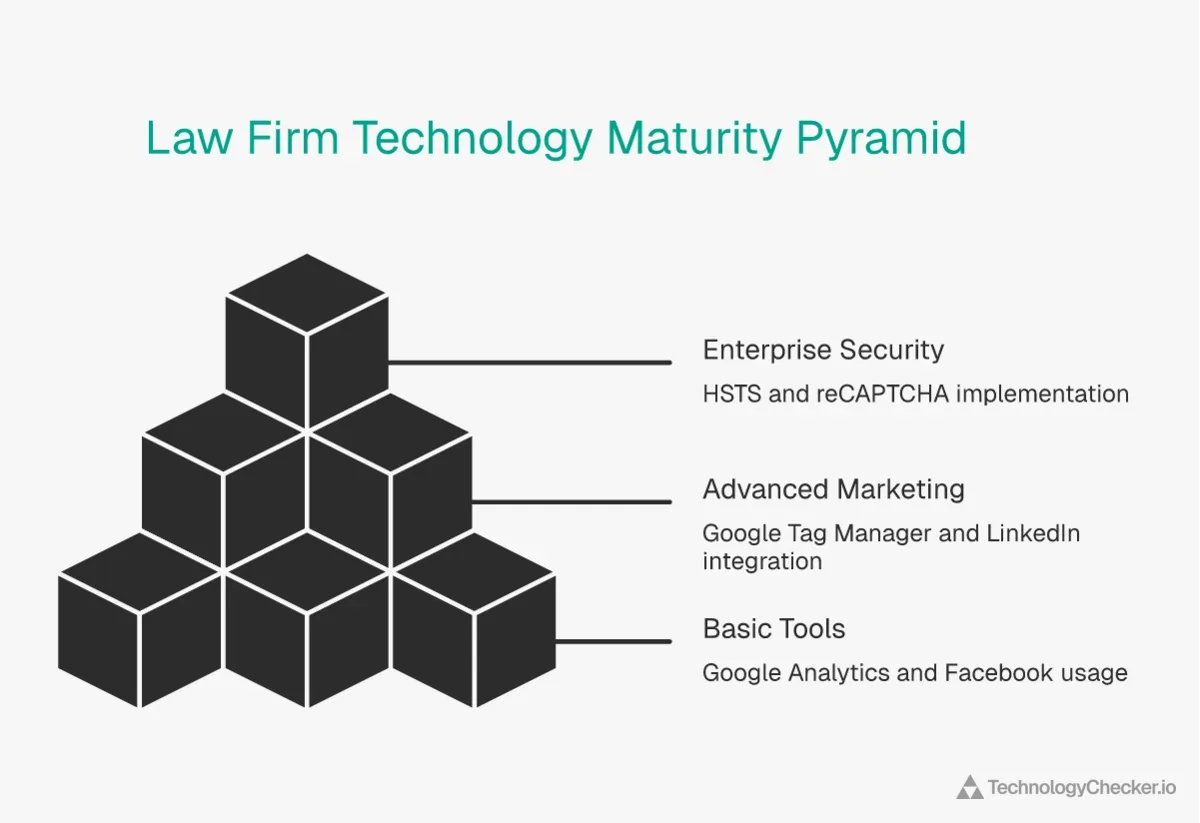
What This Data Tells Us
- Microsoft's email stack is the law firm default. Microsoft Exchange Online and Office 365 Mail together dominate email services at every firm size, but Google Apps for Business still captures 17.43% of small firms where cost and simplicity matter most.
- Social media strategy shifts by firm size. Small firms put Facebook first (40.55%), targeting individual clients. Mid-market and enterprise firms prioritize LinkedIn (72.25% and 62.94%), targeting corporate clients and talent.
- Enterprise firms operate in a different technology tier. Cloud infrastructure, consent management (Optanon at 14.71%), and specialized analytics (Siteimprove at 12.35%) only appear at the enterprise level. Smaller firms don't have the compliance pressure or IT budgets to justify these tools.
If you're a small law firm evaluating your web stack, our data shows Google Tag Manager is already used by 36.87% of firms your size, and adoption among mid-market firms reaches 69.15%. For security, reCAPTCHA protects 19.69% of small firm sites and scales well to enterprise (36.47%). The technology choices you make now shape how you compete as you grow.
Explore individual technology pages for deeper analysis: Google Tag Manager, reCAPTCHA, Cloudflare Hosting, React, GoDaddy. For more technology data across industries, visit TechnologyChecker.io.

Sophie Clarke
Product Marketing Manager