Phishing Statistics Q3 2026: Malicious Email Nearly Doubled
Phishing statistics, Q3 2026: 10.65% of email Cloudflare scanned was malicious, up from 5.43% a year ago. Only about 1 in 12 domains uses a mail gateway.
Published •Data through October 2026•17 min read
Phishing statistics for Q3 2026 start with one number: 10.65% of the inbound email Cloudflare scanned was malicious, up from 5.43% in Q3 2025, according to Cloudflare Radar. TechnologyChecker's own MX-record data adds the defence side. Only about 1 in 12 business domains with a detectable mail route sends it through a dedicated email security gateway first.
Most phishing roundups recycle the same survey numbers. I run the crawl infrastructure at TechnologyChecker, and DNS records are part of what we read, so I wanted the half those roundups skip: who actually filters a company's mail before it reaches the inbox. This report pairs thirteen months of Cloudflare Radar email data with the email security gateways our crawler detects in MX records.
Key findings from this report:
- Malicious mail nearly doubled in a year. 10.65% of scanned email was malicious in Q3 2026 against 5.43% in Q3 2025, on Cloudflare Radar.
- The spring wave broke. On Cloudflare's current scoring, malicious mail peaked at 25.85% in June 2026 and fell to 8.10% in October (provisional). That's still above October 2025's 6.00%. The size of the peak has been revised more than once, so treat it as approximate.
- Spam went the other way. Spam fell from 7.35% of scanned mail in Q3 2025 to 4.52% in Q3 2026, so the junk got smaller while the dangerous share grew.
- Links carry the attack. 74.40% of threat-flagged mail in Q3 2026 carried a malicious-link signal. QR-code phishing was on 0.011%.
- Few domains filter at the gateway. TechnologyChecker counts 767,806 gateway detections against 8,867,796 for mailbox hosts like Microsoft 365 and Google Workspace in its October 2026 data.
- Proofpoint owns half the gateway market we can see. Proofpoint Essentials, Proofpoint and Hornetsecurity together filter 388,636 domains, 50.6% of gateway detections.
How much email is phishing in 2026?
About 1 in 10 inbound emails was malicious in Q3 2026, on the mail Cloudflare's email security service scans. Cloudflare Radar's email security data put the malicious share at 10.65% for July to September 2026, against 5.43% for the same quarter of 2025. That's a 1.96x increase.
The quarterly figure hides a much sharper spike. Malicious mail ran between 6% and 13.5% from October 2025 to March 2026, then climbed to 19.26% in April, 24.68% in May and 25.85% in June. One inbound message in four was malicious at the peak. It broke just as fast: 13.14% in July and 8.10% in October.
| Metric | Q3 2025 | Q2 2026 | Q3 2026 | Oct 2026 | Q3 YoY |
|---|---|---|---|---|---|
| Malicious | 5.43% | 23.34% | 10.65% | 8.10% | +5.22 pt |
| Spoofed | 12.89% | 28.48% | 15.30% | 12.12% | +2.41 pt |
| Spam | 7.35% | 5.03% | 4.52% | 3.90% | −2.83 pt |
Source: Cloudflare Radar, email/security/summary/{malicious, spoof, spam}, calendar windows, pulled 2026-11-26. Normalization: PERCENTAGE of messages. October 2026 is provisional.
I'd read the spam line as the more surprising one. Spam fell by more than a third over the year while malicious mail nearly doubled. Bulk junk is getting easier to stop, and what's left is the mail built to steal something.
Did phishing get worse in 2026, or was it one wave?
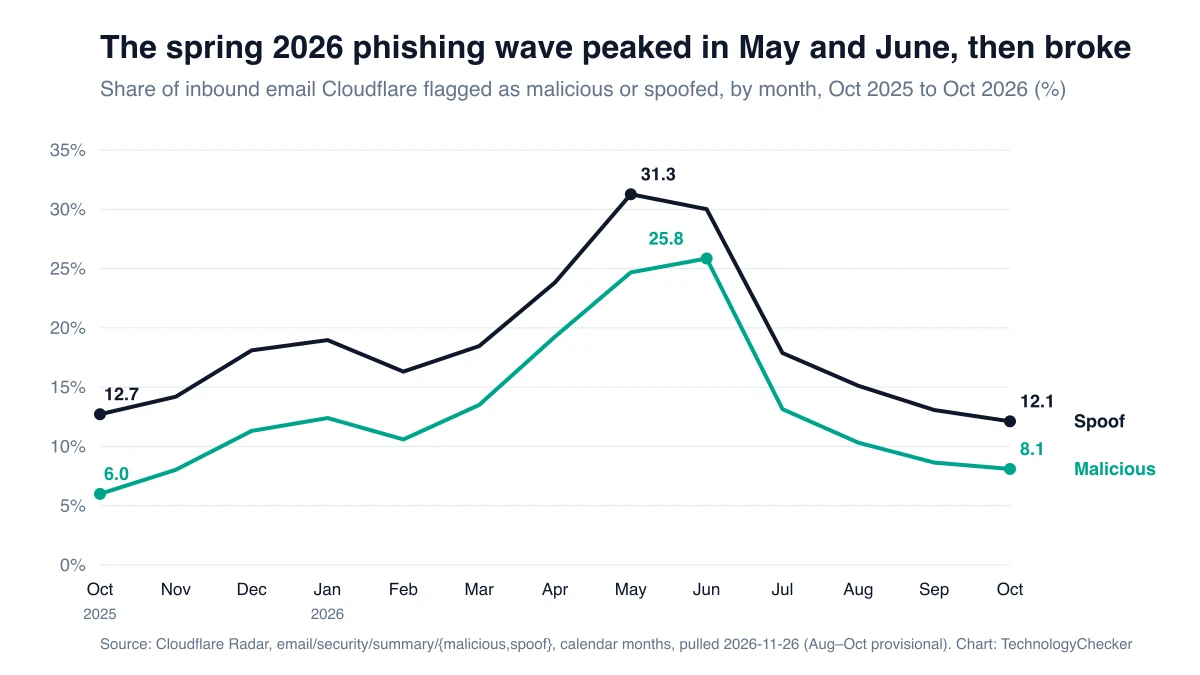
Both. There was one large wave, from April to June 2026, and the floor under it is higher than a year ago. Malicious mail was 6.00% of scanned email in October 2025 and 8.10% in October 2026, on Cloudflare Radar's monthly series. Spoofing, by contrast, is back to where it was: 12.72% in October 2025, 12.12% in October 2026.
| Month | Malicious | Spoofed | Spam |
|---|---|---|---|
| Oct 2025 | 6.00% | 12.72% | 6.59% |
| Jan 2026 | 12.40% | 18.97% | 6.45% |
| Mar 2026 | 13.50% | 18.46% | 4.84% |
| Apr 2026 | 19.26% | 23.83% | 4.47% |
| May 2026 | 24.68% | 31.27% | 6.47% |
| Jun 2026 | 25.85% | 30.01% | 4.04% |
| Jul 2026 | 13.14% | 17.88% | 4.62% |
| Aug 2026 | 10.32% | 15.11% | 4.65% |
| Sep 2026 | 8.64% | 13.07% | 4.32% |
| Oct 2026 | 8.10% | 12.12% | 3.90% |
Source: Cloudflare Radar, email/security/summary/{malicious, spoof, spam}, calendar months, all re-pulled 2026-11-26 so every month sits on the same scoring vintage. August to October are provisional.
The year-over-year step is the part I'd plan around, because it holds up across revisions. Our October 1 pull had Q3 2026 at 10.71% malicious against 5.37% a year earlier; today's pull says 10.65% against 5.43%. The wave itself is real too: APWG recorded its busiest phishing month since April 2023 in June 2026, as covered below. Its exact height is the part that keeps changing.
What do phishing emails contain in 2026?
Links. 74.40% of the mail Cloudflare flagged as a threat in Q3 2026 carried a malicious-link signal, up from 49.11% in Q3 2025. Attachments were on 1.37%. A phishing email in 2026 is overwhelmingly a message that wants a click, not a file that wants to run. Microsoft's Q1 2026 email threat report found the same thing on its own mail flow: 78% of email threats were link-based.
Cloudflare tags each threat message with every signal it trips, so one email can be a link, a brand impersonation and a newly registered domain at once. The shares below overlap and don't sum to 100%.
| Threat signal | Q3 2025 | Q3 2026 | Oct 2026 | Last 28 days |
|---|---|---|---|---|
| Malicious link | 49.11% | 74.40% | 71.72% | 79.60% |
| Scam | 1.74% | 70.81% | 69.50% | 69.70% |
| Sender IP reputation | 17.06% | 65.64% | 65.05% | 68.28% |
| Identity deception | 38.87% | 40.60% | 36.24% | 38.87% |
| Brand impersonation | 32.20% | 38.06% | 32.71% | 32.53% |
| Newly registered domain | 24.39% | 35.57% | 24.60% | 20.60% |
| Credential harvester | 19.55% | 7.11% | 7.54% | 11.25% |
| Extortion | 2.86% | 8.05% | 5.18% | 0.96% |
| Attachment | 2.37% | 1.37% | 2.48% | 2.17% |
| Business email compromise (BEC) | 2.29% | 0.54% | 0.61% | 0.67% |
| Voice phishing (callback) | 0.23% | 0.42% | 0.40% | 0.60% |
| QR code | 0.031% | 0.011% | 0.010% | 0.019% |
Source: Cloudflare Radar, email/security/summary/threat_category, pulled 2026-11-26. Normalization: OVERLAPPED_PERCENTAGE, the share of threat-flagged mail carrying each signal. "Last 28 days" is October 29 to November 26, 2026. Radar labels: Link, Scam, IPReputation, IdentityDeception, BrandImpersonation, DomainAge, CredentialHarvester, Extortion, Attachment, BEC, VoicePhishing, QRCode.
Two lines need a caveat. The scam signal went from 1.74% to 70.81% in a year. A 40x move in one label looks more like Cloudflare widening what it calls a scam than attackers changing their mail overnight, so I wouldn't quote it as a trend. The credential harvester signal fell from 19.55% to 7.11%, and it has climbed back to 11.25% in the last four weeks.
Which domains send the most malicious email?
Mostly cheap new-gTLD domains. In October 2026, 99.85% of the email Cloudflare scanned from .bond domains was malicious, and so was 99.84% from .boats and 99.61% from .reisen. Those are shares within each top-level domain, not shares of all phishing. The same Radar view lists .com at 32.53% of all scanned mail.
| TLD | Malicious share of that TLD's mail, Oct 2026 |
|---|---|
| .bond | 99.85% |
| .boats | 99.84% |
| .reisen | 99.61% |
| .motorcycles | 99.52% |
| .forum | 99.33% |
| .uno | 98.83% |
| .pf | 96.94% |
| .pics | 96.57% |
| .hair | 94.23% |
| .beauty | 93.22% |
Source: Cloudflare Radar, email/security/top/tlds/malicious/malicious, October 1 to 31, 2026, pulled 2026-11-26. Values are the malicious share within each TLD's scanned mail. Radar doesn't publish the volume behind each TLD here, so a small TLD can top this list on modest volume.
The newly-registered-domain signal tells the same story from another angle. It sat on 35.57% of threat-flagged mail in Q3 2026: a third of phishing comes from domains too young to have a reputation.
Do 90% of cyberattacks start with phishing?
No. Phishing does NOT start 90% of breaches. The Verizon 2026 Data Breach Investigations Report puts phishing at 16% of breaches as the initial access vector, unchanged from the year before. Exploited vulnerabilities lead, at 31%.
The 90% figure has a real origin. CISA's Shields Up page told readers in early 2023 that "more than 90% of successful cyber-attacks start with a phishing email" (archived January 3, 2023). The page gave no method or source, and the live version no longer carries the line. CISA's current employee phishing guidance says only that "most online attacks begin with a single click."
People still matter more than 16% suggests. The same Verizon report found a human element in 62% of breaches, up from 60%. And in phishing simulations, the median click rate through voice and text lures was 40% higher than through email.
| Source | What it measures | Figure |
|---|---|---|
| Verizon DBIR 2026 | Breaches where phishing was the initial access vector | 16% |
| Verizon DBIR 2026 | Breaches with a human element | 62% |
| Verizon DBIR 2026 | Breaches where vulnerability exploitation was the initial access vector | 31% |
| CISA Shields Up (archived Jan 2023) | "Successful cyber-attacks" starting with phishing, no method given | More than 90% |
Sources: Verizon 2026 DBIR executive summary (dataset October 2024 to November 2025, more than 22,000 confirmed breaches); CISA Shields Up via the Internet Archive. Both fetched and checked on 2026-11-26.
How many phishing attacks are reported each year?
191,561 phishing and spoofing complaints reached the FBI in 2025, according to the FBI IC3 2025 Internet Crime Report. That made it the most-reported crime type by count, down slightly from 193,407 in 2024. Reported phishing losses were $215,843,126, three times 2024's $70,013,036.
Business email compromise is where the money is. IC3 logged 24,768 BEC complaints in 2025 with $3,046,598,558 in reported losses, more than 14 times the phishing line. The APWG Q2 2026 Phishing Activity Trends Report counted 1,069,681 phishing attacks in April to June 2026, and 425,808 in June alone, its highest month since April 2023. That June peak lines up with the Cloudflare Radar high above. Two unrelated sensors saw the same wave.
Who filters business email? What our MX data shows
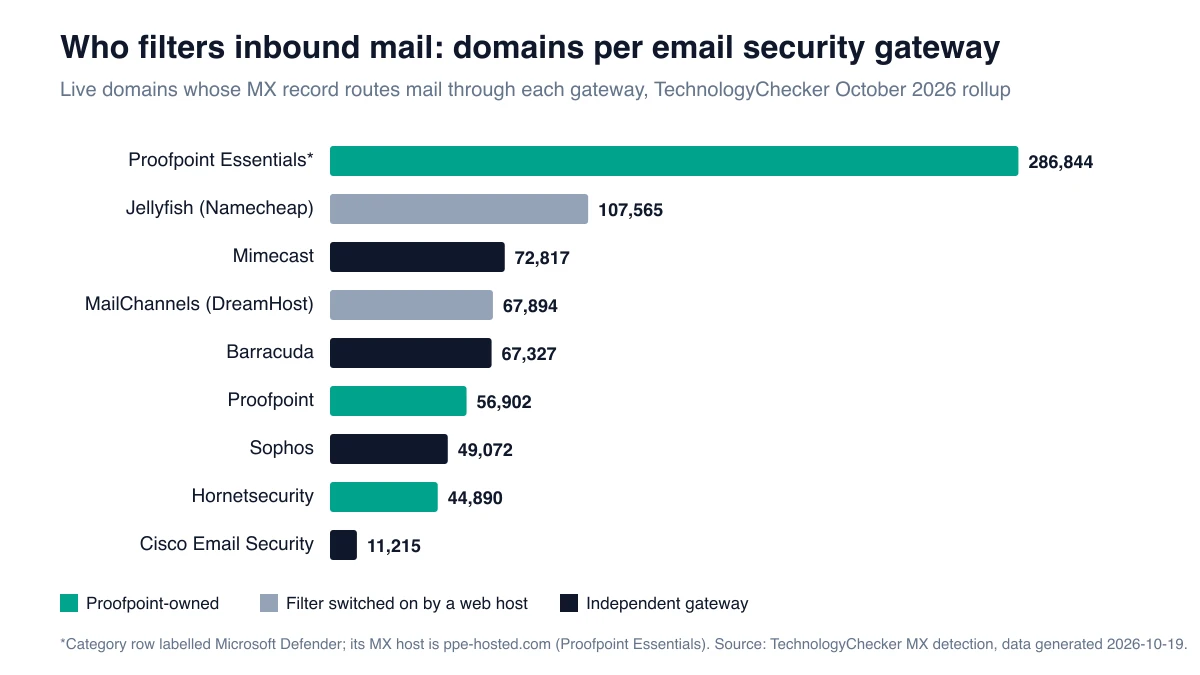
Most business domains don't put a dedicated gateway in front of their mail. TechnologyChecker reads each domain's MX record, the DNS entry that says where inbound mail is delivered. In our October 2026 category data, 767,806 domain detections point at one of 12 email security gateways, while 8,867,796 point straight at a mailbox host such as Microsoft 365 or Google Workspace. That's about 8 gateway detections for every 100 detectable mail routes, roughly 1 domain in 12.
| Gateway | Live domains (MX) | Share of gateway detections | Type |
|---|---|---|---|
| Proofpoint Essentials* | 286,844 | 37.36% | Proofpoint-owned |
| Jellyfish | 107,565 | 14.01% | Web-host default (Namecheap) |
| Mimecast | 72,817 | 9.48% | Independent gateway |
| MailChannels | 67,894 | 8.84% | Web-host filter (mostly DreamHost) |
| Barracuda | 67,327 | 8.77% | Independent gateway |
| Proofpoint | 56,902 | 7.41% | Proofpoint-owned |
| Sophos | 49,072 | 6.39% | Independent gateway |
| Hornetsecurity | 44,890 | 5.85% | Proofpoint-owned (since Dec 2025) |
| Cisco Email Security | 11,215 | 1.46% | Independent gateway |
| SpamTitan | 1,740 | 0.23% | Independent gateway |
| Validity | 1,537 | 0.20% | Other |
Source: TechnologyChecker MX-record detection, data/categories/email-security.json, generated October 19, 2026. *Our category table labels this row Microsoft Defender, but the MX host it reads is ppe-hosted.com, which belongs to Proofpoint Essentials. Shares are of the 767,806 summed detections; a domain with two gateways counts twice. Sophos is matched by a verification TXT record or an MX record, so part of its count is account setup rather than live routing.
Two of the top five aren't products anyone chose. Jellyfish is the spam filter Namecheap switches on by default for its shared-hosting customers, and MailChannels inbound filtering shows up the same way for DreamHost customers who have the host's spam filtering switched on. Together they account for 175,459 detections, 22.9% of the gateway total. For a lot of small businesses, "we have an email gateway" really means "our web host turned one on."
The gap between the two counts is the useful part. Microsoft 365 and Google Workspace filter mail themselves, so a domain without a gateway isn't unprotected. But for roughly 11 domains in 12, nothing visible in DNS sits in front of that built-in filter. Cloudflare's 10.65% is the share of mail one dedicated filter flagged; on those domains, the same call falls to the mailbox host alone, or to an API add-on our MX data can't see.
Which companies run an email security gateway?
Regulated, older, mid-sized firms. TechnologyChecker's Mimecast profile shows financial services as its largest industry, at 6.08% of matched companies, with insurance at 4.63% and law practices at 4.36%. 41.41% of Mimecast's matched companies were founded before 1990, and 51.89% have 11 to 200 staff. Those numbers come from our October 2026 crawl.
The UK leans on Mimecast unusually hard. The United Kingdom has 14,962 matched Mimecast companies, about half the US count, in our data. Hornetsecurity's base is German: Germany holds 55.82% of its matched companies.
Churn says something too. Since March 16, 2026, 948 domains have dropped Hornetsecurity, against 5,010 on Barracuda's larger base. Of the 904 Hornetsecurity domains that left on every hostname, 594 now point their MX at Microsoft 365. They didn't switch gateways. They removed the gateway and let the mailbox host take the mail directly.
What should security teams do with these phishing statistics?
Four things follow from the data, in order of effort.
- Treat links as the main attack surface. 74.40% of threat-flagged mail carried a malicious link in Q3 2026 and 1.37% an attachment. Time-of-click URL checking matters more than attachment sandboxing for most inboxes.
- Use domain age and TLD as cheap signals. A third of Q3 threat mail came from newly registered domains, and some new gTLDs send almost nothing but malicious mail.
- Close the authentication gap that spoofing relies on. Spoofed mail was still 12.12% of scanned email in October 2026. Our DMARC adoption statistics cover how far DMARC enforcement has got.
- Know who filters your mail, and your suppliers' mail. Check your MX record. If it points straight at Microsoft 365 or Google Workspace, the mailbox host's filter is the first line, unless you've added an API-based tool. That's the setup on roughly 11 domains in 12 in our data.
If you sell email security, the same MX data is a prospect list: TechnologyChecker shows which companies route mail through which gateway, and which ones have none.
Methodology and sources
Cloudflare Radar (external, primary). All Radar figures come from the Radar API, pulled on November 26, 2026: email/security/summary/{malicious, spoof, spam} for Q3 2025, Q2 2026, Q3 2026, each calendar month from October 2025 to October 2026, and the 28 days to November 26; email/security/summary/threat_category for the same quarters, October 2026 and the last 28 days; and email/security/top/tlds with and without the malicious filter for October 2026. Radar's email security data covers inbound mail scanned by Cloudflare's email security service, not all email on the internet. Recent months are provisional and get re-scored.
TechnologyChecker (first-party). Gateway and mailbox-host counts come from our MX-record detection, as aggregated in our Email Security and Email & Webmail category data generated on October 19, 2026. Our live ClickHouse cluster was unreachable on November 26, 2026, so these counts were not refreshed on the day; they're dated to that October rollup. Industry, country and churn figures come from our Mimecast and Hornetsecurity technology profiles, analysed October 10 and 11, 2026. Category totals are sums of per-technology counts, so a domain using two gateways counts twice.
Other sources. Verizon 2026 DBIR executive summary; FBI IC3 2025 Internet Crime Report (complaint and loss tables); APWG Phishing Activity Trends Reports for Q1 and Q2 2026; Microsoft Threat Intelligence's Q1 2026 email threat report; CISA's phishing assessment infographic and Shields Up archive. Each figure was read in the source document on November 26, 2026; none was taken from a statistics aggregator.
Frequently asked questions about phishing
How many emails are phishing?
On Cloudflare Radar, 10.65% of scanned inbound email was malicious in Q3 2026 and 7.99% in the four weeks to November 26, 2026. That's mail scanned by Cloudflare's email security service, so it's one large sample rather than every inbox.
What percentage of phishing attacks are successful?
It depends on what you count. CISA's phishing assessment infographic says 1 in 10 of its test phishing emails got a user to open a malicious attachment or link, and 8 in 10 assessed organizations had at least one person fall for it. Verizon's 2026 DBIR puts phishing at 16% of breaches as the way in.
How many phishing emails are sent every day?
Nobody counts every inbox, but Microsoft Threat Intelligence alone detected about 8.3 billion email phishing threats in Q1 2026. Spread across the quarter's 90 days, that's roughly 92 million a day on Microsoft's mail flow, a floor rather than a global total.
Is phishing increasing in 2026?
Yes, year over year. Malicious mail on Cloudflare Radar was 10.65% in Q3 2026 against 5.43% in Q3 2025. It peaked in May and June 2026 (25.85% in June on Cloudflare's current scoring) and has eased since, but October 2026's 8.10% is still above October 2025's 6.00%.
What is the most common type of phishing?
Link-based phishing. 74.40% of the mail Cloudflare flagged as a threat in Q3 2026 carried a malicious link, while 1.37% carried a malicious attachment and 0.011% a QR code.
Do 90% of cyberattacks start with phishing?
No. Verizon's 2026 DBIR puts phishing at 16% of breaches as the initial access vector. The "90%" line comes from an older CISA Shields Up page that gave no method, and CISA's current guidance doesn't repeat it.
How much does business email compromise cost?
The FBI IC3 received 24,768 business email compromise complaints in 2025, with $3,046,598,558 in reported losses, up from $2.77 billion in 2024. APWG member Fortra saw wire-transfer BEC requests average $61,732 in Q2 2026.
How many companies use an email security gateway?
In TechnologyChecker's October 2026 data, 767,806 domain detections route inbound mail through one of 12 email security gateways, against 8,867,796 that route straight to mailbox hosts like Microsoft 365 and Google Workspace. That's about 1 domain in 12.
Which email security vendor has the largest market share?
By domains in our MX data, Proofpoint. Proofpoint Essentials, Proofpoint and Hornetsecurity together filter 388,636 domains, 50.6% of gateway detections. Mimecast is the largest gateway outside Proofpoint's group, at 72,817 domains.

CTO
15+ years of experience
David is the CTO of TechnologyChecker, responsible for the engineering and architecture behind the platform's crawling infrastructure.
- MEng Computer Science, University of Edinburgh
- AWS Solutions Architect Professional
- Contributor, Open Source Crawling Frameworks
Never miss our research