IPv6 Adoption 2026: 41.7% of Human Traffic, Bots Lag at 13%
IPv6 adoption in October 2026: 41.66% of human requests on Cloudflare Radar vs 13.36% of bot requests, and which hosts our crawl finds serve IPv6 by default.
Published •19 min read

IPv6 adoption reached 41.66% of human HTTP requests on Cloudflare Radar in October 2026, up from 39.56% a year earlier, while only 13.36% of bot requests used IPv6. The blended figure fell from 31.03% to 29.25% because bots grew to 39.29% of all requests. On the server side, TechnologyChecker detects default-on Cloudflare on 11,101,946 live domains.
Most IPv6 adoption pages quote one number, usually Google's, and stop. I run the crawl infrastructure at TechnologyChecker, so the question I care about has two halves: how many visitors arrive over IPv6, and how many websites can answer them. This report splits Cloudflare Radar's October 2026 data into humans and bots, then checks the server side against the edge and hosting providers our crawler detects on live business domains.
Key findings from this report:
- Humans moved forward. 41.66% of human requests to Cloudflare used IPv6 in October 2026, up 2.10 points in a year. Google's own October average rose 1.94 points to 48.02%.
- The blended share went backwards. All traffic fell from 31.03% to 29.25% IPv6. Bots went from 28.22% to 39.29% of requests, and bots use IPv6 only about 13% of the time.
- Mobile is the IPv6 network. 43.52% of mobile requests used IPv6 in October 2026, against 22.02% on desktop.
- 19 of the 24 countries we tracked gained. India leads at 72.00% of human requests; Indonesia added 7.54 points; China fell 9.78 points to 36.33%.
- The server side splits by provider. Cloudflare (11,101,946 live domains) enables IPv6 by default. Vercel (507,196 domains) says "IPv6 is not supported", and Netlify (194,042) keeps it off by default.
- Attacks barely use IPv6. Only 0.40% of network-layer DDoS attack traffic on Radar was IPv6 in October 2026.
What is the IPv6 adoption rate in 2026?
The IPv6 adoption rate in 2026 is about 41.7% of human web traffic and 29.3% of all traffic, measured as the share of HTTP requests reaching Cloudflare over IPv6 in October 2026. Which number you quote depends on whether you count bots, and the two moved in opposite directions this year.
Other sensors land in the same range. Google measures the share of its users reaching Google over IPv6; its IPv6 statistics averaged 48.02% across October 2026, with daily values from 45.59% to 51.69% (weekends run higher). The Internet Society Pulse reported that Google's native IPv6 access first passed 50% on 28 March 2026, at 50.10%. APNIC Labs, which measures whether end users can use IPv6, puts the world at 43.04% IPv6-capable and 39.50% IPv6-preferred in its 30-day world estimate to 24 November 2026.
| Measure (October) | 2025 | 2026 | Change |
|---|---|---|---|
| Human HTTP requests over IPv6 (Cloudflare Radar) | 39.56% | 41.66% | +2.10 pts |
| All HTTP requests over IPv6 (Cloudflare Radar) | 31.03% | 29.25% | −1.77 pts |
| Bot HTTP requests over IPv6 (Cloudflare Radar) | 12.91% | 13.36% | +0.45 pts |
| Mobile requests over IPv6 (Cloudflare Radar) | 41.95% | 43.52% | +1.58 pts |
| Desktop requests over IPv6 (Cloudflare Radar) | 23.76% | 22.02% | −1.75 pts |
| Google users reaching Google over IPv6 (monthly average) | 46.08% | 48.02% | +1.94 pts |
Source: Cloudflare Radar http/summary/ip_version, calendar months, all traffic and split by botClass and deviceType, pulled 2026-11-25. Google figures are monthly averages of the daily series behind Google's IPv6 statistics page, fetched 2026-11-25.
Why the denominator matters: Google's number counts people, Radar's blended number counts requests from people and machines, and APNIC counts capability rather than use. None of them is wrong. They answer different questions, which is why I keep the human and bot series apart for the rest of this report.
Why did the IPv6 share fall while humans adopted more of it?
The IPv6 share of all traffic fell because bot traffic grew, not because people went back to IPv4. Human requests ended the year more IPv6-heavy than they started it. Bots, which mostly run over IPv4, took a much larger slice of the requests.
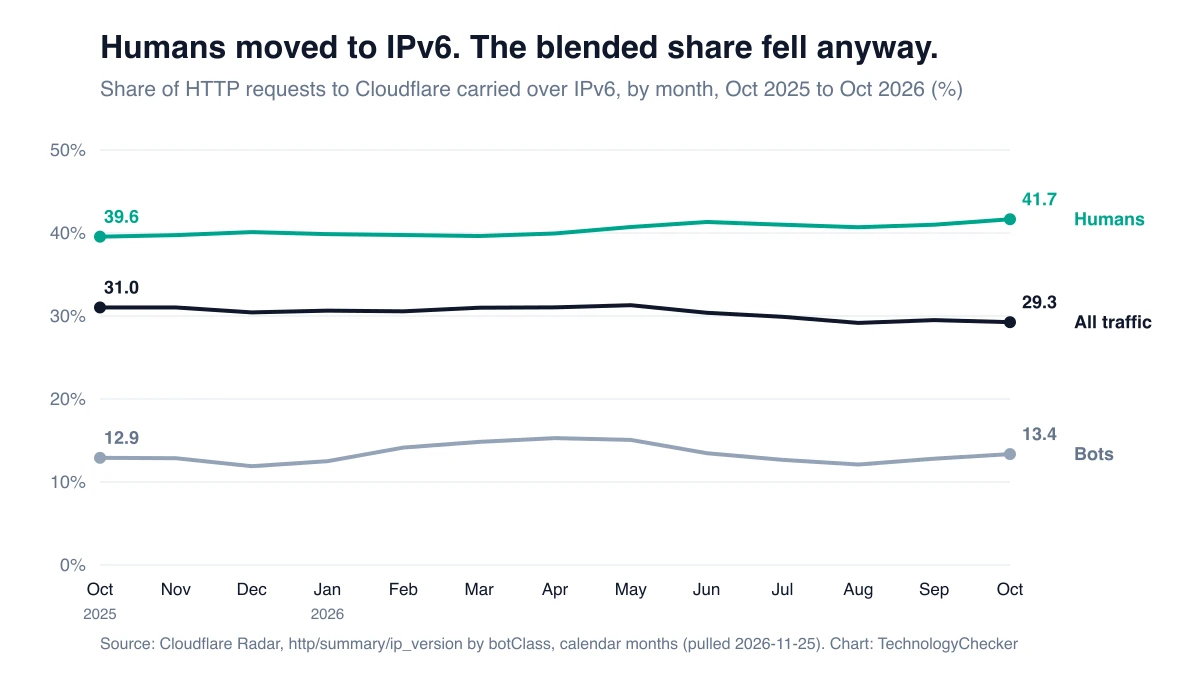
Cloudflare Radar's bot-class split moved from 28.22% bots in October 2025 to 39.29% in October 2026. Over the same months the IPv6 rate for humans went from 39.56% to 41.66%, and for bots from 12.91% to 13.36%. Both groups edged toward IPv6. The mix tilted toward the group that barely uses it.
A simple two-group check shows the size of the mix effect. Weighting October 2026's human and bot IPv6 rates by October 2025's traffic mix gives 33.67%. Weighting them by October 2026's actual mix gives 30.54%. That 3.1-point gap is roughly the whole story. (This weighting doesn't reproduce Radar's published blended figure exactly; it runs about one point high in both years, because Radar computes the class splits and the overall split as separate summaries. The direction and size of the mix effect hold either way.)
Why this matters: an IPv6 dashboard that shows a falling line can hide a rising one. If you track your own IPv6 share from server logs, split it by bot class before you report it, or this year's bot growth will look like a protocol retreat.
What to do with this insight:
- Report human and automated IPv6 shares separately in your own analytics.
- Treat a falling blended IPv6 share as a bot-mix signal first and check your bot share before anything else.
Why do bots use IPv6 so rarely?
Bots reached Cloudflare over IPv6 for 13.36% of their requests in October 2026, about a third of the human rate (41.66%). The gap has held all year. Bot IPv6 share ranged between 11.90% (December 2025) and 15.29% (April 2026) and never came near the human line.
My read, as someone who runs a crawler fleet: bots don't sit on mobile carrier networks, which is where most IPv6 lives. They run in data centers and cloud regions, where IPv4 is the path of least resistance. A cloud VM, a load balancer or a NAT gateway usually gets an IPv4 address without anyone asking. IPv6 is usually a deliberate extra step. AWS documents dual-stack on its Application Load Balancer as an IP address type you select, and it requires IPv6 CIDR blocks on the VPC and subnets first. When nobody does that step, the scraper speaks IPv4.
The exceptions are networks that went IPv6-first on purpose. In Radar's ranking of networks by human IPv6 share for October 2026, Korea Telecom (AS3559) and the CERNET2 research network (AS23910) were at 100%, and Google's AS36384 at 99.88%.
What to do with this insight:
- Bot rules keyed on IPv4 ranges miss the minority of bots that come over IPv6. Make sure your allowlists and rate limits cover both address families.
- Rate-limit on the IPv6 /64 prefix rather than the single address, because one client can rotate through many addresses inside its /64.
Is mobile IPv6 adoption higher than desktop?
Yes. Mobile carried 43.52% of its requests over IPv6 in October 2026, nearly double desktop's 22.02%. Mobile rose 1.58 points in a year; desktop fell 1.75 points.
My read: mobile carriers have the strongest reason to move, because every subscriber needs an address and IPv4 ones are scarce, so they put phones on IPv6 rather than add more layers of carrier-grade NAT. Home and office broadband carries more legacy IPv4 equipment. I'd treat desktop's fall with some care, though. Radar's device split covers all traffic, and much automated traffic presents as desktop, so the same bot growth that dragged the blended figure down likely weighs on the desktop line too. The human-only series above didn't fall.
For the country-level device picture, our mobile internet usage by country report pairs device share with IPv6 share across the same markets.
External context: France was among the leaders on Google's country view (73%, per the Internet Society Pulse write-up in April 2026). On Radar's human-only series, it is second only to India in our 24-country set, at 68.33%.
IPv6 adoption by country in 2026
India had the highest IPv6 adoption among the 24 countries we pulled, at 72.00% of human requests in October 2026, followed by France (68.33%) and Saudi Arabia (64.40%). At the bottom were South Africa (3.70%), Egypt (5.07%) and Nigeria (6.02%). In Radar's full ranking, Malaysia (62.10%) sits fourth, between Saudi Arabia and Germany.
| Country | Human IPv6 share, Oct 2025 | Human IPv6 share, Oct 2026 | Change |
|---|---|---|---|
| India | 70.26% | 72.00% | +1.74 pts |
| France | 64.17% | 68.33% | +4.17 pts |
| Saudi Arabia | 63.07% | 64.40% | +1.33 pts |
| Germany | 54.59% | 57.18% | +2.59 pts |
| Vietnam | 50.40% | 55.37% | +4.97 pts |
| Brazil | 51.97% | 54.28% | +2.31 pts |
| Japan | 54.01% | 53.27% | −0.73 pts |
| United States | 50.12% | 51.65% | +1.53 pts |
| Mexico | 48.70% | 49.40% | +0.70 pts |
| Canada | 39.09% | 39.57% | +0.48 pts |
| United Kingdom | 37.46% | 38.66% | +1.19 pts |
| China | 46.11% | 36.33% | −9.78 pts |
| Netherlands | 30.49% | 34.34% | +3.85 pts |
| Australia | 33.13% | 34.21% | +1.07 pts |
| Indonesia | 18.25% | 25.79% | +7.54 pts |
| Turkey | 17.28% | 19.50% | +2.22 pts |
| South Korea | 23.77% | 18.46% | −5.31 pts |
| Italy | 15.93% | 17.34% | +1.42 pts |
| Poland | 16.79% | 17.23% | +0.44 pts |
| Spain | 12.04% | 11.79% | −0.25 pts |
| Russia | 7.92% | 11.67% | +3.75 pts |
| Nigeria | 4.99% | 6.02% | +1.03 pts |
| Egypt | 5.08% | 5.07% | 0.00 pts |
| South Africa | 2.70% | 3.70% | +1.00 pts |
Source: Cloudflare Radar http/summary/ip_version?location={cc}&botClass=LIKELY_HUMAN, October 2025 and October 2026, pulled 2026-11-25. Human traffic only, so these figures run higher than all-traffic country figures you may see elsewhere.
Nineteen of the 24 countries gained. Indonesia (+7.54 points), Vietnam (+4.97) and France (+4.17) moved most. The fallers are the interesting ones. China dropped 9.78 points and South Korea 5.31, even though Korea Telecom's network ran 100% IPv6 for human traffic. A national share is a weighted average of a few big carriers, so one large network shifting its routing, or its customers shifting to another network, moves the country. I'd wait for a second quarter before reading either decline as a policy story. Cloudflare also sees less of China's domestic traffic than of most countries' traffic, so treat that figure with extra care.
How ready is the server side? What our crawl shows
On the server side, IPv6 depends mostly on which edge or hosting provider a website sits behind, and the biggest one turns it on by default. TechnologyChecker detected Cloudflare on 11,101,946 live domains in our November 23, 2026 crawl, more than a third of the 29.9M live business domains we track. Cloudflare's IPv6 compatibility docs say: "By default, IPv6 compatibility is turned on for your domain" for proxied DNS records. Only Enterprise customers can switch it off.
That one default means the edge of over 11 million sites answers IPv6 clients even when the origin server behind it is IPv4-only. Cloudflare's docs note that it prefers the IPv4 address when it connects back to an origin that has both. Other providers made the opposite call. Here is what each provider's own documentation says, next to the live domains TechnologyChecker detects for it.
| Provider | Live domains (TechnologyChecker) | Count date | IPv6 for visitors, per the provider's docs |
|---|---|---|---|
| Cloudflare | 11,101,946 | Nov 23, 2026 crawl | On by default for proxied records |
| Google Cloud CDN | 1,080,581 | Oct 19, 2026 category data | Opt-in: needs an IPv6 address on the load balancer's forwarding rule |
| Vercel | 507,196 | Oct 19, 2026 category data | Not supported: "IPv6 is not supported on Vercel" |
| Amazon CloudFront | 448,182 | Nov 23, 2026 crawl | Per-distribution setting ("Enable IPv6"); the docs don't state the default |
| Netlify | 194,042 | Oct 19, 2026 category data | Off by default; can be enabled through Netlify DNS |
| Bunny | 156,529 | Oct 19, 2026 category data | Dual stack by default, where the chosen edge server has IPv6 |
| Fastly | 117,193 | Nov 23, 2026 crawl | On by default for newly created hostnames |
| GitHub Pages | 85,342 | Oct 19, 2026 category data | Opt-in: the site owner adds AAAA records |
| Akamai | 49,016 | Nov 23, 2026 crawl | Chosen per edge hostname (IPv4, IPv6 or dual stack) |
Live-domain counts: TechnologyChecker v2 crawl (November 23, 2026) and TechnologyChecker category data for CDN and PaaS (generated October 19, 2026). Provider defaults: each provider's documentation, fetched 2026-11-25. Sources: Google Cloud load balancing IPv6, Vercel DNS docs, CloudFront distribution settings, Netlify enable IPv6, Bunny IP family policy, Fastly dual-stack connections, GitHub Pages custom domains, Akamai edge hostnames.
Put the two sides together. On Cloudflare Radar, 41.66% of human requests already arrive over IPv6. On the server side, the default-on group is dominated by Cloudflare. In our October 19 category data, Cloudflare (10,497,906 domains) fronted about 13 times as many live domains as Vercel, Netlify and GitHub Pages combined (786,580). Three developer platforms popular with front-end teams are, by default, the IPv4-only corner of the web.
What to do with this insight:
- If your site is on Vercel, Netlify or GitHub Pages, check your apex and
wwwrecords for AAAA. If none exist, decide whether to enable IPv6 where the provider allows it or front the site with an IPv6-capable CDN. - Prospecting by infrastructure? The CDN category and PaaS category pages list the providers we detect, which is a quick way to find the accounts that sit on IPv4-only defaults.
Limitations: these counts show which provider a domain is routed through, not whether that domain's IPv6 is switched on. A Vercel site proxied through Cloudflare is IPv6-reachable at the edge, and our crawl can't see a per-zone setting. The overlap between providers was not measured for this report.
Is DNS ready for IPv6?
AAAA lookups, which ask for a name's IPv6 address, made up 20.97% of queries to Cloudflare's 1.1.1.1 resolver in October 2026, up from 19.93% a year earlier. A records (IPv4) were 64.57%. Clients ask for IPv6 addresses about a third as often as for IPv4 ones, and the gap closed by a point in twelve months.
The transport is a different story. Only 9.20% of DNS queries reached 1.1.1.1 over IPv6 in October 2026, down from 10.84%. Asking for an IPv6 address and asking over IPv6 are separate things: a device connected only over IPv4 can still request AAAA records, and many operating systems ask for both record types. Our DNS statistics report covers the resolver side in more depth.
| DNS measure (Cloudflare Radar, 1.1.1.1) | Oct 2025 | Oct 2026 |
|---|---|---|
| AAAA (IPv6 address) share of queries | 19.93% | 20.97% |
| A (IPv4 address) share of queries | — | 64.57% |
| Queries carried over IPv6 transport | 10.84% | 9.20% |
Source: Cloudflare Radar dns/summary/query_type and dns/summary/ip_version, October 2025 and October 2026, pulled 2026-11-25. The October 2025 A-record share was not part of this pull.
How much email and attack traffic uses IPv6?
Mail forwarded by Cloudflare Email Routing used IPv6 for 38.76% of messages in October 2026, up from 13.40% a year earlier. That is the largest jump in this report. Email Routing is a single Cloudflare product, so a change in how it delivers mail could account for much of the rise. I'd treat it as a product signal, not a measure of email in general.
Attacks are the opposite case. Only 0.40% of network-layer (layer 3) DDoS attack traffic on Cloudflare Radar used IPv6 in October 2026, up from 0.26% in October 2025. Attackers still work almost entirely over IPv4, which fits the bot pattern above: the infrastructure behind automated traffic defaults to IPv4. Our DDoS attack statistics report covers the attack side.
IPv6 adoption benchmarks at a glance
| Benchmark | Value | Source | Notes |
|---|---|---|---|
| Human HTTP requests over IPv6 | 41.66% | Cloudflare Radar, Oct 2026 | +2.10 pts on Oct 2025 |
| All HTTP requests over IPv6 | 29.25% | Cloudflare Radar, Oct 2026 | −1.77 pts; bot mix effect |
| Bot HTTP requests over IPv6 | 13.36% | Cloudflare Radar, Oct 2026 | Range 11.90%–15.29% over 13 months |
| Mobile / desktop requests over IPv6 | 43.52% / 22.02% | Cloudflare Radar, Oct 2026 | All traffic by device type |
| Google users over IPv6 | 48.02% | Google, Oct 2026 average | Daily range 45.59%–51.69% |
| IPv6-capable end users, world | 43.04% | APNIC Labs, 30 days to 24 Nov 2026 | IPv6-preferred 39.50% |
| Highest human IPv6 share (24 countries) | India, 72.00% | Cloudflare Radar, Oct 2026 | France 68.33% |
| Live domains on Cloudflare (IPv6 on by default) | 11,101,946 | TechnologyChecker crawl, Nov 23, 2026 | Of 29.9M live business domains |
| Live domains on Vercel (IPv6 not supported) | 507,196 | TechnologyChecker category data, Oct 19, 2026 | Per Vercel's DNS docs |
| AAAA share of DNS queries | 20.97% | Cloudflare Radar 1.1.1.1, Oct 2026 | +1.04 pts |
| Layer 3 DDoS traffic over IPv6 | 0.40% | Cloudflare Radar, Oct 2026 | 0.26% in Oct 2025 |
How we conducted this research
Data source: Cloudflare Radar's public API for traffic, DNS, email and attack data, and TechnologyChecker's own detection data for the server side.
Radar windows: calendar months, October 2025 through October 2026, pulled 2026-11-25. HTTP figures are the share of HTTP requests to Cloudflare's network over IPv4 vs IPv6 (http/summary/ip_version), overall and filtered by botClass (likely human vs likely automated), deviceType and location. DNS figures come from Cloudflare's 1.1.1.1 resolver. Country figures are human traffic only.
TechnologyChecker data: live-domain counts for Cloudflare, Amazon CloudFront, Fastly and Akamai come from our v2 crawl as of November 23, 2026. Counts for Google Cloud CDN, Vercel, Netlify, Bunny and GitHub Pages come from our CDN and PaaS category data, generated October 19, 2026, because our live database was unreachable on the day this report was written. "29.9M" is the number of live business domains we crawl.
Provider defaults: taken only from each provider's own documentation, fetched 2026-11-25. Where the documentation doesn't state a default (CloudFront, Akamai), the table says so instead of guessing.
Limitations: Radar sees traffic to Cloudflare's network, not the whole internet. Bot classification changed in late September 2026, which inflates the year-over-year bot share. Our detection shows the provider in front of a domain, not that domain's IPv6 setting.
Frequently asked questions about IPv6 adoption
What percentage of internet traffic uses IPv6 in 2026?
On Cloudflare Radar, 29.25% of all HTTP requests used IPv6 in October 2026, and 41.66% of human requests did. Google measured 48.02% of its users reaching it over IPv6 on average in October 2026.
Is IPv6 actually used?
Yes. In October 2026, 43.52% of mobile requests to Cloudflare came over IPv6, and India (72.00%) and France (68.33%) carried most human traffic over it. Google's IPv6 share first passed 50% in March 2026.
Why is it taking so long to switch from IPv4 to IPv6?
Because IPv4 still works everywhere and IPv6 is often an extra step. Dual stack and NAT let networks delay the move. On the server side, Vercel doesn't support IPv6 and Netlify keeps it off by default, while Cloudflare turns it on for every proxied domain.
What is one factor increasing the adoption of IPv6?
Mobile networks. Mobile requests used IPv6 at nearly twice the desktop rate in October 2026 (43.52% vs 22.02%). Default-on edge networks help on the server side: Cloudflare enables IPv6 for proxied domains, and TechnologyChecker detects it on 11,101,946 live domains.
Why do bots lag humans in IPv6 adoption?
Bots run on cloud and data-center infrastructure where IPv4 is the default and IPv6 takes deliberate setup. In October 2026, 13.36% of bot requests to Cloudflare used IPv6, against 41.66% of human requests.
Which countries have the highest IPv6 adoption?
Among the 24 countries in this report, India (72.00%), France (68.33%) and Saudi Arabia (64.40%) led on human requests in October 2026. Malaysia (62.10%) and Germany (57.18%) followed in Radar's full ranking.
Does IPv6 slow down internet speed?
Not by design. Browsers use "Happy Eyeballs" (RFC 8305), which tries IPv6 and IPv4 and uses whichever connects first, so a slow IPv6 path falls back quickly. Radar doesn't publish speed split by IP version, so this report makes no speed comparison.
Does Vercel support IPv6?
No. Vercel's DNS documentation states that "IPv6 is not supported on Vercel." TechnologyChecker detects Vercel on 507,196 live domains (October 19, 2026 category data). A Vercel site can still be IPv6-reachable if it sits behind another IPv6-capable proxy.
Should websites still support IPv4 in 2026?
Yes. 70.75% of all HTTP requests to Cloudflare still used IPv4 in October 2026, including most bot traffic. Run dual stack: keep IPv4 and add IPv6, as Cloudflare does by default.

CTO
15+ years of experience
David is the CTO of TechnologyChecker, responsible for the engineering and architecture behind the platform's crawling infrastructure.
- MEng Computer Science, University of Edinburgh
- AWS Solutions Architect Professional
- Contributor, Open Source Crawling Frameworks
Never miss our research